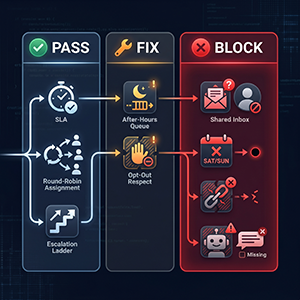
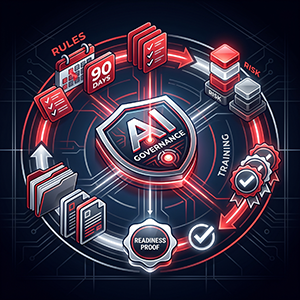
A deterministic conformance standard for the output of an AI decision gate. Grades each decision point ENFORCEABLE, ADVISORY ONLY or NOT A VERDICT across six elements in two groups, and ships a runnable engine, a reproducing workbook, and a working MCP reference server.
GOVERN
Gate-to-Tool Exposure Kit
$99
A deterministic instrument that grades whether an AI gate can actually stop an agent. Reads custody of the refusal across six observations and returns FAIL-CLOSED, FAIL-OPEN or DECORATIVE per gate, then rolls each governed tool up to its weakest gate.
GOVERN
Conditions Ledger
$99
A deterministic instrument for the conditions attached to conditional approvals. Grades each condition BOUND, NOTIFIED ONLY or LAPSED by testing its claimed consequence against the machinery that would deliver it, then reads each approval by its strongest condition.
GOVERN
Stop-Authority Assay
$109
A deterministic instrument that grades what each of your stop controls has been shown to do rather than what it claims. Returns STOPS, SLOWS or NAMED ONLY per control, then reads each agent by its strongest control.
GOVERN
Write-Back Reconciliation Warden
$99
A deterministic instrument for the gap between an automated action and the record of it. Grades each write-back path IN THE RECORD, PARTLY IN or UNRECONCILED by asking whether the action and its record can come apart, and whether the record is usable once it is there.
GOVERN
Audit Evidence Pack Assay
$119
A deterministic instrument for whether an automated decision can be reconstructed by somebody who was not there. Grades the joins between the decision record and the context, policy and authorisation behind it, returning ANSWERABLE, NEEDS A WITNESS or NO RECORD.
GOVERN
Deterministic Replay Warden
$109
A deterministic instrument for whether a decision already made could be produced again. Grades six sources of variance as a conjunction with no partial credit, then a three-part record as a fallback rung, returning REPLAYABLE, RECONSTRUCTABLE or UNREPLAYABLE.
BUNDLE
Who Authorized This
$719
All ten instruments of the execution-layer lane, plus a deterministic roll-up engine that reads their findings in order across three stages. A later stage can never read higher than an earlier one, so the roll-up names which of your readings are moot. Returns HELD END TO END AS DESCRIBED, HELD IN PARTS or NOT HELD, and NOT RUN until every stage has a finding.
REACH
Channel Continuation Assay
$99
Decide which distribution channel earned another cycle — the decision nobody makes, because nobody kills a channel, they just stop looking at it. Six signals with weights summing to 100, banded COMPOUNDING / TREADING WATER / CUT IT, and a two-trigger gate where BOTH must pass: an action you can attribute, and one you can afford at the ceiling you set. The portfolio rollup takes the BEST channel rather than the worst — you do not need ten that work, you need one. Deterministic, offline, no benchmarks.
REACH
Content-to-Offer Junction
$89
Grade the path from every published piece to the thing you sell. Five steps in path order, scored as a product rather than a weighted sum — so one dead step kills the path instead of being averaged away — returning ROUTED / DEAD-END / MISROUTED, with a wrong destination ranked below a missing one. Deterministic, offline, no benchmarks.
REACH
Growth-Vendor Promise Turnstile
$89
Read a growth vendor's proposal one promise at a time. Six falsifiability signals with weights summing to 100 and four verdicts — including IMPOSSIBLE AS WRITTEN for a guarantee of an outcome a third party owns. It grades the wording in front of you, never the vendor and never people. Deterministic, offline.
REACH
Owned-vs-Rented Reach Manifest
$99
Sort every surface into OWNED / RENTED / BORROWED on six weighted signals, then delete the largest one you do not own and see what share of your reach survives the night. A dispositive owned floor sits above the retention number, so a healthy-looking total cannot hide having nothing of your own. Deterministic, offline, no benchmarks.
REACH
Publishing Cadence Backstop
$79
Grade whether you can hold the publishing cadence you committed to — before the third week proves you cannot. Five weighted signals, an evidence ceiling that caps the verdict at the quality of the evidence beneath it, and an overcommitment dispositive that breaks a plan on arithmetic rather than opinion. Deterministic, offline.
REACH
Self-Promo Survivability Checkpoint
$79
Grade a post before you publish it into a moderated community. Six signals with weights summing to 100, three verdicts, a worsen-only residual ceiling and a dispositive precedent floor — because a room that removed you once is evidence, not a hunch. It grades posts, never people. Deterministic, offline.
BUNDLE
Nobody Came Distribution Stack
$549
All ten instruments in the distribution lane, plus the one thing none of them can do alone: a rollup that reads all ten answers together and, where a stage is blocked, names the binding constraint. Seven ordered stages from ground to spend; the earliest blocked stage is what is next, and every problem above it is marked NOT YET ACTIONABLE — real, but not yet worth touching. An instrument you did not run reads UNKNOWN and can never be the constraint.
SALES
RFQ Bid/No-Bid Triage Gate
$79
Two independent reads on every RFQ — winnability and worth-winning — with a dispositive economics gate that forces NO-QUOTE on uncosted tooling or a missing margin path. Reclaim the quoting hours your desk spends on RFQs it should never quote.
SALES
Quote-to-Actual Cost Calibration Tripwire
$99
Measure the drift between what you quoted and what closed jobs actually cost — per work type, per component — then see the dollars of open quotes still priced on estimates your own data has disproven. DO NOT SEND AS PRICED until it's repriced or recalibrated.
SALES
Promise-Date Integrity Tripwire
$89
Score every closed order against two clocks — the promise you gave first and the promise you gave last. The spread is the measured size of the re-promising habit, and a key-account order re-promised twice trips the verdict to PROMISE INFLATION. Deterministic, offline, $89.
SALES
Backlog-to-Capacity Lead-Time Reality Check
$79
Computed lead = backlog hours ÷ demonstrated weekly hours — per work center, from your own actuals. Confront every quoted lead with it, and let a DIVERGING QUEUE gate force LEAD-TIME FICTION on any center booking more than it burns. Deterministic, offline, $79.
SALES
Rep & Distributor Scorecard
$69
Two independent reads per channel partner from your closed sales records: contribution (margin per support hour) and self-generation (share of new business they actually win). CARRYING THE LINE / PULLING THEIR WEIGHT / DEAD WEIGHT, and SELLS FOR YOU / ORDER-TAKER / COASTING ON THE NAME — with a DEAD SLOT gate. Deterministic, offline, no dates, $69.
OPS
NCR-to-CAPA Routing Triage
$89
The CAPA decision fails in two directions: minor NCRs promoted to full CAPAs until the desk drowns, and the same repeat dispositioned forever. This triage routes every NCR — DISPOSITION AND CLOSE / CORRECT AND WATCH / OPEN A CAPA — and grades the decisions your team actually made. Deterministic, offline, $89.
OPS
Gauge Calibration Integrity Check
$79
Two facts per gauge: the calendar (IN CAL / DUE / OVERDUE against a pinned date) and the last as-found result. Fleet verdict on the overdue-in-service share, plus a gate that forces MEASURING BLIND on any unassessed as-found FAIL — because those parts already shipped. Deterministic, offline, $79.
OPS
ECN Propagation Tripwire
$79
Every open ECN graded on five propagation points — drawings, routers, open POs, floor stock, customer notice — against a pinned date: PROPAGATED / IN FLIGHT / STRANDED. A worsen-only gate forces BUILDING TO THE OLD PRINT on any mandated ECN incomplete past its effectivity date. Deterministic, offline, $79.
OPS
Order-Book Buildability Gate
$89
Every open order graded on the fundamentals — releases complete, material on hand or arriving with real production margin — and the book read the way the bank reads it: what share of booked dollars can you actually build? READY TO BUILD / MATERIAL RACE / PAPER ORDER, with a red-zone gate. Deterministic, offline, $89.
OPS
Supplier Lead-Time Honesty Scorecard
$69
Two independent reads per supplier from your receiving history: reliability (how often they miss) and bias (which way the quote leans). DELIVERS AS QUOTED / QUIETLY LATE / CHRONICALLY LATE, and QUOTES HOLD / PADS THE QUOTE / OPTIMISTIC QUOTES — with a QUOTED FICTION gate. Deterministic, offline, no dates, $69.
INBOUND
AI Voice Agent Deployment Kit
$99
Vapi · Retell · ElevenLabs · GHL. Production call flows + compliance layer.
INBOUND
Voice-Agent Conversation QA & Escalation Auditor
$129
Your dashboard says the call was resolved — was it? Grade a batch of voice-agent call transcripts and catch the calls a human would call mishandled: the hallucinated balance, the angry caller who never got a handoff, the polite call that ended with the goal unmet. Mark six 0/1/2 signals per call — a craft MIN over task resolution, policy, handling, and tone sets the base, then a graduated trust gate over factual grounding and escalation correctness worsens it (a trust signal at 1 caps to SOFT-HANDLED, at 0 forces MISHANDLED). Per call RESOLVED / SOFT-HANDLED / MISHANDLED; the batch rolls up CLEAN RUN / SPOT-CHECK / MISHANDLING FOUND with a mishandle rate and, where any call is short, the one call to review first. The post-launch QA layer beside the Voice Agent Deployment Kit (build) and the Go-Live Readiness Gate (pre-launch). Runnable Python engine + workbook + four Claude Skills + 729-combo verifier + 2 playbooks. Deterministic, offline; grades the conversation, never people.
INBOUND
GHL AI Activation Kit
$149
Turn on GoHighLevel's native AI correctly — Conversation AI, Voice AI, Reviews AI. Five build blueprints, paste-ready bot scripts, a runnable prompt linter, and a readiness tracker with a hard A2P / TCPA / FTC compliance gate. You build it (not importable Snapshots); operational guidance, not legal advice.
REACH
AEO Citation Audit Kit
$79
Audit how AI engines see your business, then optimize.
REACH
AI Crawler Access & Render Audit Kit
$79
Your AEO can be perfect and the AI still can't read you. Grade whether each answer engine's crawler can fetch, render, and extract your money content — six access signals per engine (robots.txt, WAF/CDN, JS render, extractability, fetch health, log verification) → CRAWLABLE / PARTIALLY BLOCKED / INVISIBLE TO AI, with a worsen-only access gate (a robots.txt disallow or WAF block forces INVISIBLE regardless of score) and a site rollup naming the one engine + signal to unblock first where an engine is blocked. Knows the facts that trip people up (ChatGPT rides OAI-SearchBot not GPTBot; most AI crawlers run no JavaScript). The infrastructure gate under the AEO line. Runnable Python engine + workbook + 729-combo verifier + 2 playbooks. Deterministic, offline; grades access posture, not people.
REACH
AI Search & Product-Answer Visibility Kit
$89
The AI never sees your homepage — it reads your feed. Grade each product or local listing on six surfacing dimensions for AI-shopping panels, AI Overviews carousels, and the local pack: CITED / PARTIAL / INVISIBLE, headlined by the weakest dimension, with an entity-consistency gate that hard-stops feed-vs-schema and NAP contradictions. Grades the product surface, not answer text; earned, not bought. Runnable engine + workbook.
REACH
Lead-Capture Page Kit
$79
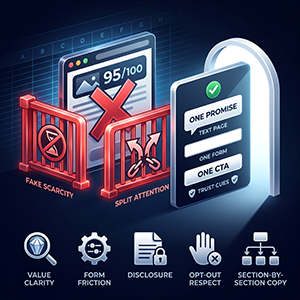
Grade the lead-capture (opt-in) page your lead magnet lives on. A runnable grader + workbook score it 0–100 on six weighted levers (message match, single conversion goal, value-for-email clarity, form friction, trust at capture, honest promise) and return GO LIVE / TIGHTEN / REWORK — with an honesty gate that forces REWORK on fake scarcity or a broken promise, and a focus gate that caps a page with competing CTAs at TIGHTEN. Names each page's weakest lever with its own mark, and the page to go live first. Your marks, no baked-in benchmark; grades the page, doesn't build it. Distinct lane from the Offer & Landing-Page kit (sales pages). Not legal advice.
REACH
Web-Form Consent & Lead-Capture Compliance Gate
$79
Grade every marketing web form on TCPA prior-express-written-consent (PEWC) readiness across six weighted controls (affirmative unchecked opt-in, clear disclosure, disclosure proximity, written E-SIGN signature, retained per-consumer consent record, revocation/DNC & source diligence) and get CONSENT-READY AS DESCRIBED / FIX FIRST / EVIDENCE GAP per form, with a program rollup (READY TO CAPTURE / REMEDIATE / DO NOT LAUNCH). A defective-capture gate hard-stops the three gate-triggering patterns — a pre-checked/non-affirmative opt-in, no retained consent record, or purchased leads with no provenance — because consent the consumer didn't unmistakably give, or that you can't produce later, isn't defensible. Names one fix-first per form where a control is short. Date-agnostic, and it deliberately does NOT grade the vacated 2023 one-to-one rule. Runnable Python engine + workbook + consent-audit & capture-fix playbooks + a 7-form sample. A readiness aid, not a certification or legal advice — TCPA law is unsettled; consult counsel before launch.
REACH
Interactive Lead-Magnet Builder
$89
Build an interactive assessment lead magnet that scores honestly and out-converts a PDF. A runnable Python scorer + a design workbook turn a respondent's own 0–5 answers (question weights summing to 100) into a 0–100 score and an honest, score-appropriate result band — with a no-manufactured-problems gate that returns PUBLISH / FIX / REWORK, refusing to let the top band diagnose a problem or hard-sell your best respondents. Ships the scorer, workbook, question + band-copy prompts, a starter question bank, and two playbooks. Your weights, no rigged gradient; portable to any quiz tool. Not a hosted quiz platform. Not legal advice.
REACH
Webinar Lead System
$79
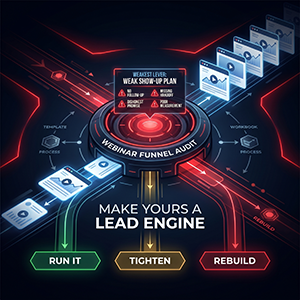
Grade your webinar as a lead engine, not just a talk. A runnable Python grader + a workbook score it 0–100 on six weighted funnel levers (registration conversion, show-up plan, in-event qualification, follow-up speed & segmentation, lead scoring & handoff, honest measurement) and return RUN IT / TIGHTEN / REBUILD — with two gates: a bait-and-switch forces REBUILD however polished, and a webinar with no follow-up caps at TIGHTEN. Follow-up carries the most weight because the pipeline is won in the 24–48h after. Ships reminder + segmented follow-up templates and two playbooks. Your marks, no baked-in benchmark; no guaranteed registrations or pipeline. Grades the funnel, not the registration page in depth. Marketing guidance, not legal advice.
REACH
Scaled-Content Penalty Exposure Gate
$79
Grade your already-published pages against Google's scaled-content-abuse signals before the next enforcement cycle. Mark each page on six signals (template / mass-sameness, per-page value depth, first-hand experience / E-E-A-T, internal near-duplication, editorial review vs velocity, genuine intent) and get a MIN-as-headline verdict — DEFENSIBLE / THIN / EXPOSED — where the weakest signal is the diagnosis, plus a site rollup and exposure rate. A structural gate forces EXPOSED on a mass-templated page with no first-hand value (the exact survivor/casualty split), regardless of how the rest scores; lift either gate axis and it releases. Names the fix-first signal per page where a signal is short, and tells you whether to fix or consolidate the cluster. Runnable Python engine + workbook + audit & remediation playbooks + a 6-page sample. Grades pages, not people; a working aid, not affiliated with Google, with no guaranteed rankings.
REACH
ChatGPT Ad & Conversational-Answer Readiness Kit
$79
Grade a proposed ChatGPT ad and its landing page before you spend. Scores six readiness dimensions (OAI-AdsBot crawler access, allowed ad category, conversational not-a-billboard tone, answer-first landing match, claim verifiability, creative completeness within your builder's limits) weighted to 100 and returns READY TO SERVE / TIGHTEN / WON'T SERVE per ad, with a batch rollup (ALL READY / SOME TO TIGHTEN / PULL FIRST). Two worsen-only gates force WON'T SERVE — the landing page blocks OAI-AdsBot (the silent approved-but-never-serves failure) or the offer is in a disallowed category. It never hard-codes the disputed character limits — you enter what your live OpenAI ad builder shows and it validates against that. Names the one thing to fix first where a signal is short. Runnable Python engine + workbook + conversational copy prompts + audit & serve/convert playbooks + a 6-ad sample. Grades the ad and the page, not a person; verify against OpenAI's live builder and current ad policy. Not legal advice.
REACH
GEO / AI Visibility Playbook
$149
Get your brand cited by AI answer engines — ChatGPT, Perplexity, AI Overviews, Gemini, Claude. The CLEAR framework, paste-ready content templates, a live AI visibility tracker, and a prompt pack with a 30/60/90 plan. The treatment to the AEO Audit Kit's diagnosis. No guaranteed citations — better odds, measured.
REACH
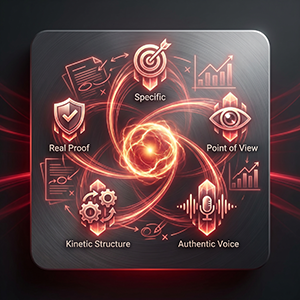
Anti-Slop Content System
$79
Use AI for speed without sounding like everyone else's AI. A heuristic slop scanner, the SPARK scorecard (Publish / Revise / Rework), a field guide of AI tells with fixes, brand-voice prompts, and a playbook. AI in the decisions, your voice in the words — a quality guardrail, not an AI detector.
REACH
Distinctive AI Visuals Kit
$79
Make AI visuals that look like you, not everyone's defaults. Twelve ownable postdigital style recipes (halftone, riso, glitch, dithering, CRT…), a brand-system worksheet that scores each asset On-system / Tweak / Off-brand, and a runnable prompt builder. Real photos for real people; disclose AI; no IP imitation.
REACH
AI Brand Misinformation Watch
$99
Find out what AI assistants say about your brand and correct what's wrong — honestly. A prompt battery to audit ChatGPT/Gemini/Perplexity, a Brand AI Accuracy scorecard (Healthy / Watch / At risk), a findings triage, the Brand Truth Pack correction toolkit, and a runnable battery generator + correction linter. Correct facts; never suppress legitimate criticism.
REACH
AI Marketing Measurement Kit
$99
Measure AI-era marketing honestly. The CLEAR framework, a KPI tracker, a result Rigor Scorecard (Trustworthy / caveats / don't report yet), a channel ROI workbook, honest report templates, and a runnable evaluator + claim linter that flags thin samples, missing baselines, and over-reach. A methodology, not financial advice — it estimates influence, not causation.
REACH
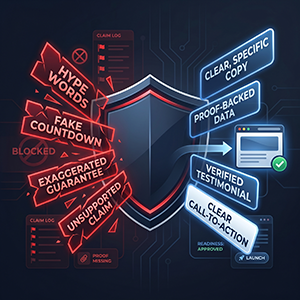
AI Offer & Landing-Page Conversion Kit
$79
Build offers and landing copy that convert — and check their own claims. A Conversion-Ready Scorecard (Clarity / Proof / Relevance / Friction / Honesty), section-by-section templates, an offer-stack worksheet, prompts, a Claim & Proof Log, and a runnable claim-honesty linter that flags overclaiming, fake scarcity, and missing proof. Marketing guidance, not legal advice; no guaranteed conversion rate.
REACH
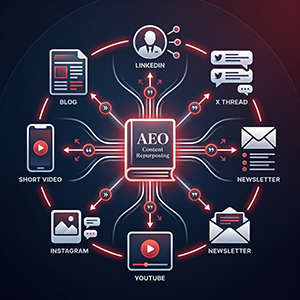
AEO-Aware Content Repurposing System
$79
Turn one anchor asset into AEO-optimized, brand-voice-locked, omni-channel pieces — the strategy layer clippers skip. The 5A engine (Anchor / Atomize / AEO-optimize / Adapt / Amplify), per-channel templates and prompts, a Repurposing Readiness scorer (Ship / Tighten / Rework), a runnable brief generator + AEO linter, and an optional GHL workflow. A strategy kit, not a clipper; no citation guarantee.
SALES
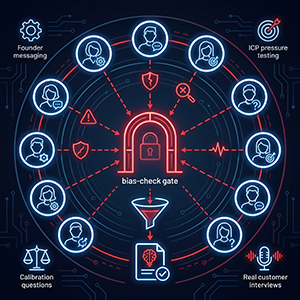
Synthetic Customer Research Panel
$69
12 ICP personas + bias-check protocol. Pressure-test positioning in a weekend.
CLAUDE
Solo Founder Skills Pack
$79
Six Claude skills that auto-load when you need them. Investor updates, board memos, runway, weekly cadence.
CLAUDE
Ecommerce Skills Pack
$89
Six Claude skills for Shopify, Amazon & multi-channel operators. Variant-aware, composable, agency-licensed.
CLAUDE
Local Service Trades Skills Pack
$89
Six Claude skills for HVAC, plumbing, electrical, roofing, and landscaping shops. Lead intake, estimates, service reports, follow-ups, reviews, local SEO. Truck-friendly.
CLAUDE
Agency Operators Skills Pack
$89
Six Claude skills for digital, creative, marketing, PR, dev, and consulting agencies. Onboarding, status reports, scope creep, kickoff decks, invoice reconciliation, renewals.
CLAUDE
Fractional Executive & Consultant Skills Pack
$99
Six Claude skills for fractional CFO/CMO/COO/CRO/CPO/CHRO engagements. Diagnostic memos, engagement architect, retainer pricing, 90-day plans, board updates, executive briefs.
CLAUDE
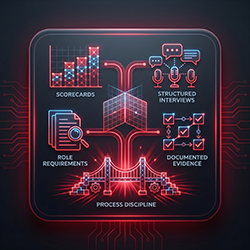
Recruiting & Hiring Skills Pack
$79
Six Claude skills for the full hiring lifecycle. Bias-checked JD writer, structured screener, interview kit with lawful-question flags, scorecard, candidate comms, offer drafter.
CLAUDE
Customer Support & Success Skills Pack
$89
Six Claude skills spanning support and success. Triage, on-brand reply drafter (never invents), macros & KB, reply QA, churn-risk flagger, customer health check.
CLAUDE
Real Estate Skills Pack
$79
Six Claude skills across the deal lifecycle. Listing writer with Fair Housing check, CMA narrative builder, marketing kit, lead follow-up, buyer/seller comms, transaction update.
CLAUDE
Agency & Studio Operations Skills Pack
$89
Seven Claude skills that protect agency margin at the scope boundary: scope-creep detection, SOW generation, change orders, project retros, status updates, deliverable QA, the boundary email.
CLAUDE
Manufacturing & Distribution Ops Pack
$89
Seven Claude skills for the make-and-move surface — plus a runnable inventory auditor that reads your CSV and flags reorder, stockout, overstock, and dead stock. POs, three-way receiving match, scheduling, supplier scorecards, quality reports.
OPS
OEE Honesty Grader
$99
Grade whether your plant's OEE is a real number or a story your reports tell. Computes each line's OEE as reported and as true, exposes the hidden factory, and forces INFLATED on any line whose planned time quietly omits changeover. Deterministic, offline, your own shift facts.
OPS
Tribal-Knowledge Loss Exposure Radar
$99
Grade every critical process on whether its know-how is captured in a form someone else can run — or lives only in one head. Forces SINGLE-POINT on any critical, solo-held process with no verified SOP, and, where a process is exposed, names the one to capture first before the person who holds it retires. Deterministic, offline.
OPS
PM Deferral & Pencil-Whip Tripwire
$89
Your CMMS shows 96% PM compliance right until the gearbox fails. This tripwire reads your export and catches the two lies inside compliance — deferral and pencil-whipping — forcing RUN-TO-FAILURE on any critical asset that's been double-deferred or signed off in less time than the work could take. Deterministic, offline.
OPS
Cost-of-Poor-Quality Ledger
$99
Scrap, rework, containment, warranty, and expedite live in five GL accounts nobody totals. This ledger sums all five per cell, projects the figure monthly and annually against your own revenue, and, where a cell is outside your tolerances, names the worst cell and the one stream driving it — with a concentration gate that flags a runaway stream a modest ratio hides. Deterministic, offline, your own numbers.
OPS
Attribution Integrity Ledger
$89
A deterministic grader for marketing attribution reports. Mark each report on six weighted dimensions for a 0–100 integrity score (TRUST THE NUMBER AS DESCRIBED / LEAKY / BLACK BOX), with a reconciliation gate that floors any report where a deal's credit doesn't sum to 100% or a touchpoint fired no rule. It grades a report's integrity, not its accuracy, and scores no person. Deterministic, offline, your own numbers.
OPS
Critical-Spares Stockout Watchtower
$89
A storeroom's fill rate averages a $12 fuse with a 26-week-lead coupling that downs the line if it stocks out. This watchtower reads your storeroom export and gives two independent reads per spare — coverage and exposure severity — forcing SINGLE-FAILURE RISK on any crit-A spare with no supply, no substitute, and a lead past tolerable downtime. Deterministic, offline.
BUNDLE
Plant Margin & Reliability Desk
$376$299
Four RedHub systems that read the same plant from four angles — OEE honesty, PM execution, cost of poor quality, and critical-spares stockout risk — plus a 90-day playbook that runs them as one quarterly reliability rhythm. All four full products for less than buying separately. Every verdict from your own numbers; grades assets, never people.
BUNDLE
Quote-to-Build Desk
$346$294
A quote is a chain of four promises: worth chasing, priced right, lead time that holds, and buildable once they say yes. Four RedHub Systems check all four links — RFQ triage, cost calibration, backlog reality, order buildability — in the order a quote travels. $294 versus $346 separately, plus a connective playbook. Deterministic, offline.
BUNDLE
Quality Integrity Bundle
$247$209
An auditor doesn't check whether you have a quality system — they check whether it's telling the truth. Three RedHub Systems catch the three places it quietly isn't: NCR-to-CAPA routing, gauge calibration integrity, and ECN propagation. $209 versus $247 separately, plus a connective pre-audit playbook. Deterministic, offline.
BUNDLE
Channel & Supply Honesty Bundle
$138$118
Every relationship you depend on has a number attached, and both sides lie the same two ways. Two RedHub Systems split the deceptive single metric into honest reads: the Supplier Lead-Time Honesty Scorecard (inbound) and the Rep & Distributor Scorecard (outbound). $118 versus $138 separately, plus a connective playbook. Deterministic, offline, no dates.
BUNDLE
Release-Safety Trio
$217$169
A voice-agent guardrail can fail in three places: it was never there, it got edited out in the console, or a release quietly changed the behavior around it. Three RedHub Systems close all three — Voice Prompt Forge (written), Prompt Version Vault (live), Canary Call Library (behaving). $169 versus $217 separately, plus a connective playbook. Deterministic, offline.
BUNDLE
Call-Data Hygiene Trio
$227$179
Every call leaves a trail that carries three risks: you called someone you shouldn't have, you're holding a card number read aloud, or you're sitting on data you should have deleted. Three RedHub Systems cover the full life of call data — DNC Suppression Sweep, Spoken-PII Transcript Redactor, Retention Purge Scheduler. $179 versus $227 separately, plus a playbook. Deterministic, offline.
BUNDLE
Call-Data Compliance Quad
$296$229
Every outbound call carries four compliance exposures that bite at different moments — wrong number, wrong time, kept PII, over-retained data. Four RedHub Systems close all four: DNC Suppression Sweep, Calling-Window Compliance Checker, Spoken-PII Transcript Redactor, Retention Purge Scheduler. $229 versus $296 separately, plus a connective playbook. Deterministic, offline.
BUNDLE
Voice Desk Bundle
$800$549
The whole AI-voice-agent lifecycle under one honest standard: build, prove, and test the agent, run the live calls, and cover every call-data compliance exposure. All ten Voice Desk Systems, priced below sum-of-parts, plus the connective Voice Desk Playbook. $549 versus $800 separately. Deterministic, offline; every tool grades prompts, calls, and records — never a person.
DEV
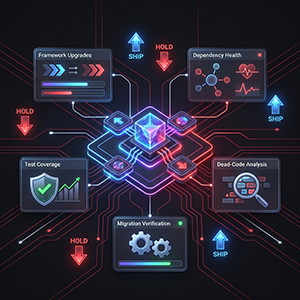
Codex Migration & Refactor Pack
$99
Six Codex skills + a runnable verifier for dev teams: framework upgrades (Next 15, React 19), dependency sweeps, monolith extraction, test backfill, dead-code removal. SHIP or HOLD with proof.
DEV
Codex Code-Review & PR-Hygiene Pack
$79
Six Codex skills + a runnable PR-hygiene gate: PR descriptions, security smells, breaking-change detection, conventional commits, review comments. PASS or BLOCK with proof.
DEV
Technical Documentation Engine
$99
Six Codex + Claude skills that document your codebase — README, API reference, ADRs, onboarding, changelogs (Diátaxis) — plus a runnable auditor that returns DOCUMENTED or GAPS.
DEV
Agent Orchestration Cookbook
$79
25+ multi-agent patterns. Full code in Claude Agent SDK + LangGraph. Eval harnesses included.
DEV
Prompt Evaluation & Versioning System
$49
Eval framework + dashboard + Notion war-room. Treat your prompts like code.
Forecasting calculator + routing matrix + cache patterns + 15 production teardowns. Stop AI margin death.
DEV
RAG Retrieval Grader
$89
Score the retrieval step of your RAG pipeline — Recall@k, Precision@k, MRR, nDCG — and get a ship / hold / fix verdict with every miss named. Python + TypeScript, any vector DB, gates retrieval in CI. Pairs with AutoChunk: chunk there, grade here.
DEV
Agent Memory & Context Poisoning Exposure Probe
$79
Prompt injection ends; a poisoned memory doesn't. A pre-deployment probe for agent memory, RAG indexes, and context stores: mark six OWASP ASI06 lifecycle controls (write-path validation, trust-aware retrieval, provenance, scope isolation, decay/TTL, audit trail) for a weighted 0-100 score and CONTAINED / HARDEN / POROUS, with a two-condition kill-chain gate that forces POROUS when poison can be both written (weak validation) and recalled as ground truth (no trust check) — even at 78/100. Names the control to fix first where a control is short; rolls a fleet up. Runnable Python engine + workbook + exposure-audit & fix-the-control playbooks + a 7-store sample. The persistence layer beside the Prompt Injection Red Team Kit. Grades the architecture, never people. Not a scanner or attack simulator.
DEV
RAG & Knowledge-Base Retrieval-Readiness Gate
$89
Before you ground an AI on your documents, gate the corpus. Mark six 0/1/2 content controls (freshness, single source of truth, named ownership, structure & chunkability, access-permission mapping, top-question coverage); the verdict is the weakest control — ANSWER-READY / STALE / UNGROUNDED — with a dispositive worsen-only gate that forces UNGROUNDED on contradictory authoritative docs or unmapped permissions, even at a 92% score. Not a retrieval-metric grader and never touches a vector DB — it grades whether the documents are worth retrieving in the first place. Runnable Python engine + workbook that reproduces it + audit & fix-it playbooks + a 6-corpus sample. Scores the corpus, never people; reads no live data.
DEV
Vibe-Coded App Pre-Launch Security Gate
$79
The security check vibe-coding skips. Nearly half of AI-generated code ships with a known vulnerability — run this gate before your first public launch. Mark six controls per app (secrets out of the client bundle, server-side auth on every sensitive route, input validation & injection defense, dependency & supply-chain integrity, no verbose errors/source maps in prod, access control actually tested) for a weighted 0-100 score and LAUNCH-READY AS DESCRIBED / HARDEN FIRST / DO NOT SHIP, with a single-fault gate that forces DO NOT SHIP when either secrets or server-side auth is absent — even at 78/100, the exposed-DB-key-in-the-client pattern. Names the control to fix first where a control is short; rolls a batch up. Runnable Python engine + workbook + audit & fix-the-control playbooks + a 7-app sample. The launch-moment go/no-go beside the Vibe-Coded App Hardening Kit. Grades the posture you describe, never people. Not a scanner or pentest.
DEV
Prompt Injection Red Team Kit
$99
Run 15 OWASP-mapped injection & system-prompt-leak probes against your own LLM app, score severity-weighted resilience, and gate CI with a ship / hold / fix verdict. Python + TypeScript, deterministic, offline. Defensive / authorized-use only.
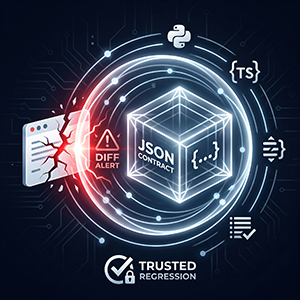
DEV
Prompt Regression Lab
$89
Snapshot a baseline, diff every prompt change, and fail CI on any regression — deterministic checks, A/B compare, and a ship / hold / regressed verdict in Python + TypeScript. The third dev-tools gate: functional regressions.
DEV
Agent Reliability Harness
$149
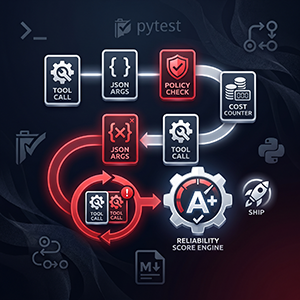
Evaluate AI agents at the trajectory level — tool choice, argument validity, step efficiency, cost, and policy — and gate CI on a ship / hold / fix verdict. Six deterministic evaluators, framework-agnostic, Python, zero dependencies. The fourth dev-tools gate: agent behavior.
DEV
Agent Action Admissibility Engine
$99
Check the actions your AI agent proposes against your own domain rules before any of them execute. Four constructs — functional, disjoint, range, one_of — return ADMISSIBLE / REVIEW / INADMISSIBLE per action and a batch verdict, with no admissibility score because a contradiction cannot be scored. Deterministic, offline Python engine + reproducing workbook; grades proposed actions, never people.
DEV
Domain Ontology Readiness Survey
$89
Grade whether your domain is written down in a form a machine could check. Six dimensions per domain return MODELED / PARTIAL / UNMODELED, with an entity-count gate that overrides a partial model once undeclared distinctions become where contradictions come from. Deterministic, offline Python engine + reproducing workbook; grades the model you describe, never people.
DEV
Validation-Layer Coverage Map
$99
Map which validation layers actually cover which decisions, then read the matrix down the columns as well as along the rows — because a layer covering three decisions out of forty is a pilot, not a layer. Returns FOUR-LAYER / THIN / UNVALIDATED per decision and a map verdict, discounting nominal layers. The lane hub. Deterministic engine + workbook; grades the map you draw, never people.
DEV
Tool-Input Schema Turnstile
$79
Grade whether every tool your AI agent can call has an input contract that could actually refuse a bad call. Each parameter reads TYPED / LOOSE / OPEN DOOR from its kind and its consequence — money needs a ceiling AND a cross-field rule, so a $10,000 cap that can't stop a $9,999 refund on a $12 order still reads OPEN DOOR. Deterministic engine + workbook; grades contracts, never people.
DEV
Agent Side-Effect & Blast-Radius Checkpoint
$89
Grade whether an agent action is safe to run unattended, on two axes it prints separately: reversibility (can you undo it in time) and blast radius (how many records one call touches). Returns RUN UNATTENDED / RUN WITH APPROVAL / DO NOT AUTOMATE, and a typical count is never treated as a bound. Deterministic engine + workbook; grades the actions you describe, never people.
DEV
Validation-Failure Backstop
$79
Grade what happens after a check says no. Six controls per validation path return FAILS CLOSED / FAILS SOFT / FAILS OPEN — because an approval step that auto-approves when nobody answers is a delay, not a control. Where a go-live gate asks whether an escalation path exists, this asks whether it works when nobody's there. Deterministic engine + workbook; grades the paths you describe, never people.
DEV
Inferred-Fact & Unstated-Assumption Trace
$89
Take a finished AI-assisted deliverable apart fact by fact and sort each into ASSERTED / DERIVABLE / ASSUMED — following derivations ten levels deep, because a fact can look perfectly derived and still rest on an assumption three rows down. Fix-first names the root, not the symptom. Deterministic engine + workbook; grades the facts you record, never people.
DEV
Ontology Change-Impact Tripwire
$79
Grade every proposed change to your data model before it ships and catch the SILENT BREAK — the change where everything still validates, every consumer still runs, and the answers are quietly different. Ranks SILENT BREAK worst, above BREAKING, above ADDITIVE. Deterministic engine + workbook; grades the changes you describe, never people.
BUNDLE
The Refusal Trio
$257$199
Three ways to stop an AI agent, at the three moments it can do damage — Tool-Input Schema Turnstile (the door), Agent Action Admissibility Engine (the ledger), Validation-Failure Backstop (the catch) — plus a chain rollup that names the weakest layer where one of them is short. They fail independently; the bundle proves which link is weak.
BUNDLE
Model & Identity Trio
$207$159
One survey asks what you declared; two sweeps go and measure it. Domain Ontology Readiness Survey + Enum & Status-Value Drift Sweep + Entity Identity & Functional-Key Sweep, plus a claim-vs-evidence rollup returning CONFIRMED / KNOWN GAP / OVERSTATED where a claim and its measurement disagree.
BUNDLE
The Ontology Layer
$820$629
The whole ontology / agent-safety line — all ten deterministic checks from whether your domain is written down to what the next change will break quietly, plus a lane rollup that names the worst finding where a check is failing, and the next thing to run where a check is unrun. A check you haven't run is not a check that passed.
SALES
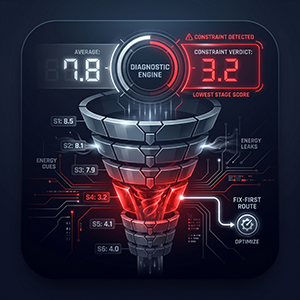
Lead-Gen Funnel Diagnostic
$79
The anchor of the lead-gen line — grade your whole lead funnel and find the one stage choking it. A runnable Python engine + a workbook score six stages (capture, speed-to-lead, qualification, definition & handoff, nurture, source ROI) 0–100 and report the constraint — the lowest-scoring stage, not the average, because a funnel flows only as fast as its tightest stage — then, where a stage is short, route you to the exact RedHub drop that fixes it. Returns FLOWING / LEAKING / CLOGGED, with a broken-stage gate that forces CLOGGED if any stage is effectively dead. Run it first to learn which drop to buy. Grades your funnel, not people. Not legal advice.
SALES
Prospect Funnel Leak Audit
$79
Your prospects don’t vanish — they leak at one stage. A deterministic diagnostic for the sales / consultation funnel: enter the real head count at each stage (inquiry → discovery booked → held → qualified → presented → client) and it computes the actual conversion at every step, marks each ON TARGET / LEAKING / SEVERE against your own editable target, and, where a stage is leaking, names the constraint — the EARLIEST severe leak, because an upstream leak starves every stage downstream (so the show-up step, not the numerically-worse close, is the fix). A dead-stage gate forces HEMORRHAGING when a step passes nobody. Funnel verdict FLOWING / LEAKING / HEMORRHAGING plus a dollar estimate of closing the constraint to target from your own client value — no invented lift. Runnable Python engine + workbook + measurement & leak-fix playbooks + a worked sample. Grades a funnel, never people. Not financial advice.
SALES
RFP & Proposal Response Engine
$99
Six Claude skills that run the full RFP response the Shipley way — shred, bid-decide, build the compliance matrix, theme, draft — plus a runnable verifier that catches the missed requirement before you submit.
SALES
Sales Enablement Battlecard Builder
$79
Five field-ready battlecards from your real intel — competitor, objection handling, discovery, talk track, persona. Accurate, honest, never invents competitor facts. Prompt, skill, or Project.
SALES
Bid Sprint Drill
$69
Score whether you're ready to win the freshness window — the Build / Monitor / Sprint readiness system from Chapter 7 of The AI Proposal System (Brooks), as a pre-week check. Mark six readiness controls 0/1/2 (weighted to 100) and enter your typical minutes-to-send; the Drill maps speed via the book's Freshness Window Benchmark and returns READY / TIGHTEN / NOT SPRINT-READY plus, where a control is short, the one to fix first. A two-asset gate forces NOT SPRINT-READY when the archetype file or proof stack is missing — speed without a staged asset is just fast spam — so you can score 78 and still read NOT SPRINT-READY. Runnable engine + workbook + readiness & build-phase playbooks. The third companion to the per-proposal Quality Probe and the monthly Funnel Map; grades readiness, never a person, guarantees no response rate.
SALES
Proposal Funnel Map
$79
Enter your own 30-day proposal numbers and find the one stage that's costing you the work — the seven-metric dashboard and six-stage funnel map from The AI Proposal System (Brooks), turned into a monthly instrument. The Map scores three funnel stages against the book's niche benchmarks and, where a stage is leaking, names the constraint — the earliest stage below healthy, not the lowest score, because an upstream leak starves everything below it — then routes you to the drop that fixes it. Verdict HEALTHY / LEAKING / BLEEDING, set by the constraint stage, never the average, with a broken-stage gate that forces BLEEDING when a stage is non-functional. Runnable engine + workbook + diagnosis & constraint playbooks. The monthly companion to the per-proposal Quality Probe; grades the funnel, never a person.
SALES
Proposal Quality Probe
$79
Score one freelance proposal before you send it — the five-criterion rubric from The AI Proposal System (Brooks), turned into a deterministic pre-send checkpoint. Mark opening, proof, approach, CTA, and bot-risk 1–5 for a score out of 25 and the book's verdict (SUBMIT / REVISE / DO NOT SEND / START OVER), with two worsen-only gates: a sub-3 criterion floors to REVISE, a bot-risk mark of 4–5 floors to DO NOT SEND — so a 22/25 can still read DO NOT SEND. The verdict is the book's, from your own marks; no hidden benchmark. Runnable engine + workbook + scoring & fix-it playbooks. The book's companion; grades the proposal, never a person.
SALES
AI Service Pricing Kit
$79
Diligence-grade pricing intelligence for agencies adding AI services in 2026. 25+ service categories with sourced rates, pricing model decision tree, margin defense playbook.
Most businesses overpay for card processing by 20-40%, and in 2026 several processors met interchange cuts by adding padded line items to claw the savings back. This audit grades a merchant-processing statement on the two axes that decide whether you're overpaying: your realized effective rate (total fees / total volume) against the well-optimized band you confirm for your channel, and the fee padding a clean-looking rate hides. Each statement scores FAIRLY PRICED / RENEGOTIATE / BEING BLED on rate, then a worsen-only padding gate floors the verdict to BEING BLED whenever junk fees hit 15% of the bill or unexplained downgrades hit 20% of volume — so a statement can sit inside its rate band and still read BEING BLED, the money a rate calculator never surfaces. The shipped teaching case: a 2.10% card-present statement inside the 2.20% band floors to BEING BLED on a 16% junk load; strip the padding and it releases to FAIRLY PRICED. It names the one fix to make first where a statement is padded, totals the reclaimable dollars per statement, and rolls a portfolio up to ALL FAIR / OVERPAYING SOMEWHERE / MONEY LEAVING THE BUILDING. Runnable zero-dependency Python engine + workbook (Start Here / Dashboard / Fee-Padding Audit) + Statement-Audit SOP + Fee-Renegotiation Runbook + a 4-statement sample. Deterministic and offline; audits the statement you paste, sets no rate, moves no money, contacts no processor. Grades a fee statement, not a person. Not financial, accounting, or legal advice.
SALES
Margin Leak Auditor
$79
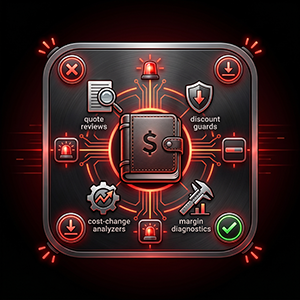
Five Claude skills for margin defense + a runnable auditor that sweeps your deal book for realized (pocket) margin below floor — names the deals losing money behind your blended average. Discount guard, quote review, cost-change impact, leak diagnosis. Defends the price; doesn't set it.
SALES
AI Pricing & Quote Intelligence Studio
$99
Find a current, sourced price with live web search, draft a defensible quote with its reasoning shown, and grade it before it reaches a buyer — QUOTE-READY / SHORE UP / DON'T QUOTE, with a two-trigger gate that forces DON'T QUOTE on any fabricated benchmark or below-margin-floor price. You supply cost and floor; it invents no number. Grades a quote, not a person; not financial advice.
SALES
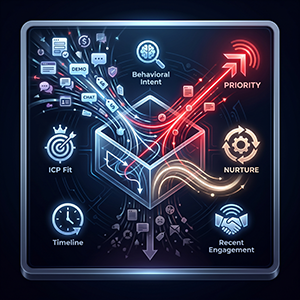
Inbound Lead Qualification Engine
$99
Score every inbound lead and work the right ones first. A runnable Python engine + a workbook grade each lead PURSUE NOW / NURTURE / DISQUALIFY on five weighted signals (fit, intent, timeline, authority, recency) from your own marks — with a hard gate that holds back a great-looking lead that has no budget or no timeline. Priority, not permission; the verdict comes from your marks, no multiplier.
RETAIN
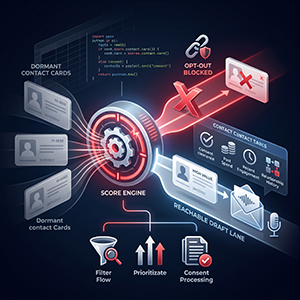
Database Reactivation Readiness Engine
$99
The compliance gate that runs before you wake a dormant list. Scores every contact CONTACT / REPERMISSION FIRST / SUPPRESS and gates the whole list GO / FIX / HOLD — from each contact's own consent and risk fields, not a guess. Ships a runnable Python tool, a workbook, two playbooks, and a sample list. It's the gate, not the sender; reduces TCPA/CTIA risk (not legal advice).
RETAIN
Lead Nurture Decision System
$69
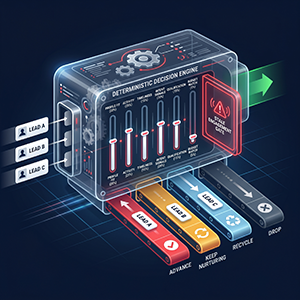
The pre-sale decision layer for captured leads. A runnable Python engine + a workbook score each lead 0–100 on six weighted levers (ICP fit, need signal, engagement recency, engagement depth, authority, timing) and return ADVANCE / KEEP NURTURING / RECYCLE / DROP — with a stale-engagement gate that holds a high-fit but cold lead in nurture (fit is not readiness). Routes the rest to the right nurture track. Reads and scores only; it never sends or edits your CRM, and doesn't grant permission to contact — confirm consent first. Your marks, no baked-in benchmark. Not legal advice.
REACH
Voice & Likeness Compliance Gate
$99
The pre-publish gate for AI voices, clones, avatars, and digital likenesses. Scores every asset CLEAR / FIX FIRST / DO NOT PUBLISH and gates the set GO / FIX / HOLD — from each asset's own consent and disclosure structure, with the exact fix. Runnable engine + workbook + disclosure/consent playbooks. It's the gate, not the maker; reduces FTC/right-of-publicity/EU-AI-Act risk (not legal advice).
REACH
YouTube Packaging & Retention Engine
$99
The honest measurement layer for YouTube growth. Scores every video SHIP / TIGHTEN / REWORK against your own channel baseline, and runs a real two-proportion z-test on A/B thumbnail tests — a significance-checked winner, never a noisy bump. Retention is the gate; packaging is the optimization. Runnable engine + workbook + hook/thumbnail playbooks. No tool guarantees views — every verdict is a gap analysis from your own data.
REACH
Instagram Profile Conversion Audit
$79
Score your Instagram profile across six surfaces — bio, niche, link-in-bio, pinned proof, highlights, CTA — and, where a surface is short, get the single thing to fix first. The headline is your weakest conversion surface; an unreadable niche floors the whole profile to INVISIBLE because distribution precedes conversion. Runnable engine + workbook + two fix playbooks. Deterministic, offline, scores the profile not people.
REACH
Instagram DM-to-Sale Readiness Gate
$79
Gate your automated Instagram DM sales flow before you turn it on. Scores five stages — greet & disclose, qualify, value answer, offer, hand to checkout — READY / FIX / DO NOT AUTOMATE, with a dominant disclosure-and-opt-out gate that HOLDs the whole flow if an automated DM doesn't disclose it's automated or offer a way out. Runnable engine + workbook + two playbooks. A risk judgment, not legal advice.
REACH
AI Music & Audio Rights Kit
$89
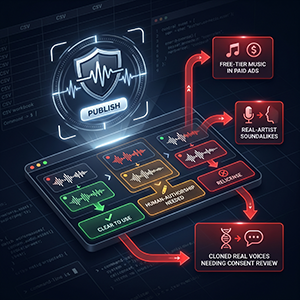
The rights gate for AI-generated music, voices, and audio. Scores every asset CLEAR TO USE / HUMAN-AUTHORSHIP NEEDED / RELICENSE and gates the library GO / REVIEW / HOLD — from each asset's own rights structure (tool plan, human authorship, use, artist imitation, voice consent), with the exact fix. Runnable engine + workbook + rights/disclosure playbooks. The rights layer; pairs with the Voice & Likeness Compliance Gate (consent). Not legal advice.
REACH
AI Disclosure & Labeling Readiness Kit
$79
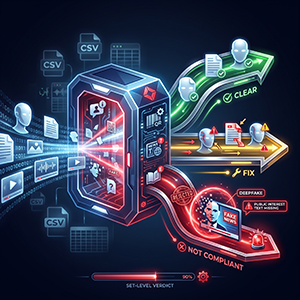
A pre-publish readiness audit for the EU AI Act's Article 50 transparency rules. List every AI surface you operate — chatbots, AI images and audio, deepfakes, AI-written public-interest text — and get CLEAR / FIX / EVIDENCE GAP per surface plus a READY / FIX / EVIDENCE GAPS PRESENT AS DESCRIBED set verdict, with one hard gate: any synthetic surface passed off as real sinks the whole set. Runnable engine + workbook + playbooks. Readiness aid, not legal advice; not a watermarking tool.
REACH
Content Provenance & C2PA Readiness Gate
$79
Grade published media on whether its C2PA Content Credentials are attached, validly signed, from a trusted signer, carrying the right disclosure assertion, and durable enough to survive the publish path. Returns SIGNED / GAPS / UNVERIFIABLE per asset with a library rollup — and a stripping gate that hard-stops to UNVERIFIABLE when your CDN, CMS, or a social re-encode destroys the credential and no durable fallback can recover it. Runnable Python engine + workbook + two playbooks + a 7-asset sample. The technical-durability layer the AI Disclosure Kit excludes. A nutrition label, not a force field; not a deepfake detector. Not legal advice.
REACH
AI UGC Ad Compliance System
$89
The pre-launch compliance gate for AI and UGC-style ads. Returns LAUNCH / FIX / PROHIBITED per ad and a campaign GO / FIX / HOLD gate — reading who speaks, what's claimed, and what's disclosed, not a platform label — and hard-blocks a synthetic spokesperson framed as a real testimonial. Runnable Python linter + workbook + disclosure/triage playbooks + sample ad set. Pairs with the Voice & Likeness Compliance Gate. Guidance, not legal advice.
REACH
Creator Sponsorship & Media Kit System
$79
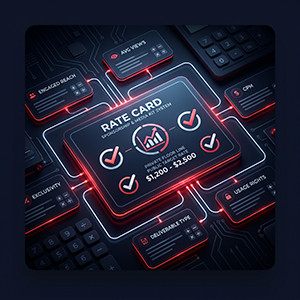
Price brand sponsorships from your own reach and engagement — no invented multiplier — build an honest media kit, and grade every inbound offer Fair / Negotiate / Walk against your own target and floor, adjusted for deliverables, usage rights, and exclusivity. Runnable Python calculator + workbook + media-kit & negotiation playbooks + sample set. Never inflates a kit; the #ad note is guidance, not legal advice.
REACH
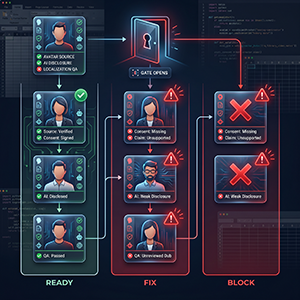
AI Avatar Video Production Kit
$89
The pre-publish readiness gate for AI avatar (talking-head) video. Returns READY / FIX / BLOCK per video on consent and truthfulness and a library GO / FIX / HOLD gate — hard-blocking a missing consent artifact or an avatar giving a first-person testimonial. Reads the video's production structure, not a platform label. Runnable Python checker + workbook + consent/disclosure & script-to-avatar playbooks + sample set. Bring your own avatar tool; this gates the output. Guidance, not legal advice.
REACH
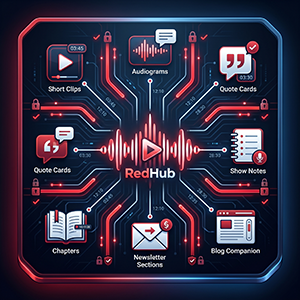
Podcast Production & Repurposing Engine
$79
Audio-anchored. Scores every podcast episode Publish / Tighten / Hold against six weighted criteria with a hard audio gate (bad audio caps at Hold), then plans audio-native repurposing — clips, audiograms, quote cards, show notes, chapters — with counts bounded by the moments you marked, never invented. Runnable Python engine + workbook + five Claude skills + two playbooks. Hands the text companion to the AEO Repurposing System. Not legal advice on synthetic-audio disclosure.
REACH
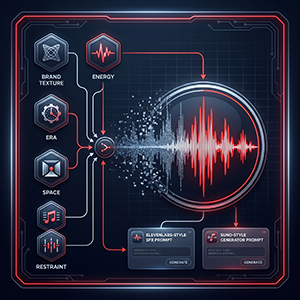
AI Sound Design & SFX Kit
$59
Make AI sound effects and ambient beds that sound like your brand, not the default tool preset. Scores each asset On-brand / Tweak / Off-brand against a sonic identity you define on six weighted criteria, with a hard anti-slop gate (a dense generic preset wash can't pass). Prompt recipes for ElevenLabs SFX + Suno-style generators, a runnable scorer, a workbook, five Claude skills, two playbooks. The audio companion to the Distinctive AI Visuals Kit; non-vocal sound design only. Not legal advice.
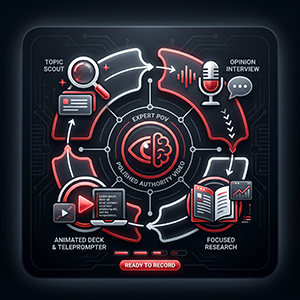
WORKFLOW
Authority Video Engine
$199
The MCP-driven workflow that turns vidIQ search data into a recorded, point-of-view YouTube video in ~70 minutes. Four Claude Skills scout the topic on real search data, interview you into an opinionated outline, fill gaps in scope, and build an animated Claude Design deck with a built-in teleprompter. A runnable scorer with an authority gate that refuses any topic you can't speak to first-hand. Bring your own vidIQ Max plan; not legal advice.
WORKFLOW
Inbox-to-Done Engine
$129
The MCP-driven workflow that turns an email backlog into a finished morning in ~30 minutes. Four Claude Skills read your inbox via the Gmail MCP, triage every thread (Reply now / Delegate / Schedule / Archive), draft the replies that need you in your voice, and hand you one ordered plan — with a delegate gate that routes off your pile anything that matters but isn't yours. It reads and drafts only; it never sends or deletes. Bring your own Gmail MCP; not legal advice.
WORKFLOW
Lead-to-Meeting Engine
$149
The MCP-driven workflow that turns new inbound leads into drafted meeting invites. Four Claude Skills read new leads from your HubSpot or GoHighLevel CRM and Gmail, score each (BOOK NOW / NURTURE / DECLINE) on the same five-signal model as the Inbound Lead Qualification Engine, and draft a first-touch reply proposing real open times read from your own Google Calendar — with a meeting-readiness gate that holds back any lead with no budget or no timeline, then assemble one prioritized contact queue and a speed-to-lead tracker. It reads and drafts only; it never sends, books, holds a slot, edits a record, or deletes — you send and book. Bring your own Calendar + CRM + Gmail MCP; not legal advice.
WORKFLOW
CRM Win-Back System
$149
The MCP-driven workflow that revives a dormant HubSpot or GoHighLevel list. Four Claude Skills read your contacts, rank every one (Revive now / Nurture / Let go / Do not contact), design an honest segment-matched offer, and draft the re-engagement sequence in your voice — with a suppression gate that holds back anyone opted-out or unreachable, whatever their value. It ranks and drafts only; you clear consent and send. Pairs with the Reactivation Readiness Engine (consent gate). Not legal advice.
WORKFLOW
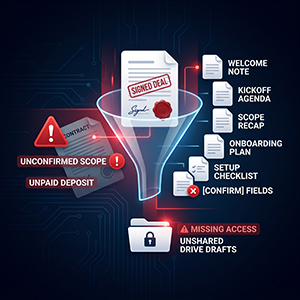
The Client-Onboarding Runway
$129
The MCP-driven workflow that clears every new client for takeoff. Four Claude Skills read your signed deal from HubSpot or GoHighLevel, score whether the engagement is truly ready to kick off (Go / Almost / Not ready / Hold kickoff), and draft the whole onboarding packet into your own Google Drive — with a blocker gate that holds the kickoff until the contract, deposit, and scope are locked. It drafts and stages unshared; you share and send. Not legal advice.
WORKFLOW
The Forecast Floor
$149
The MCP-driven workflow that grades a live sales pipeline so the forecast is honest. Four Claude Skills read your open deals from HubSpot or GoHighLevel, score whether each is truly committed (Commit / Best-case / At risk / Slipping), and draft the deal-review brief and rescue nudges — with a commit gate that refuses to count a deal with no next step, a dead close date, or gone silent as committed forecast, however large. It reads and drafts; you update the CRM and send. Forecast hygiene, not financial advice.
WORKFLOW
Content Refresh & Publishing Engine
$129
The MCP-driven workflow that grades a published content library so you refresh the right posts. Four Claude Skills read your posts from WordPress, score which are worth refreshing (Refresh now / Worth a refresh / Low priority / Rewrite or retire), draft the refresh in your voice, and assemble a publish-ready package — with a publish gate that refuses to fast-track inaccurate, unsalvageable, or worthless content, however well it ranks. It reads, drafts, and stages an unshared draft; you publish. No guaranteed rankings; never invents a stat.
EXEC
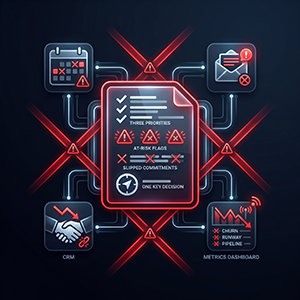
Operating Cadence Engine
$299
Your founder's chief-of-staff, on a cadence — the flagship of the Executive Suite. Four Claude Skills read your calendar, inbox, CRM, and metrics every Monday and deliver a one-page operating report to your own inbox: the three priorities, the at-risk flags, what slipped, and the one decision to make. It grades every area against the target and floor you set (On track / Watch / Off track) and rolls the week up to Steady / Needs attention / Off plan — with a floor gate that calls a crossed red line (runway below your minimum, churn above your maximum) OFF PLAN, however the week otherwise feels. It reads and synthesizes; you act. Operating hygiene, not financial advice.
EXEC
Founder's Weekly Intelligence Digest
$129
The knowledge cockpit of the Executive Suite, beside the Operating Cadence Engine's metrics cockpit. Four Claude Skills read your own docs, notes, CRM, and calendar (plus optional live signals) and self-deliver one Monday briefing to your inbox. A deterministic engine grades every tracked thread DECIDE NOW / KEEP WATCHING / PARKED — with a decision-trigger gate that surfaces the quiet-looking threads that are genuinely due: blocked on you, or a deadline this week with the ball in your court. Reads and self-delivers to your own inbox only; acts on nothing. Not financial advice.
EXEC
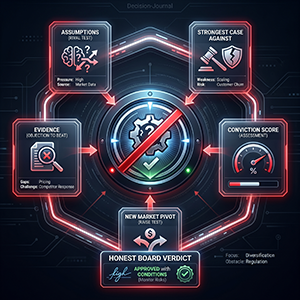
Devil's-Advocate Board
$199
The advisor built to tell you no — the Executive Suite's anti-sycophancy product. Bring one hard decision (a pivot, price change, raise, or new market) and a five-member skeptical board each builds the strongest case against it and scores how well the case survives, for an honest verdict: Go / Go with conditions / Not yet / No-go. The anti-sycophancy core is a veto gate — any one lens scoring a fatal objection forces NO-GO no matter how high the conviction score. A stress-test, not a decision-maker; the call is yours. Not financial, legal, or investment advice.
EXEC
Pipeline Commander
$249
Your AI VP of Sales — the Executive Suite's revenue inspector. Reads your CRM and grades every open deal on qualification, not the stage or amount a rep entered: Commit / Best case / At risk / Not real, with a pipeline verdict of Healthy / Thin / Exposed against quota and the one deal to work first where anything needs working. The anti-happy-ears core is a disqualifier gate — a deal missing an engaged economic buyer or a concrete next step is AT RISK no matter its stage or size. Read-only: it grades and delivers the review; you work the deals. Feeds The Forecast Floor and the OCE Monday report. Not financial advice.
EXEC
Cash-Flow Sentinel
$249
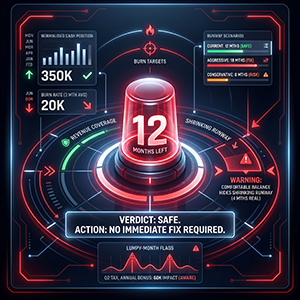
Your AI CFO — the Executive Suite's cash inspector. Grades your cash position on runway and trajectory, not the bank balance: reads your recent monthly numbers, computes net burn, the current rate versus the trailing average, revenue coverage, and your real runway (cash divided by current burn), then returns a verdict — HEALTHY / TIGHT / AT RISK / CRITICAL — with the concrete fix. The anti-happy-ears core is two gates: a hard runway floor (under three months is CRITICAL regardless of trajectory) and a trajectory gate (accelerating burn bumps the verdict one level worse, because a static runway number is optimistic while burn is climbing). Read-only: it computes and delivers the read; you make the calls. Pairs with The Forecast Floor and feeds the OCE Monday report as the cash line. Not financial, accounting, investment, or tax advice.
EXEC
Agentic Executive Harness
$299
The capstone of the Executive Suite — the orchestration layer that ties your executive systems (Operating Cadence Engine, Devil's-Advocate Board, Pipeline Commander, Cash-Flow Sentinel, or any executives you run) into one honest company status. Each system's native verdict maps to one common 0–3 severity; the company status is the maximum — the worst executive, not the average — with a compounding gate that escalates to CRITICAL when two or more domains are AT RISK or worse at once, because cross-functional problems compound. Where an executive is short, it names the binding constraint (ties broken toward the domain that kills fastest), the cross-functional throughline, and Monday's top item. Orchestration only: it reads each system's verdict and delivers the briefing; it never runs the systems, moves money, or takes an action. Works standalone or with the full Suite feeding it. Not financial, legal, or investment advice.
EXEC
RedHub Operating System
$99/mo
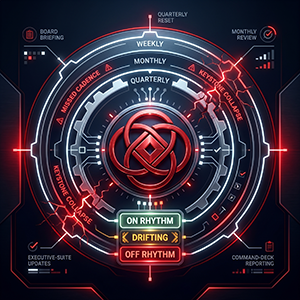
The membership that runs your Executive Suite on a rhythm. You own the five systems; this is the standing cadence that convenes them — a weekly board briefing, a monthly executive review, and a quarterly strategic reset — on a Command Deck that counts from the last time you actually ran each one. The keystone is the weekly board briefing: miss it once and you're DRIFTING, miss two full cycles and the rhythm has broken to OFF RHYTHM, no matter how current the monthly and quarterly are. Includes all five Executive Suite systems, the operating kit (engine, workbook, four Claude Skills, template, and two playbooks), and updates while subscribed. It schedules and reports; you run the company. Not financial, legal, or investment advice.
SALES
Pricing Page Performance Pack
$49
Diagnostic + 40+ patterns + AI rewriter + tier worksheet. New pricing page by 5pm.
SALES
The Founder's Positioning Forge
$59
Publication-ready positioning in a guided 90-minute sprint. Four outputs you ship Monday.
SALES
Investor-Ready Metrics Pack
$89
Diligence-grade SaaS metrics kit for founders raising in 2026. Burn Multiple, Rule of 40, LTV done right, AI gross margin defense. Sourced 2026 benchmarks.
SALES
Deal Momentum Tripwire
$89
A deterministic, offline grader that reads each open deal as a physical system — momentum, friction, decay — and scores it 0–100 on five weighted signals from your own numbers (stakeholder coverage, response-latency trend, stage age vs. your own median, days since last touch, activity direction), banded ACCELERATING / STALLING / DEAD WEIGHT. Its spine is a dispositive worsen-only ghost-deal gate: a deal that is single-threaded AND has outlived its stage (age past 1.5× your median) is floored to DEAD WEIGHT no matter how many points it scored, releasing the moment either clears — a 57 in the STALLING band reads DEAD WEIGHT while its two-threaded twin releases. Every verdict ends with the single cheapest move that changes it, and the pipeline rolls up worst-first. Runnable Python engine + workbook + Deal Momentum Playbook + Momentum Recovery Runbook + a seven-deal sample. Gong and Clari show what is happening; this prescribes what to do — no forecast, no probability, no black box. Grades a deal's momentum, never a person.
RETAIN
Customer Onboarding Sequence Kit
$69
Six sequence types anchored to your real activation milestone — welcome, activation, adoption, stall-recovery, expansion, milestones. Activation-first, helpful, never oversells your product.
RETAIN
Customer Churn Autopsy Kit
$69
Exit interview + classifier + retention analyzer + 5 win-back sequences by churn reason. 48 hours to clarity.
RETAIN
Chargeback Threshold & MID-Survival Gate
$89
Visa cut the merchant Excessive VAMP ratio from 2.2% to 1.5% on April 1, 2026 — comfortable in March, in violation in April on the same volume. This gate computes your Visa VAMP and Mastercard ECP ratios from your own numbers against the thresholds you confirm and reads each merchant account HEADROOM / APPROACHING / OVER THE LINE (worst network wins, Visa's 1,500-event monitoring floor respected). Prevention is scored separately — six weighted controls roll up HARDENED / SOFT / EXPOSED and name the fix-first move where a control is short, but never average into the verdict, because winning a representment does not remove a counted chargeback. The shipped sample proves it: prevention 100 / HARDENED, ratio OVER THE LINE. Thresholds are buyer-confirmed editable cells so it stays right when the line moves again. Zero-dependency Python engine + workbook + ratio-math SOP + monthly-run runbook + a 3-MID sample. Grades an account's numbers, never a person; reads no live processor data, files and sends nothing. Not legal or payment-compliance advice.
RETAIN
AI Support Deflection Kit
$89
Deflect the repetitive tickets, escalate the rest, always offer a person. An honest escalation rule + a deflection playbook, AI-ready knowledge-base templates, a deflection & CSAT tracker, and a prompt pack. No-code, no bot that traps customers, no guaranteed rate.
OPS
AI Document Extraction Kit
$99
Turn invoices, receipts, and forms into structured data with AI that flags low-confidence fields for review instead of guessing. A runnable extractor (zero deps, runs keyless in demo, exits non-zero on review), editable JSON schemas, a QA tracker, and a playbook. Flag, don't guess — no accuracy guarantee.
OPS
Document Field Validator
$79
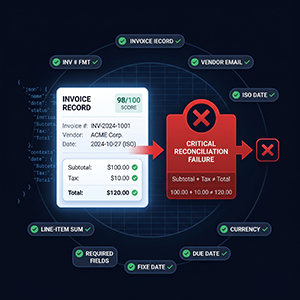
The deterministic layer that judges extracted or keyed document fields against fixed rules — format, range, required, allowed-value, and cross-field math (subtotal + tax = total) — and returns PASS / REVIEW / REJECT per record. A runnable Python engine + a workbook reproduce the same rules, with a hard-fail gate that rejects any record with a critical failure (a missing total, a math error) however high it scores — a record can't be 90% valid. Type-agnostic: swap the rule pack for POs, applications, claims, intake forms. The validation step the AI Document Extraction Kit hands off to. Validates your own documents, not people. Not legal advice.
OPS
PII Redaction Readiness Kit
$89
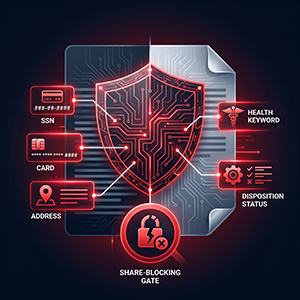
The deterministic pre-share safety gate for documents. A pattern pack of fixed detectors scans a document's text for PII across three sensitivity tiers — SSNs, cards, bank routing, health markers, dates of birth, addresses, emails, phones, IPs — and returns CLEAR / REDACT FIRST / DO NOT SHARE per document, with a library rollup. An exposure gate blocks any document with an unhandled high-sensitivity finding however high its coverage — one open SSN is dispositive. It flags what to redact and what's still exposed; it does NOT redact, is not a certified tool, and does not score or rank people. Tunable patterns and tiers. Validates your own documents; not legal advice. You remain responsible for what you share.
OPS
Invoice-PO-Receipt 3-Way Match
$79
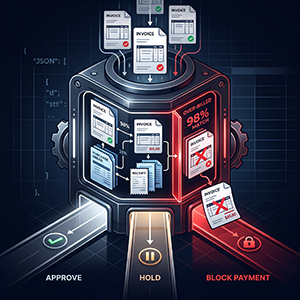
The deterministic AP money-gate: match every invoice line against the purchase order (what you authorized) and the goods receipt (what you received), run seven fixed checks, and return APPROVE / HOLD / BLOCK PAYMENT per invoice, with an AP-run rollup. A payment-block gate stops any line that bills more than was received, references no PO, has no receipt, or is overcharged — regardless of the match score; one over-bill is dispositive. Four editable tolerances separate a real exposure from rounding. It gates the pay decision; it moves no money, doesn't score people, and is not accounting advice. The general-AP three-way match — not a manufacturing receiving check, not a month-end close. Runnable engine + workbook. Not legal advice.
OPS
Document Classify & Route Kit
$69
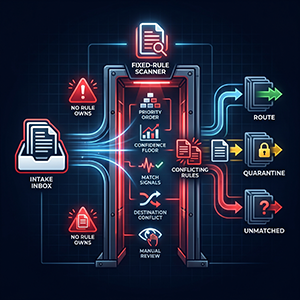
The deterministic front door for document intake: a priority-ordered routing rule pack matches each incoming document on fixed signals (filename, keyword, sender, amount, date), assigns a type + destination first-match-wins, and returns ROUTE / QUARANTINE / UNMATCHED, with a batch rollup. An ambiguity gate quarantines any document two rules send to two different destinations — regardless of priority — so a signed contract is never silently first-match-won into AP. A confidence floor quarantines a too-weak single match. QUARANTINE (conflict) is distinct from UNMATCHED (no rule). No model, no probabilities — rules you control. It decides the destination; it moves nothing and doesn't score people. Runnable engine + workbook. Not legal advice.
OPS
Allowance & Contingency Discipline Gate
$79
The deterministic "is that a price or a placeholder?" gate over the allowances and contingencies carried in a bid. Six signals per carried line (scope written down, basis for the number stated, exclusions named, disclosed in the bid, owner named, conversion date set) read DEFINED / SOFT / PLACEHOLDER — and the roll-up is the share of allowance DOLLARS reading DEFINED, never the share of lines. That is the whole instrument: five tidy $2,000 allowances beside one $180,000 placeholder is 83% clean by count and about 19% by value, and it is the value you carry into the job. It is the only roll-up in the construction lane that weighs rather than counts. A worsen-only definition gate forces PLACEHOLDER MONEY two ways: any line with no written scope at all (nobody can convert a number when nothing says what it buys), or — reading the whole book against the bid rather than any row — an allowance book at or above 15% of the bid with under half its value defined. Without a bid total that second trigger reports NOT EVALUABLE rather than clear, because a gate that reads clear having read nothing is worse than no gate. Runnable Python engine + live-formula workbook, verified in lockstep across 2,918 parity cases. It reads no estimate, sets no price, never says whether the value you carried is enough, and takes no view on whether an allowance clause would hold. Not legal advice.
SALES
Bid-Result Debrief Gate
$79
You lose most of the bids you write, and on public work the reason is published in a bid tab almost nobody reads. This grades whether you ever found out where your number sat. Six signals per closed bid (result obtained, position known, gap attributed to scope / rates / markup rather than "they were cheaper", checked against your pattern, pursuit rule touched, debrief retained) read DEBRIEFED / PARTIAL / UNEXAMINED, and the practice verdict is the share that reached DEBRIEFED. A worsen-only near-miss gate forces BIDDING BLIND two ways: any CLOSE bid nobody debriefed — the only RedHub gate that selects its subset by a continuous field, because losing by 22% teaches you almost nothing and losing by 0.8% says your number was right and something else decided it — or, reading the whole register, nothing that ever changed what you chase. A loss with no recorded margin counts as CLOSE, which closes the escape hatch: you cannot call a loss a blowout you never looked at. Wide wins are reported and never gated. Runnable Python engine + live-formula workbook, verified in lockstep across 6,564 parity cases. It fetches no bid tab, reads no CRM, and never says whether your win rate is good or what your number should have been.
OPS
Unit-Cost Basis Freshness Gate
$69
The deterministic "what is that rate actually based on?" gate over the unit costs you price with. NOT an age check: a firm that raises every rate 4% each January has a basis that is dated today and founded on nothing, and every age column reads fresh. EVERY TRADE SETS ITS OWN CLOCK — it declares itself stable, moving or volatile, which sets a freshness horizon of 24, 12 or 6 months, and that per-row threshold is the only one of its kind in the catalog. In the worked example a rate 19 months old reads CURRENT and one 17 months old reads STALE. Six signals per trade (source of the rate named, evidence retrievable, market-tested rather than escalated, escalation declared, what the rate includes stated, owner named) read CURRENT / AGING / STALE, and the verdict is the share of priced EXPOSURE on a current basis. A worsen-only freshness gate forces PRICING ON MEMORY two ways: any trade past twice its own horizon, or — the escalation trap — any trade INSIDE its horizon that has never been market-tested, which fires precisely where the first trigger cannot and closes its escape route. A blank date caps the trade at AGING and fires nothing, because not knowing is a different failure from demonstrable rot. Runnable Python engine + live-formula workbook verified in lockstep across 21,871 cases. It holds no cost data, reaches no index, and never says what a rate should be or where a price is heading.
OPS
Estimate-to-Actual Feedback Gate
$99
The deterministic “did the job teach anyone anything?” gate. NOT a drift measurement — in construction the variance figure is usually unavailable rather than bad, because every project is a one-off and nobody went back to look. Six signals per closed job (closeout complete, cost codes map to the estimate, variance causes named, estimator saw the result, basis updated, comparison retrievable) read FED BACK / PARTIAL / LOST, and the practice verdict is the SHARE that fed back — not the worst job, because a loop is a property of a practice and one sloppy closeout does not break it. A worsen-only feedback gate forces LOOP OPEN two ways: any job whose cost codes do not map to its estimate (the comparison is not possible, not merely undone), or — reading the whole register rather than any row — no job that ever changed the estimating basis. In the worked 8-job example 71% of jobs fed back and the verdict is still LOOP OPEN. Runnable Python engine + live-formula workbook, verified in lockstep across 6,187 cases. It reads no accounting system, computes no variance or unit cost, and never says what anything should have cost.
OPS
Scope-Gap & Division Coverage Gate
$99
The deterministic “who is actually carrying this?” gate for a bid. Every division lands in exactly one of six states — OWNED / EXCLUDED / THIN / ASSUMED / UNCOVERED / OUT OF SCOPE — because a division is not 73% covered: either somebody carries it, or it is excluded in writing, or it is a gap. ASSUMED catches two failures that cost the same thing: a name penciled in with no bid behind it, and a division your own proposal excludes while a subcontractor is assigned to it. A worsen-only coverage gate forces UNCOVERED SCOPE whenever anything reads UNCOVERED or ASSUMED, whatever the coverage percentage says — 95% coverage with one uncovered division is not 95% safe. Fix-first follows dollars, not row order. In the worked 20-division example coverage reads 83% and $658,000 sits on two divisions. Runnable Python engine + live-formula workbook, verified in lockstep across 4,288 cases. It reads no bid, no drawing and no contract, prices nothing, allocates no risk, and is not legal advice.
OPS
Drawing-Set Takeoff Readiness Gate
$99
The deterministic “can a machine read this set?” gate for construction drawings. Mark six properties on every sheet (scale declaration, revision currency, addenda incorporation, legend resolvability, text legibility, sheet completeness) and six on the set as a whole, and the headline is the worse of the set read and the WORST SINGLE SHEET — never the average, because a takeoff is only as good as the weakest drawing it reads. A worsen-only measurability gate forces NOT MEASURABLE regardless of both scores when any measured sheet has no declared scale, or when the set has neither a controlled source nor a revision log. In the worked 14-sheet example the set controls score 92 and eleven sheets read READABLE, and the verdict is still NOT MEASURABLE because one elevation sheet has no scale. Runnable Python engine + live-formula workbook, verified in lockstep across 7,645 cases. It never opens your drawings, produces no quantity or cost, and is not affiliated with any takeoff vendor.
OPS
Document Intake Completeness Checker
$69
The deterministic “do we have everything to start?” gate. Define a requirements checklist for an intake type (new-client packet, loan file, vendor onboarding, patient packet) with required/optional + blocker flags and an acceptance rule (present / non-expired / matches-format). Each case gets a per-item status (OK / MISSING / EXPIRED / INVALID) and a verdict — COMPLETE / CHASE / HOLD INTAKE — with a blocker gate that holds a case missing a non-negotiable (a signed agreement, a consent, a valid ID) regardless of the completeness percent; 83% with an expired ID is still HOLD INTAKE. CHASE = required paperwork outstanding but blockers OK (safe to start prep). Offline workbook + runnable engine; reads a packet you enter, not your systems. Doesn't score or rank people. Not legal advice.
OPS
Template Merge & Mail-Merge Engine
$69
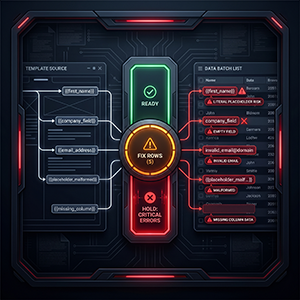
The pre-send check for a mail-merge. Point it at a template and a data list; it returns READY / FIX / BLOCK per row and MERGE READY / FIX ROWS / HOLD per template, with a structural-dominant gate — an unmapped placeholder or a malformed token forces HOLD no matter how many rows are clean, because it breaks every row identically. Each row is graded on its own fields (a missing required value is BLOCK, a malformed email is FIX); nothing is ever filled or guessed. Catches the literal {{first_name}} before it sends. Runnable Python engine + a workbook that reproduces it + two playbooks + a worked sample. It's the check, not the sender — your ESP/Word/GHL still sends. Offline, deterministic. Not legal, compliance, or deliverability advice.
OPS
Document Processing Pipeline Diagnostic
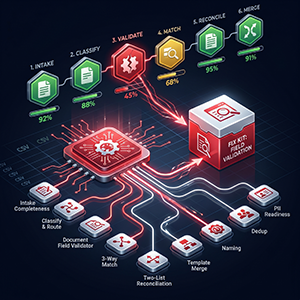
$79
The front door to the document-ops line: run it first to learn which fix to buy. Score your workflow across six stages — intake, classify, extract, reconcile, merge, govern — from your own 0–5 marks; it takes the worst stage as the headline (MIN-as-headline — a pipeline is only as automated as its weakest stage), returns AUTOMATED / MANUAL DRAG / STALLED, and routes the constraint stage to the exact RedHub drop that fixes it. A hard stall gate forces STALLED if any stage falls to 40 or below regardless of the rest; the mean is context only. Ties break to the earliest stage. Runnable Python engine + a workbook that reproduces it + two playbooks + a worked sample. Deterministic and offline — your inputs, no AI scoring, no lift multiplier. A gap analysis; you run the pipeline. Not legal or accounting advice.
LEARN
AI Fluency Diagnostic
$79
Score AI fluency across six skills — foundations, verification, prompting, workflow, safety, and role use — from your own 0–5 marks. The weakest skill is the headline (MIN, not the flattering average), and an essential gate holds anyone back to AWARE who can't verify a fact or handle data safely (Verification or Safety < 3/5) no matter how strong the rest. Tiers FLUENT / CAPABLE / AWARE, an overconfidence flag where self-rating outruns measured skill, and, where a skill is short, a per-person route to the exact training next — plus a team roll-up (weakest-learner tier + most-common gap). Runnable Python engine + a workbook that reproduces it + individual & team playbooks. For individual development and training planning — not a hiring, promotion, performance-review, or certification tool, and not legal advice.
LEARN
AI Literacy Evidence & Article 4 Readiness Kit
$99
Prove your AI-literacy program is defensible — role by role — before you spend on more training. Read your own tool inventory, role-to-system mapping, and training records; it scores coverage and proportionality per role (EVIDENCED / PARTIAL / UNEVIDENCED) on weighted levers, with a hard gate that flags any in-scope role whose staff operate an AI system with zero training record. The org verdict is the weakest in-scope role (MIN-as-headline — DEFENSIBLE / SHORTFALL / EVIDENCE GAPS PRESENT AS DESCRIBED), not a coverage average that masks the one untrained operating role; coverage % and mean are context only. Date-agnostic (it scores evidence, never a statutory deadline). Runnable Python engine + a workbook that reproduces it + two playbooks (evidence record + remediation runbook). The evidence gate that runs before the AI Literacy & Workforce Training Kit — prove it, then train. Produces the audit-ready evidence record; does not certify compliance and is not legal advice.
LEARN
Prompt Practice Lab
$69
Practice prompts like a skill — graded drills with spaced repetition. Each prompt you write is scored 0–5 on the six RCTFCV criteria (Role, Context, Task, Format, Constraints, Verification-ask) on weights summing to 100, banded STRONG / WORKABLE / WEAK — with one hard gate: if the Verification-ask is below floor (you never ask the model to check its own work), the drill caps at WORKABLE no matter how high the total. A great prompt that doesn't ask for verification can't be STRONG. Then a Leitner spaced-repetition schedule (boxes 1–5 → review in 1/2/4/8/16 sessions, no calendar dates) puts the weak drills back in front of you until they stick. Grades prompt craft, not the model's output; deterministic and offline. Runnable Python engine + a workbook that reproduces it + two playbooks (the RCTFCV rubric + a deliberate-practice guide). The skill-building companion to the AI Fluency Diagnostic. Not legal, medical, or professional advice.
LEARN
AI Over-Reliance & Critical-Thinking Check
$69
Test whether you catch errors in AI output instead of trusting it. Review a piece of AI text deliberately seeded with six planted problems — a confidently-stated fabricated statistic, plausible-but-false claims, and biased framing — and mark which you caught; it scores your weighted catch-rate and returns INDEPENDENT / ASSISTED / RELIANT, with a hard gate on the fabricated statistic (miss the fake number and you can't be INDEPENDENT, capped to ASSISTED) and an over-confidence flag where you were highly confident on an item you missed — the over-reliance signal. A team roll-up reports the weakest-learner tier and the most-common missed error type. Deterministic and offline — your own marks drive the score, no AI grades you. Runnable Python engine + a workbook that reproduces it. The deep dive on the verification skill the AI Fluency Diagnostic flags. For individual development and training only — not a hiring, promotion, performance-review, or ranking tool, and not legal advice.
LEARN
AI Adoption Curriculum Builder
$99
Backward-design an AI-adoption curriculum and grade whether it holds together. Map each target outcome to a role, a sequence step, an hours cost, and a Kirkpatrick measure, set a weekly time budget and rollout window, and the engine scores four weighted dimensions (role fit 25 · sequence & spacing 25 · outcome-measure coverage 30 · time-budget realism 20) into a 0–100 coherence score — COHERENT / LOOSE / FLAWED — and, where a dimension is short, names the one to fix first. A hard unmeasured-outcome gate fails any plan with a single outcome that has no measure, regardless of the total (the shipped sample scores 94 and is still FLAWED). Runnable Python engine + a workbook that reproduces it + two playbooks (backward design, rollout sequencing) + a worked sample. It grades the structure of a plan you enter — it does not score or rank people and is not for any employment decision. Educational; not legal, HR, or financial advice.
LEARN
Teach-It-Back AI Champion Kit
$79
A tracker for peer-led AI skill-sharing that tells you, honestly, whether the habit is taking root. Score each teach-back session on three dimensions — accuracy, transfer (peers can now do it unaided), and participation — capped by the weakest (MIN) into SOLID / PATCHY / HOLLOW, then roll the program up by density and recency to SELF-SUSTAINING / PROPPED-UP / DORMANT. A keystone gate forces DORMANT when the program is too new or the last two sessions both went HOLLOW (the shipped sample reads 0.6 solid-share but DORMANT — it has gone quiet), and an independence downgrade drops a one-teacher program to PROPPED-UP. Runnable Python engine + a workbook that reproduces it + a champion playbook + a repeatable 45-minute session kit + a worked program log. It grades a session's quality and a program's habit, not any individual teacher or learner, and not for any employment decision; not legal, HR, or compliance advice.
LEARN
Exec AI Briefing & Decision Course
$99
A 60-minute leadership AI-readiness diagnostic. Your leadership team scores its own organization across five weighted dimensions — strategy & business case (20), spend & ROI visibility (20), risk & regulatory exposure (25), team capability & adoption (20), competitive & market awareness (15) — for a weighted 0–100 total banded LEADING (≥75) / CATCHING UP (50–74) / BLINDSIDED (<50), and, where a dimension is short, the one to fix first. A hard critical-blindspot gate forces BLINDSIDED if either gate dimension (risk/regulatory or competitive awareness) is scored 0, no matter how high the total — the shipped sample scores 53 and is still BLINDSIDED on a single zero. Runnable Python engine + a workbook that reproduces it + a facilitator playbook (the 60-minute briefing) + a five-lesson decision course + a worked read. It grades a leadership team's preparedness, not any individual, and not for any employment decision; not legal, financial, investment, or compliance advice — confirm exposure with counsel.
LEARN
AI Security & Safe-Use Drills
$79
Run six AI safe-use drills past your team and find out if they catch the everyday mistakes — pasting client PII into a public tool, leaking a secret or credential, shadow AI, a hallucinated fact, prompt injection from pasted content, an over-permissioned connector. Mark recognition and correct action 0–5 per drill; the weaker mark caps the drill (you can't respond to a threat you never spotted) into a SAFE / RISKY / UNSAFE verdict, and the team band is your single weakest drill — DRILLED / UNEVEN / RAW — never the flattering average. A hard regulated-data gate forces the whole team to RAW if any regulated drill lands UNSAFE (the shipped sample averages 73 and is still RAW on one missed drill). Runnable Python scorer + a workbook that reproduces it + two playbooks (running the drills, the six failure modes) + a worked sample. It scores the drills, not people — not a score of individuals, not monitoring, not a security audit. Educational; not legal advice.
OPS
Finance & Reporting Automation Kit
$129
Faster monthly reporting built around a workbook that checks its own math — enter the figures and every tie-out is labeled Ties out, Review, or Does not reconcile, with one close status. Self-checking reconciliation workbook, close SOP, finance prompts. You keep the numbers; not accounting advice.
RETAIN
Meeting Intelligence System
$49
One master prompt + five focused prompts that turn any meeting transcript into summary, decisions, action items, follow-up emails, and a standup-ready roll-up. Honest by design.
RETAIN
Brand Voice Engine
$59
Codify your voice into rules a machine can check. Voice Extractor + 8-section Voice Spec + On-Brand Writer + 100-point QA Checker + Voice Transfer. Worked example: 22 -> 92.
REACH
Brand-Voice Content Multiplier & Drift Guard
$99
Lock your brand voice once, from your real writing. Four Claude Skills draft multi-channel content from a single anchor, and a deterministic drift guard scores every draft ON-VOICE / DRIFTING / OFF-BRAND by its weakest dimension — with an anti-slop gate that catches machine-wash the dimensions miss. Grades a draft, not a person; not an AI detector.
REACH
Brand-Voice Email & Newsletter Engine
$69
Send email that sounds like you, lands in the inbox, and earns the click — honestly. The VOICE standard, voice-locked templates and welcome/re-engagement sequences, humanize prompts, a deliverability QA workbook (SPF/DKIM/DMARC), and a runnable send-readiness linter. No inbox-placement guarantee.
Grade every sending domain against the post-2024 Google/Yahoo/Microsoft bulk-sender rules — SPF, DKIM, DMARC policy, From-alignment, RFC 8058 one-click unsubscribe, spam-complaint headroom — and get one verdict each: ENFORCING / AT RISK / FAILING, with an account rollup. A structural gate fails any bulk sender (>5,000/day) with a hard authentication blocker (no DMARC, or no alignment), because that mail is being rejected at the SMTP level right now — no matter how high the score. Names one fix-first per domain where a control is short. Runnable Python engine + workbook + two playbooks + a 7-domain sample. The domain layer; sibling to the Brand-Voice Email Engine (message layer). No inbox-placement guarantee; not legal advice.
REACH
AI Reputation & Reviews Engine
$99
Earn more real reviews, respond on-brand, and stay on the right side of the FTC Consumer Review Rule. The five moves (Ask / Respond / Resolve / Showcase / Track), GHL-ready templates, a self-checking workbook, and a runnable compliance linter (Compliant / Fix / Prohibited). Guidance, not legal advice.
REACH
Paid Ads Creative & Testing System
$89
Generate more winning ad creative, test it one variable at a time, and scale only what is statistically real. An angle/hook engine, a one-variable test matrix, a fatigue-aware CTR/CPA/ROAS tracker, and a two-proportion significance check. Scale signal, not luck.
REACH
Organic Social & Short-Form Video System
$79
Originate short-form video that gets watched: content pillars, a hook engine with a Ship/Tighten/Rework scorer, tight script templates, Kling B-roll prompts, and a cadence you can keep. The creation layer, not just repurposing.
GOVERN
NIST AI RMF Readiness Kit
$149
Stand up AI governance mapped to the NIST AI RMF (Govern/Map/Measure/Manage): a readiness assessment, AI use-case register, maturity scorecard, model cards, and a vendor-questionnaire answer bank, crosswalked to ISO 42001 and the EU AI Act. A tool that won’t bless a high-impact, no-oversight use case. Governance guidance, not legal advice.
GOVERN
ISO 42001 AIMS Readiness & Gap Diagnostic
$249
Score your AI Management System across the six ISO 42001 clause-groups and find the one blocking certification — the weakest mandatory control decides, never the average. Returns CERTIFIABLE / GAPS TO CLOSE / NOT READY with a mandatory-clause gate and, where a clause-group is short, the exact fixer to buy next. A readiness diagnostic, not an ISO 42001 certification or audit; not legal advice.
GOVERN
AI Risk Register & Treatment-Tracking System
$99
A living AI risk register that grades its own defensibility. Mark six governance fields per risk (likelihood, impact, treatment, owner, residual, review) and get GOVERNED / GAP / UNGOVERNED per entry and DEFENSIBLE / GAPS TO CLOSE / EVIDENCE GAPS PRESENT AS DESCRIBED for the register, with a dispositive accepted-high-residual gate that catches the severe risk nobody owns. A working aid, not a risk assessment or legal advice.
GOVERN
AI Impact Assessment Builder
$99
Build and grade one AI system's impact assessment — rated on its worst unmitigated impact, never an average. Score each impact on severity, likelihood, reversibility, and affected-population scale; mitigation reduces it to a residual; MITIGATED / RESIDUAL / UNACCEPTABLE per impact, DEFENDED / GAPS REMAIN / EVIDENCE GAPS PRESENT AS DESCRIBED overall, with an irreversible-harm-to-vulnerable-group gate. EU AI Act Art. 27 / ISO 42001 Annex A. A working aid, not legal advice.
GOVERN
Model & System Card Builder
$69
Build and grade a model or system card so it informs the reader instead of over-claiming. Mark seven disclosure sections 0-2 for a completeness score, plus a dispositive claim-vs-evidence gate — a card that makes a performance or fairness claim it can't back is forced NOT PUBLISHABLE no matter how complete it looks. DISCLOSED / THIN / MISSING per section, PUBLISHABLE / DRAFT / NOT PUBLISHABLE overall. Model-card norms + EU AI Act Art. 13.
A machine decided about a person — a credit denial, an insurance tier, a tenant score, a benefits cut. Could you show you told them, explained it, and gave them a way to be heard? Grade each automated decision system on six weighted controls (disclosure, meaningful-logic explanation, human appeal, opt-out/correction, scope mapping, recordkeeping) for a 0-100 score and DISCLOSED / GAPS / MATERIAL TRANSPARENCY GAPS, with a disclosure gate that forces UNDISCLOSED when the person was never told it was automated — even at 74/100 — and a recourse flag for a system with no appeal and no opt-out. Date-agnostic (a composite set of controls drawn from several regimes, not one statute's dates) and people-blind — it grades a decision system, never a person. Runnable engine + workbook + Disclosure Mapping & Transparency-Remediation playbooks + a 6-system sample. The everywhere-else sibling to the AEDT Deployer Dossier. Not legal advice.
GOVERN
AI Notetaker Compliance Tripwire
$79
Seventy percent of RIAs run an AI meeting notetaker and regulators treat an ungoverned one like an unauthorized texting app. This tripwire grades each tool/deployment on six weighted controls — client consent before capture and human review before notes enter the record are gate controls — for a 0-100 score and DEFENSIBLE / SHORTFALL / EVIDENCE GAP per tool, with a worsen-only gate: either gate control at zero forces EVIDENCE GAP no matter the score. The firm rolls up to its worst tool (ALL DEFENSIBLE AS DESCRIBED / GAPS TO CLOSE / STOP AND FIX). Runnable Python engine + workbook + audit & remediation playbooks + a 5-tool sample. Grades the process, never a person; renders no legal ruling and takes no position on whether AI summaries are books-and-records. Not legal advice.
GOVERN
Marketing-Rule Testimonial & Promoter Audit
$79
Grade every testimonial, endorsement, and paid promoter under SEC Marketing Rule 206(4)-1. Mark each arrangement on six weighted controls — required disclosures clear & prominent (gate) and a written promoter agreement (gate only for a compensated, over-de-minimis, non-affiliate promoter) plus compensation/conflicts disclosed, bad-actor screen, claims substantiated/net shown, and ad-copy recordkeeping — for a 0-100 score and COMPLIANT / SHORTFALL / EVIDENCE GAP per arrangement. A conditional worsen-only gate fires exactly where the rule requires it, so an identically-marked de-minimis twin stays COMPLIANT while the compensated one fails. Campaign rolls up to its worst arrangement (ALL DOCUMENTED AS DESCRIBED / GAPS TO FIX / PULL OR FIX). Runnable Python engine + workbook + audit & remediation playbooks + a 6-arrangement sample. Grades the arrangement, never a person; renders no legal ruling and confirms no compliance status. Not legal advice.
GOVERN
Advisory-Firm AI Exam Defensibility Audit
$99
Would your RIA’s AI use survive an SEC or state exam? A deterministic self-assessment across the six exam-surface domains an examiner probes when a firm uses AI — AI in marketing (20, gate), books & records for AI outputs (20, gate), supervision & written policies (18, gate), vendor AI oversight (16), client disclosure & Form ADV (14), AI communications capture (12) — marked 0/1/2 on your own evidence for a 0-100 score banded EXAM-READY / OPEN FINDINGS / EVIDENCE GAP. A dispositive domain evidence gate forces EVIDENCE GAP when any of the three gate domains is zero — so a firm can score 73 and still be EVIDENCE GAP with books-and-records at zero. Portfolio rolls up to the worst branch (ALL EXAM-READY AS DESCRIBED / FINDINGS TO CLOSE / DEFICIENCY LIKELY) with the domain to fix first where a domain is short. Date-agnostic and people-blind. Runnable Python engine + workbook + assessment & remediation playbooks + a 5-firm sample. Grades a firm’s evidence file, renders no legal ruling, scores no person. Not legal advice.
GOVERN
AI Incident Reporting & Regulatory-Notification Drill
$79
An AI incident can start a regulatory clock you can't see, and different regimes use different triggers. Rehearse your response before it's real: drill each incident scenario on six weighted controls (detection-to-awareness, regime, trigger & severity triage, a named, authorized decision-maker for trigger assessment and escalation, regulator contact map, notification drafting & incident record, cross-track coordination) for a 0-100 score and NOTIFIABLE-READY AS DESCRIBED / TIGHTEN / WOULD MISS THE CLOCK, with a dispositive trigger-assessment gate that forces WOULD MISS THE CLOCK when you couldn't recognize and assess a potential trigger in time or no one is authorized to assess potential trigger points and escalate — even at 82/100. Date-agnostic: it grades the process, never a deadline, so it survives every regime change. Runnable engine + workbook + Drill Facilitator & Notification-Readiness playbooks + a 6-scenario sample. The notification-side companion to the AI Incident Postmortem & Readiness Gate. Grades a process, never people. Not legal advice.
INBOUND
AI Chat & SMS Concierge (GHL)
$99
A text concierge for GoHighLevel that captures, qualifies, books, and hands off without inventing a policy. The Concierge Flow, qualification and booking scripts, grounded-answer rules, GHL workflow recipes, and a flow linter (Pass / Fix / Block). Discloses it is an AI; not legal advice.
GOVERN
AI Agent & Connector Access Auditor
$99
Audit what your AI agents, MCP servers, and OAuth connectors can actually touch. Scores each connector's access risk — least-privilege, over-scoped, or ungoverned — and rolls the fleet up to GOVERNED / DRIFTING / EXPOSED, with a dispositive gate for an unowned connector that can write regulated data. Deterministic, offline, scores connectors not people.
GOVERN
AI Deliverable Claim & Citation Defensibility Gate
$79
Grade a finished AI-assisted deliverable — memo, report, proposal, case study — claim by claim before it ships. Mark five 0/1/2 signals per claim (citation present, reachable, source actually supports the claim, fabrication-free, internally consistent) weighted to 100, flag which claims are material, and get per-claim SUPPORTED / CHECK / UNSUPPORTED plus a deliverable verdict: DEFENSIBLE / VERIFY FIRST / DO NOT SHIP, with a batch rollup. A keystone gate forces DO NOT SHIP whenever one material claim rests on an unreachable or fabricated citation — so a deliverable can score 89/100 and still be held, because the failure is local and a high average hides it. Names the one claim to fix first where a claim is short. Runnable Python engine + workbook + claim-review & fix-the-citation playbooks + a 9-claim sample. The substance layer beside the Audit-Trail Kit (provenance) and Anti-Slop System (voice). A review aid that grades claims, never people; not an automatic fact-checker; not legal advice.
GOVERN
Internal AI Handoff QA Gate
$79
Before you pass an AI-assisted memo, analysis, or summary to a colleague, gate it. Mark six 0/1/2 signals (sources reachable, figures traced, task advanced, owner edits, claims scoped, next action clear); the verdict is the weakest signal — HAND OFF / REWORK / DO NOT HAND OFF — with a dispositive worsen-only gate that forces DO NOT HAND OFF when a source is unreachable or a figure is untraced, even where the weakest signal alone would only read REWORK. The internal, peer-to-peer lane where 'workslop' spreads. Runnable Python engine + workbook that reproduces it + reviewer & fix-it playbooks + a 6-deliverable sample. Scores the deliverable, never the person; not for hiring or performance decisions; not legal advice.
GOVERN
Customer-Facing AI Output Risk Triage
$79
Triage every customer-facing AI surface — support bot, chat widget, AI product-page copy, FAQ generator — on liability exposure before the next answer goes out. Mark six 0/1/2 control signals per surface (regulated-claim control, policy-invention control, human exit ramp, performance-claim control, source grounding, scope & disclosure) weighted to 100 and get per-surface LOW / REVIEW / HIGH RISK, a set posture, and, where a surface is short, the highest-risk one to fix first. A keystone gate forces HIGH RISK whenever a surface can state policy with no grounding AND offers no human escalation — the pattern behind the support-bot liability cases — so a surface with four of six controls green can still gate (the sample scores 58/100 and does). Close either gap and the gate releases. Runnable Python engine + workbook + surface-inventory & control-hardening playbooks + a 4-surface sample. Every HIGH RISK routes to human review, never a clearance. A risk-triage aid that grades the surface's controls, never people; not a live test of your systems; not legal advice.
REACH
Agentic-Commerce Product-Feed Readiness Gate
$79
Find out whether an AI shopping agent can machine-read, trust, and act on your product feed — before it skips you for a competitor with cleaner data. Scores each item on seven durable, protocol-agnostic signals and returns AGENT-READY / GAPS / UNREADABLE via the weakest signal, with two agent-distrust gates (a feed-vs-page contradiction, a missing identifier) that each force UNREADABLE, a catalog rollup with an exposure rate, and, where a signal is short, the fault to fix first. Grades durable feed readiness, not today's checkout protocol. Runnable engine + workbook + playbooks. Deterministic, offline, grades the feed not people.
REACH
AI Overview Traffic-Loss Diagnostic
$79
The front-door diagnostic for the AI-visibility line. From your own Search Console numbers, grade each page on six signals for whether Google's AI Overviews are quietly evaporating its clicks even as impressions hold, return DECOUPLING / EVAPORATING per page with a site verdict, and, where a page is short, route it to the exact fix to buy next. Runnable engine + workbook + playbooks. Diagnosis only — connects to nothing, scores no people.
SALES
Checkout Friction & Abandonment Exposure Gate
$79
The checkout-stage grader below the page-level conversion tools. Score a cart/checkout flow on seven friction signals (total-cost transparency, guest checkout, length, trust, payment options, mobile, delivery clarity), each marked 0-2, and get SMOOTH / LEAKING / HEMORRHAGING per flow from the weakest signal, a gate on total cost and guest checkout, a portfolio rollup, and, where a signal is short, the fix to make first. Runnable engine + workbook + playbooks. Grades a flow you describe; no store connection, scores no people.
REACH
Google Business Profile Suspension-Risk Gate
$79
Grade a Google Business Profile on seven suspension-trigger signals (name compliance, NAP consistency, address type, category fit, review integrity, edit stability, duplicates) and return COMPLIANT / AT RISK / SUSPENSION-LIKELY via the weakest signal, with a top-trigger gate, a portfolio rollup, and, where a signal is short, the fix to make first — before a suspension takes you off the map. Runnable engine + workbook + playbooks. Not affiliated with Google; files no appeals, scores no people. Not legal advice.
GOVERN
AI Output Audit-Trail & Record-Keeping Kit
$79
Audit your record of AI usage — not the output itself — for whether each entry is defensible: who generated it, with what tool, when, for what decision, who reviewed it, and where the source is. Returns LOGGED / PARTIAL / NO TRAIL per entry and a TRACEABLE / GAPS / UNRECORDED org rollup, with a structural gate where one untraceable high-impact decision makes the whole org UNRECORDED. Runnable Python auditor + workbook. Record-keeping discipline, not legal advice.
OPS
CSV / Data-Export Schema & Quality Gate
$69
Grade whether an exported CSV is structurally fit to be processed before any row-level tool touches it. Per-column CLEAN / DIRTY / MISSING plus one file verdict — READY / FIX / BLOCK — with a hard structural gate: a ragged row, mangled header, or missing required column blocks the file no matter how clean the cells that parsed look (the sample is all-CLEAN, quality 100, and still BLOCKs). Runnable Python engine + workbook. The upstream gate for the whole Document Processing line; grades the file, not people.
OPS
Multi-Source Data Reconciliation Engine
$89
Reconcile 3+ sources on one key — a bank export, a processor export, and your ledger; or three feeds that must agree. Classifies every key AGREED / DISPUTED / INCOMPLETE (separating a value conflict from a coverage gap, which a two-list tool can't) and rolls up to RECONCILED / FIX / NOT RECONCILED, with a one-disagreement gate: a single disputed key blocks the reconciled verdict however many keys agree. Runnable Python engine + workbook. Deterministic, offline; reconciles data values, not people.
OPS
PII Detection for Structured Data
$79
A column-aware PII readiness check for CSV / CRM exports. Classifies each column by the PII it holds and whether it's handled to the minimum its class requires — HANDLED / MASK FIRST / EXPOSED per column, SAFE TO USE AS DESCRIBED / REMEDIATE / HOLD for the dataset — with a regulated-exposed gate: one open regulated column (an SSN with no handling) holds the whole dataset, 83% handled notwithstanding. Column-grain, not a cell-by-cell text scan. Runnable Python engine + workbook. Deterministic, offline; flags columns, not people. Not legal advice.
OPS
Spreadsheet Formula & Model Integrity Auditor
$69
Audit a spreadsheet's formula layer — not its numbers — for the faults that silently corrupt a model: error cells, broken links, hardcoded magic numbers, copy-paste inconsistencies, and volatile dependencies. Reads a real .xlsx and returns SOUND / REVIEW / BROKEN per formula cell and a model gate where one error cell breaks the whole model — the shipped sample scores 89 and is still BROKEN because one cell carries a #REF!. Runnable Python auditor + workbook. Deterministic, offline; audits formulas, not people. A clean total is not a sound model.
GOVERN
AI Vendor & Sub-Processor Data-Flow Register
$89
Register every vendor, AI tool, and sub-processor that touches your data and grade whether each flow is governed — DOCUMENTED / GAP / UNVETTED per flow, REGISTER COMPLETE AS DESCRIBED / GAPS TO CLOSE / EVIDENCE GAPS PRESENT AS DESCRIBED per register. The required controls adapt to what the flow carries (a regulated cross-border flow needs a DPA, retention, sub-processors, and a transfer mechanism), and one ungoverned regulated flow (a shadow LLM API seeing PII with no DPA) holds the whole register at EVIDENCE GAPS PRESENT AS DESCRIBED — 67% documented notwithstanding. The records GDPR Art. 28/30 contemplate. Runnable Python engine + workbook. A working aid, not legal advice.
DEV
MCP Server & Connector Builder Kit
$99
Build MCP servers useful to agents and safe by default: a grounded four-phase workflow, tool-design + security patterns, an inventory + checklist workbook, and a Pass/Fix/Block tool linter (a leaked secret, over-broad scope, or dangerous capability is a hard Block). Security guidance, not a security audit.
RETAIN
Customer Referral & Advocacy Engine
$79
Turn happy customers into a predictable, lowest-CAC referral channel, compliantly. The advocacy loop, a referral-economics model (referral CAC, net value, viral coefficient), reward + disclosure templates, and GHL wiring. Rewards honest referrals, never positive reviews. Not legal advice.
RETAIN
Referral System Health Scorecard
$79
Is your advisory firm’s referral engine systematic or running on luck? A deterministic diagnostic — the grade-it companion to the build-it Advocacy Engine. Mark six dimensions 0/1/2 on evidence — ask cadence & triggers (18, growth), centers-of-influence pipeline (20, growth), advocacy identification (16), tracking & attribution (14), compliance & disclosure (20, gate), reciprocity & nurture loop (12) — for a 0-100 score banded SYSTEMATIC / LEAKY / AD HOC. Two worsen-only overrides catch what a score hides: a compliance-zero gate (a compensated arrangement without agreement or disclosure evidence forces AD HOC) and a no-engine floor (no ask AND no COI pipeline forces AD HOC). Portfolio rolls up to the worst firm (ALL SYSTEMATIC AS DESCRIBED / GAPS TO CLOSE / RUNNING ON LUCK) with the fix-first dimension where a dimension is short. Runnable Python engine + workbook + assessment & build-up playbooks + a 5-firm sample. Grades a referral system, never people, and rules on no specific arrangement. Marketing-Rule-aware, not legal advice.
RETAIN
Expansion & Upsell / NRR System
$89
Grow net revenue retention by expanding the customers who are succeeding: a health-gated expansion engine, an NRR/GRR calculator with a band verdict, expansion plays, value-first scripts, and no-dark-patterns guardrails. At-risk accounts get a save first. Not legal advice.
INBOUND
No-Show Reduction & Reactivation Kit (GHL)
$69
Cut appointment no-shows and win back dormant customers on GoHighLevel, without spam: a short reminder cadence, same-day recovery, a 3-touch win-back, a recovery calculator, and SMS-compliance guardrails (consent, opt-out, quiet hours). Not legal advice.
INBOUND
Speed-to-Lead Routing Kit
$69
Audit your lead-routing setup on the six rules that decide speed — instant acknowledgment, assignment/ownership, escalation if unclaimed, after-hours coverage, SLA defined & measured, and speed-respects-consent. A runnable Python linter + a workbook score it 0–100 → PASS / FIX / BLOCK, with four hard gates that force BLOCK regardless of score: no after-hours path, an unowned inbox, a channel that routes nowhere, or a first-touch that fires without consent. GoHighLevel build recipes included. The routing layer, not the conversation; your marks, no baked-in benchmark. Not legal advice.
REACH
Founder / Exec LinkedIn Authority System
$79
Build genuine LinkedIn authority in your real voice, without slop or engagement games: a POV worksheet, content pillars, post frameworks, honest hook patterns, an engagement playbook (no pods or bots), and a post checker that refuses to Ship engagement-bait.
OPS
AI Agent Go-Live Readiness Gate
$79
Before you flip an AI agent live, score its guardrails. Five operational controls — approval gate, logging, rollback, bounded scope, escalation — one verdict: READY / FIX / DO NOT DEPLOY. A destructive action with no human approval is a hard stop, no matter how high the rest scores. Deterministic, offline, runnable.
OPS
AI Seat Right-Sizing & Waste-Rate Scorecard
$79
Stop paying for AI seats nobody uses. Score every license on one tool's roster across five weighted signals — KEEP / DOWNGRADE / RECLAIM per seat — with a dead-seat gate that forces RECLAIM on inactive, cold licenses no matter how they score, and a fleet waste rate that surfaces what the average hides. Deterministic, offline, runnable.
GOVERN
"Pass a 90-Day AI Audit?" Readiness Triage
$79
If an auditor asked for your AI governance evidence in 90 days, would you pass? Triage seven control domains to an AUDIT-READY AS DESCRIBED / PATCHABLE / WOULD NOT PASS verdict — with a no-owner gate that fails any in-scope control nobody owns, no matter how high the score. Names the one domain to fix first where anything is short. A readiness self-assessment, not legal advice.
AI makes a fabricated application read as cleanly as a true one. Triage how verifiable an application is — the document, not the person — across six signals into LOW-RISK / FLAG TO VERIFY / HIGH-RISK, with a keystone gate that flags any uncorroborable core claim no matter how polished the rest. Every verdict routes to verification, never to a reject. Not a hiring, screening, or ranking tool; not legal advice.
OPS
AI Incident Postmortem & Readiness Gate
$79
A thorough postmortem isn't a closed incident. Grade an AI-incident postmortem across six sections of a blameless writeup into CLEARED TO CLOSE AS DESCRIBED / FINISH ACTIONS / NOT CLOSEABLE, with an open-critical-action gate that refuses to close while a single critical fix is still open — no matter how complete the writeup. Grades the document and remediation state, not people. Deterministic, offline, runnable.
OPS
MCP Server & Skill Trust Gate
$79
Before you install a third-party MCP server or agent skill, grade whether it should be trusted at all. Mark six trust signals (publisher provenance, change history, declared-vs-actual scope, credential handling, approval behavior, sandbox containment) — the verdict is the weakest signal, TRUSTED / REVIEW / DO NOT INSTALL — with a supply-chain gate that forces DO NOT INSTALL whenever credential handling AND approval behavior are both below full, the clean-then-poisoned pattern, even at 75/100. Names the signal to vet first where an artifact is short; rolls a registry up to GOVERNED / DRIFTING / EXPOSED. Runnable Python engine + workbook + vetting & trust-hardening playbooks + a 5-artifact sample. Grades the artifact, never people. Not a code scanner or malware detector.
OPS
Out-of-Band Payment Verification Readiness Gate
$79
Would a deepfake call or spoofed-vendor email actually be stopped before the money left? Grade a payment-approval process on six out-of-band verification controls (callback to a known-good number, second approver, sender/domain check, escalation & stop path, code-word protocol, bank-change re-verify) — the verdict is the weakest control, DEFENSIBLE / TIGHTEN / EVIDENCE GAP — with an independent-validation gate that forces EVIDENCE GAP whenever the callback AND second-approver controls are both below full, since a single person can still push an urgent request through, even at 79/100. Names the control to fix first where a control is short; rolls a portfolio up to READY / PATCH / EXPOSED. Runnable Python engine + workbook + facilitator & control-hardening playbooks + a 5-process sample. Grades the process, never people. Not fraud detection or legal advice.
OPS
Indirect Prompt-Injection Exposure Gate
$79
Could a poisoned web page, email, ticket, or document quietly take over your AI agent? Grade an agent's exposure to indirect prompt injection on six design controls (weighted to a 0-100 score, CONTAINED / HARDEN / HIGH EXPOSURE) with a dispositive kill-chain gate that forces HIGH EXPOSURE when untrusted input can enter, an unscoped tool can act, and no human is in the loop to catch it, even at 72/100. Names the control to harden first where a control is short; rolls a fleet up to DEFENSIBLE / HARDENING / EXPOSED. Runnable Python engine + workbook + exposure-mapping & control-hardening playbooks + a 5-agent sample. Grades the agent's design, never people. Not a scanner or red-team.
OPS
Non-Human Identity & Credential Sprawl Gate
$79
Grade your non-human-identity governance — service accounts, API keys, tokens, OAuth apps, agent credentials — on the six controls that decide whether a leaked or orphaned secret becomes a breach. The verdict is the weakest control (GOVERNED / SPRAWLING / UNMANAGED, mean shown for context only), with a dispositive leaked-key gate that forces UNMANAGED when secrets are both un-vaulted and un-revocable — reachable and un-killable at once — so a class averaging 83% still reads UNMANAGED. Names the control to harden first where a control is short; rolls the org up to GOVERNED / SPRAWLING / UNMANAGED. Runnable Python engine + workbook + inventory & credential-hardening playbooks + a 5-class sample. The credentials layer beneath the Connector Access Auditor's reach layer. Grades the setup, never people. Not a scanner, vault, or discovery tool.
EXEC
The Founder-Time Leverage Audit
$79
Founders don't get trapped by one big thing — they get trapped by a plate full of small tasks they keep doing because it's faster themselves, and the business bottlenecks on them. Mark each task on six weighted signals 0/1/2 (core founder work and willing-to-transfer-the-decision are gates) for a 0-100 leverage score — OFF YOUR PLATE / DOCUMENT FIRST / KEEP — measuring what you'd reclaim by removing it. Two worsen-only trap gates each force KEEP and name which fired: the CORE-WORK trap (only you can carry it) and the PHANTOM-DELEGATION trap (you'd keep the decision, so it routes back) — the sample's Investor updates (53) and Refund approvals (72) both read KEEP. Rolls your whole plate up to LEVERAGED / STRETCHED / FOUNDER-BOUND, folding in the catch every framework names: reclaimed hours only count if you redeploy them. Runnable Python engine + workbook + leverage-audit & clean-handoff playbooks + a 6-task sample. The step before the hire; grades how your time is spent, never a person. Not financial, legal, or management advice.
EXEC
Customer-Concentration Risk Gate
$99
The risk that doesn't show in a monthly report until a renewal goes sideways and a third of your revenue walks. Paste your revenue-by-customer list (and your monthly cost base) and the gate computes single-customer share, top-5 share, and a 0-100 safety score — DIVERSIFIED / CONCENTRATED / DANGER — weighting the single-customer share heavier (100 under 10%, 0 by 40%). A worsen-only survival gate forces DANGER when losing your #1 would drop you below break-even, no matter how the percentages look — the Consultancy sample scores 51 and still reads DANGER. No cost base? It degrades to flagging any single customer over 35%. Names the account to address first where concentration is above the line, and the diversification target to get your top under 25%. Rolls a portfolio up to ALL DIVERSIFIED / WATCH THE MIX / DANGER PRESENT. Computed from your own numbers, not a mark grid; runnable Python engine + workbook + audit & diversification playbooks + a 6-business sample. Grades a revenue mix, never a person. Not financial, investment, or accounting advice.
EXEC
The First-Hire Go/No-Go
$129
The founder's go/no-go on the scariest hire — the first one. Most owners hire on exhaustion, not readiness, then can't make payroll or hire before the work is documented and stay the bottleneck. Mark six weighted signals 0/1/2 (fully-loaded cost coverage and work-documented are gates) for a 0-100 score — HIRE NOW / BRIDGE WITH A CONTRACTOR / NOT YET — with a worsen-only two-trigger gate that forces NOT YET when revenue can't cover the fully-loaded cost or the work lives only in your head, even at 76/100. BRIDGE WITH A CONTRACTOR is a capacity result, not a determination or recommendation that anyone qualifies as an independent contractor. It means only that temporary outside capacity may be worth considering before a full-time hire—which could come from an agency, vendor, professional firm, or properly classified contractor. Confirm the actual arrangement under applicable federal and state standards before engaging anyone. Names the one thing to fix first where a signal is short; rolls a slate up to ALL CLEAR TO HIRE / STAGGER THE HIRES / HOLD HIRING. Runnable Python engine + workbook + readiness & get-to-go playbooks + a 6-role sample. A decision aid that grades the hiring decision, never a person. Worker classification depends on the applicable law and the facts of the actual working arrangement. A contract or Form 1099 label does not by itself determine status. Confirm affordability with your CPA and uncertain or consequential classifications with qualified employment counsel. Not financial, tax, or legal advice.
GOVERN
AEDT Deployer Compliance Dossier
$99
Grade the evidence dossier for an automated employment decision tool before a regulator or candidate asks. Mark six weighted compliance controls 0/1/2 (an independent bias audit and pre-use candidate notice are gates) for a 0-100 score — DOSSIER READY AS DESCRIBED / SHORTFALL / EVIDENCE GAP — with a worsen-only two-trigger gate that forces EVIDENCE GAP when there's no independent audit (a vendor's internal self-assessment is not, by itself, that audit) or candidates were never notified, even at 76/100. Names the control to close first where a control is short; rolls a portfolio up to PORTFOLIO READY AS DESCRIBED / CONDITIONS OUTSTANDING / REVIEW BEFORE CONTINUED USE. Graded against a composite US readiness baseline. These controls combine selected obligations and governance practices drawn from multiple US jurisdictions. Not every control is legally required for every tool, employer, location, or employment decision. Confirm scope and applicable requirements before treating a missing control as legally required. Runnable Python engine + workbook + dossier-assembly & gap-closure playbooks + a 6-tool sample. Full-regulated: a readiness aid that grades the deployer's evidence file, not a bias audit, certification, or safe harbor, and scores no candidate. Not legal advice — confirm your obligations with an employment attorney.
EXEC
The Acquisition-Offer Diligence Readiness Audit
$149
A signed LOI isn't the finish line: many signed transactions do not reach closing, and diligence findings can lead to withdrawal, repricing, additional structure, or delay. This is sell-side diligence run on yourself: mark six weighted dimensions commonly examined in buyer diligence 0/1/2 (validated financials/QoE and owner independence are gate conditions) for a 0-100 diligence-readiness score — DEAL-READY AS DESCRIBED / GAPS TO CLOSE / DILIGENCE GAPS. A 0 on either gate dimension returns DILIGENCE GAPS whatever the score — the polished agency sample scores 75 and still receives it. Customer concentration is heavily weighted, not an automatic gate. Names the one thing to fix first where a dimension is short; rolls a portfolio up to ALL DEAL-READY AS DESCRIBED / GAPS TO CLOSE / DILIGENCE GAPS. Runnable Python engine + workbook + sell-side diligence playbook & gap fix runbook + a 6-business sample. Run it 12-36 months before you sell. It does not predict whether a buyer will close, withdraw, re-trade, or change price. Grades a deal, never a person. Not a business valuation, brokerage, or legal, tax, or investment advice.
EXEC
The Co-Founder Equity Health Check
$79
Is your founding equity structured to survive a co-founder leaving? Skipping vesting is the single most-regretted founder decision — the co-founder who walks at month 11 still holding a big unvested stake becomes a cap-table problem you pay for at every future round. Score each co-founder on six structure dimensions 0/1/2 (vesting schedule, one-year cliff, stake size, acceleration, 83(b) election, documentation) for a 0-100 equity-health score — SOUND / EXPOSED / DEAD-EQUITY RISK. A two-condition dead-equity gate fires only when someone holds a material stake AND has no vesting — the precise cap-table-nuking pattern; a large stake that's properly vesting is protected, and the gate releases the moment either half clears. Names the one structural fix first (never a 'right split') and rolls everyone up to CLEAN CAP TABLE / GAPS TO FIX / FRACTURED. Runnable Python engine + workbook + equity-health & de-risking playbooks + a 6-founder sample. Grades a structure, not a deal or a person — and routes every fix to counsel. Not legal, tax, or investment advice.
EXEC
The Supplier-Concentration Risk Gate
$99
Customer concentration is the risk everyone screens for — this is its mirror, and the buyer fear is sharper: lose a critical supplier and you don't trim revenue, you can't make the product. Enter your spend by supplier and the gate computes each supplier's share, a 0-100 supply-security score on the lower diligence line (100 under 10%, 0 by 30%), and a per-supplier verdict — SECURED / EXPOSED / SINGLE-SOURCE RISK. A worsen-only survival gate forces SINGLE-SOURCE RISK only when a supplier is both material (≥18% share) AND uncontracted — the contract is the release valve, so a 30% supplier on a long-term contract is a managed risk while an 18% handshake is a single point of failure; a ready second source relaxes the line, and blank contract status degrades to a share-only threshold flag. Names the fix to make first where the base is exposed, and rolls the base up to SUPPLY SECURE AS DESCRIBED / WATCH THE BASE / SUPPLY-SHOCK RISK. The matched pair to the Customer-Concentration Risk Gate — run both before diligence. Runnable Python engine + workbook + concentration-audit & supply de-risking playbooks + a 6-supplier sample. Grades a supply structure from your own numbers, never a person. Not financial advice.
OPS
Entity & License Renewal Watchtower
$79
Most states send no renewal reminder, and a single missed annual report escalates quietly: late fee, then loss of good standing, then administrative dissolution — reinstatement runs 3-10x a timely filing, and some states release your business name. This watchtower reads every entity and license renewal from your own confirmed dates against a pinned evaluation date. Urgency is the headline — CURRENT / DUE SOON / PAST DUE — and severity rides alongside as a separate read (from a flat late fee up to dissolution or name loss). A dispositive good-standing dependency cascade forces a license to BLOCKED when its parent entity is past due, past grace, and dissolution-bound — because you can't renew a license under a dissolved entity: the shipped sample's Florida contractor license reads BLOCKED 149 days from its own renewal because the Florida LLC underneath it is 64 days past due. It ships no deadline database — every date and consequence is buyer-confirmed, so it stays right when a state changes the rules. Rolls the book up to ALL CURRENT / RENEWALS DUE / STANDING AT RISK and, where an obligation needs working, names the one to fix first. Zero-dependency Python engine + workbook with a fixed eval-date cell + reading & monthly-run playbooks + a 5-obligation sample. Grades obligations, never a person; files nothing. Not legal advice.
EXEC
The Key-Person Risk Audit
$99
Could the business keep running if this person vanished for a week? The bus-factor question — cheapest to ignore, most expensive to discover late: replacing a key employee runs 100-300% of salary and acquirers visibly discount single points of failure. Score each key person on six continuity dimensions 0/1/2 (relationships, undocumented knowledge, sole authority, trained backup, continuity protection, revenue share) for a 0-100 resilience score — COVERED / EXPOSED / SINGLE POINT OF FAILURE. A two-condition kill-chain gate refuses to cry wolf: it forces SINGLE POINT OF FAILURE only when someone is both load-bearing (holds irreplaceable relationships or knowledge) AND unbacked (no trained successor) — the precise bus-factor definition, key and irreplaceable. A brilliant person with a tested backup is covered; the gate releases the moment either half clears, so it always names the cheapest fix. Rolls everyone up to RESILIENT / KEY-PERSON GAPS / FRAGILE. Runnable Python engine + workbook + risk-audit & de-risking playbooks + a 6-person sample. Grades a continuity posture, never a person — not HR or legal advice, not grounds for any employment decision.
EXEC
Wealth-Transfer Exposure Radar
$99
Roughly $84 trillion is moving to the next generation and most heirs leave the advisor who served their parents. This Radar reads your advisory book (AUM, primary-contact age band, heir-relationship depth) and computes how much AUM is in transfer motion, how well that at-risk pool is covered by an engaged next generation, and a 0-100 book continuity score banded SECURE / AGING / EXPOSED. A worsen-only aging-book trigger forces EXPOSED when a single household is material (15%+ of the book), 75+, and has no heir named — the exact pattern an acquirer discounts. Names the one heir to engage first where AUM is uncovered. Runnable Python engine + workbook + audit & heir-engagement playbooks + a 6-household sample. Scores the book, never a person; not legal, tax, or investment advice.
EXEC
Succession Continuity Tripwire
$99
Would your advisory firm and its clients survive your exit — planned or sudden? A deterministic self-assessment: mark six continuity dimensions 0/1/2 on evidence — written succession plan (18), named & ready successor (20, tripwire), continuity/contingency agreement (18, tripwire), client-relationship transferability (16), funding & valuation (14), operational readiness (14) — for a 0-100 score banded SECURE / EXPOSED / NO SUCCESSION. A dispositive kill-chain tripwire forces NO SUCCESSION only when the firm has neither a ready successor nor a continuity agreement — the intersection where clients have nowhere to go — and releases the moment either half clears, so it always names the cheapest fix. Portfolio rolls up to the worst firm (ALL SECURE AS DESCRIBED / GAPS TO CLOSE / CONTINUITY AT RISK). Runnable Python engine + workbook + assessment & continuity playbooks + a 5-firm sample. Grades a firm’s continuity posture, never people, and drafts no documents. Not legal, financial, or investment advice.
OPS
Live Support-Bot Fitness Gate
$79
Decide whether a live support bot is fit to stay live before it quietly costs you customers. Mark six fitness signals 0/1/2 (grounded answering and verified resolution are gates) — the verdict is the WEAKEST signal, KEEP LIVE / RESTRICT SCOPE / PULL BACK, with the mean shown for context only. A worsen-only vanity-deflection gate forces PULL BACK when grounding AND verified resolution are both only partial — the bot improvises answers and counts abandoned chats as resolved — so a bot averaging 83 still reads PULL BACK. Names the signal to fix first where a signal is short; rolls a fleet up to ALL LIVE / SOME TO RESTRICT / PULL-BACK FIRST. Runnable Python engine + workbook + fitness-review & keep/restrict/pull-back playbooks + a 6-bot sample. The fitness lane beside the Support Deflection Honesty Grader (is the number real) and the Customer-Facing AI Output Risk Triage (legal exposure). Grades the bot's fitness, never people. Not a compliance certification or legal advice.
OPS
AI Pilot Proof-of-Value & Scale-or-Kill Verdict
$79
The post-pilot scale-or-kill decision: grade a running AI pilot on whether it earned production. Six weighted signals from your own marks (measured outcome vs. target and cost-vs-value are gates) for a 0-100 score and one verdict — SCALE / EXTEND PILOT / KILL — with a worsen-only two-trigger gate that forces KILL when a pilot was never measured or loses money, even at 76/100. Names the signal to fix first where a signal is short; rolls a portfolio up to ALL SCALE / SOME TO EXTEND / KILL-FIRST. Runnable Python engine + workbook + facilitator & proof-out/kill playbooks + a 6-pilot sample. The post-pilot companion to the Agent Use-Case Fit Gate (which decides whether to build before you spend). Grades the pilot you describe, never people. Not financial, investment, or legal advice.
OPS
Ransomware & AI-Outage Recovery Readiness Drill
$79
A backup you've never restored isn't a recovery plan. A pre-incident drill: would you actually recover from ransomware or a critical AI-dependency outage? Score six recovery controls per system (tested timed restore, immutable/isolated backups, AI-dependency fallback, RTO defined & validated, incident runbook, comms plan) for a weighted 0-100 number and RESILIENT / GAPS / WOULD NOT RECOVER, with a two-trigger untested-recovery gate that forces WOULD NOT RECOVER when you've never run a timed restore OR have no fallback for a load-bearing AI dependency — even at 78/100. Names the control to drill first where a control is short; rolls a portfolio up. Runnable Python engine + workbook + recovery-readiness & drill-and-fix playbooks + a 6-system sample. The pre-incident companion to the AI Incident Postmortem & Readiness Gate. Grades the posture you describe, never people. Not a backup tool, DR platform, or the rehearsal itself.
OPS
AI Vendor Reliability & Spend-Justification Scorecard
$79
Cheap and well-loved isn't the same as worth renewing. Score every AI/SaaS vendor on reliability and whether the spend is justified — RENEW / RENEGOTIATE / DO NOT RENEW — with a reliability-floor gate that refuses to justify renewing a business-critical vendor you can't rely on, however cheap or well-adopted. Grades the relationship from your own data, not people. Deterministic, offline, runnable.
OPS
Inbound Contract & SOW Risk Gate
$99
A deterministic first-pass triage for any contract or SOW someone has asked you to sign. Grades six clause-risk areas (limitation of liability, IP assignment, indemnification, auto-renewal & termination, payment terms, scope clarity) weighted to 100 and returns SIGN / NEGOTIATE / UNSIGNABLE AS DRAFTED per contract, with a portfolio rollup. A structural deal-breaker gate hard-stops the two clauses that carry existential exposure — uncapped liability or a full pre-existing-IP assignment — no matter how clean the rest reads. Names the one clause to redline first where a clause is short. Runnable Python engine + workbook + reviewer & redline-negotiation playbooks + a 7-contract sample. Grades the document's risk surface from your own reading, never your legal rights. Not legal advice — have counsel review before you sign.
OPS
Agent Use-Case Fit & Proof-of-Value Gate
$99
Decide whether a proposed AI agent is worth building before you spend on it. Scores six use-case-fit dimensions (genuine autonomy need, bounded scope, integration readiness, measurable outcome, ROI survives mitigation, failure fallback) weighted to 100 and returns BUILD / PILOT FIRST / DON'T BUILD per agent, with a slate rollup (SLATE READY / SOME TO PILOT / STOP-FIRST). Two worsen-only structural gates force DON'T BUILD — the mitigation erases the ROI (the controls cost as much as the agent returns), or there's no genuine autonomy need (automation rebranded as an agent) — so an agent can score 94/100 and still not be worth building. Names the one thing to fix first where a signal is short. Runnable Python engine + workbook + facilitator & build/pilot/stop playbooks + a 6-project sample. A planning decision aid from your own numbers; it never builds or runs an agent and scores no person. Not financial or legal advice.
OPS
Agent-Executable SOP Readiness Gate
$79
Grade an existing SOP step by step on whether an autonomous agent could actually run it unattended. Mark six 0/1/2 signals per step (unambiguous action, named tool/system, explicit decision branches, defined success criterion, defined stop/escalation path, no undefined references) weighted to 100 and get per-step READY / GAP / BLOCKER plus an SOP verdict: RUNNABLE / TIGHTEN / NOT EXECUTABLE, with a library rollup. A keystone gate forces NOT EXECUTABLE whenever one step has no checkable success criterion or no stop/escalation path — the two things a human improvises around and an agent can't — so an SOP can score 96/100 and still be held. Names the one step to fix first where a step is short. Runnable Python engine + workbook + step-review & fix-the-step playbooks + a 6-step worked SOP. The agent-era companion to the AI-First SOP Engine. A readiness aid that grades the document, never people, and never runs an agent; not legal, safety, or compliance advice.
OPS
AI-First SOP Engine
$79
Loom in → SOP + Claude skill + automation map out. The ABS Framework's doc method, productized.
GOVERN
AI Governance & Acceptable Use Kit
$39
Six editable policy templates for the moment an enterprise prospect, insurer, or auditor asks.
LEARN
AI Literacy & Workforce Training Kit
$199
Turnkey, plain-language AI literacy program — 28-slide deck, workbook, knowledge check, certificate, and a completion log. Role-based, deploy in a week, built to evidence EU AI Act Article 4 measures. Educational, not legal advice.
GOVERN
EU AI Act Readiness Kit
$249
Inventory your AI systems, classify each into the right risk tier, run a 30-item gap assessment, and produce the documents (FRIA, system cards, vendor reviews) — plus a cross-framework register (EU AI Act ↔ ISO 42001 ↔ NIST AI RMF). A working aid, not legal advice.
GOVERN
AI Governance Maintenance Plan
$499/yr
Keep your AI governance from drifting: a light quarterly rhythm — re-assessment, new-hire training, change-watch updates, and a leadership report — plus refreshed templates while you're subscribed. Runs after the Governance Starter Bundle. A maintenance aid, not legal advice.
CLAUDE
Claude Project Blueprint Library
$79
Ten drop-in Claude Project blueprints — one per business function. Sales, founder, support, marketing, ops, finance, HR, product, legal, content. Custom instructions + KB map + starter prompts each.
OPS
AI Data Analysis Starter Kit
$79
Master prompt + 8 focused prompts + 24-question bank across Sales/Marketing/Finance/Ops. Five-rule honesty layer keeps the output defensible. For any AI tool that runs code on uploads.
LEARN
AI for People Over 50
$29
A calm, large-type printable guide — plain English, no rush, a whole part on staying safe from AI scams, and a printable gift note. Yours to keep, no subscription.
BUNDLE
The Complete Skills Library
$781$479
All 9 Claude Skills Packs in one purchase — 55 installable skills across founder, ecommerce, trades, agency, studio operations, fractional exec, recruiting, support, real estate. 39% off the line.
BUNDLE
Customer Retention Bundle
$286$225
Four tools for the whole retention lifecycle — onboarding sequences, support & success skills, churn autopsy kit, brand voice engine. One honest standard across every customer touch.
BUNDLE
The Front Door
$177$139
Two halves of one door, plus the line's map. The Browser Line reads whether decisions are made on your server; Logged-In Is Not Allowed reads whether your server checks who is asking. Composed with AND, not worst-of — neither half alone is a door. DOOR HOLDS / ONE HALF OF A DOOR / NO DOOR.
BUNDLE
The Data Layer
$197$149
Three kits that sit on top of each other — your tables' shape, the rules written on them, and what you're holding about people — read in dependency order. A clean rules verdict on a model that can't hold a rule is locked against nothing. DATA LAYER HOLDS / GAPS IN THE LAYER / NOTHING UNDERNEATH IT.
BUNDLE
Before You Take Money
$167$129
Three kits, and only one is about the money. Grades your order flow, then whether that grade described anything — a clean path proven against a sandbox on a shared account is PROVEN IN THE WRONG WORLD, ranked below a path that doesn't work. THE PATH IS PROVEN / NOT PROVEN / WRONG WORLD.
BUNDLE
Past the Prototype
$600$459
The whole Past the Prototype line — all ten production-readiness kits: the front door, the data layer, the money path, and whether you can get back and explain what you built. Everything to take a vibe-coded prototype to something you can charge for. $459 vs $600 separately.
BUNDLE
Sales Stack Bundle
$286$225
Four tools for the whole selling motion — battlecards, fractional-exec skills pack, brand voice engine, meeting intelligence. Honest selling, on-brand, call to close.
BUNDLE
Dev Team Suite
$277$219
The three Codex packs in one suite: Migration & Refactor, Code-Review & PR-Hygiene, and the Documentation Engine. 18 skills, 3 runnable CI gates. Fix it, guard it, document it.
BUNDLE
Retain & Govern Bundle
$355$269
The whole retention lifecycle — onboarding, support & success, churn autopsy, brand voice — PLUS the AI Acceptable Use Policy Builder to govern the AI doing the work, with a 90-day playbook. The Customer Retention Bundle, plus governance.
BUNDLE
AI Governance Starter Bundle
$517$399
Policy → People → Proof: the AI Acceptable Use Policy Builder, the AI Literacy & Workforce Training Kit, and the EU AI Act Readiness Kit — three governance tools run as one program with a 90-day playbook. A working aid, not legal advice.
BUNDLE
AI Reliability Bundle
$426$329
The four-tool LLM dev-tools stack: RAG Retrieval Grader, Prompt Regression Lab, Prompt Injection Red Team Kit, and Agent Reliability Harness — one CI-ready tool for each way AI breaks, plus a pipeline playbook. Deterministic, offline, gate-your-build.
BUNDLE
AI Visibility Bundle
$228$175
The audit-and-fix loop for AI visibility: the AEO Citation Audit & Optimizer Kit (diagnose where you stand) + the GEO / AI Visibility Playbook (fix it), with a 90-day loop playbook. Measure it, improve it, prove it. No guaranteed citations.
BUNDLE
AI Back-Office Bundle
$317$249
The honest back office: the AI Support Deflection Kit (escalate), the AI Document Extraction Kit (flag), and the Finance & Reporting Automation Kit (reconcile), with a connective playbook. One rule across inquiries, paperwork, and the books — don't guess, surface it. Humans stay in the loop.
BUNDLE
Agentic AI Security Bundle
$316$269
Four gates for the four attack surfaces of an AI agent: what you install (MCP/skill trust), what it reads (prompt injection), what it remembers (context poisoning), and what it can reach (non-human identity). Secure the agent before you ship it.
BUNDLE
Data Quality & Integrity Bundle
$306$239
The four ways a data file lies, each caught: schema & quality (CSV gate), cross-source agreement (reconciliation engine), formula integrity (spreadsheet auditor), and PII safety (structured-data scanner). Grade the file before you trust the number.
BUNDLE
AI Audit & Accountability Bundle
$346$269
Prove how your AI is governed across four kinds of evidence: connector access (auditor), output records (audit-trail kit), disclosure (synthetic-content readiness), and data flows (vendor register). Answer with documents, not adjectives. A working aid, not legal advice.
BUNDLE
AI Cost & Reliability Bundle
$177$129
Get AI spend and reliability under control in one pass: forecast the budget blowout, reclaim the unused seats inside the tools you keep, and catch the multi-step agents quietly failing end-to-end. Cheaper and reliable, not cheaper and broken.
BUNDLE
Hiring Verification Bundle
$128$99
Verify what an application claims — the document, never the candidate: a whole-application fabrication-risk triage plus a per-claim verification checklist. Triage which applications need checking, then verify them claim by claim. Every verdict routes to verification, never a reject. A working aid, not legal advice.
BUNDLE
AI Reliability Operations Bundle
$277$219
Keep production AI agents reliable end-to-end across the whole loop: evaluate the release at the trajectory level (reliability harness), catch the compounding quiet failures and drift in production (drift monitor), and close every incident for real (postmortem gate that won't close on an open critical fix). Evaluate, monitor, learn — the operations sibling to the dev-CI Reliability Bundle.
BUNDLE
Support Deflection Honesty Bundle
$138$109
Build support deflection the honest way, then prove it's real. The AI Support Deflection Kit stands up deflection that always offers a person; the Support Deflection Honesty Grader audits whether your 'deflected' bucket is genuine resolution or hidden demand (abandonment + repeat contact) — REAL / SOFT / FALSE DEFLECTION, with a gate that forces FALSE when a third or more is hollow. Build it, then prove it — a deflection number you can defend.
BUNDLE
Chargeback Defense Bundle
$138$119
Two sides of chargeback defense in one loop: the Chargeback Threshold & MID-Survival Gate ($89) computes your Visa VAMP and Mastercard ECP ratios against the thresholds you confirm and reads each account HEADROOM / APPROACHING / OVER THE LINE with a separate prevention scorecard; the Chargeback-Proof Order Evidence Kit ($49) matches representment evidence to the reason code the bank filed and verdicts each dispute SUBMIT-READY / STRENGTHEN / DON'T FIGHT with deadline and no-case overrides. A 90-day playbook connects them with the one rule neither tool makes alone — your ratio band sets your representment posture: over the line you fight everything winnable and pre-empt counted events, in headroom you're selective. Both full products plus the loop for less than buying separately. Grades numbers and evidence, never people. Not legal or payment-compliance advice.
BUNDLE
Workslop → Handoff Bundle
$128$109
Diagnose the cost of AI 'workslop,' fix the handoff that causes it, and prove the drop. Pairs the Workslop Cost & Verification-Tax Calculator (prices the hours a team spends verifying and redoing hollow AI output) with the Internal AI Handoff QA Gate (catches that work before it moves), plus a 90-day playbook that runs them together — measure, fix, prove. Two tools for less than buying each on its own.
GOVERN
Prompt Version Vault
$59
Prove the prompt you approved is the one actually running. Register approved versions, hash what's live, and catch the console-edited shadow prompt — IN SYNC / DRIFTED / UNKNOWN VERSION per agent.
INBOUND
Voice Prompt Forge
$79
Lint a voice-agent prompt against four safety blocks as hard gates — disclosure, no premature confirmation, barge-in, escalation — so a prompt that reads well but has no guardrails can't ship.
GOVERN
Spoken-PII Transcript Redactor
$89
Catch PII spoken aloud in call transcripts — a card number read digit by digit — then re-scan the output for anything that survived. What document scanners miss.
GOVERN
DNC Suppression Sweep
$79
Find the suppressed do-not-call numbers still sitting in your dialing lists, normalizing phone formats so a DNC contact can't hide behind a different spelling of the same number.
GOVERN
Calling-Window Compliance Checker
$69
Resolve every queued call into the called party's local time and flag the ones that would fire outside the calling window — before the batch dials.
INBOUND
Canary Call Library
$79
Score each release against your own baseline on the voice behavior a text diff can't see — barge-in, latency, dead-air, escalation — and fail CI on a regression.
INBOUND
Handoff Packet Generator
$69
Generate the warm-transfer briefing for a voice-agent escalation and grade its completeness. Reason and ask are essential — miss either and it's a context-less dump.
INBOUND
Phantom-Appointment Reconciliation Tripwire
$89
Reconcile booked appointments against what really happened and flag the phantoms — the confirmations a voice agent logged that never became real visits.
INBOUND
Post-Call Intelligence Pipeline
$129
Turn a week of call transcripts into per-call verdicts and a GHL field export. One deterministic pipeline — whole week, no LLM required.
GOVERN
Retention Purge Scheduler
$59
Turn your retention policy into a dated purge schedule and flag what you're over-retaining — while never scheduling a class under legal hold. It schedules only; it deletes nothing.
Free
Missed Call Revenue Calculator
Free
Quantify the cost of missed calls — five inputs, industry benchmark, shareable card.