Scale avatar video.Ship each one clear to publish.
AI avatars make talking-head video cheap to produce — and easy to get wrong on consent and truthfulness. This system checks every video on both, and returns a verdict — READY / FIX / BLOCK — plus one library gate before the set goes out.
Not legal advice. This is triage and documentation support. Platform consent requirements, state likeness law, and the EU AI Act Article 50 date move quickly; verify against primary sources and have counsel review anything high-stakes.
The avatar is easy. The clearance is the work.
A custom avatar of a real person needs that person’s consent on file. An avatar can’t claim it used your product. A dubbed version can drift in meaning. None of these stop the render — but each one stops a clean publish.
A custom avatar of a real person needs a completed consent artifact — 'pending' doesn't clear it.
Lived experiences an avatar has. So it can't give a first-person testimonial, no matter how polished.
Every localized version needs its own QA pass — meaning drift and lip-sync, not just a render.
Eight videos, one library gate.
This is the readiness checker, live. Click any video to see why it landed where it did, and change a field to watch the verdict move. It’s the same logic the workbook and the Python tool run.
Readiness checker — live
8 example videos · evaluated 2026-06-18
VID-01 · real person, no consent
Avatar source
Consent artifact
Claim framing
Claim
Claim has basis
AI disclosure
Localization
Real person's face or voice in use with no completed consent artifact. A hard stop — complete the consent video / release for this person and use before publishing.
Change any field to see the verdict move. It reads the video's production structure, not a platform label. Resets on reload. Not legal advice.
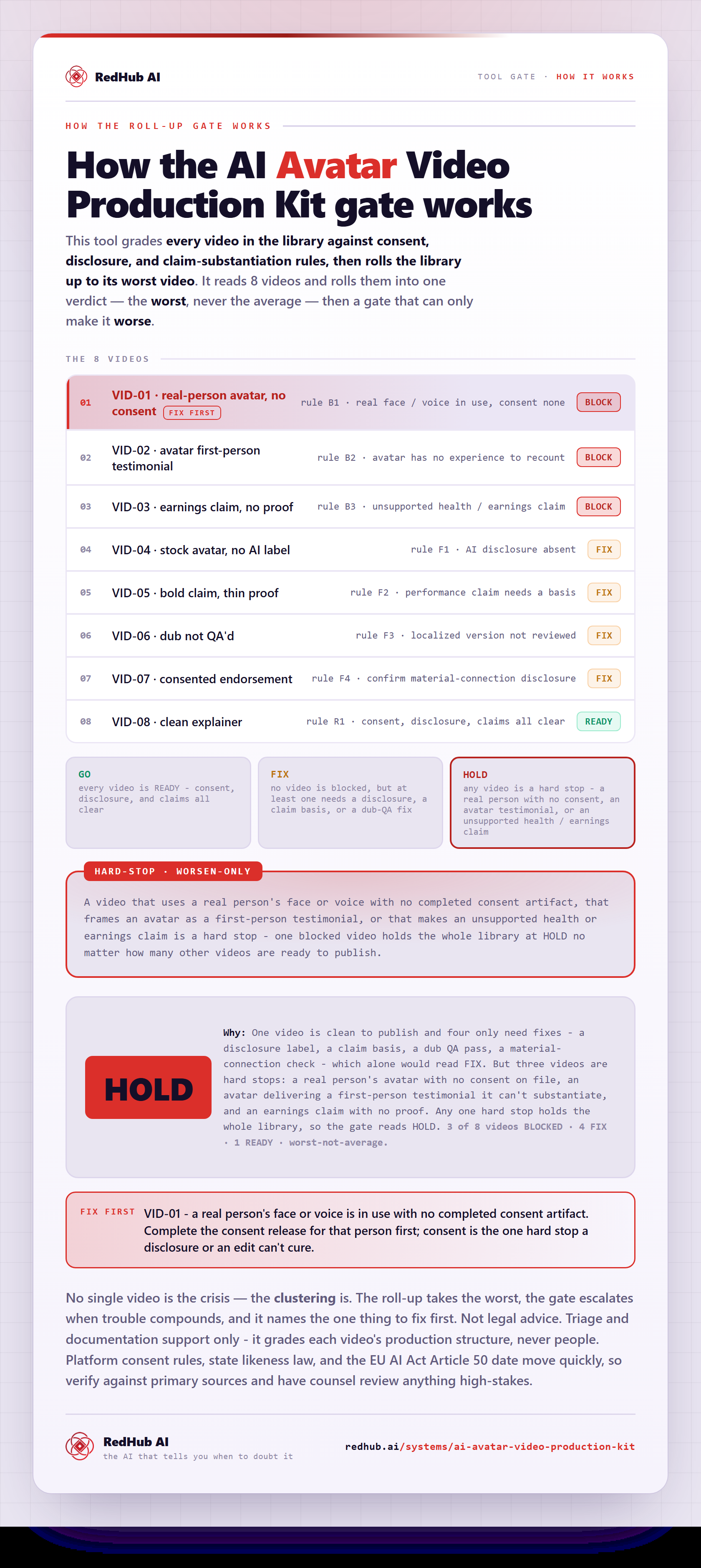
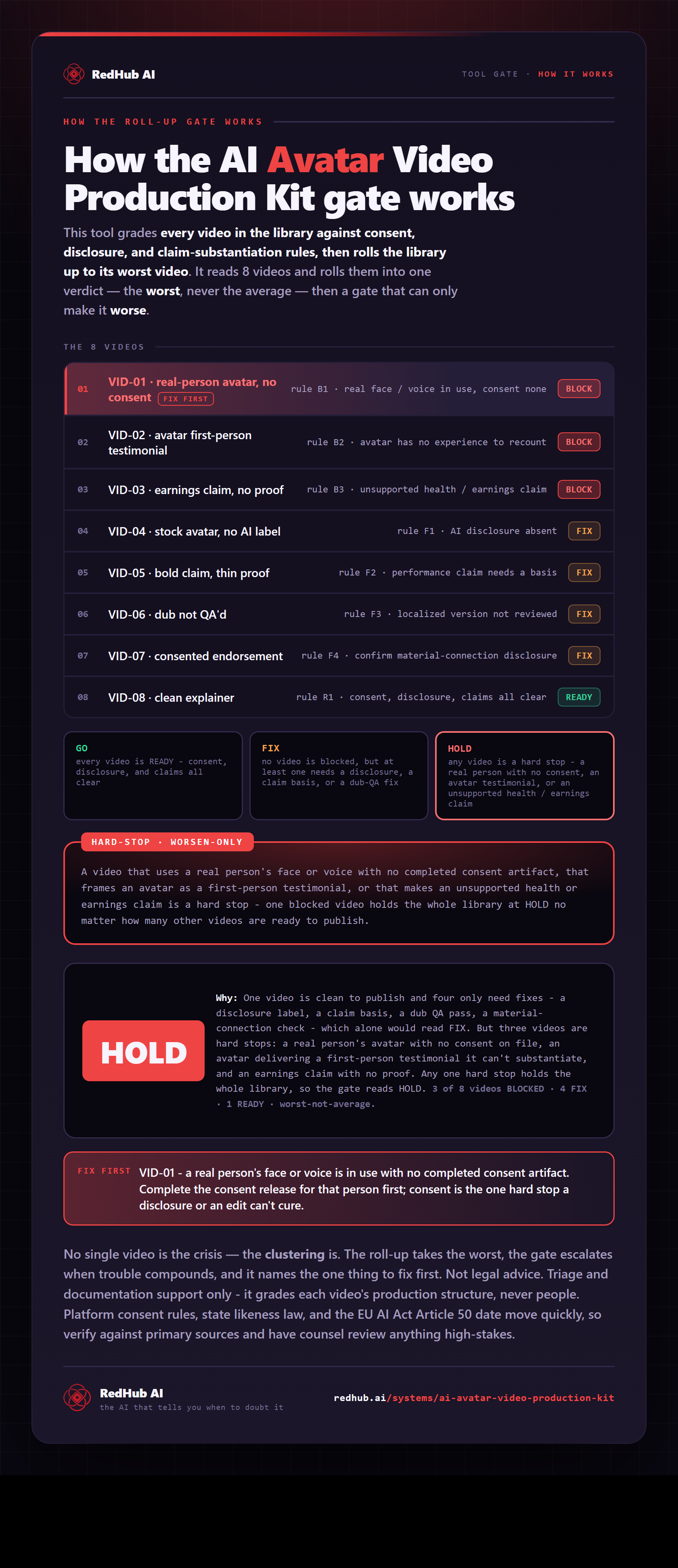
How the gate works, in one image
How the AI Avatar Video Production Kit rolls a batch of avatar videos up to its worst and holds the whole library when one video lacks consent or makes an unsupported claim — the same math the demo runs, as a diagram you can share or embed anywhere.
View & embed the full diagramRun it offline. Get a verdict you can act on.
The Python checker reads a CSV of your videos and prints exactly this — per-video verdicts with the rule that fired, plus the library gate. No install, no network, deterministic. Here’s its output on the sample set:
================================================================
  AI Avatar Video Production Kit  (AVP-089)
  Evaluation date: 2026-06-18    Videos: 8
================================================================

  LIBRARY GATE:  HOLD
  READY 1   FIX 4   BLOCK 3

----------------------------------------------------------------
  [BLOCK ] VID-01-realperson-noconsent   (rule B1)
      source: custom_avatar_real_person / consent: none
      - Real person's face or voice in use with no completed
        consent artifact. Right-of-publicity and platform consent
        rules make this a hard stop. Complete the consent video /
        release for this person and use before publishing.

  [BLOCK ] VID-02-avatar-testimonial   (rule B2)
      framing: personal_experience
      - An avatar cannot deliver a first-person lived-experience
        testimonial - it has no experience, so the claim is
        unsubstantiable and a disclosure does not cure it.
        Reframe, or use real footage of the real person.

  [BLOCK ] VID-03-earnings-noproof   (rule B3)
      claim: health_or_earnings / basis: no
      - Unsupported health or earnings claim - deceptive on its
        face regardless of presenter or disclosure.

  [FIX   ] VID-04-stock-nolabel   (rule F1)
      - A talking-head avatar needs a clear-and-conspicuous
        disclosure that the presenter is AI-generated.

  [FIX   ] VID-05-bold-claim-thin   (rule F2)
      - Performance claim needs a reasonable basis. Substantiate,
        soften to what the evidence supports, or remove it.

  [FIX   ] VID-06-dub-not-qa   (rule F3)
      - A localized version was generated but not QA'd. Review
        for meaning drift, accuracy, and lip-sync before it ships.

  [FIX   ] VID-07-consented-endorse   (rule F4)
      - Consent and disclosure are in order; confirm a material-
        connection disclosure if the person is paid or affiliated.

  [READY ] VID-08-clean-explainer   (rule R1)
      - Consent not required, disclosure adequate, no
        unsupportable claim, dub QA'd. Publish.
----------------------------------------------------------------Three principles it holds to.
Consent before generation
If a real person's face or voice is involved, the consent artifact comes first. No artifact, no publish — the verdict is BLOCK until it's on file.
An avatar can't testify
It has no experience to recount. The kit blocks a personal-experience claim outright and points you to a framing that's actually true.
Disclose, then localize
Tell viewers the presenter is AI-generated, place it where they'll see it, and QA every dub before it ships. Structure over a platform toggle.
Clear about the lane. No inflated promises.
What it is
- A production pipeline plus a pre-publish readiness gate per video.
- A consent-and-disclosure workflow you can hand to a team.
- A documentation trail — consent artifacts and claim basis on file.
What it isn’t
- Legal advice, or a substitute for counsel on high-stakes work.
- An avatar generator — bring your tool (HeyGen, etc.); this gates the output.
- A live legal database — platform and state rules need verifying at use.
Not legal advice. This is triage and documentation support. Platform consent requirements, state likeness law, and the EU AI Act Article 50 date move quickly; verify against primary sources and have counsel review anything high-stakes.
Built for the teams shipping avatar video at volume.
- L&D and enablement teams scaling training video without re-filming
- Marketing teams producing talking-head content at volume
- Agencies offering avatar video as a service to clients
- Founders localizing one message into many languages, compliantly
Build the rest of the synthetic-media stack.
Voice & Likeness Compliance Gate
Consent and disclosure across all synthetic media — the broader gate this kit's avatars sit inside.
AI Literacy & Workforce Training Kit
If your avatars present training, the turnkey literacy program they live inside.
Organic Social & Short-Form Video System
The creation layer — pillars, hooks, and scripts for the content your avatars deliver.
The questions teams actually ask before they publish an avatar video.
Clear the video before it ships.
Not after.
One purchase, lifetime access, 12 months of updates. The checker, the workbook, the playbooks, and the sample set. $89, once.
Sold by RedHub AI LLC · Secured by Stripe · redhub.ai
Not legal advice. Triage and documentation support — platform consent rules, state likeness law, and the EU AI Act Article 50 date move quickly; verify at use and have counsel review anything high-stakes.