Production got cheap.Permission didn’t.
AI clones a voice, builds a talking-head avatar, or dubs a video in minutes — but a synthetic spokesperson can’t claim it tried your product, a cloned voice needs consent dated before you used it, and a paid AI ad needs two disclosures, not one.
Describe each asset and get a verdict — CLEAR, FIX FIRST, or DO NOT PUBLISH — plus a GO / FIX / HOLD gate for the whole set, and the exact fix, before it reaches a platform or a regulator.
The cost of making it fell to zero. The exposure didn’t.
Synthetic spokespeople, cloned voices, AI dubs — the bottleneck moved from making the asset to being allowed to use it. Get it wrong and the penalties are real and assessed per asset, and the platform pulls it before the regulator even gets involved.
The failure modes are mechanical and repeatable: an AI persona that says it “tried” the product, a voice clone with no release dated before the shoot, an AI ad disclosed only in the caption, a paid AI ad with a single label where two are required. None of it shows once the video is rendered — all of it is a problem you want to catch on your own desk.
FTC disclosure, fake-testimonial, right-of-publicity, and synthetic-performer rules are enforced per asset — the bill scales with how many you shipped, not how many got noticed.
A synthetic or AI-fabricated testimonial that claims personal experience is deceptive on its face. A disclosure label does not fix it — the only fix is to rebuild without the claim.
A real person's cloned voice or likeness needs a release dated before production. Retroactive consent does not cure a use that already happened — so the check has to run before you publish.
Reduces FTC / right-of-publicity / EU-AI-Act and platform risk; it does not eliminate it. Not legal advice.
Change one input and watch the verdict move.
This is the same logic that ships in the Python engine and the workbook — running in your browser on a single asset. Load a preset, toggle a region, flip a consent field. Nothing is sent and nothing is stored.
- Obtain a signed consent/release from the depicted person, dated before production. Retroactive consent does not cure a use that already happened.
- Add a clear, conspicuous AI-generated disclosure baked into the asset (in-video or in-audio), not only in the caption or description.
Frameworks (for counsel review, not legal advice):
- Right of publicity / digital-replica consent [in force]
- TN ELVIS Act — voice & likeness protection [in force]
- FTC Endorsement Guides — clear & conspicuous disclosure [in force]
Evaluated as of 2026-06-18. This demo runs the same logic as the included engine. Not legal advice — verify dated specifics and high-risk uses with counsel.
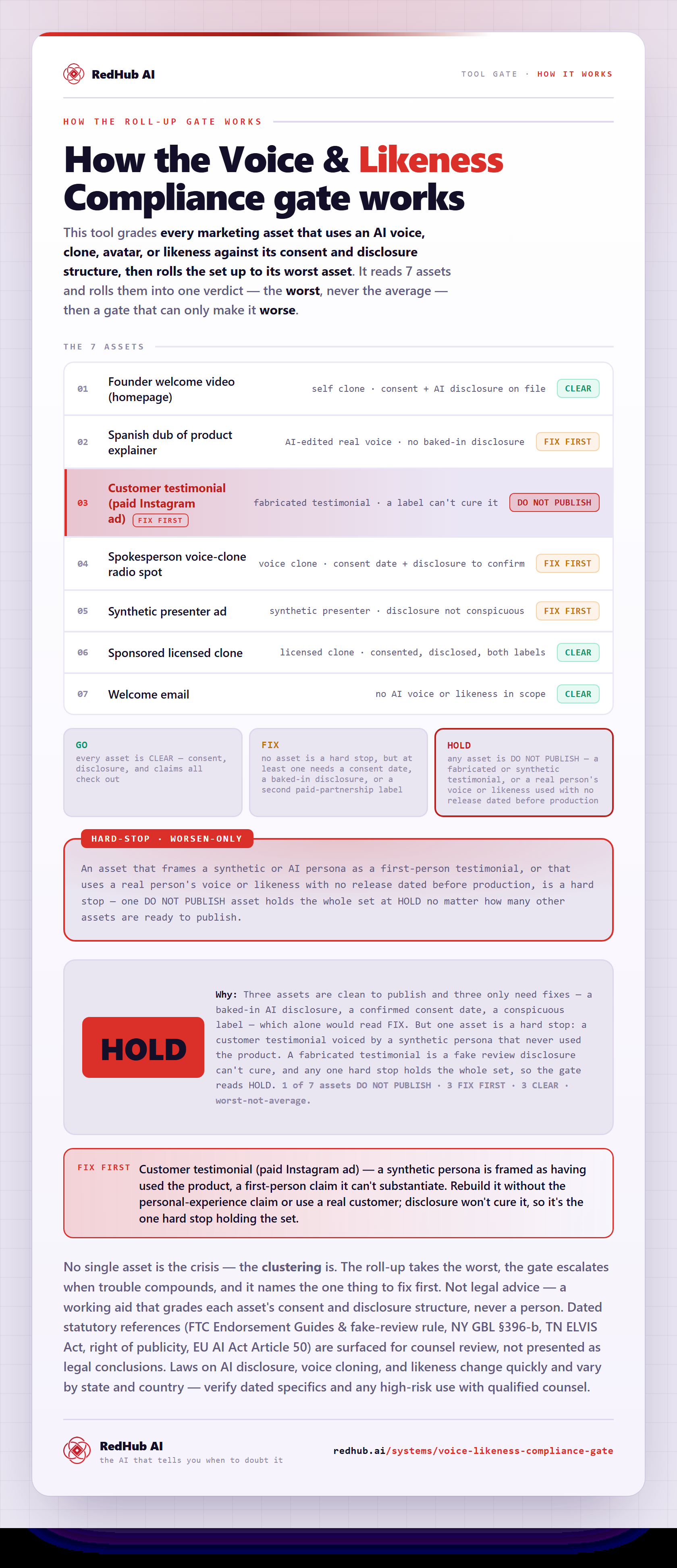
How the gate works, in one image
How the Voice & Likeness Compliance Gate rolls assets up to its worst and holds the set when one asset lacks consent — the same math the demo runs, as a diagram you can share or embed anywhere.
View & embed the full diagramThe engine actually runs. Here’s real output.
This is the included voice_likeness_gate.py run against the 7-asset sample manifest — not a screenshot of a promise. Three clear, three to fix, one to rebuild — so the launch is held until the blocked asset is gone.
$ python3 voice_likeness_gate.py --in sample/sample-manifest.csv --as-of=2026-06-18

========================================================================
VOICE & LIKENESS COMPLIANCE GATE  ·  VLG-099
As-of: 2026-06-18   ·   Assets reviewed: 7
========================================================================

[CLEAR]  Founder welcome video (homepage)
  risk: LOW
  note: Clear for the inputs given. Re-check if the asset, its claims, or its distribution regions change.

[FIX FIRST]  Spanish dub of product explainer
  risk: MEDIUM
  action: Add a clear, conspicuous AI-generated disclosure baked into the asset (in-video or in-audio), not only in the caption or description.
  frameworks (for counsel review, not legal advice):
    - EU AI Act Article 50 — transparency / AI-content marking [upcoming 2026-08-02]

[DO NOT PUBLISH]  Customer testimonial (paid Instagram ad)
  risk: HIGH
  action: Rebuild without the personal-experience claim: a synthetic or AI persona cannot truthfully say it used the product, and an AI-fabricated testimonial is a fake review that disclosure does not cure.
  action: Add a clear, conspicuous AI-generated disclosure baked into the asset (in-video or in-audio), not only in the caption or description.
  action: Add a clear, conspicuous paid-partnership / material-connection disclosure. If an AI disclosure is also required, a single label does not satisfy both (double disclosure).
  frameworks (for counsel review, not legal advice):
    - FTC fake-review / fake-testimonial rule [in force]
    - FTC Endorsement Guides — clear & conspicuous disclosure [in force]
    - NY GBL §396-b — synthetic performer advertising disclosure [in force]
    - FTC Endorsement Guides — material-connection disclosure [in force]

[FIX FIRST]  Spokesperson voice-clone radio spot
  risk: HIGH
  action: Obtain a signed consent/release from the depicted person, dated before production. Retroactive consent does not cure a use that already happened.
  action: Add a clear, conspicuous AI-generated disclosure baked into the asset (in-video or in-audio), not only in the caption or description.
  frameworks (for counsel review, not legal advice):
    - Right of publicity / digital-replica consent [in force]
    - TN ELVIS Act — voice & likeness protection [in force]
    - FTC Endorsement Guides — clear & conspicuous disclosure [in force]

[FIX FIRST]  Synthetic presenter brand ad
  risk: MEDIUM
  action: Add a clear, conspicuous AI-generated disclosure baked into the asset (in-video or in-audio), not only in the caption or description.
  frameworks (for counsel review, not legal advice):
    - FTC Endorsement Guides — clear & conspicuous disclosure [in force]
    - NY GBL §396-b — synthetic performer advertising disclosure [in force]

[CLEAR]  Sponsored creator voiceover (licensed clone)
  risk: LOW
  note: Clear for the inputs given. Re-check if the asset, its claims, or its distribution regions change.

[CLEAR]  Welcome email copy (AI-assisted text)
  risk: LOW
  note: Clear for the inputs given. Re-check if the asset, its claims, or its distribution regions change.

========================================================================
LIST GATE: HOLD
  CLEAR: 3   FIX FIRST: 3   DO NOT PUBLISH: 1
  Do not launch the set: at least one asset must be rebuilt.
  Not legal advice. Verify dated specifics and high-risk uses with counsel.
========================================================================

$ echo $?
0
Reads a CSV of your own assets, annotates each framework as in-force or upcoming as of the --as-of date, and prints a per-asset verdict plus the list gate. --json for tooling. The engine, the workbook, and the demo above share one logic and are verified to agree on all 7 sample assets.
Two principles the verdict can’t be talked out of.
Verdicts come from the consent and disclosure structure of each asset, not from statute text — so they don’t give worse advice as effective dates pass. Two rules hold the line:
Consent must precede use
If a real person's voice or likeness is used, a signed release dated before production must exist. Retroactive consent does not cure a use that already happened — which is exactly why the gate runs before you publish, not after.
Disclosure must be conspicuous
Bake the AI disclosure into the asset itself, not the caption. A paid AI asset needs both an AI disclosure and a paid-partnership disclosure — one label does not satisfy both. And a fabricated testimonial is never cured by a label; it must be rebuilt.
The dated statutory references (FTC Endorsement Guides & fake-review rule, NY GBL §396-b, TN ELVIS Act, right of publicity / digital-replica consent, EU AI Act Article 50) are surfaced for triage and counsel review only — the engine annotates each as in-force or upcoming as of your evaluation date and never presents them as legal conclusions. This reduces legal and platform risk; it is not legal advice. Confirm the rules for your industry, states, and regions with qualified counsel.
It’s the checkpoint in front of your creative tools.
The AI creative stack makes the voice, the avatar, the dub. None of those tools ask “are you allowed to publish this?” This runs first and answers exactly that — then hands the CLEAR set back to the tools that ship it.
- ·Generate the voice, avatar, dub, or edit
- ·Optimize for speed and output volume
- ·Assume you're cleared to publish
- ·The penalty for being wrong is per asset
- ·Verdicts each asset before it ships
- ·Names the exact fix, not just a flag
- ·Treats missing consent/disclosure as unproven
- ·Hands a CLEAR set to your publish tools
List each asset's structure — what AI made it, whose voice/likeness, consent, paid status, disclosure, regions. No legal reading required.
Each asset gets CLEAR / FIX FIRST / DO NOT PUBLISH; the whole set gets GO / FIX / HOLD. One blocked asset holds the launch.
Apply the exact action it names — consent dated before use, a baked-in disclosure, a second disclosure for paid — then re-gate.
Ship the CLEAR set to your video, voice, and ad tools. This is the gate that runs before them, not the tool that makes the content.
Clear about the lane. No inflated promises.
- The gate (Python) — A runnable linter that reads a CSV of your assets and returns the per-asset verdicts and the list gate. Standard library only; runs offline, no API key. --as-of pins the framework annotations; --json for tooling.
- The workbook — The identical logic as a live spreadsheet — Start Here, a Compliance Gate tab with dropdowns and per-asset verdicts, and a launch-gate Dashboard. No setup; opens in Excel, Sheets, or Numbers.
- Compliance Playbook — How the gate decides, the two operating principles, and a dated framework reference (FTC, NY GBL §396-b, TN ELVIS, right of publicity, EU AI Act Art. 50) surfaced for counsel review.
- Disclosure & Consent Templates — Copy-ready AI and paid-partnership disclosures, double-disclosure examples, and a consent/release starting template — plus a 7-asset sample manifest spanning every verdict.
- Not legal advice — it reduces FTC / right-of-publicity / EU-AI-Act and platform risk; it doesn't eliminate it. Confirm dated specifics and high-risk uses with counsel.
- Not a content tool — it gates assets; it doesn't make voices, avatars, or dubs. Hand the CLEAR set to your creative tools.
- No music / track rights — song and sound-recording licensing is a separate question this gate does not decide.
- No cosmetic-only AI — lighting, color, and grammar fixes are out of scope; the gate is for voice, likeness, and synthetic personas.
- No SaaS, no monthly fee, no telemetry — your asset data never leaves your environment.
Anyone shipping AI voices, clones, avatars, or dubs.
Agencies & creative teams
If you produce AI spokespeople, dubs, or UGC for clients, the gate is your liability shield — you publish only what you can defend, and you can show the client why an asset was held.
Brands running AI ads
Paid AI ads carry the double-disclosure trap and the synthetic-testimonial trap. Gate every asset before it hits a platform's ad review or a regulator's desk.
Creators using clones & avatars
Voice clones and talking-head avatars are fast — and easy to ship without the consent date or the baked-in disclosure that keeps them publishable.
Database Reactivation Readiness Engine
The same verdict-gate discipline, applied to your dormant email list before you send — CONTACT / REPERMISSION / SUPPRESS per contact, GO / FIX / HOLD for the list.
Short-Form Video Content System
The make side of the stack: hooks, scripts, and a content engine for short video. Clear the asset here, then produce and ship it there.
Distinctive AI Visuals Kit
On-brand AI imagery without the templated look. The gate checks the voice/likeness layer; this gives the visuals a distinctive, owned style.
The questions teams actually ask before they hit publish.
No. It is a working aid that flags what to fix or verify before you publish. Laws on AI disclosure, voice cloning, and likeness change quickly and vary by state and country. Verify dated specifics and any high-risk use with qualified counsel.
For each marketing asset, it reads the consent and disclosure structure — what AI made it, whose voice or likeness is used, whether consent is on file and dated before use, whether it is a paid endorsement, and where it runs. It returns CLEAR, FIX FIRST, or DO NOT PUBLISH per asset, plus a GO / FIX / HOLD gate across the whole set.
Yes for voice, voice clones, synthetic avatars, digital likenesses, and AI-edited footage from any tool. Music and track rights are a separate question this gate does not decide; purely cosmetic AI such as lighting or grammar is out of scope.
The verdict logic is built on durable structure — consent must precede use, disclosure must be conspicuous — not on statute text, so it does not give worse advice as effective dates pass. The dated statutory specifics live in the reference material and are flagged for counsel review. Re-check each asset when its claims or regions change.
Yes. The included workbook reproduces the identical logic with dropdowns and live verdicts — no setup. If you prefer, the Python engine runs offline on a CSV of your assets and returns the same results.
Consent for your own voice or likeness is implicit, so it will not trigger the consent fix — but a conspicuous AI disclosure still applies where required, and the cloning platform will usually require its own recorded consent step.
Clear the gate before you publish.
The engine, the workbook, both playbooks, and the worked example — one purchase, yours to run on every voice, clone, and avatar you ship. Describe each asset, get the verdict and the exact fix, and publish only what you can defend.
Not legal advice. Verify dated specifics and any high-risk use with qualified counsel.
Sold by RedHub AI LLC · Secured by Stripe · redhub.ai