A pre-checked box isn’tconsent you can defend.
Marketing robocall and robotext consent requirements now require jurisdiction-, technology-, and campaign-specific analysis. This gate uses clear, conspicuous, affirmative, written, signed, and provable consent as a conservative evidence standard — was the opt-in a deliberate act, and can you produce a dated record tying this consumer to this consent? This gate grades each form on six controls and returns one verdict — CONSENT-READY AS DESCRIBED, FIX FIRST, or EVIDENCE GAP — with a hard stop on the three capture gaps that trigger its evidence gate.
Not legal advice. This kit is a readiness aid that grades your own assessment of prior-express-written-consent readiness; it is not a compliance certification, an opinion of counsel, or a safe harbor. The TCPA landscape is unsettled and enforced by private litigants — the FCC’s 2023 one-to-one rule was vacated and is not graded here, the written-consent requirement is now jurisdiction-dependent after the Fifth Circuit held in Bradford v. Sovereign Pest Control (February 2026) that the statute permits oral prior express consent, and the “revocation-all” provision is delayed. Confirm the federal and state requirements that apply to your calls, texts, and AI voice/text agents, and consult qualified counsel before you launch.
Update notice — version 1.1.0 (2026-09-23). This package replaces version 1.0 of the Web-Form Consent & Lead-Capture Compliance Gate. The consent-standard text and the audit playbook's gate wording are revised. Scoring is unchanged: the same marks produce the same score and verdict as in version 1.0. Existing buyers: the download link in your original purchase email now serves version 1.1.0.
The fight moved from the rule to the receipt.
A checklist that grades your form’s wording while the opt-in is pre-checked, or while you store no record, is grading the wrong thing. This gate grades the consent as you’d have to defend it — a deliberate affirmative act, captured and provable — and forces EVIDENCE GAP when it isn’t, no matter how good the copy is.
Mark six controls. Uncheck one box. Watch the verdict flip.
Defective-capture gate: a pre-checked / non-affirmative opt-in — consent you can’t prove you got. EVIDENCE GAP regardless of score.
Mark six consent controls
Same math as the workbook and the Python engine: six controls weighted to 100, CONSENT-READY AS DESCRIBED at 85+, FIX FIRST at 55+, and a defective-capture gate that forces EVIDENCE GAP on a non-affirmative opt-in, a missing consent record, or purchased leads with no provenance. It grades the prior-express-written-consent readiness of forms, not people, and deliberately doesn’t grade the vacated one-to-one rule. A readiness aid, not legal advice.
This is the live engine. Grade every lead-capture form in one workbook + a runnable engine Catch the pre-checked box or missing record before a dispute does Where a control is short, get the one fix-first per form, with the exact capture-fix step
Get the kit — $79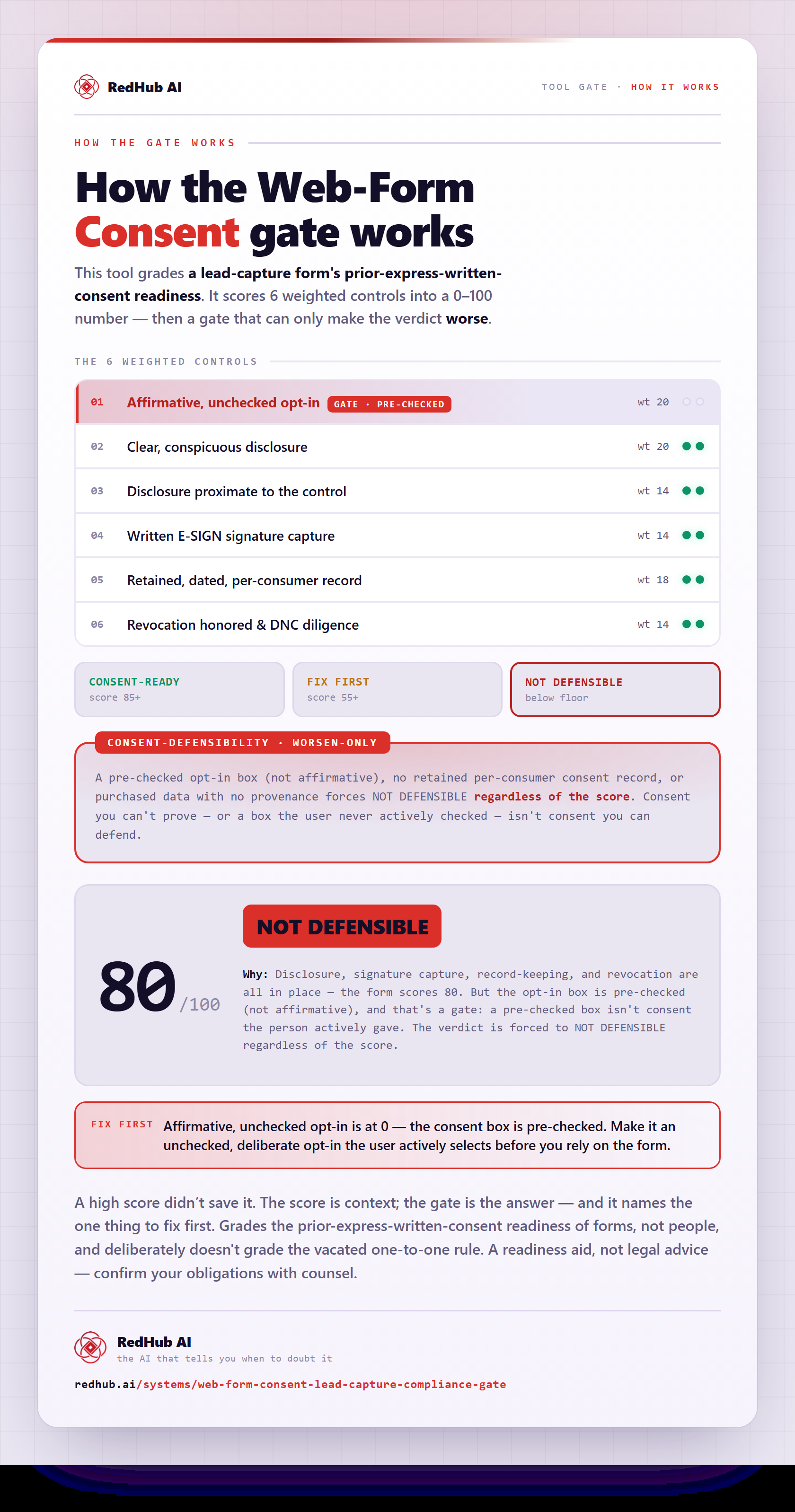
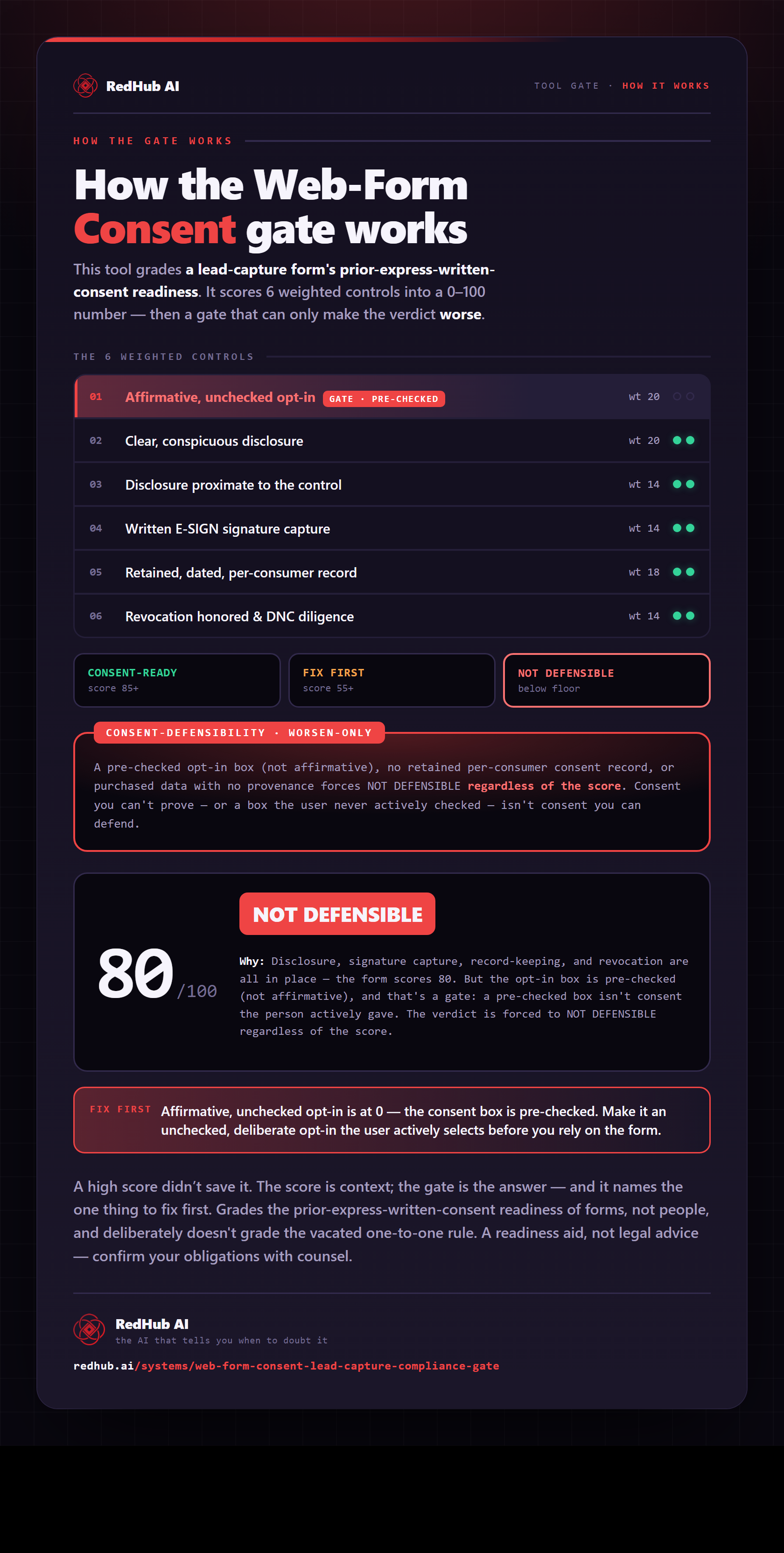
How the gate works, in one image
Six consent controls scored into a 0–100 readiness number and the consent-defensibility gate that forces EVIDENCE GAP on a pre-checked opt-in box — the same math the demo runs, as a diagram you can share or embed anywhere. A readiness aid, not legal advice.
View & embed the full diagramThe same verdict, offline, from your terminal.
The workbook and the Python engine share one config — same six controls, same weights, same defective-capture gate. Run it against the shipped seven-form sample:
$ python3 engine/wfc_engine.py engine/sample_forms.csv

Web-Form Consent & Lead-Capture Compliance Gate
================================================
Program: DO NOT LAUNCH

Demo request (pre-checked consent box)
  score 80/100  ->  EVIDENCE GAP   [GATE: pre-checked / non-affirmative opt-in -> EVIDENCE GAP]
  fix first: Affirmative, unchecked opt-in (a deliberate act)

Demo request (same form, unchecked box)
  score 100/100  ->  CONSENT-READY AS DESCRIBED

Newsletter + SMS opt-in (all six controls at the top mark)
  score 100/100  ->  CONSENT-READY AS DESCRIBED

Webinar signup (vague disclosure, fine print)
  score 69/100  ->  FIX FIRST
  fix first: Clear, conspicuous disclosure naming caller & autodial/robotext marketing

Quote form (no consent record kept)
  score 68/100  ->  EVIDENCE GAP   [GATE: no retained consent record -> EVIDENCE GAP]
  fix first: Retained, dated, per-consumer consent record

Bought list blast (no provenance)
  score 70/100  ->  EVIDENCE GAP   [GATE: purchased leads with no consent provenance -> EVIDENCE GAP]
  fix first: Purchased-lead consent provenance

Contact form (thin but affirmative & logged)
  score 60/100  ->  FIX FIRST
  fix first: Clear, conspicuous disclosure naming caller & autodial/robotext marketing

The one-to-one rule was vacated and is NOT required here; this grades
prior-express-written-consent readiness. A readiness aid, not legal advice.
Rows 1 and 2: the same form, one box unchecked — EVIDENCE GAP becomes CONSENT-READY AS DESCRIBED. The gate is the only difference.
Six weighted controls — and a gate on the three gate-triggering gaps.
Consent must be a deliberate act
A pre-checked or bundled opt-in isn't the clear, unmistakable affirmative consent this gate uses as its evidence standard — so it forces EVIDENCE GAP no matter how good the rest of the form is.
If you can't prove it, you can't defend it
No retained, dated, per-consumer record means you could never show consent in a dispute. A missing record triggers the evidence gate; it is not a minor gap.
One-to-one is not graded
The vacated 2023 rule is deliberately excluded. This gate uses clear, conspicuous, affirmative, written, signed, and provable consent as a conservative evidence standard. It does not determine that federal law requires written consent for every call or text.
A readiness gate for your forms. Not a certification.
- A deterministic, per-form verdict on prior-express-written-consent readiness.
- A way to find the capture defect that makes consent unprovable — and the fix.
- A repeatable triage you re-run before wiring a form into a dialer or SMS/AI agent.
- A compliance certification, opinion of counsel, or safe harbor.
- A grader of the vacated one-to-one rule — that’s deliberately excluded.
- A people-scoring tool — it grades forms and flows, not anyone’s behavior.
Not legal advice. This kit is a readiness aid that grades your own assessment of prior-express-written-consent readiness; it is not a compliance certification, an opinion of counsel, or a safe harbor. The TCPA landscape is unsettled and enforced by private litigants — the FCC’s 2023 one-to-one rule was vacated and is not graded here, the written-consent requirement is now jurisdiction-dependent after the Fifth Circuit held in Bradford v. Sovereign Pest Control (February 2026) that the statute permits oral prior express consent, and the “revocation-all” provision is delayed. Confirm the federal and state requirements that apply to your calls, texts, and AI voice/text agents, and consult qualified counsel before you launch.
Anyone who turns a form fill into a call or a text.
Build the page, capture consent defensibly, then send.
Lead-Capture Page Kit
Build the opt-in page; this gate checks its consent is defensible. $79.
ViewAI Chat & SMS Concierge (GHL)
The SMS/AI agent that needs this consent gate upstream of it. $99.
ViewAI Disclosure & Synthetic-Content Labeling Readiness Kit
Sibling readiness gate for EU AI Act Article 50 disclosure. $79.
ViewWhat teams ask before they buy.
The FCC's one-to-one consent rule was vacated by the Eleventh Circuit in January 2025 (IMC v. FCC), and the FCC reinstated its prior express written consent standard in August 2025. That standard is not uniform nationwide: in February 2026 the Fifth Circuit held in Bradford v. Sovereign Pest Control that the statute permits oral prior express consent, so the written-consent requirement is now jurisdiction-dependent. State mini-TCPAs may be stricter. Not legal advice; consent requirements are fact-specific.
Not under the FCC's written-consent definition. Under the FCC's telemarketing rules, prior express written consent means a written agreement bearing the signature of the person called that clearly authorizes the seller to deliver telemarketing messages by autodialer or artificial or prerecorded voice, to a number the signer designates, with a clear and conspicuous disclosure — including that the person is not required to sign as a condition of buying anything. A pre-checked box, or consent bundled into a 'submit' or terms-acceptance click, requires no affirmative act by the consumer, which is why this gate treats it as a gate-triggering evidence gap: it forces EVIDENCE GAP regardless of how good the rest of the form is. In the demo and the engine, unchecking that one box is the difference between EVIDENCE GAP and CONSENT-READY AS DESCRIBED. Courts have been reading the TCPA's consent requirement independently of the FCC since 2025, and in February 2026 the Fifth Circuit held the statute permits oral as well as written consent; this gate uses written consent as a conservative evidence standard, not as a determination that written consent is legally required for every communication. Confirm the federal and state requirements that apply to your specific channels with counsel.
The FCC has confirmed that AI-generated voices are 'artificial' voices within TCPA scope, so AI voice calls and automated marketing texts fall under the same TCPA consent framework as other autodialed or prerecorded marketing outreach. Marketing robocall and robotext consent requirements now require jurisdiction-, technology-, and campaign-specific analysis. The Eleventh Circuit vacated the FCC's one-to-one consent restriction, and the Fifth Circuit's Bradford decision rejected the FCC's prior-express-written-consent requirement in the circumstances before it. Other courts, FCC rules, and state laws may produce different requirements. That's why this gate sits upstream of your dialer or your AI chat/SMS concierge: it checks that the form feeding those systems captured consent you can actually prove, including a clear disclosure that marketing calls/texts may be autodialed or use an artificial voice. Confirm the federal and state requirements that apply to your specific channels with counsel.
One verdict per form — CONSENT-READY AS DESCRIBED, FIX FIRST, or EVIDENCE GAP — plus, where a control is short, a single fix-first naming the highest-leverage control to change. You mark six weighted controls (affirmative unchecked opt-in, clear disclosure, disclosure proximity, written E-SIGN signature, retained per-consumer consent record, revocation/DNC & source diligence) and flag purchased leads with no provenance. A defective-capture gate hard-stops the three gate-triggering patterns: a non-affirmative opt-in, no retained consent record, or purchased leads with zero provenance. A program rollup grades all your forms together as READY TO CAPTURE, REMEDIATE, or DO NOT LAUNCH. It ships a workbook, a runnable Python engine that reproduces the verdict offline, two playbooks, and a seven-form worked sample.
Different layers. The Lead-Capture Page Kit grades the page's conversion design — message match, single goal, friction, trust — whether the form converts. This gate grades whether the consent that form captures is defensible — whether the opt-in is affirmative, disclosed, signed, and provable under the TCPA. A page can convert beautifully and still capture consent you could not prove later. Build and optimize the page there; clear its consent here before you wire it into anything that calls or texts.
No to both. It's a readiness aid that grades your own assessment of prior-express-written-consent readiness — not an opinion of counsel, not a certification, and not a safe harbor. The TCPA landscape is genuinely unsettled and enforced by private litigants: the Eleventh Circuit vacated the FCC's one-to-one consent restriction, the Fifth Circuit's Bradford decision rejected the FCC's prior-express-written-consent requirement in the circumstances before it, courts have split on points like whether texts are 'calls,' and the revocation-all provision is delayed. The engine uses written consent as a conservative evidence standard, not as a determination that written consent is legally required for every communication, and stays date-agnostic, but you must confirm the federal and state requirements for your calls, texts, and AI voice/text agents and consult qualified counsel before you launch.
Capture consent you could
actually defend.
One purchase, lifetime access, 12 months of updates. $79, once.
Not legal advice. This kit is a readiness aid that grades your own assessment of prior-express-written-consent readiness; it is not a compliance certification, an opinion of counsel, or a safe harbor. The TCPA landscape is unsettled and enforced by private litigants — the FCC’s 2023 one-to-one rule was vacated and is not graded here, the written-consent requirement is now jurisdiction-dependent after the Fifth Circuit held in Bradford v. Sovereign Pest Control (February 2026) that the statute permits oral prior express consent, and the “revocation-all” provision is delayed. Confirm the federal and state requirements that apply to your calls, texts, and AI voice/text agents, and consult qualified counsel before you launch.
Sold by RedHub AI LLC · Secured by Stripe · redhub.ai