Find out which AI surfacesyou can disclose your way past.
A pre-publish readiness audit for the EU AI Act's Article 50 transparency rules. List every AI surface you put in front of people — chatbots, AI images and audio, deepfakes, AI-written public-interest text — and get a clear verdict per surface and for the whole set, with one hard gate for any synthetic surface passed off as real.
Not legal advice. This is a readiness aid for EU AI Act Article 50 transparency obligations, not a watermarking or detection tool and not a high-risk (Annex III) assessment — that regime's deadline is 2 December 2027. Effective dates (50(1)/50(4) on 2 Aug 2026; 50(2) marking on 2 Dec 2026 under the May 2026 Omnibus grace) are current as of June 2026 and may change. Confirm your surfaces and exemptions with counsel.
Article 50 lands in August 2026 — and most teams can't see their own surfaces.
Article 50 transparency obligations apply — chatbot, deepfake, and public-interest-text disclosure.
Machine-readable marking deadline after the four-month Omnibus grace; new systems still target August.
The separate high-risk (Annex III) deadline — not August 2026. This kit keeps the two apart.
The trap isn't the deadline — it's inventory. A team that has wired AI into a support chatbot, ad imagery, a cloned voiceover, and a synthetic spokesperson rarely has one list of those surfaces, let alone a per-surface read on which disclosures the law expects. This kit produces that list, and the verdict.
One deceptive surface sinks an otherwise-clean set.
Live demo · edit any surface
Set verdict
EVIDENCE GAPS PRESENT AS DESCRIBED
deceptive-surface gate FIRED on S4
Surfaces
4 clear · 1 fix · 1 evidence gap (67% clear)
Fix first: Spokesperson "deepfake" ad
Each surface's verdict is its weakest applicable obligation — no average can launder a missing disclosure. One synthetic surface presented as real, with no mark (and, for a deepfake, no label), trips the gate and sinks the whole set, however clean the rest is.
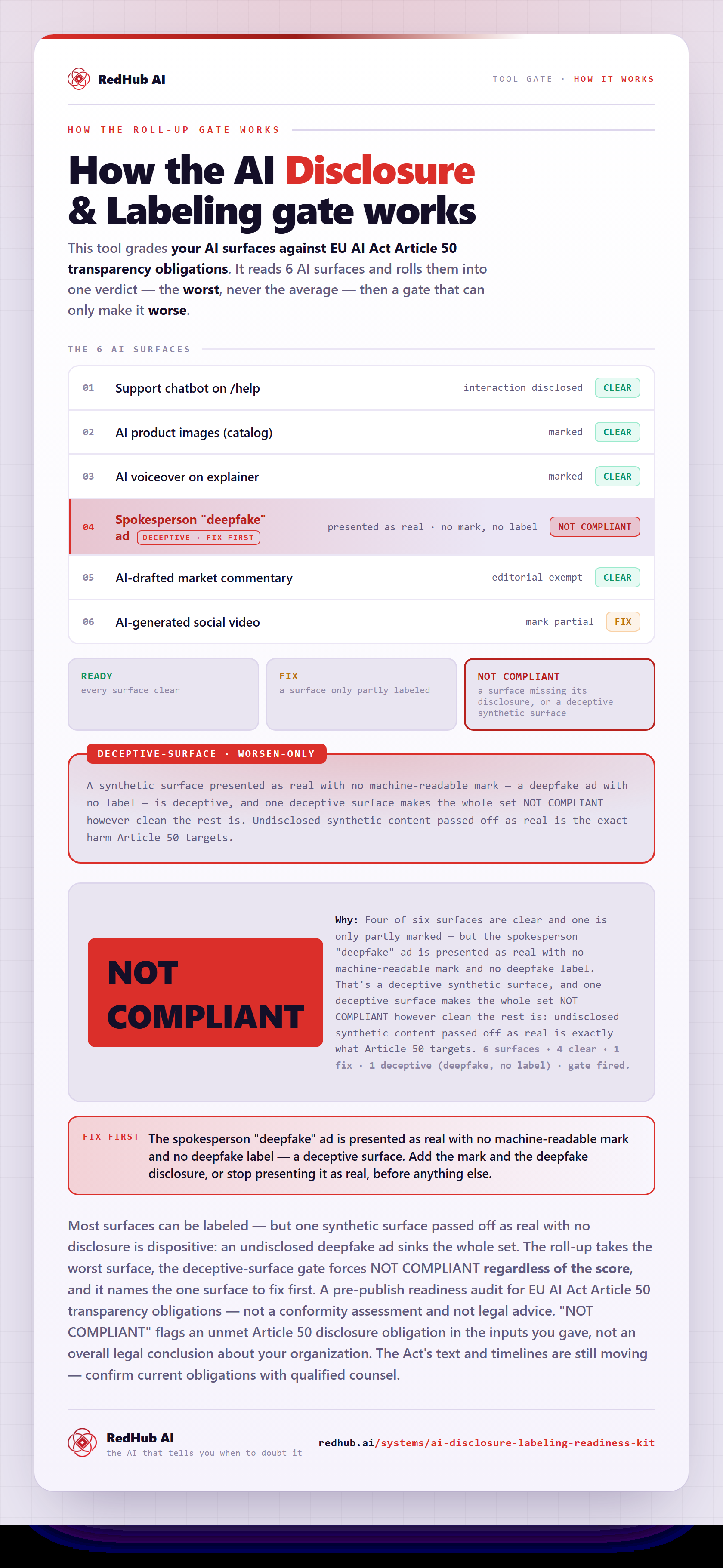
How the gate works, in one image
Each AI surface rolled up to the worst against EU AI Act Article 50 obligations and the deceptive-surface gate that carries the whole set to EVIDENCE GAPS PRESENT AS DESCRIBED on an undisclosed synthetic surface — the same logic the demo runs, as a diagram you can share or embed anywhere. A readiness aid, not a conformity assessment and not legal advice.
View & embed the full diagramVerbatim output on the shipped 6-surface sample.
Five of six surfaces read CLEAR or FIX and the set is 67% clear — and yet the set verdict is EVIDENCE GAPS PRESENT AS DESCRIBED, because one unlabeled spokesperson deepfake presented as real trips the deceptive-surface gate. The headline tells the truth a percentage would have hidden.
AI DISCLOSURE & LABELING READINESS  —  Article 50 (as of 2026-06-23)
================================================================
[S1] Support chatbot on /help  (chatbot)  ->  CLEAR
        50(1)  AI-interaction disclosure                  present          CLEAR
[S2] AI product images (catalog)  (synthetic_image)  ->  CLEAR
        50(2)  Machine-readable synthetic-content mark    present          CLEAR
[S3] AI voiceover on explainer  (synthetic_audio)  ->  CLEAR
        50(2)  Machine-readable synthetic-content mark    present          CLEAR
[S4] Spokesperson "deepfake" ad (founder likeness)  (deepfake)  ->  EVIDENCE GAP  <-- DECEPTIVE
        50(2)  Machine-readable synthetic-content mark    missing          EVIDENCE GAP
        50(4)  Deepfake disclosure label                  missing          EVIDENCE GAP
[S5] AI-drafted market commentary post  (public_interest_text)  ->  CLEAR
        50(4)  Public-interest-text disclosure            editorial_exempt CLEAR
[S6] AI-generated social video  (synthetic_video)  ->  FIX
        50(2)  Machine-readable synthetic-content mark    partial          FIX
----------------------------------------------------------------
Surfaces: 4 CLEAR / 1 FIX / 1 EVIDENCE GAP (67% clear)
Deceptive-surface gate: FIRED on S4
Base set verdict (pre-gate): EVIDENCE GAPS PRESENT AS DESCRIBED
SET VERDICT: EVIDENCE GAPS PRESENT AS DESCRIBED
Fix first: S4

Readiness aid for EU AI Act Article 50 transparency obligations — not legal
advice, and not a watermarking/detection tool. Article 50 transparency is
separate from the high-risk (Annex III) rules (deadline 2 Dec 2027); this
kit asserts no August-2026 high-risk deadline. Confirm with counsel.Three rules that keep the verdict honest.
A disclosure is present or it is not. Each surface's verdict is its weakest applicable obligation — no average that can launder a missing one.
Any synthetic or deepfake surface presented as real with no mark — and, for a deepfake, no label — carries the whole set to EVIDENCE GAPS PRESENT AS DESCRIBED, full stop.
Effective dates are reported so you know how long you have. A deadline never decides your verdict — a present disclosure is compliant today.
A readiness map, not a watermarker and not a lawyer.
- A per-surface audit against the four Article 50 transparency obligations.
- A set-level readiness verdict with one hard deceptive-surface gate.
- A runnable engine plus a workbook that reproduces it, line for line.
- A planning view of effective dates, with the Omnibus grace period flagged.
- A watermarking or detection tool — it doesn't mark or scan content.
- Legal advice, or a substitute for counsel on your specific surfaces.
- A high-risk (Annex III) assessment — that's a separate 2 Dec 2027 regime.
- A guarantee of compliance; the Code of Practice is still being finalized.
Not legal advice. This is a readiness aid for EU AI Act Article 50 transparency obligations, not a watermarking or detection tool and not a high-risk (Annex III) assessment — that regime's deadline is 2 December 2027. Effective dates (50(1)/50(4) on 2 Aug 2026; 50(2) marking on 2 Dec 2026 under the May 2026 Omnibus grace) are current as of June 2026 and may change. Confirm your surfaces and exemptions with counsel.
Teams shipping AI content into the EU market.
- · Marketing and content teams using AI imagery, voice, or video.
- · Founders and ops leads who own an AI chatbot or assistant.
- · Agencies preparing client surfaces ahead of the August 2026 dates.
- · Compliance owners who need a per-surface inventory and verdict.
- · Anyone publishing AI-written public-interest text in the EU.
- · Teams who keep conflating Article 50 with the high-risk deadline.
Where this sits in the compliance line.
Consent and disclosure gate for AI voices, clones, and avatars before they publish.
Claim-and-persona linter that blocks a synthetic spokesperson framed as a real testimonial.
The broader AI Act readiness program when you need more than the Article 50 transparency layer.
The honest answers.
The core obligations apply 2 August 2026: Article 50(1) AI-interaction disclosure (e.g. a chatbot must say it's AI), and Article 50(4) deepfake labels and AI-written public-interest-text disclosure. The Article 50(2) machine-readable marking of synthetic content has a four-month grace to 2 December 2026 under the May 2026 Omnibus agreement — though new systems still target August. This kit reports those dates so you can plan, but a deadline never decides your verdict: a disclosure that's present today is compliant today. Dates are current as of June 2026 and the Omnibus was provisional at writing — confirm with counsel before you rely on them. Not legal advice.
It's the one fault that sinks an otherwise-clean set. Any synthetic or deepfake surface you present to people as real, with no machine-readable mark — and, for a deepfake, no disclosure label — carries the whole set to EVIDENCE GAPS PRESENT AS DESCRIBED, no matter how many other surfaces are clear. In the worked sample, five of six surfaces read CLEAR or FIX and the set is 67% clear, yet the set verdict is EVIDENCE GAPS PRESENT AS DESCRIBED because one unlabeled spokesperson deepfake is passed off as real. A percentage would have hidden that; the gate refuses to.
No. The AI Disclosure & Labeling Readiness Kit is a readiness map, not a watermarking or detection tool — it never marks or scans your content. It takes the inventory of AI surfaces you enter and tells you, per surface, which Article 50 disclosures the law expects and whether you carry them: CLEAR, FIX, or EVIDENCE GAP, plus a READY / FIX / EVIDENCE GAPS PRESENT AS DESCRIBED verdict for the whole set. Applying the actual marks and labels is your team's job; this tells you where they're required and missing.
No, and conflating them is the most common mistake the kit is built to prevent. Article 50 transparency obligations are a separate regime from the high-risk (Annex III) rules, whose deadline moved to 2 December 2027. This kit covers only Article 50 transparency and asserts no August-2026 high-risk deadline. If you need the broader program — risk classification, FRIAs, system cards — that's the EU AI Act Readiness Kit, which this pairs with.
Six surface types, each mapped to its applicable Article 50 obligation: chatbots and AI assistants (50(1) interaction disclosure), AI-generated images, audio, and video (50(2) machine-readable mark), deepfakes (50(2) mark plus 50(4) label), and AI-written public-interest text (50(4) disclosure, with the editorial-control exemption). The included Surface-Mapping Playbook walks you through finding every AI surface you operate so none is missed — the inventory, not the deadline, is where most teams get caught. A worked six-surface sample is included so you can see a full audit immediately.
No. The AI Disclosure & Labeling Readiness Kit is a readiness aid for EU AI Act Article 50 transparency obligations — not legal advice, not a watermarking or detection tool, and not a high-risk (Annex III) assessment. The dated specifics in this area are fast-moving (the Omnibus grace and the Code of Practice on Transparency were still settling as of June 2026), so confirm every date, exemption, and obligation for your specific surfaces with your own counsel before you publish. It pairs with the Voice & Likeness Compliance Gate (consent for AI voices and avatars) and the EU AI Act Readiness Kit (the broader program).
See every AI surface.
Disclose the ones that need it.
One purchase, lifetime access, 12 months of updates as the Article 50 Code of Practice settles. $79, once.
Not legal advice. A readiness aid for EU AI Act Article 50 transparency obligations; not a watermarking tool and not a high-risk (Annex III) assessment. Dates current as of June 2026 and may change — confirm with counsel.
Sold by RedHub AI LLC · Secured by Stripe · redhub.ai