Will your AI adsurvive an FTC look?Find out before it runs.
AI and UGC-style ads are exploding — and they’re a direct enforcement target. This system checks each ad against the two questions a regulator asks: is every disclosure clear, and can every claim be supported? You get a verdict per ad — LAUNCH / FIX / PROHIBITED — and one campaign gate.
Not legal advice. This is triage and documentation support. Dated figures — penalty amounts, state-law amounts, the EU AI Act Article 50 date — move quickly; verify against primary sources and have counsel review anything high-stakes.
The cheap AI ad is the expensive one to get wrong.
A synthetic persona can’t have “tried” your product. An AI voice clone needs its own disclosure. A buried hashtag isn’t conspicuous. None of these are obvious in the rush to ship — and each is a separate exposure.
Reported max FTC civil penalty per violation in 2026 — and each non-compliant post counts separately.
Disclosures a synthetic endorsement can require: that it's an ad, and that the endorser is AI-generated.
Liability is independent — a contract pushing it to the brand doesn't bind the FTC.
Eight ads, one campaign gate.
This is the linter, live. Click any ad to see why it landed where it did, and change a field to watch the verdict move. It’s the same logic the workbook and the Python tool run.
Compliance linter — live
8 example ads · evaluated 2026-06-18
AD-01 · synthetic testimonial
Who speaks
Framing
AI edit
Sponsorship disclosure
AI disclosure
Claim
Claim has basis
Synthetic persona giving a lived-experience testimonial it can't substantiate. A label doesn't cure it — reframe or use a real customer.
Change any field to see the verdict move. The verdict reads the ad's structure, not a platform label. Resets on reload. Not legal advice.
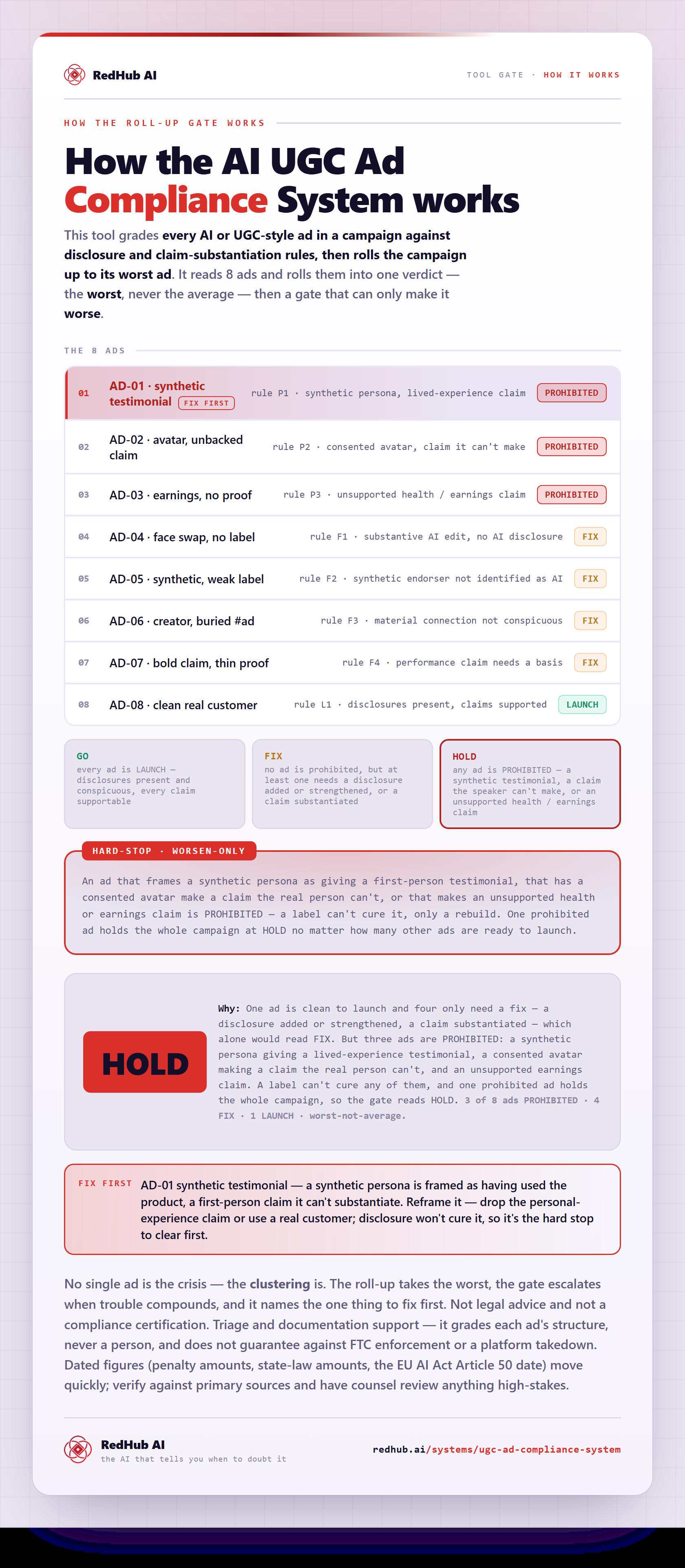
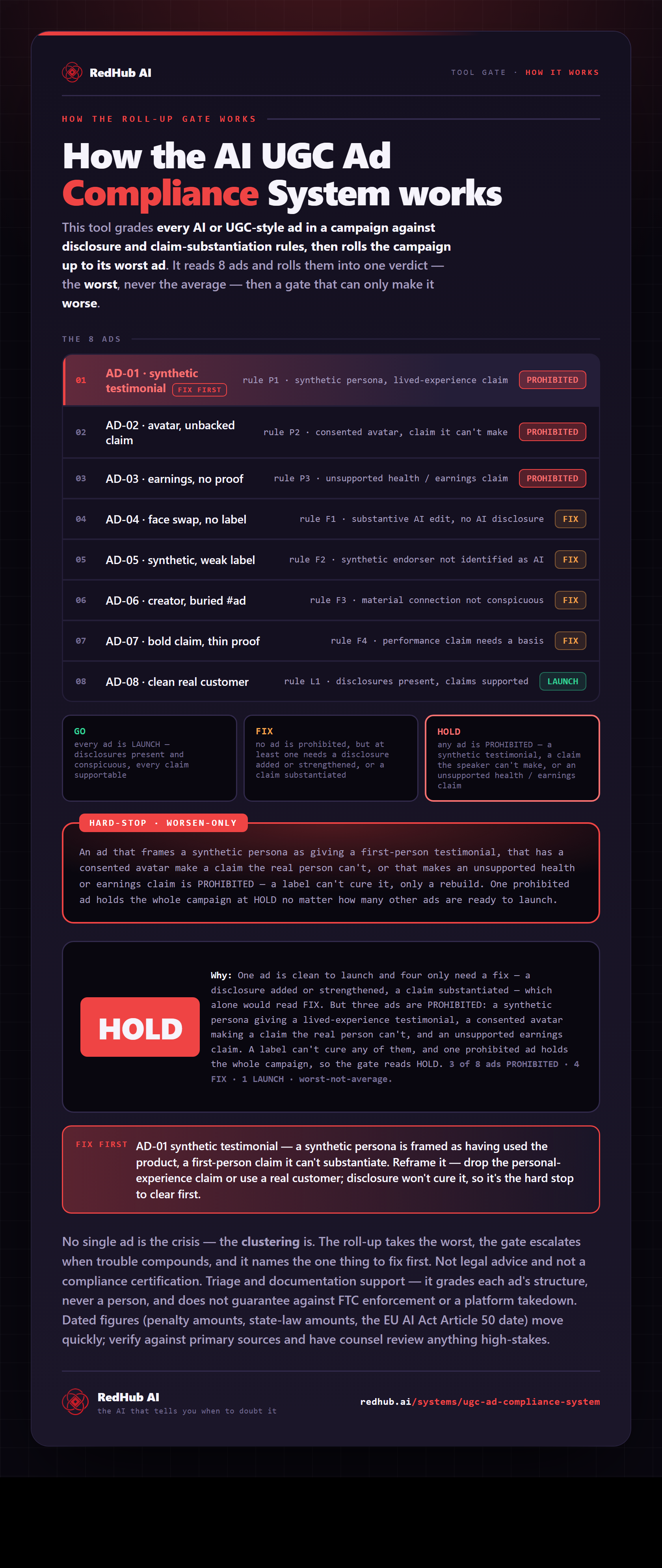
How the gate works, in one image
How the AI UGC Ad Compliance System rolls a campaign up to its worst ad and holds it when one ad is prohibited — the same math the demo runs, as a diagram you can share or embed anywhere.
View & embed the full diagramRun it offline. Get a verdict you can act on.
The Python linter reads a CSV of your ads and prints exactly this — per-ad verdicts with the rule that fired, plus the campaign gate. No install, no network, deterministic. Here’s its output on the sample set:
================================================================
  AI UGC Ad Compliance System
  Evaluation date: 2026-06-18    Assets: 8
================================================================

  CAMPAIGN GATE:  HOLD
  LAUNCH 1   FIX 4   PROHIBITED 3

----------------------------------------------------------------
  [PROHIBITED] AD-01-synthetic-testimonial   (rule P1)
      speaker: synthetic_persona / framing: personal_experience
      - Synthetic persona giving a first-person lived-experience
        testimonial; it never used the product, so the claim is
        unsubstantiable and a label does not cure it. Reframe:
        drop the personal-experience claim or use a real customer.

  [PROHIBITED] AD-02-avatar-unbacked-claim   (rule P2)
      speaker: ai_avatar_of_real_consenting_person
      - Consented avatar delivering a personal-experience claim
        the underlying person cannot actually make. Consent to
        the likeness is not substantiation of the claim.

  [PROHIBITED] AD-03-earnings-noproof   (rule P3)
      speaker: no_person / claim: health_or_earnings
      - Unsupported health or earnings claim - deceptive on its
        face regardless of speaker or disclosure.

  [FIX       ] AD-04-faceswap-nolabel   (rule F1)
      - Substantive AI edit (face swap / voice clone / AI
        lip-sync) requires a clear-and-conspicuous AI disclosure.

  [FIX       ] AD-05-synthetic-nolabel   (rule F2)
      - Synthetic endorser must be clearly identified as
        AI-generated, separate from the sponsorship disclosure.

  [FIX       ] AD-06-creator-buried-disc   (rule F3)
      - A material connection is not disclosed clearly. A hashtag
        in a caption block is not enough - make it unmissable.

  [FIX       ] AD-07-bold-claim-thin   (rule F4)
      - Performance claim needs a reasonable basis. Substantiate
        it, soften it to what the evidence supports, or remove it.

  [LAUNCH    ] AD-08-clean-real-customer   (rule L1)
      - Every required disclosure is present and conspicuous and
        no claim is unsupportable. Ship it.
----------------------------------------------------------------Three principles it holds to.
Reframe, don't relabel
A label can't make a synthetic testimonial true. When disclosure can't cure it, the verdict is PROHIBITED and the fix is the asset, not a sticker.
Structure over labels
Verdicts read what the ad is — who speaks, what's claimed, what's disclosed — not whether a platform toggle is on. So the kit survives changing label tools.
Document the basis
Every claim needs a reasonable basis and every disclosure needs to be conspicuous. The kit makes you record both, so diligence is provable later.
Clear about the lane. No inflated promises.
What it is
- A pre-launch triage that flags disclosure and substantiation gaps per ad.
- A documentation trail you can show if questions arise.
- A shared standard for everyone touching the creative.
What it isn’t
- Legal advice, or a substitute for counsel on high-stakes work.
- A guarantee against enforcement or a platform takedown.
- A live legal database — dated figures need verifying at use.
Not legal advice. This is triage and documentation support. Dated figures — penalty amounts, state-law amounts, the EU AI Act Article 50 date — move quickly; verify against primary sources and have counsel review anything high-stakes.
Built for the teams shipping AI ads at volume.
- DTC and ecommerce brands running AI or UGC-style paid social
- Agencies producing creator and synthetic-persona ads at volume
- Performance marketers scaling AI ad variants who need a pre-launch gate
- Founders who can't afford a regulator's attention on a first campaign
Build the rest of the compliant creative stack.
Voice & Likeness Compliance Gate
Consent and disclosure for a real person's voice or face — the layer before a synthetic edit.
AI Offer & Landing-Page Conversion Kit
The claims themselves: proof, scarcity, and overclaiming, with a claim-honesty linter.
Paid Ads Creative & Testing System
Once an ad is clear, test it one variable at a time and scale only what's statistically real.
The questions marketers actually ask before they ship an AI ad.
Check the ad before it runs.
Not after the complaint.
One purchase, lifetime access, 12 months of updates. The linter, the workbook, the playbooks, and the sample set. $89, once.
Sold by RedHub AI LLC · Secured by Stripe · redhub.ai
Not legal advice. Triage and documentation support — verify dated figures against primary sources and have counsel review anything high-stakes.