You signed the file.Did the credential survive?
Attaching a Content Credential is the easy part. The hard part is that your CDN, your CMS, and every social platform quietly strip it on the way to your audience — so the provenance you worked to add never arrives. This gate grades each asset on five C2PA dimensions and returns one verdict — SIGNED, GAPS, or UNVERIFIABLE — with a hard stop on credentials your own pipeline destroys.
The credential dies in transit — and you never see it happen.
A checklist that grades the asset as you signed it lies to you. This gate grades the asset as your viewer receives it — so a file signed flawlessly at the source but stripped on publish, with no way to recover the credential, is UNVERIFIABLE, and you find out before you stake a trust claim on it.
Mark five dimensions. Toggle the stripping path. Watch it flip.
Stripping gate: the publish path strips the credential and no durable fallback can recover it — UNVERIFIABLE no matter how cleanly the source was signed. A downstream viewer sees an unsigned file.
Mark five C2PA dimensions
Same math as the workbook and the Python engine: five weighted dimensions out of 100, SIGNED at 85+, GAPS at 55+, and a stripping gate that forces UNVERIFIABLE when the credential can’t survive publication and can’t be recovered. It grades the credential, not whether the content is real. Not a deepfake detector.
This is the live engine. Grade your whole library in one workbook + a runnable engine Catch credentials your own CDN strips before anyone sees them Get the one durability fix per asset, with the exact runbook step
Get the kit — $79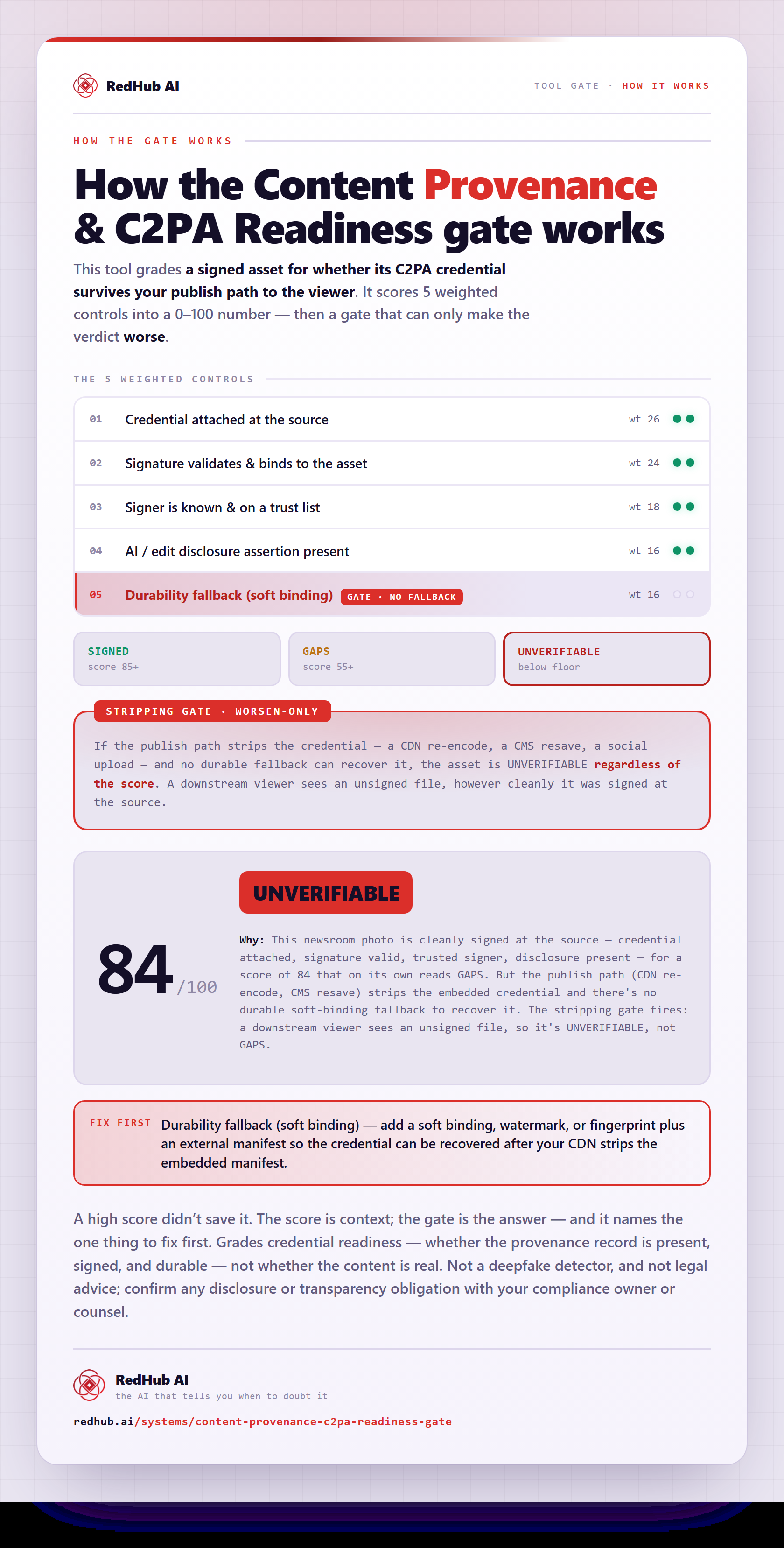
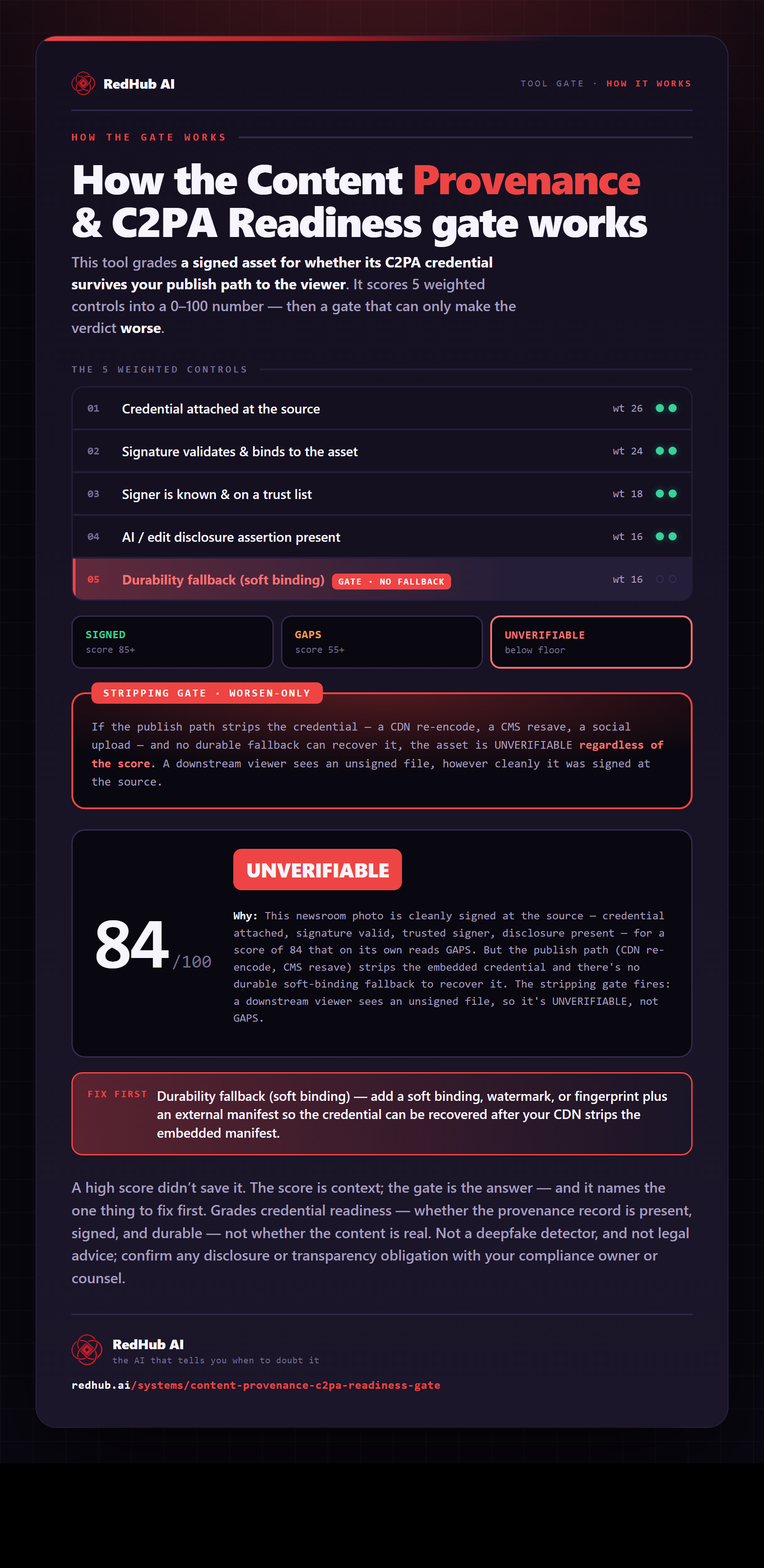
How the gate works, in one image
How the Content Provenance & C2PA Readiness Gate scores a provenance record and forces UNVERIFIABLE when the publish path strips the credential — the same math the demo runs, as a diagram you can share or embed anywhere.
View & embed the full diagramThe same verdict, offline, from your terminal.
The workbook and the Python engine share one config — same dimensions, same weights, same stripping gate. Run it against the shipped seven-asset sample:
$ python3 engine/cpr_engine.py engine/sample_assets.csv

Content Provenance & C2PA Readiness Gate
==========================================
Library: UNTRUSTED CHAIN

Newsroom photo (signed, stripping CDN)
  score 84/100  ->  UNVERIFIABLE   [GATE: credential stripped on publish, no durable fallback -> UNVERIFIABLE]
  fix first: Durability fallback (soft binding) for stripping

Newsroom photo (same, durable fallback)
  score 100/100  ->  SIGNED

Firefly hero image (fully durable)
  score 100/100  ->  SIGNED

Marketing video (no disclosure assertion)
  score 76/100  ->  GAPS
  fix first: AI / edit disclosure assertion present

Stock illustration (unknown signer)
  score 54/100  ->  UNVERIFIABLE
  fix first: Signer is known & on a trust list

Screenshot repost (no credential at all)
  score 0/100  ->  UNVERIFIABLE   [GATE: credential stripped on publish, no durable fallback -> UNVERIFIABLE]
  fix first: Credential attached at the source

Pixel capture (signed, no fallback, kept local)
  score 76/100  ->  GAPS
  fix first: Durability fallback (soft binding) for stripping

Provenance is a nutrition label, not a force field.
It grades credential readiness; it is not a deepfake detector. Not legal advice.
Same asset, one field apart (first two rows): a durable fallback is the difference between UNVERIFIABLE and SIGNED on a stripping pipeline.
Five dimensions, weighted — and one gate that grades survival.
A stripped credential is worth nothing
If the publish path strips the credential and no durable fallback can recover it, the asset is UNVERIFIABLE no matter how well it scored. Where you publish matters as much as how you sign.
Durability is recoverable provenance
Durable Content Credentials — invisible watermark + fingerprint + external manifest repository — let a verifier recover the credential even after a platform strips the embedded copy.
One fix-first per asset
Where a signal is short, the verdict names the single highest-leverage move, and the runbook gives the exact pipeline, signing, or disclosure fix to make.
A readiness gate for the credential. Not a truth machine.
- A deterministic, per-asset verdict on whether your C2PA credential is real and durable.
- A test of the credential as your audience receives it — including your own stripping pipeline.
- A repeatable audit you re-run whenever you change CDN, CMS, or export settings.
- A deepfake detector — it grades the credential, not whether the content is real or true.
- A file scanner — you verify each asset and mark it; it doesn’t read your media for you.
- A compliance certification — for the Article 50 disclosure layer, pair it with the Disclosure Kit.
Provenance is a nutrition label, not a force field. C2PA proves a signed record is present, intact, and bound to the asset — not that the content is real, true, or fairly used, and a missing credential is not proof of fakery. The C2PA spec, trust lists, and surrounding regulations change; re-audit periodically. Not legal advice.
Anyone who stakes trust on the media they publish.
Sign it durably, disclose it legally, defend the brand.
AI Disclosure & Synthetic-Content Labeling Readiness Kit
The legal layer: are your AI surfaces disclosed under EU AI Act Article 50. $79.
ViewVoice & Likeness Compliance Gate
Consent and rights for AI voice and likeness before you publish. $99.
ViewAI Brand Misinformation Watch
Find and correct what AI assistants get wrong about your brand. $99.
ViewWhat teams ask before they buy.
Because the credential lives as a manifest embedded in the file, and almost every publish step rewrites the file. When a CDN re-encodes, a CMS resaves on upload, or a social platform transcodes your image or video, it produces new bytes and discards the embedded C2PA manifest along the way. The signature was never deleted on purpose — it just doesn't survive the round-trip. That is exactly what this gate tests: it grades the asset as your audience receives it, after your own pipeline has touched it, not as you signed it at the source.
Mostly no. Despite public commitments to provenance, most platforms re-encode media on upload, and that re-encode drops the embedded manifest. So a credential you attached perfectly can be gone the moment it lands on a feed. The durable answer is a soft binding — an invisible watermark plus a fingerprint plus an external manifest repository — so a verifier can recover the credential even after the embedded copy is stripped. The gate scores whether that durable fallback is present and forces UNVERIFIABLE when a stripping path has nothing to fall back on.
No. C2PA proves that a signed record is present, intact, and cryptographically bound to the asset — it says where a file came from and what was done to it, not whether the content is real, true, or fairly used. A valid credential does not mean the image is authentic, and a missing credential does not mean it is fake. This gate grades credential readiness, the technical durability of the provenance record. It is a nutrition label, not a force field, and it is not legal advice.
One verdict per asset — SIGNED, GAPS, or UNVERIFIABLE — plus, where a signal is short, a single fix-first that names the highest-leverage move for that asset. You mark each asset on five weighted C2PA dimensions (attached, signature valid, trusted signer, disclosure assertion, durability fallback) and flag whether the publish path strips the credential. A stripping gate hard-stops to UNVERIFIABLE when the credential can't survive and can't be recovered, no matter how cleanly it was signed. A library rollup grades your whole set as VERIFIABLE, PATCHY, or UNTRUSTED CHAIN.
Different layers of the same problem. The AI Disclosure & Synthetic-Content Labeling Readiness Kit audits your disclosure obligations — whether your AI surfaces are labeled the way transparency rules like EU AI Act Article 50 expect — and it deliberately is not a watermarking or detection tool. This gate owns the layer the Disclosure Kit excludes: the technical durability of the cryptographic credential itself, whether your C2PA provenance is attached, signed, trusted, and able to survive your CDN. Sign it durably here, disclose it correctly there.
No scanner is included or required. You verify each asset with whatever C2PA tooling you already use — the Content Credentials inspector, your signing tool's validation output, or your platform's provenance check — and mark what you find. The kit then grades those marks deterministically, offline, the same way every time. It ships a workbook, a runnable Python engine that produces the identical verdict from your terminal, two playbooks, and a seven-asset worked sample so you can see the full scoring before you touch your own library.
Find out if your provenance
actually reaches your audience.
One purchase, lifetime access, 12 months of updates. $79, once.
Provenance is a nutrition label, not a force field. It grades credential readiness — it is not a deepfake detector and does not prove an asset is real. Not legal advice.
Sold by RedHub AI LLC · Secured by Stripe · redhub.ai