Know when the episode is ready.Turn each one into a week of assets.
Score every episode Publish / Tighten / Hold with a hard audio gate, then turn one episode into audio-anchored clips, audiograms, show notes, and chapters — with counts bounded by the moments you actually marked, never invented.
Over-polished, under-repurposed, sometimes shipped broken.
Independent shows lose time re-editing episodes that were ready, occasionally publish one with a defect that costs listeners, and almost never turn an episode into the assets it could become. A gate and a plan fix all three.
How long creators re-edit an episode that was ready — while the calendar slips.
And the one they do ship with bad audio quietly loses listeners in seconds.
Most episodes get published once and repurposed into nothing. The reach is left on the table.
Score an episode, plan its assets.
Score the six criteria on the left for a Publish / Tighten / Hold verdict. Set the length and marked moments on the right to see the repurposing plan. Same logic the workbook and the Python engine run.
Episode readiness
Score each 0–5. Weights sum to 100.
Audio is clean (levels, noise, no clipping)
weight 25
Strong open in the first 30 seconds
weight 20
Clear structure / segments
weight 15
Tight — dead air and rambles cut
weight 15
At least 3 clip-worthy moments
weight 15
Show notes + chapters drafted
weight 10
Ready. Ship it on schedule and run the repurposing plan.
Repurposing plan
Counts sized to runtime, capped by the moments you marked.
Caps clips and quote cards — no inventing.
Move the scores and the planner inputs to see the verdict and asset counts update — same logic as the workbook and the Python engine. Every asset ties to a timestamp you mark; clip counts never exceed the moments you flagged. Reference 2026-06-18. Resets on reload. Synthetic-audio disclosure guidance is not legal advice.
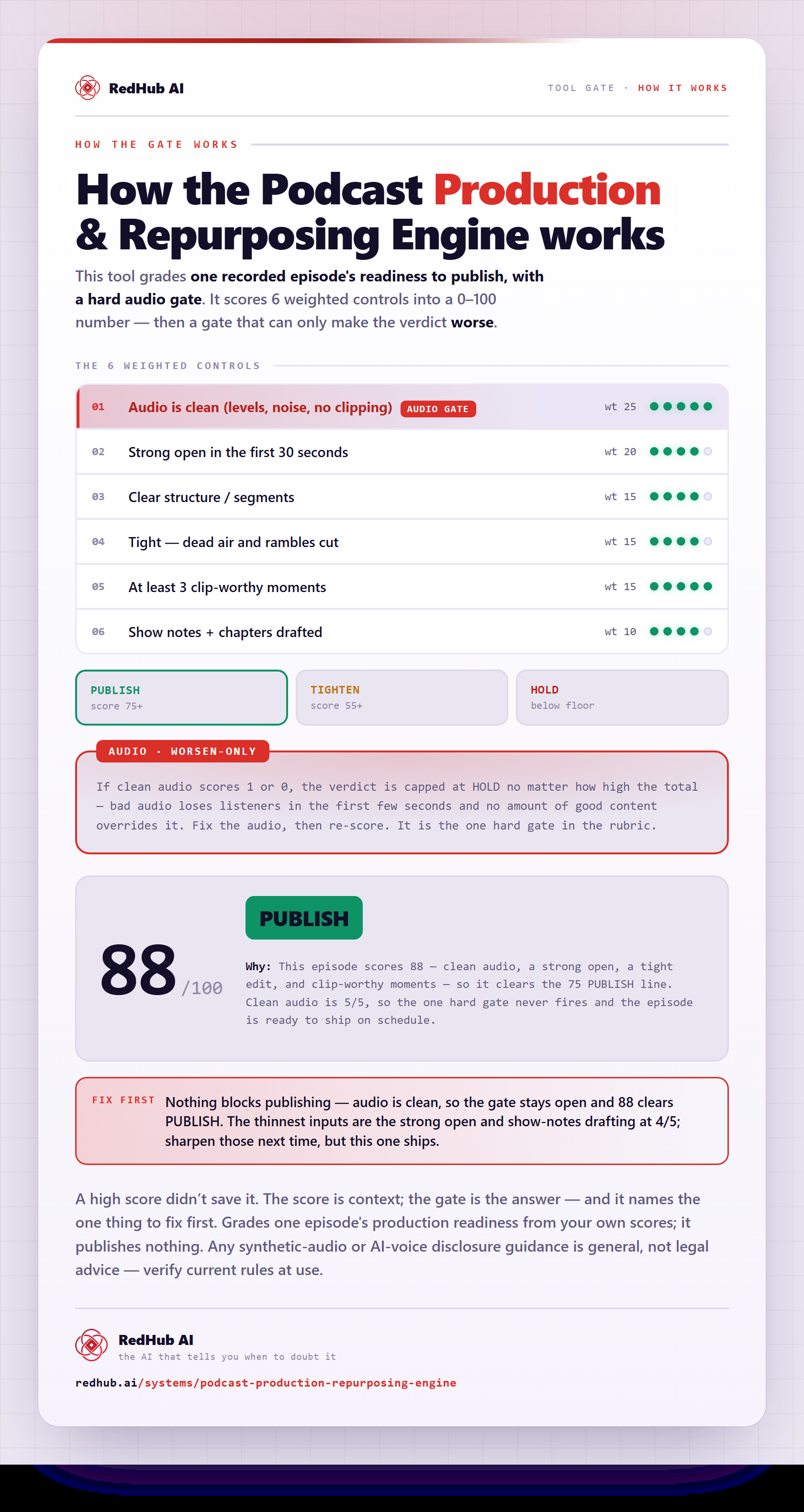
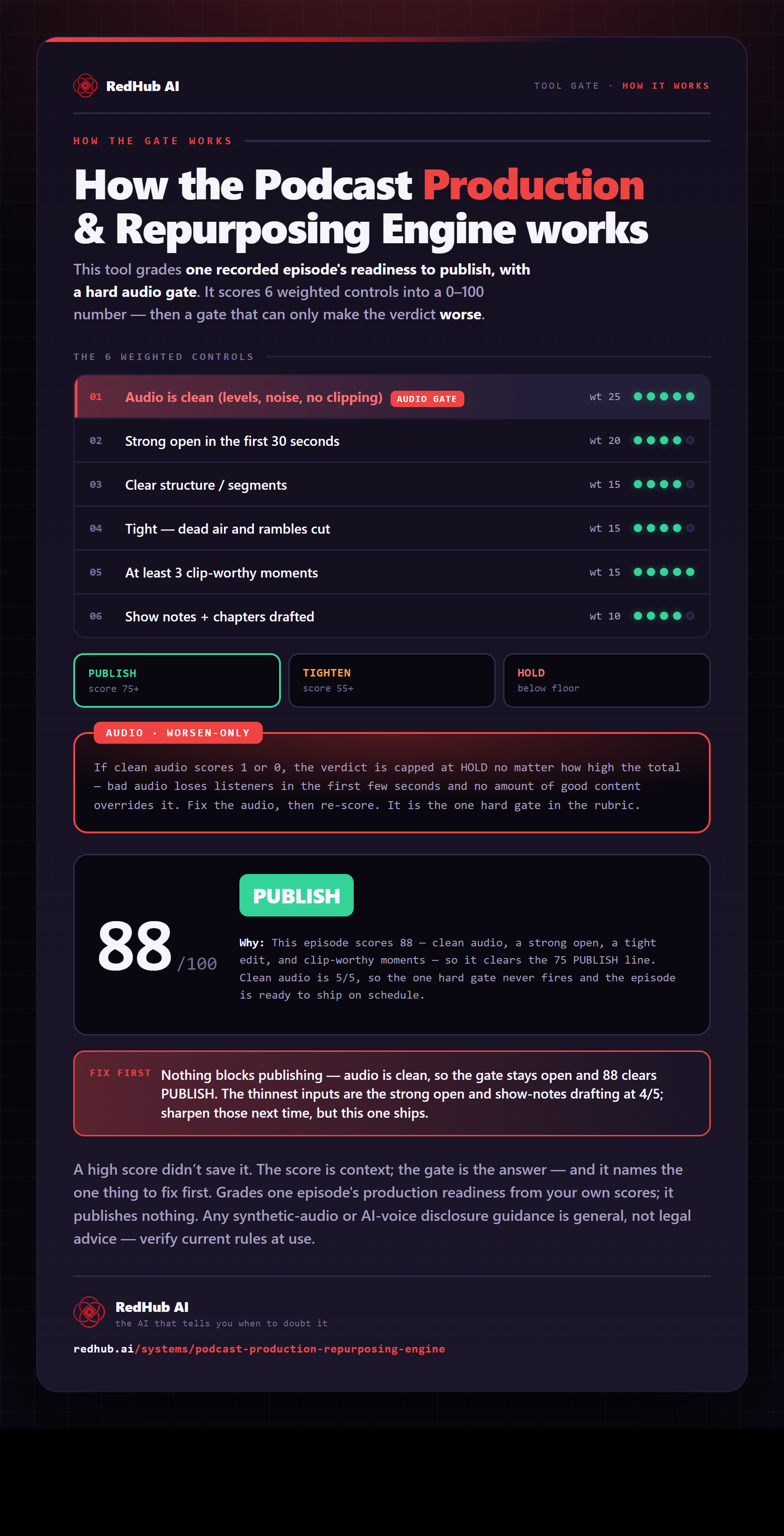
How the gate works, in one image
How the Podcast Production & Repurposing Engine scores an episode's production readiness and caps it at HOLD when the audio isn't clean — the same math the demo runs, as a diagram you can share or embed anywhere.
View & embed the full diagramBatch your whole feed, offline.
The Python engine reads a CSV of episodes and prints exactly this — a verdict per episode (with the audio gate and lift coaching) and a bounded repurposing plan. No install, no network, deterministic. Here’s the sample:
==================================================================
  Podcast Production & Repurposing Engine  (PPR-079)
  Reference date: 2026-06-18
==================================================================

  [HOLD    ] Ep 43: Quick solo - tool roundup  -  54/100   (audio gate: fix R1 first)
      - lift: Audio is clean (levels, noise, no clipping) (now 1/5)
      - lift: Clear structure / segments (now 3/5)
      repurpose (24 min, 3 marked moments): 10 assets
        3x short clips, 3x audiograms, 1x show notes, 3x chapters

  [HOLD    ] Ep 44: Rambly Q&A (needs edit)  -  40/100
      - lift: Tight - dead air and rambles cut (now 1/5)
      - lift: Show notes + chapters drafted (now 1/5)
      repurpose (75 min, 2 marked moments): 3 assets
        2x short clips, 1x show notes

  [TIGHTEN ] Ep 42: Guest interview - creator burnout  -  66/100
      - lift: Show notes + chapters drafted (now 2/5)
      - lift: Strong open in the first 30 seconds (now 3/5)
      repurpose (62 min, 4 marked moments): 20 assets

  [PUBLISH ] Ep 41: Pricing your first deal  -  88/100
      repurpose (48 min, 5 marked moments): 19 assets
        5x short clips, 3x audiograms, 5x quote cards, 1x show
        notes, 4x chapters, 1x newsletter
------------------------------------------------------------------Three principles it holds to.
Ship-ready, not perfect
A Publish / Tighten / Hold verdict against six weighted criteria, so you stop polishing publishable episodes and stop shipping defective ones.
The audio is the source
Every repurposed asset ties to a timestamp you mark. The planner hands you slots to fill, never an invented quote — and never more clips than the moments you flagged.
Bad audio can't pass
Clean audio is a hard gate: score it 1 or 0 and the verdict caps at HOLD regardless of total. No amount of good content overrides unlistenable audio.
Clear about the lane. No inflated promises.
What it is
- An audio-first readiness gate and a bounded repurposing planner.
- Five skills that draft derivatives without inventing facts or quotes.
- Anchored to the episode — every asset ties to a timestamp you mark.
What it isn’t
- Not the text/SEO layer — the blog companion goes to the AEO Repurposing System.
- Not a transcription or hosting tool, and not an audio editor.
- Not legal advice — the synthetic-audio/disclosure notes are general guidance.
On AI voices & disclosure: if you use an AI voice, a clone, or AI-generated audio, disclosure expectations and consent/likeness rules may apply, and an AI-voiced sponsor read may carry #ad duties — see the AI Voice & Likeness Compliance Gate. General guidance, not legal advice; verify current rules at use.
Built for shows that publish on a schedule.
- Independent podcasters who publish on a schedule and want a consistent ship/hold call
- Solo creators turning one episode into a week of social assets
- Shows that keep meaning to repurpose but never systematize it
- Producers who want a defensible quality bar before an episode goes out
Produce it here, optimize and distribute next.
AEO-Aware Content Repurposing System
The text/citation layer this hands off to — optimize the blog companion for AI answer engines. Audio here, written anchors there.
Organic Social & Short-Form Video System
Turn the clips and audiograms into a sustained short-form cadence with a hook engine and pillars.
Brand Voice Engine
Keep show notes, titles, and clips sounding unmistakably like you across every derivative.
The questions podcasters actually ask before they ship an episode.
Publish with confidence.
Repurpose without guessing.
One purchase, lifetime access, 12 months of updates. The engine, the workbook, five skills, and two playbooks. $79, once.
Sold by RedHub AI LLC · Secured by Stripe · redhub.ai