The third scratchis a process.
The CAPA decision fails in two directions, and most quality systems police neither. Promote every minor scratch to a full CAPA and the desk drowns in paperwork while the two CAPAs that matter wait in the queue. Disposition the same part-and-cause repeat forever and the systemic cause never gets fixed. This triage routes every NCR in your log — and then grades the calls your team actually made, in both directions.
Your CAPA queue is full. The wrong things are in it.
Open CAPAs in the sample log that are minor, contained, first-occurrence overkill — 57% of the desk’s workload spent investigating one-off cosmetic scratches with full root-cause paperwork.
Occurrence of the same scratch, same part, same cause code, inside 90 days — dispositioned use-as-is again. The first scratch is a disposition. The third scratch is a process.
CAPAs open on it. The one investigation the log is begging for doesn’t exist — it’s standing in line behind four cosmetic one-offs. That’s both failure modes in one desk.
Twelve NCRs, both failure modes — live.
| NCR | Part | Cause | Sev | Flags | Rec | Routing verdict | Actual | Call |
|---|---|---|---|---|---|---|---|---|
| NCR-2411 | P-2201 | 1 | DISPOSITION AND CLOSE | aligned | ||||
| NCR-2415 | P-3310 | 1 | DISPOSITION AND CLOSE | CAPA OVERKILL | ||||
| NCR-2419 | P-1105 | 1 | CORRECT AND WATCH | aligned | ||||
| NCR-2423 | P-2201 | 2 | DISPOSITION AND CLOSE | aligned | ||||
| NCR-2427 | P-4420 | 1 | DISPOSITION AND CLOSE | CAPA OVERKILL | ||||
| NCR-2430 | P-3310 | 1 | DISPOSITION AND CLOSE | CAPA OVERKILL | ||||
| NCR-2433 | P-5501 | 1 | OPEN A CAPA | aligned | ||||
| NCR-2436 | P-6600 | 1 | OPEN A CAPA · ESCAPE | aligned | ||||
| NCR-2440 | P-2201 | 3 | OPEN A CAPA · REPEAT OFFENDER | MISSED ESCALATION | ||||
| NCR-2444 | P-7700 | 1 | DISPOSITION AND CLOSE | CAPA OVERKILL | ||||
| NCR-2448 | P-8800 | 1 | OPEN A CAPA | MISSED ESCALATION | ||||
| NCR-2452 | P-9900 | 1 | CORRECT AND WATCH | aligned |
Try it: open the CAPA on NCR-2440 (the third scratch) and fix-first moves to the uncontained major at NCR-2448. Or recode NCR-2440’s cause and watch the REPEAT OFFENDER trigger release — same part, different cause, different process.
Same math as the engine and the workbook — byte-for-byte. Each NCR is judged as of its own date. Nothing here is scored by AI, nothing leaves this page, and the verdict will not soften because you wanted it to.
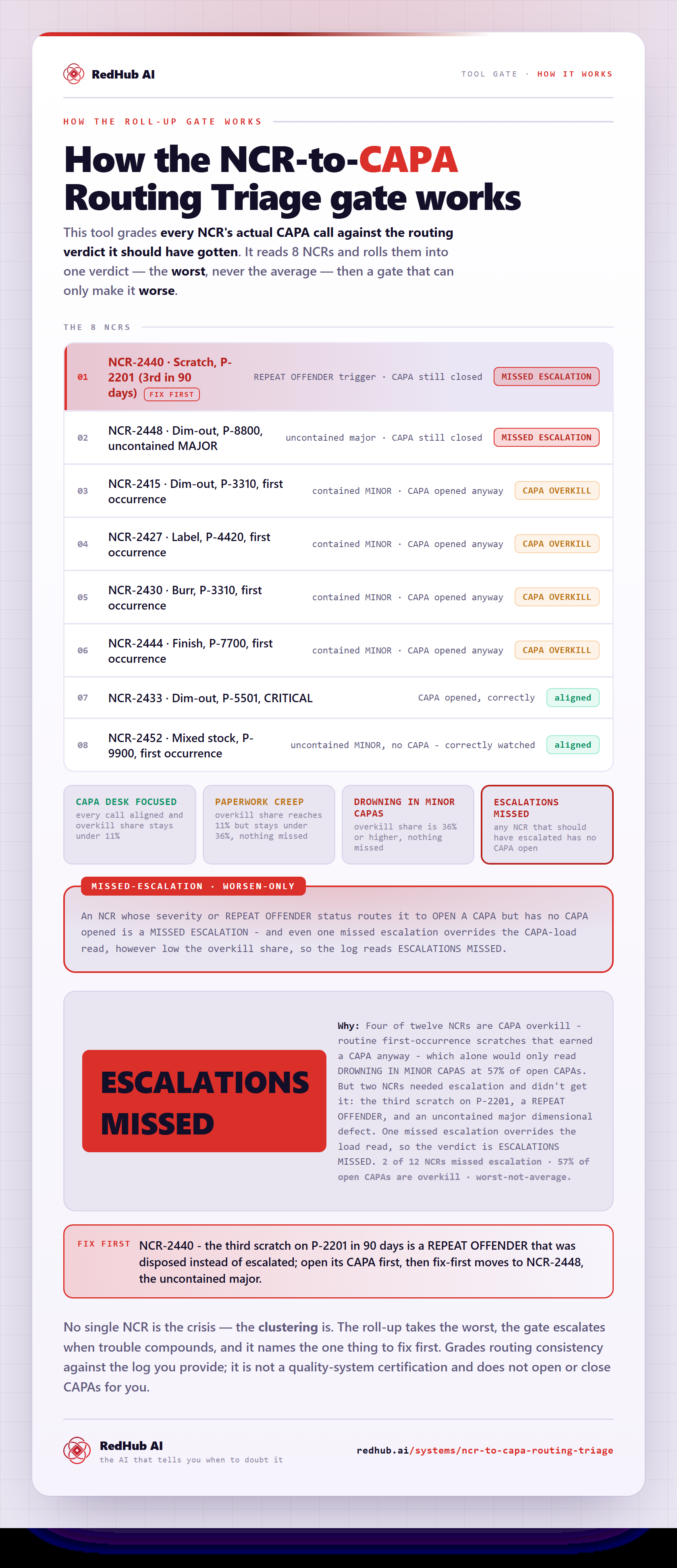
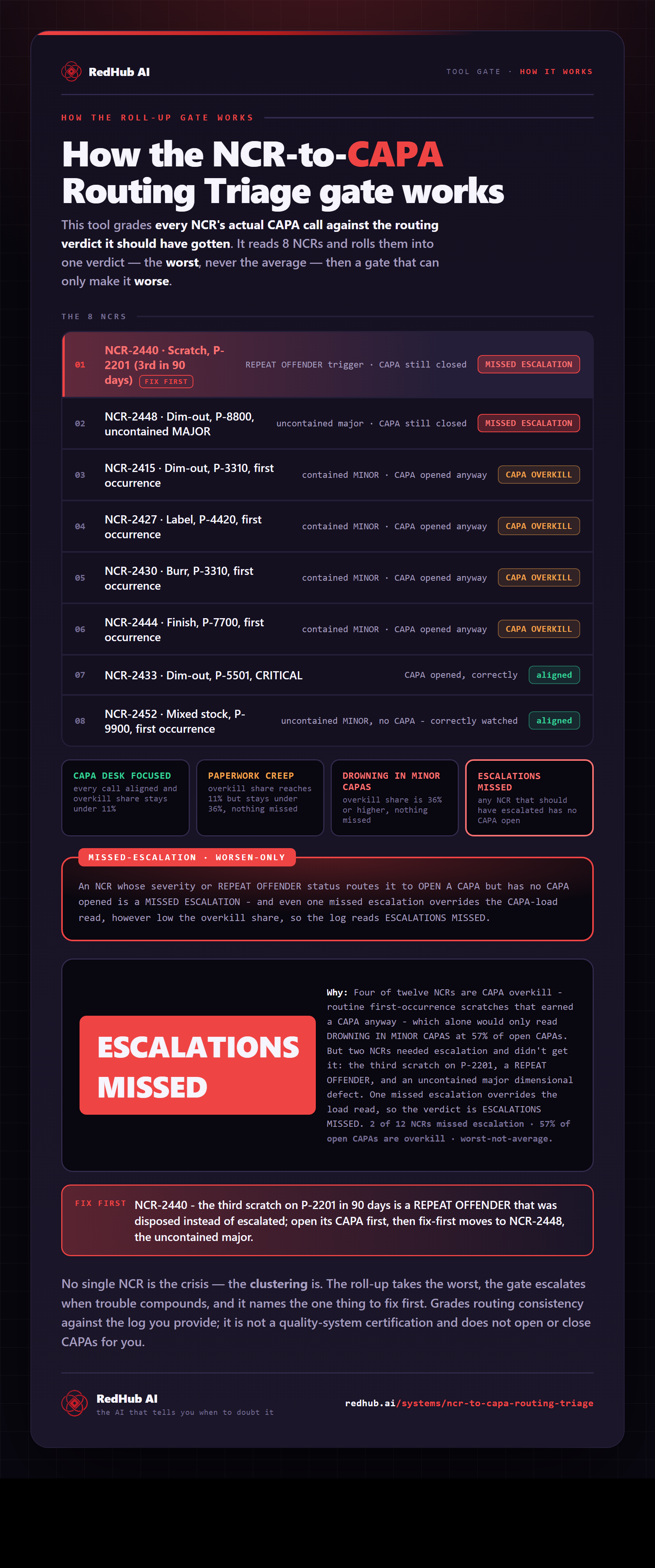
How the gate works, in one image
How the NCR-to-CAPA Routing Triage routes 12 nonconformances and forces ESCALATIONS MISSED when a repeat or uncontained major has no CAPA — the same math the demo runs, as a diagram you can share or embed anywhere.
View & embed the full diagramA routing you can run, not a policy field left blank.
The engine is zero-dependency Python — point it at your NCR log export and it routes every record, flags both triggers, and grades the desk. The workbook reproduces the identical logic for the spreadsheet-native, and the demo above runs the same math. Each NCR is judged as of its own date, so nothing in the tool ever reads today’s date. This is the engine’s verbatim output on the shipped sample:
NCR-TO-CAPA ROUTING TRIAGE - NCT-089
==================================================================
NCRs read: 12   CAPAs actually opened: 7

NCR       PART    CAUSE        SEV       REC  ROUTING VERDICT                ACTUAL   CALL
NCR-2411  P-2201  SCRATCH      MINOR       1  DISPOSITION AND CLOSE          closed   aligned
NCR-2415  P-3310  DIM_OOT      MINOR       1  DISPOSITION AND CLOSE          CAPA     CAPA OVERKILL
NCR-2419  P-1105  POROSITY     MAJOR       1  CORRECT AND WATCH              CAPA     aligned
NCR-2423  P-2201  SCRATCH      MINOR       2  DISPOSITION AND CLOSE          closed   aligned
NCR-2427  P-4420  LABEL        MINOR       1  DISPOSITION AND CLOSE          CAPA     CAPA OVERKILL
NCR-2430  P-3310  BURR         MINOR       1  DISPOSITION AND CLOSE          CAPA     CAPA OVERKILL
NCR-2433  P-5501  DIM_OOT      CRITICAL    1  OPEN A CAPA                    CAPA     aligned
NCR-2436  P-6600  COATING      MAJOR       1  OPEN A CAPA [ESCAPE]           CAPA     aligned
NCR-2440  P-2201  SCRATCH      MINOR       3  OPEN A CAPA [REPEAT OFFENDER]  closed   MISSED ESCALATION
NCR-2444  P-7700  FINISH       MINOR       1  DISPOSITION AND CLOSE          CAPA     CAPA OVERKILL
NCR-2448  P-8800  DIM_OOT      MAJOR       1  OPEN A CAPA                    closed   MISSED ESCALATION
NCR-2452  P-9900  MIXED_STOCK  MINOR       1  CORRECT AND WATCH              closed   aligned

CAPA load: 4 of 7 open CAPAs are minor first-occurrence overkill (57%) - DROWNING IN MINOR CAPAS
Escalations missed: 2

VERDICT: ESCALATIONS MISSED
Fix first: NCR-2440
Built so the verdict can’t be negotiated.
Categorical, not scored
No 0–100 score, on purpose. A score invites the negotiation — “it’s a 62, let’s not open one” — that a routing decision shouldn’t allow. Severity and containment route the NCR; two triggers can only force it upward. DISPOSITION AND CLOSE is a first-class verdict, stated proudly: closing a minor one-off is quality discipline, not quality laziness.
Recurrence has a memory
The repeat trigger counts same-part, same-cause NCRs inside the trailing window, judged as of each NCR’s own date. The Nth occurrence forces OPEN A CAPA no matter how minor the marks — and a customer escape forces it the same way. Worsen-only: triggers escalate, never soften.
Both directions, never averaged
The CAPA-load read grades the paperwork problem; the escalation read grades the systemic-blindness problem. They sit side by side, unblended — and a missed escalation forces the verdict, because a missing systemic CAPA outranks any amount of paperwork.
The routing layer your QMS shipped blank.
- The decision layer that works with your QMS, not instead of it: export the NCR log as CSV, run the triage, execute the verdicts back in ETQ, MasterControl, QT9, uniPoint — or the binder. For paper shops, the workbook is the triage log.
- A two-sided audit of the desk’s actual calls: overkill CAPAs named for closure, missed escalations named for opening, one fix-first NCR ranked by trigger strength.
- A monthly discipline: the runbook installs the triage-at-intake habit, the recurrence review, and the CAPA-queue cleanup that gets the two real investigations to the front.
- A QMS, an eQMS module, or anything that connects to one. It reads a CSV you export and grades routing; your QMS keeps the forms, signatures, and audit trail.
- CAPA-phobic. A CAPA opened on the middle verdict is treated as a judgment call, not flagged — the tool only calls overkill on minor, contained, first-occurrence, non-escape NCRs.
- A compliance determination. The thresholds are your documented escalation criteria, entered by you; where regulations or customer requirements mandate CAPA behavior, they override this tool — full stop.
Scope note. This tool grades NCR-to-CAPA routing consistency against escalation criteria you enter — it scores routing decisions, never people. It is not a quality-management system, not a compliance determination, and not a certification of any standard. In regulated industries, your documented procedures and any regulatory or customer QMS requirements override this tool. Not legal advice.
Anyone whose CAPA queue has become a filing cabinet.
Quality managers whose CAPA backlog is measured in months while the same part keeps coming back
Job-shop owners who suspect the quality system generates paperwork instead of fixes but can't prove which is which
Ops leads who want the escalation criteria to be a rule the log enforces, not a policy field nobody filled in
Quality engineers doing the monthly management review who need both failure modes on one page
Teams inheriting a CAPA queue and needing to triage it honestly: close the overkill, open the missing
Shops preparing for an audit who want routing consistency demonstrated from their own log before the auditor asks
The quality leg of the honesty desk.
Cost-of-Poor-Quality Ledger
$99What the un-fixed repeats cost: price the scrap, rework, and warranty behind every NCR the desk closed too fast.
PM Deferral & Pencil-Whip Tripwire
$89The same integrity audit pointed at maintenance: the PMs marked done that never happened.
OEE Honesty Grader
$99Whether the availability and quality rates feeding your metrics are even real — before you plan around them.
Straight answers, before you pay.
No — it works with it, deliberately. Your QMS (ETQ, MasterControl, QT9, uniPoint, or the paper binder) is the workflow layer: forms, signatures, dispositions, audit trail. What none of them ship is an honest routing layer — most will happily let a team open a CAPA for every cosmetic scratch or disposition the same repeat forever. Export the NCR log as CSV, run the triage, and execute the verdicts back in your QMS. For paper shops, the workbook itself is the triage log.
The opposite is the point. DISPOSITION AND CLOSE is a first-class verdict, stated proudly: a minor, contained, first-occurrence NCR does not deserve a CAPA, and opening one is itself a quality-system failure — it buries the two CAPAs that matter under forty cosmetic scratches. The desk read quantifies exactly that: what share of your open CAPAs are minor first-occurrence overkill.
Each NCR is judged as of its own date: the trigger counts NCRs with the same part and same cause code inside the trailing window (default: 3rd occurrence in 90 days, both yours to confirm). The Nth occurrence forces OPEN A CAPA regardless of how minor the marks read — the first scratch is a disposition, the third scratch is a process. A customer escape forces it the same way. Both triggers are worsen-only: they can escalate a verdict, never soften one.
The tool grades the decisions your team actually made against its routing. No CAPA on an OPEN A CAPA verdict is a MISSED ESCALATION; a CAPA opened on a DISPOSITION AND CLOSE verdict is CAPA OVERKILL. A CAPA on the middle verdict, CORRECT AND WATCH, is treated as a judgment call and not flagged — the tool is deliberately not CAPA-phobic. Any missed escalation forces the verdict to ESCALATIONS MISSED, because a missing systemic CAPA outranks any amount of paperwork.
As a decision aid only, and with your procedures on top. The thresholds are your documented escalation criteria, entered by you — and where regulations or customer requirements mandate CAPA behavior, those override this tool, full stop. It grades routing consistency against criteria you confirm; it is not a compliance determination, not a quality-system certification, and not legal advice.
Eight columns per NCR: ID, part, cause code, date, severity (MINOR/MAJOR/CRITICAL), customer-escape flag, containment flag, and whether a CAPA was actually opened. Every eQMS exports these; a binder provides them in an afternoon. Nothing is scored by AI — it's deterministic and offline, the same log in produces the same verdict out in the engine, the workbook, and this page's demo alike.
Close the paperwork.
Open the one that matters.
One purchase, lifetime access, 12 months of updates. $89, once.
Grades NCR routing, never a person. Regulatory and customer QMS requirements override this tool. Not certification or legal advice.
Sold by RedHub AI LLC · Secured by Stripe · redhub.ai