Packaging problem,or content problem?
Score your packaging against your own channel baseline, and A/B test it with real statistics. Know whether a video’s problem is the thumbnail or the content — and whether a thumbnail test actually won, or just got a three-day bump that was noise.
A SHIP / TIGHTEN / REWORK verdict per video and a significance-checked winner per test — never a guess. Retention is the gate; packaging is the optimization.
Two packaging mistakes quietly cost channels growth.
The first is scaling a thumbnail on a three-day bump that was really just noise. The second is celebrating a high click-through rate on a video people leave early — the exact mismatch the algorithm reads as a broken promise and stops recommending.
This engine refuses to make either one. It only calls an A/B winner when the result is statistically real, and it refuses to tell you to scale a high-CTR, low-retention video. No guaranteed views, no vanity metric — just an honest read of your own numbers.
A thumbnail that 'won' on 1,200 impressions usually didn't — that's a coin flip. The engine runs a real two-proportion z-test and only calls a winner when the gap clears significance.
A great thumbnail on a video people leave early is the mismatch the algorithm suppresses. That's REWORK, not SHIP — and no amount of repackaging fixes a content problem.
A 4% CTR is excellent in one niche and weak in another. Every verdict is indexed to your channel's own norm, not an industry benchmark you can't act on.
Change the numbers and watch the verdicts move.
This is the same logic that ships in the Python engine and the workbook — the A/B significance test on the left, the per-video diagnosis on the right. Nothing is sent and nothing is stored.
Is this A/B winner real?
Two-proportion test on a thumbnail or title test.
CTR A 5.00% · CTR B 6.00% · z 1.07
Not significant yet. About 8,155 impressions per variant would be needed to confirm a gap this size. Don't scale on this.
Packaging problem or content problem?
Judged against your own channel baseline.
CTR is at/above baseline but retention is below it. The packaging overpromises and the algorithm suppresses the mismatch. Fix the open and payoff; don't scale the click.
Indexes are this video ÷ your baseline. Retention below your baseline is always REWORK — packaging can't fix a content problem.
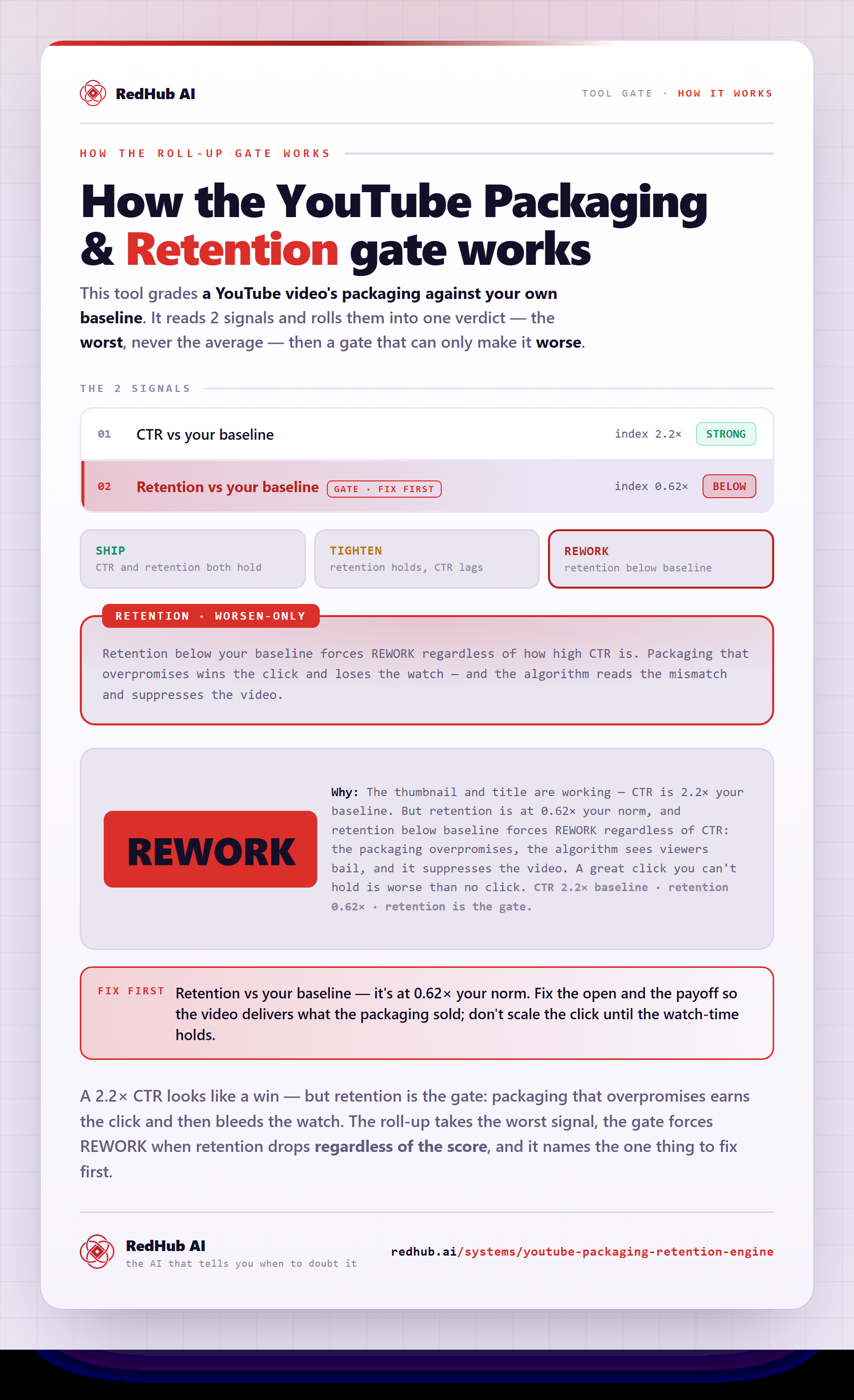
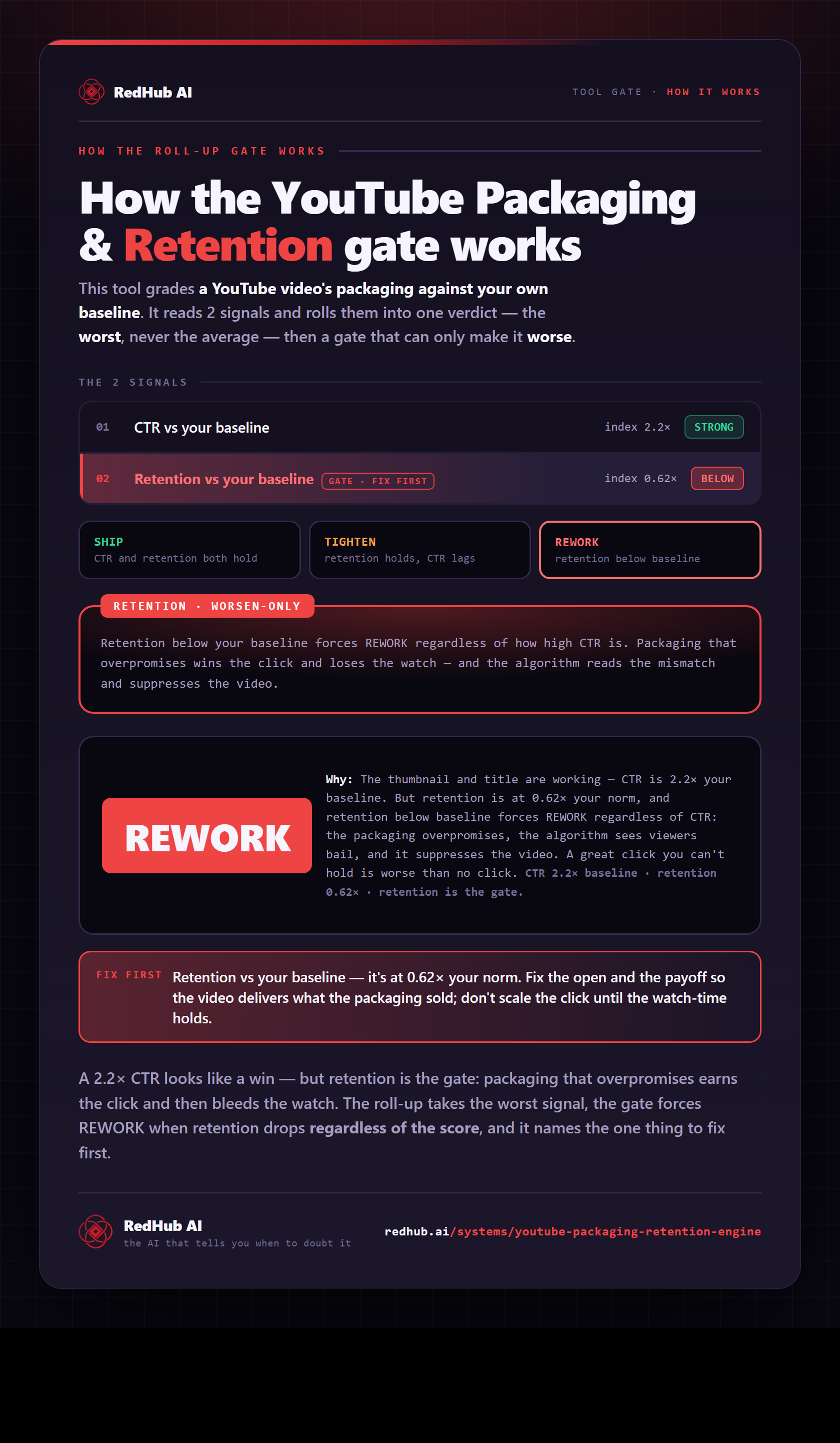
How the gate works, in one image
CTR and retention rolled up against your own baseline and the retention gate that forces REWORK when watch-time drops even as CTR soars — the same math the demo runs, as a diagram you can share or embed anywhere.
View & embed the full diagramThe engine actually runs. Here’s real output.
This is the included youtube_packaging_engine.py on five sample videos and two thumbnail tests — including the viral-looking video it refuses to scale, and the A/B lead it calls too thin to trust.
$ python3 youtube_packaging_engine.py --videos sample/sample-videos.csv \
      --tests sample/sample-ab-tests.csv --base-ctr 4.0 --base-apv 45

========================================================================
YOUTUBE PACKAGING & RETENTION ENGINE
As-of: 2026-06-18
========================================================================

VIDEO DIAGNOSIS   (baseline CTR 4.0%  ·  baseline APV 45%  ·  band ±10%)

[SHIP]  How I edit a video in 20 minutes
  CTR 6.2% (index 1.55)   APV 52% (index 1.16)   impressions 180,000
  CTR and retention both at or above your baseline. Scale this packaging pattern.

[TIGHTEN]  My full camera setup for 2026
  CTR 3.1% (index 0.78)   APV 58% (index 1.29)   impressions 95,000
  Retention holds but CTR lags. The content works; the packaging is not earning the click. Rework the title/thumbnail and keep the video.

[REWORK]  I tried the viral $5 microphone
  CTR 8.9% (index 2.23)   APV 28% (index 0.62)   impressions 420,000
  CTR is at/above baseline but retention is below it. The packaging overpromises and the algorithm suppresses the mismatch. Fix the open and payoff, or change the promise; do not scale the click.

[REWORK]  Channel update — what's next
  CTR 2.2% (index 0.55)   APV 31% (index 0.69)   impressions 60,000
  CTR and retention both below baseline. Rework packaging and content before promoting.

[SHIP]  Lightroom preset pack walkthrough
  CTR 4.1% (index 1.02)   APV 46% (index 1.02)   impressions 120,000
  CTR and retention both at or above your baseline. Scale this packaging pattern.

  Channel read:  SHIP 2   TIGHTEN 1   REWORK 2
  Top quick win: re-title/re-thumbnail “My full camera setup for 2026” (95,000 impressions, retention already holds).

========================================================================
A/B PACKAGING SIGNIFICANCE   (two-proportion z-test, alpha 0.05)

[WINNER]  Face vs no-face thumbnail
  CTR A 4.00%   CTR B 4.60%   z 4.68   p 0.000
  Variant B wins. Roll it out.

[KEEP TESTING]  Title: "How I" vs "How to"
  CTR A 5.00%   CTR B 6.00%   z 1.07   p 0.283
  No significant difference yet. About 8,155 impressions per variant would be
  needed to confirm a gap this size. Don't scale on this result.

========================================================================
Verdicts are relative to your own baseline. No tool guarantees views.
========================================================================
The A/B test is a real two-proportion z-test; the diagnosis indexes each video to your own baseline. --json for tooling. The engine, the workbook, and the demo above share one logic and are verified to agree on the sample (z 4.68 / p 0.000 and z 1.07 / p 0.283).
Retention is the gate. Packaging is the optimization.
Clicks get someone in the door; watch time decides whether the door stays open. Three principles keep every verdict honest:
Retention gates packaging
A video below your retention baseline is always REWORK, no matter how good the thumbnail. Packaging only becomes the lever once retention holds — so the engine never tells you to scale a high-CTR, low-retention video.
Significance, not a bump
An A/B winner is called only when a two-proportion z-test clears alpha. If it doesn't, the engine names roughly how many more impressions per variant you'd need — so you never scale a coin flip.
Your numbers, not a benchmark
Every index is this video ÷ your own channel baseline. No industry average, no promised CTR or view count. The honest spine: no tool guarantees views — this one measures the gap.
The measurement layer in front of your creation tools.
Creation tools make the video, the hook, the thumbnail. None of them tell you whether the packaging actually earned the click or whether a test really won. This is the layer that does — then sends you back to create with a clear read.
- ·Generate the hook, script, thumbnail, or series
- ·Optimize for output and ideas
- ·Can't tell a real A/B win from noise
- ·Leave the packaging call to your gut
- ·Verdicts each video against your own baseline
- ·Runs a real significance test on A/B thumbnails
- ·Refuses to scale a high-CTR, low-retention video
- ·No guaranteed views — an honest gap analysis
Set your channel's own baseline CTR and average percentage viewed. Every verdict is indexed to your norm, not an industry benchmark.
Each video gets SHIP / TIGHTEN / REWORK — is the problem the packaging or the content? Retention is the gate.
Run a real significance test on a thumbnail/title A/B. It calls a winner only when the result clears the bar — or names how much more data you need.
Scale what SHIPs, repackage what's TIGHTEN, fix what's REWORK. No guaranteed views — just honest reads from your own numbers.
Clear about the lane. No inflated promises.
- The engine (Python) — A runnable tool that diagnoses your videos against your baseline and runs the two-proportion A/B significance test. Standard library only; runs offline, no API key. --as-of pins the report; --json for tooling.
- The workbook — The identical logic as a live spreadsheet — Start Here, Video Diagnosis, A-B Significance, and a Dashboard rollup. Set your baseline, paste your videos, run tests, read the verdicts. No setup.
- Packaging & Retention Playbook — How the engine decides, why retention is the gate and packaging is the optimization, and the A/B testing discipline that keeps you from scaling noise.
- Title, Thumbnail & Hook Patterns — Copy-ready title formulas, a thumbnail legibility checklist, and first-30-second hooks that protect retention — without overpromising. Plus 5 sample videos and 2 sample A/B tests.
- No guaranteed views — every verdict is a gap analysis from your own data, never a promised lift, CTR, or view count.
- Not a creation tool — it measures packaging; it doesn't write hooks, scripts, or make thumbnails. Pair it with the creation layer.
- Not the official algorithm — it reflects widely-reported behavior and YouTube creator guidance; exact ranking weights aren't public. It's a decision aid, not a formula.
- No fake confidence — a thin A/B sample gets 'keep testing', not a declared winner; a high-CTR, low-retention video gets REWORK, not SHIP.
- No SaaS, no monthly fee, no telemetry — your channel numbers never leave your environment.
Creators and channels that want the truth, not the bump.
Creators scaling a channel
If you're deciding which thumbnail to roll out and which video pattern to repeat, the engine tells you what actually worked — and refuses to let a noisy A/B or a clickbait spike fool you.
Channel teams & editors
A shared, objective verdict on every upload — SHIP / TIGHTEN / REWORK — so packaging decisions stop being an argument and start being a read of the numbers.
Agencies running channels
Defensible reporting for clients: significance-tested A/Bs and baseline-indexed diagnoses, so you can show why you repackaged one video and reworked another.
Organic Social & Short-Form Video System
The creation layer for short video — originate the hooks and series this engine then helps you package and significance-test.
AEO-Aware Content Repurposing System
Turn one video that's proven to land into omni-channel pieces — repurpose what SHIPs, not what got a noisy bump.
Distinctive AI Visuals Kit
Make thumbnails and on-brand visuals that look like you, not everyone's defaults — then test whether they earn the click.
The questions creators actually ask before they scale a thumbnail.
No. Every number is a gap analysis from your own channel data. The engine never promises a view count, a CTR, or a retention rate — it tells you whether a result is real and whether a video's problem is packaging or content.
SHIP means CTR and retention are both at or above your baseline — scale the pattern. TIGHTEN means retention holds but CTR lags, so the content works and only the packaging needs a rework; keep the video. REWORK means retention is below your baseline, which packaging can't fix — including the high-CTR, low-retention case the algorithm suppresses.
Because most early A/B leads are noise. The engine runs a two-proportion significance test and only calls a winner when the difference clears the bar. If it doesn't, it tells you roughly how many more impressions per variant you'd need — so you don't scale a coin flip.
It works at any size. Smaller channels simply need more impressions to detect smaller differences, and the engine is honest about that — it will say keep testing rather than pretend a thin sample is conclusive.
From your own baseline CTR and average percentage viewed, not an industry benchmark. A 4% CTR is excellent in some niches and weak in others, so the engine indexes every video to your channel's own norm.
It reflects widely-reported behavior and YouTube's own creator guidance — that watch time matters and that a high-CTR, low-retention mismatch underperforms — but exact ranking weights are not public. Treat it as a decision aid grounded in reported behavior, not an official formula.
Package and test like the numbers matter.
The engine, the workbook, both playbooks, and the worked examples — one purchase, yours to run on every video. Diagnose against your own baseline, significance-test your thumbnails, and stop scaling what only looked like a win.
No tool guarantees views. Every verdict is a gap analysis from your own channel data.
Sold by RedHub AI LLC · Secured by Stripe · redhub.ai