Find out if any legstops an agent purchase.
Mark five stages from finding your store to a confirmed order. The relay takes the weakest stage as the headline, because a path is only as open as its weakest leg, and where a stage is short, it names that stage and where to fix it.
It grades your own marks about your own store. It does not visit your site, test a live checkout, contact any agent, or predict what any agent or platform will do.
A store can pass four checks and still lose the sale at the fifth.
is enough. An agent that is found, understands the catalog and is permitted still leaves if checkout needs a step only a person can pass.
A healthy mean can sit on top of one stage near zero. The path is only as open as that stage, so the relay headlines the minimum.
run from being found to a confirmed order. Single-stage tools grade one of them. Nobody grades the handoffs between stages, and that is where the path breaks.
Mark five stages. The weakest leg sets the verdict, and where it is short, the relay names it.
Can an agent reach and read your store at all?
Can an agent understand what you sell and trust it?
Have you decided which agents may do what, and can they tell?
Can a permitted agent finish the checkout?
Can both sides show the order happened?
Stall gate tripped. A stage at or below 40 stops the path however high the other four score.
Fix-It Runbook, section 3: Authorization. It is in the download.
From your own marks · pinned to 2026-10-31 · no AI, no baked-in multiplier · it does not test a live checkout or predict what any agent will do.
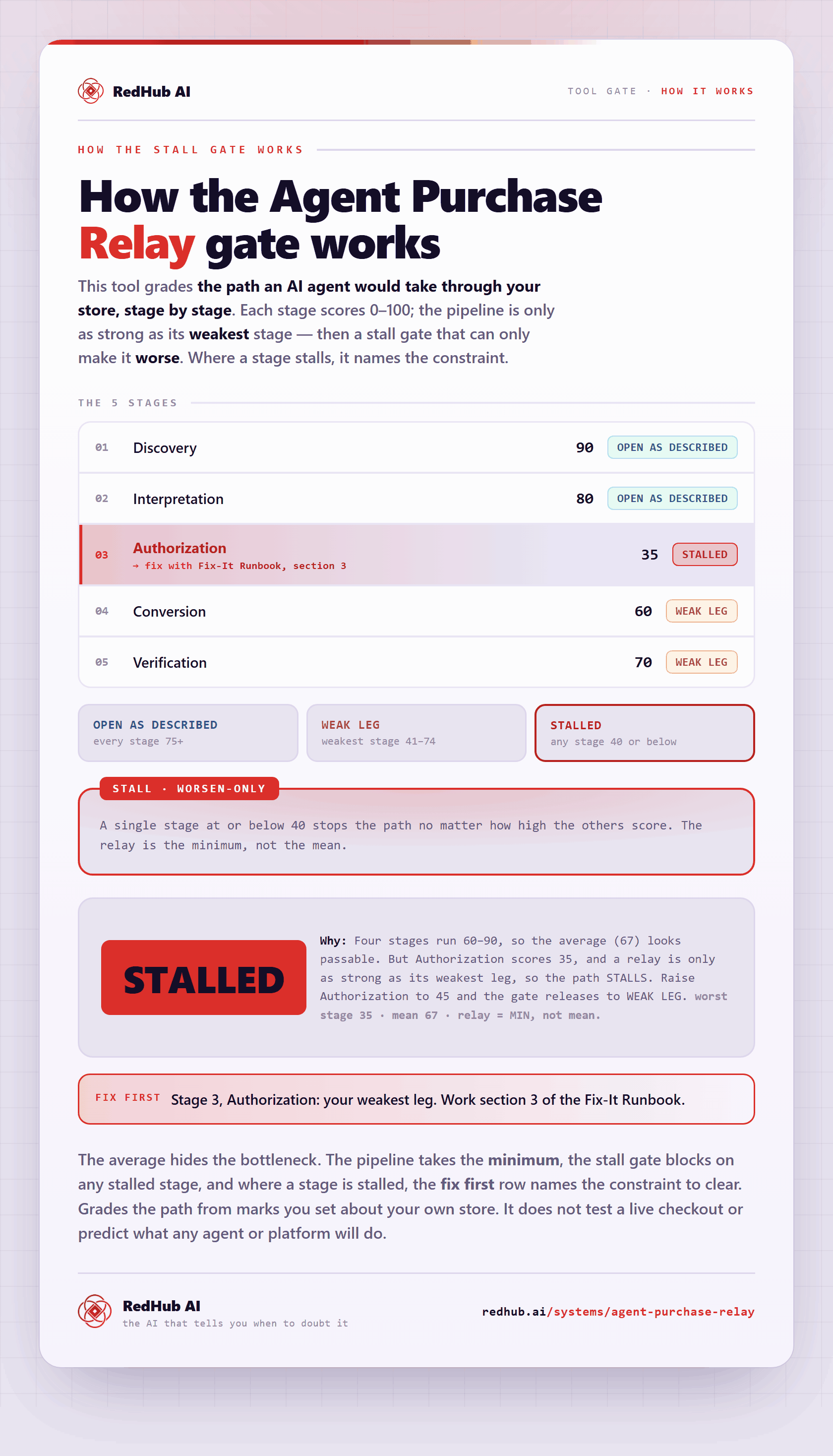
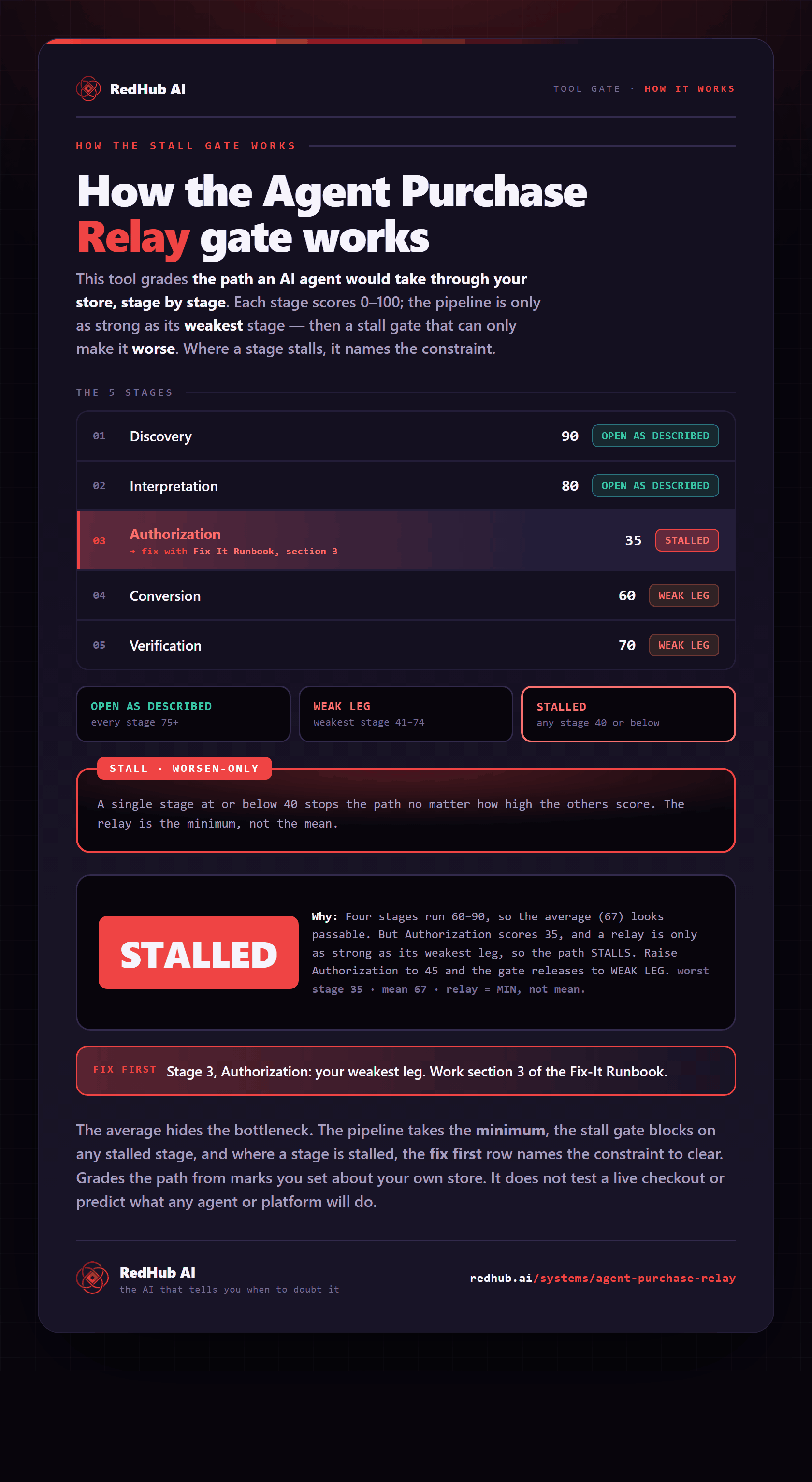
How the gate works, in one image
The five stages scored and reduced to their minimum, not the mean, with the stall gate and where the weakest leg routes you.
View & embed the full diagramThe relay score is the minimum of the five stage scores. The weakest leg is the headline.
Each stage scores 0–100 as a plain fraction of your four 0–5 marks. The relay score is the MINIMUM, the mean is context only, and ties go to the earliest stage. The stall gate forces STALLED if any stage falls to 40 or below, however high the others score. OPEN AS DESCRIBED needs every stage at 75 or higher. Here is the engine on the shipped sample:
============================================================
AGENT PURCHASE RELAY
============================================================

STAGE SCORES (0-100, from your own 0-5 marks):
  1. Discovery         90  OPEN AS DESCRIBED
  2. Interpretation    80  OPEN AS DESCRIBED
  3. Authorization     35  STALLED  <- WEAKEST LEG
  4. Conversion        60  WEAK LEG
  5. Verification      70  WEAK LEG

  Relay score (MIN, the headline): 35
  Mean (context only):             67.0
  Thresholds: OPEN >= 75 | STALLED <= 40

VERDICT: STALLED
  stall_gate TRIPPED: a stage at or below the ceiling stops the path
  however high the other four score.

FIX THIS FIRST:
  Stage 3: Authorization (35, STALLED)
  -> Fix-It Runbook, section 3: Authorization

From your own marks. It does not test a live checkout, and it does not
predict what any agent will do.
============================================================
Three operating principles keep the verdict honest.
The score is your own marks made legible. No AI scoring, no baked-in lift estimate. The same arithmetic runs in the engine, the workbook, and this page.
A stalled stage holds the whole path however strong the rest is, and releases the moment it clears 40. At OPEN AS DESCRIBED the relay names nothing to fix first, because raising a stage cannot move the verdict.
It never visits your site, runs a checkout, or contacts an agent. Where you have not checked a signal, mark it low. A stage you have not looked at is not a stage you can call open.
- Agent-Purchase-Relay.xlsx
- engine/agent_purchase_relay.py
- engine/config.json
- engine/sample_relay.csv
- Fix-It-Runbook.docx
- Reading-Your-Relay.docx
- README.md
- Welcome.pdf
- RedHub-LICENSE.txt
A grade of your own marks about your own store, not a test of any agent.
- A five-stage scorer that, where a stage is short, finds the weakest leg.
- A grade of the whole path. The Product-Feed Readiness Gate grades Interpretation only, and the crawler and bot kits cover Discovery and access.
- Deterministic and offline, the same math in three places.
- A re-runnable check you repeat after each fix.
- A crawler, a checkout test, or a connection to any agent or platform.
- A prediction of what any agent will do, or a promise of placement, purchase or acceptance.
- A statement of what you must permit or block. Authorization grades your own decision and posture.
- Legal or security advice. It is operating hygiene.
Scope: grades marks you enter about your own store. It visits nothing, tests no live checkout, contacts no agent, and guarantees no placement, purchase or acceptance. As of October 31, 2026, agent checkout rails are pilots and previews, so the relay grades your readiness, not a rail. Not legal advice.
Merchants who want to know which stage of the agent path to work on first.
Can an agent reach and read your store at all?
→ AI Crawler Access & Render Audit Kit
Can an agent understand what you sell and trust it?
→ Agentic-Commerce Product-Feed Readiness Gate
Have you decided which agents may do what, and can they tell?
→ Fix-It Runbook, section 3
Can a permitted agent finish the checkout?
→ Fix-It Runbook, section 4
Can both sides show the order happened?
→ Fix-It Runbook, section 5
Grade the whole path here, then go deep on the stage that comes up short.
AI Crawler Access & Render Audit Kit
Where Discovery is your weakest leg. Grades whether crawlers can reach and read your product pages.
Agentic-Commerce Product-Feed Readiness Gate
Where Interpretation is your weakest leg. Grades the feed an agent reads, item by item. It grades that one stage only.
Checkout Friction & Abandonment Exposure Gate
Where Conversion is short. Grades the friction in your checkout for the people who use it today.
Direct answers on the headline math, the gate, and the routing.
It grades the whole path an AI agent would take through your store, from finding you to a confirmed order, across five stages: Discovery, Interpretation, Authorization, Conversion and Verification. You enter four 0-5 marks per stage about your own store. It scores each stage, takes the weakest as the headline, and where a stage is short, names it and points to the fix. It does not visit your site, test a live checkout, or contact any agent.
Because the path is only as open as its weakest leg. An agent that cannot get through one stage never reaches the next, however clean the others are. The relay score is the minimum of the five stage scores. The mean is shown for context only, and a high mean beside a low minimum is the finding.
OPEN AS DESCRIBED means every stage scores 75 or higher. WEAK LEG means the weakest stage scores 41 to 74. STALLED means any stage scores 40 or below. The verdict describes your marks, not what any agent will do.
Through the stall gate. If any stage scores 40 or below, the verdict is STALLED however high the other four score. The gate releases when that stage clears 40, and the verdict then follows the new minimum. One stage at 40 with the rest at 100 reads STALLED; the same stage at 45 reads WEAK LEG.
Only where a stage is short. A weakest Discovery stage points to the AI Crawler Access & Render Audit Kit, or to the AI Bot & Scraper Traffic Control Readiness Gate when the block is your own bot or firewall rules. A weakest Interpretation stage points to the Agentic-Commerce Product-Feed Readiness Gate. Authorization, Conversion and Verification point to the matching section of the Fix-It Runbook in the download, not to another product. At OPEN AS DESCRIBED it names nothing, because raising a stage cannot move the verdict.
Those grade one stage each. The Agentic-Commerce Product-Feed Readiness Gate grades Interpretation only. The AI Crawler Access & Render Audit Kit and the AI Bot & Scraper Traffic Control Readiness Gate cover Discovery and access. Agent Purchase Relay grades the whole path, including the stages no sibling covers: Authorization, Conversion and Verification.
Your own decision and posture: whether you have decided what agents may do on your store, whether your terms or policy state it, whether you can recognize an operator you allow, and whether allowed actions have limits. It does not state what the law requires of you and it does not name any protocol as required. As of October 31, 2026, agent checkout rails are pilots and previews, so the stage grades your decision, not a rail. Not legal advice.
No. It grades marks you enter about your own store. It promises no placement, no purchase and no acceptance by any agent or platform, and it does not predict what any of them will do. Where a leg scores low, you know what to work on first.
A workbook (Agent-Purchase-Relay.xlsx), a runnable Python engine with its config and a sample, the Fix-It Runbook and Reading-Your-Relay playbooks as .docx files, and a README. It is $79 once, with lifetime access and 12 months of updates. Refunds are 30 days. Questions go to support@redhub.ai.
Know which leg is weakest.
Fix that one first.
One purchase, lifetime access, 12 months of updates. Mark five stages, read the verdict, re-run after each fix. $79, once. 30-day refund.
Grades your own marks about your own store. Visits nothing, tests no live checkout, contacts no agent. No placement, purchase or acceptance is guaranteed. Not legal advice.
Sold by RedHub AI LLC · Secured by Stripe · redhub.ai