Operations, strategy, sales and finance, each graded by its own RedHub system from your own numbers. The Agentic Executive Harness rolls their verdicts into one company status and, where an executive is short, names the binding constraint. They read and report. You run the company. Not financial, legal, or investment advice.
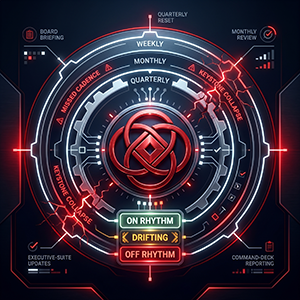
The membership convenes the five on a weekly board briefing, a monthly executive review and a quarterly strategic reset, and a Command Deck reports ON RHYTHM, DRIFTING or OFF RHYTHM from when you last actually ran each one. An active membership includes the five Executive Suite systems. It schedules and reports; you run the company.
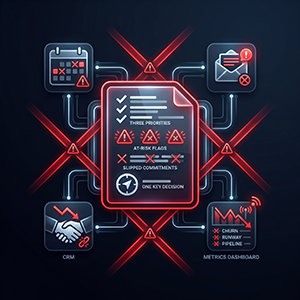
Your founder's chief-of-staff, on a cadence — the flagship of the Executive Suite. Four Claude Skills read your calendar, inbox, CRM, and metrics every Monday and deliver a one-page operating report to your own inbox: the three priorities, the at-risk flags, what slipped, and the one decision to make. It grades every area against the target and floor you set (On track / Watch / Off track) and rolls the week up to Steady / Needs attention / Off plan — with a floor gate that calls a crossed red line (runway below your minimum, churn above your maximum) OFF PLAN, however the week otherwise feels. It reads and synthesizes; you act. Operating hygiene, not financial advice.
EXEC
Founder's Weekly Intelligence Digest
$129
The knowledge cockpit of the Executive Suite, beside the Operating Cadence Engine's metrics cockpit. Four Claude Skills read your own docs, notes, CRM, and calendar (plus optional live signals) and self-deliver one Monday briefing to your inbox. A deterministic engine grades every tracked thread DECIDE NOW / KEEP WATCHING / PARKED — with a decision-trigger gate that surfaces the quiet-looking threads that are genuinely due: blocked on you, or a deadline this week with the ball in your court. Reads and self-delivers to your own inbox only; acts on nothing. Not financial advice.
EXEC
Devil's-Advocate Board
$199
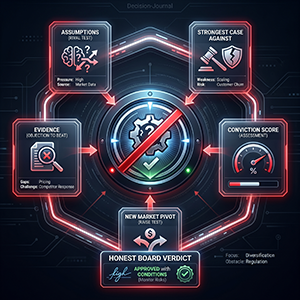
The advisor built to tell you no — the Executive Suite's anti-sycophancy product. Bring one hard decision (a pivot, price change, raise, or new market) and a five-member skeptical board each builds the strongest case against it and scores how well the case survives, for an honest verdict: Go / Go with conditions / Not yet / No-go. The anti-sycophancy core is a veto gate — any one lens scoring a fatal objection forces NO-GO no matter how high the conviction score. A stress-test, not a decision-maker; the call is yours. Not financial, legal, or investment advice.
EXEC
Pipeline Commander
$249
Your AI VP of Sales — the Executive Suite's revenue inspector. Reads your CRM and grades every open deal on qualification, not the stage or amount a rep entered: Commit / Best case / At risk / Not real, with a pipeline verdict of Healthy / Thin / Exposed against quota and the one deal to work first where anything needs working. The anti-happy-ears core is a disqualifier gate — a deal missing an engaged economic buyer or a concrete next step is AT RISK no matter its stage or size. Read-only: it grades and delivers the review; you work the deals. Feeds The Forecast Floor and the OCE Monday report. Not financial advice.
EXEC
Cash-Flow Sentinel
$249
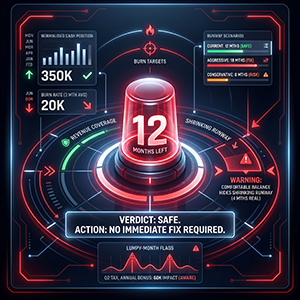
Your AI CFO — the Executive Suite's cash inspector. Grades your cash position on runway and trajectory, not the bank balance: reads your recent monthly numbers, computes net burn, the current rate versus the trailing average, revenue coverage, and your real runway (cash divided by current burn), then returns a verdict — HEALTHY / TIGHT / AT RISK / CRITICAL — with the concrete fix. The anti-happy-ears core is two gates: a hard runway floor (under three months is CRITICAL regardless of trajectory) and a trajectory gate (accelerating burn bumps the verdict one level worse, because a static runway number is optimistic while burn is climbing). Read-only: it computes and delivers the read; you make the calls. Pairs with The Forecast Floor and feeds the OCE Monday report as the cash line. Not financial, accounting, investment, or tax advice.
EXEC
Agentic Executive Harness
$299
The capstone of the Executive Suite — the orchestration layer that ties your executive systems (Operating Cadence Engine, Devil's-Advocate Board, Pipeline Commander, Cash-Flow Sentinel, or any executives you run) into one honest company status. Each system's native verdict maps to one common 0–3 severity; the company status is the maximum — the worst executive, not the average — with a compounding gate that escalates to CRITICAL when two or more domains are AT RISK or worse at once, because cross-functional problems compound. Where an executive is short, it names the binding constraint (ties broken toward the domain that kills fastest), the cross-functional throughline, and Monday's top item. Orchestration only: it reads each system's verdict and delivers the briefing; it never runs the systems, moves money, or takes an action. Works standalone or with the full Suite feeding it. Not financial, legal, or investment advice.
EXEC
The First-Hire Go/No-Go
$129
The founder's go/no-go on the scariest hire — the first one. Most owners hire on exhaustion, not readiness, then can't make payroll or hire before the work is documented and stay the bottleneck. Mark six weighted signals 0/1/2 (fully-loaded cost coverage and work-documented are gates) for a 0-100 score — HIRE NOW / BRIDGE WITH A CONTRACTOR / NOT YET — with a worsen-only two-trigger gate that forces NOT YET when revenue can't cover the fully-loaded cost or the work lives only in your head, even at 76/100. BRIDGE WITH A CONTRACTOR is a capacity result, not a determination or recommendation that anyone qualifies as an independent contractor. It means only that temporary outside capacity may be worth considering before a full-time hire—which could come from an agency, vendor, professional firm, or properly classified contractor. Confirm the actual arrangement under applicable federal and state standards before engaging anyone. Names the one thing to fix first where a signal is short; rolls a slate up to ALL CLEAR TO HIRE / STAGGER THE HIRES / HOLD HIRING. Runnable Python engine + workbook + readiness & get-to-go playbooks + a 6-role sample. A decision aid that grades the hiring decision, never a person. Worker classification depends on the applicable law and the facts of the actual working arrangement. A contract or Form 1099 label does not by itself determine status. Confirm affordability with your CPA and uncertain or consequential classifications with qualified employment counsel. Not financial, tax, or legal advice.
EXEC
Customer-Concentration Risk Gate
$99
The risk that doesn't show in a monthly report until a renewal goes sideways and a third of your revenue walks. Paste your revenue-by-customer list (and your monthly cost base) and the gate computes single-customer share, top-5 share, and a 0-100 safety score — DIVERSIFIED / CONCENTRATED / DANGER — weighting the single-customer share heavier (100 under 10%, 0 by 40%). A worsen-only survival gate forces DANGER when losing your #1 would drop you below break-even, no matter how the percentages look — the Consultancy sample scores 51 and still reads DANGER. No cost base? It degrades to flagging any single customer over 35%. Names the account to address first where concentration is above the line, and the diversification target to get your top under 25%. Rolls a portfolio up to ALL DIVERSIFIED / WATCH THE MIX / DANGER PRESENT. Computed from your own numbers, not a mark grid; runnable Python engine + workbook + audit & diversification playbooks + a 6-business sample. Grades a revenue mix, never a person. Not financial, investment, or accounting advice.
EXEC
The Supplier-Concentration Risk Gate
$99
Customer concentration is the risk everyone screens for — this is its mirror, and the buyer fear is sharper: lose a critical supplier and you don't trim revenue, you can't make the product. Enter your spend by supplier and the gate computes each supplier's share, a 0-100 supply-security score on the lower diligence line (100 under 10%, 0 by 30%), and a per-supplier verdict — SECURED / EXPOSED / SINGLE-SOURCE RISK. A worsen-only survival gate forces SINGLE-SOURCE RISK only when a supplier is both material (≥18% share) AND uncontracted — the contract is the release valve, so a 30% supplier on a long-term contract is a managed risk while an 18% handshake is a single point of failure; a ready second source relaxes the line, and blank contract status degrades to a share-only threshold flag. Names the fix to make first where the base is exposed, and rolls the base up to SUPPLY SECURE AS DESCRIBED / WATCH THE BASE / SUPPLY-SHOCK RISK. The matched pair to the Customer-Concentration Risk Gate — run both before diligence. Runnable Python engine + workbook + concentration-audit & supply de-risking playbooks + a 6-supplier sample. Grades a supply structure from your own numbers, never a person. Not financial advice.
EXEC
The Founder-Time Leverage Audit
$79
Founders don't get trapped by one big thing — they get trapped by a plate full of small tasks they keep doing because it's faster themselves, and the business bottlenecks on them. Mark each task on six weighted signals 0/1/2 (core founder work and willing-to-transfer-the-decision are gates) for a 0-100 leverage score — OFF YOUR PLATE / DOCUMENT FIRST / KEEP — measuring what you'd reclaim by removing it. Two worsen-only trap gates each force KEEP and name which fired: the CORE-WORK trap (only you can carry it) and the PHANTOM-DELEGATION trap (you'd keep the decision, so it routes back) — the sample's Investor updates (53) and Refund approvals (72) both read KEEP. Rolls your whole plate up to LEVERAGED / STRETCHED / FOUNDER-BOUND, folding in the catch every framework names: reclaimed hours only count if you redeploy them. Runnable Python engine + workbook + leverage-audit & clean-handoff playbooks + a 6-task sample. The step before the hire; grades how your time is spent, never a person. Not financial, legal, or management advice.
EXEC
The Acquisition-Offer Diligence Readiness Audit
$149
A signed LOI isn't the finish line: many signed transactions do not reach closing, and diligence findings can lead to withdrawal, repricing, additional structure, or delay. This is sell-side diligence run on yourself: mark six weighted dimensions commonly examined in buyer diligence 0/1/2 (validated financials/QoE and owner independence are gate conditions) for a 0-100 diligence-readiness score — DEAL-READY AS DESCRIBED / GAPS TO CLOSE / DILIGENCE GAPS. A 0 on either gate dimension returns DILIGENCE GAPS whatever the score — the polished agency sample scores 75 and still receives it. Customer concentration is heavily weighted, not an automatic gate. Names the one thing to fix first where a dimension is short; rolls a portfolio up to ALL DEAL-READY AS DESCRIBED / GAPS TO CLOSE / DILIGENCE GAPS. Runnable Python engine + workbook + sell-side diligence playbook & gap fix runbook + a 6-business sample. Run it 12-36 months before you sell. It does not predict whether a buyer will close, withdraw, re-trade, or change price. Grades a deal, never a person. Not a business valuation, brokerage, or legal, tax, or investment advice.
EXEC
The Key-Person Risk Audit
$99
Could the business keep running if this person vanished for a week? The bus-factor question — cheapest to ignore, most expensive to discover late: replacing a key employee runs 100-300% of salary and acquirers visibly discount single points of failure. Score each key person on six continuity dimensions 0/1/2 (relationships, undocumented knowledge, sole authority, trained backup, continuity protection, revenue share) for a 0-100 resilience score — COVERED / EXPOSED / SINGLE POINT OF FAILURE. A two-condition kill-chain gate refuses to cry wolf: it forces SINGLE POINT OF FAILURE only when someone is both load-bearing (holds irreplaceable relationships or knowledge) AND unbacked (no trained successor) — the precise bus-factor definition, key and irreplaceable. A brilliant person with a tested backup is covered; the gate releases the moment either half clears, so it always names the cheapest fix. Rolls everyone up to RESILIENT / KEY-PERSON GAPS / FRAGILE. Runnable Python engine + workbook + risk-audit & de-risking playbooks + a 6-person sample. Grades a continuity posture, never a person — not HR or legal advice, not grounds for any employment decision.
EXEC
Wealth-Transfer Exposure Radar
$99
Roughly $84 trillion is moving to the next generation and most heirs leave the advisor who served their parents. This Radar reads your advisory book (AUM, primary-contact age band, heir-relationship depth) and computes how much AUM is in transfer motion, how well that at-risk pool is covered by an engaged next generation, and a 0-100 book continuity score banded SECURE / AGING / EXPOSED. A worsen-only aging-book trigger forces EXPOSED when a single household is material (15%+ of the book), 75+, and has no heir named — the exact pattern an acquirer discounts. Names the one heir to engage first where AUM is uncovered. Runnable Python engine + workbook + audit & heir-engagement playbooks + a 6-household sample. Scores the book, never a person; not legal, tax, or investment advice.
EXEC
Succession Continuity Tripwire
$99
Would your advisory firm and its clients survive your exit — planned or sudden? A deterministic self-assessment: mark six continuity dimensions 0/1/2 on evidence — written succession plan (18), named & ready successor (20, tripwire), continuity/contingency agreement (18, tripwire), client-relationship transferability (16), funding & valuation (14), operational readiness (14) — for a 0-100 score banded SECURE / EXPOSED / NO SUCCESSION. A dispositive kill-chain tripwire forces NO SUCCESSION only when the firm has neither a ready successor nor a continuity agreement — the intersection where clients have nowhere to go — and releases the moment either half clears, so it always names the cheapest fix. Portfolio rolls up to the worst firm (ALL SECURE AS DESCRIBED / GAPS TO CLOSE / CONTINUITY AT RISK). Runnable Python engine + workbook + assessment & continuity playbooks + a 5-firm sample. Grades a firm’s continuity posture, never people, and drafts no documents. Not legal, financial, or investment advice.
EXEC
The Co-Founder Equity Health Check
$79
Is your founding equity structured to survive a co-founder leaving? Skipping vesting is the single most-regretted founder decision — the co-founder who walks at month 11 still holding a big unvested stake becomes a cap-table problem you pay for at every future round. Score each co-founder on six structure dimensions 0/1/2 (vesting schedule, one-year cliff, stake size, acceleration, 83(b) election, documentation) for a 0-100 equity-health score — SOUND / EXPOSED / DEAD-EQUITY RISK. A two-condition dead-equity gate fires only when someone holds a material stake AND has no vesting — the precise cap-table-nuking pattern; a large stake that's properly vesting is protected, and the gate releases the moment either half clears. Names the one structural fix first (never a 'right split') and rolls everyone up to CLEAN CAP TABLE / GAPS TO FIX / FRACTURED. Runnable Python engine + workbook + equity-health & de-risking playbooks + a 6-founder sample. Grades a structure, not a deal or a person — and routes every fix to counsel. Not legal, tax, or investment advice.
EXEC
RedHub Operating System
$99/mo
The membership that runs your Executive Suite on a rhythm. You own the five systems; this is the standing cadence that convenes them — a weekly board briefing, a monthly executive review, and a quarterly strategic reset — on a Command Deck that counts from the last time you actually ran each one. The keystone is the weekly board briefing: miss it once and you're DRIFTING, miss two full cycles and the rhythm has broken to OFF RHYTHM, no matter how current the monthly and quarterly are. Includes all five Executive Suite systems, the operating kit (engine, workbook, four Claude Skills, template, and two playbooks), and updates while subscribed. It schedules and reports; you run the company. Not financial, legal, or investment advice.
Common questions
Five RedHub systems that run alongside a founder or operator. Four each grade one part of the company: operations (Operating Cadence Engine), strategy (Devil's-Advocate Board), sales (Pipeline Commander) and finance (Cash-Flow Sentinel). The fifth, the Agentic Executive Harness, rolls their verdicts into one company status. Not financial, legal, or investment advice.
It maps each executive system's verdict to one common severity and reports the worst, not the average. If two or more domains are AT RISK or worse at the same time, it escalates the company to CRITICAL, even when no single executive is critical. It reads verdicts and briefs you; it never runs the systems or takes an action.
No. Each system is sold and runs on its own, and the Harness works standalone with whatever executive verdicts are present.
The cadence that convenes the five: a weekly board briefing, a monthly executive review and a quarterly strategic reset, tracked on a Command Deck that reports ON RHYTHM, DRIFTING or OFF RHYTHM. An active membership includes the five Executive Suite systems. It schedules and reports; it never runs the systems, makes decisions, moves money, or takes an action. You run the company.