You're drowning. But is itactually time to make the hire?
Most owners make their first hire on exhaustion, not readiness — then can't make payroll, or hire before the work is documented and stay the bottleneck anyway. Score a role on six signals and get one honest verdict on whether it's ready now — with a gate that won't let being busy pass for being able to afford it.
Update notice — version 1.1.0 (2026-09-23). This package replaces version 1.0 of First-Hire Go / No-Go. The worker-classification signal is renamed "Actual engagement reviewed for employee vs. independent-contractor classification", the cost multiplier is scoped as a planning assumption, and the BRIDGE WITH A CONTRACTOR verdict now carries its capacity qualification wherever it appears. Scoring is unchanged: the same marks produce the same score and verdict as in version 1.0. Existing buyers: the download link in your original purchase email now serves version 1.1.0.
Busy is not the same as ready.
As an initial planning assumption, the tool uses approximately 1.25–1.4× salary. Actual fully loaded cost may be higher and varies by role, location, benefits, insurance, equipment, recruiting expense, and business circumstances. Owners budget the headline salary and get blindsided by the rest.
of turnover is caused by a bad hire. Hiring the wrong role at the wrong time is expensive twice — the cost, and the cleanup.
the most common reason a hire doesn't help: the work was never documented, so you train by osmosis and stay the bottleneck — paying a salary and still doing the job.
This scores the decision on what actually determines whether a hire helps or hurts — and refuses to let a slammed week read as a green light when the cash floor or the handoff isn't there.
Score a role and watch the gate hold the line.
Mark each signal. The verdict updates live — same math as the workbook.
Based on your own forecast, reliable revenue or committed funding covers the estimated fully loaded cost. For an initial estimate the tool uses roughly 1.25–1.4× salary over a 2–3 month coverage period; actual cost may be higher. Planning assumption only; actual employment cost and appropriate runway vary by business, role, location, benefits, and risk tolerance.
Based on your own forecast, cash runway after the estimated fully loaded cost remains approximately six months or more. The tool uses six months only as an initial planning reference; appropriate runway varies by business model, cash-flow reliability, financing access, hiring costs, and risk tolerance.
It drives revenue or frees you to — and you can name the return, not just 'I'm busy.'
The tasks are written down / repeatable — not all in your head — so someone else could do them.
The reclaimed hours go to higher-value work, and they're worth more than the hire costs.
How the work will actually be directed, performed, integrated, and structured has been reviewed under the applicable classification standards.
- 0 — The actual working arrangement has not been defined or reviewed.
- 1 — The proposed arrangement has been outlined but not checked under current, applicable classification standards.
- 2 — The actual proposed arrangement has been documented and reviewed under current, applicable classification standards, with qualified counsel where appropriate.
A top mark means the arrangement was reviewed; it does not certify that a particular classification is correct.
Scores in the HIRE NOW band, but a gate signal is at 0 — so the verdict is forced to NOT YET. Being slammed isn't the same as being able to afford the hire, or having the work documented enough to actually hand off.
Fix first: Fully-loaded cost coverage
Your marks only · no benchmark · grades the decision, not a person
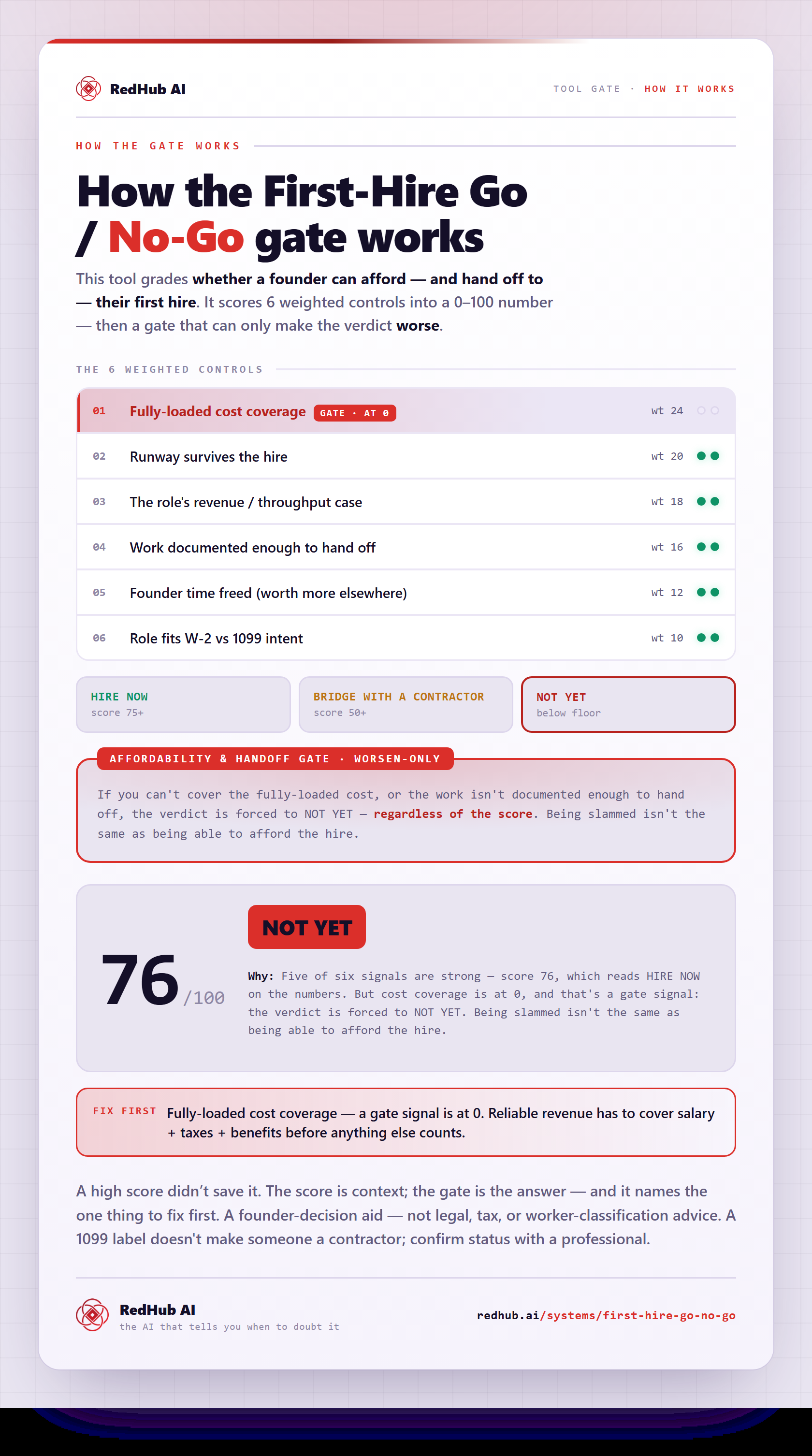
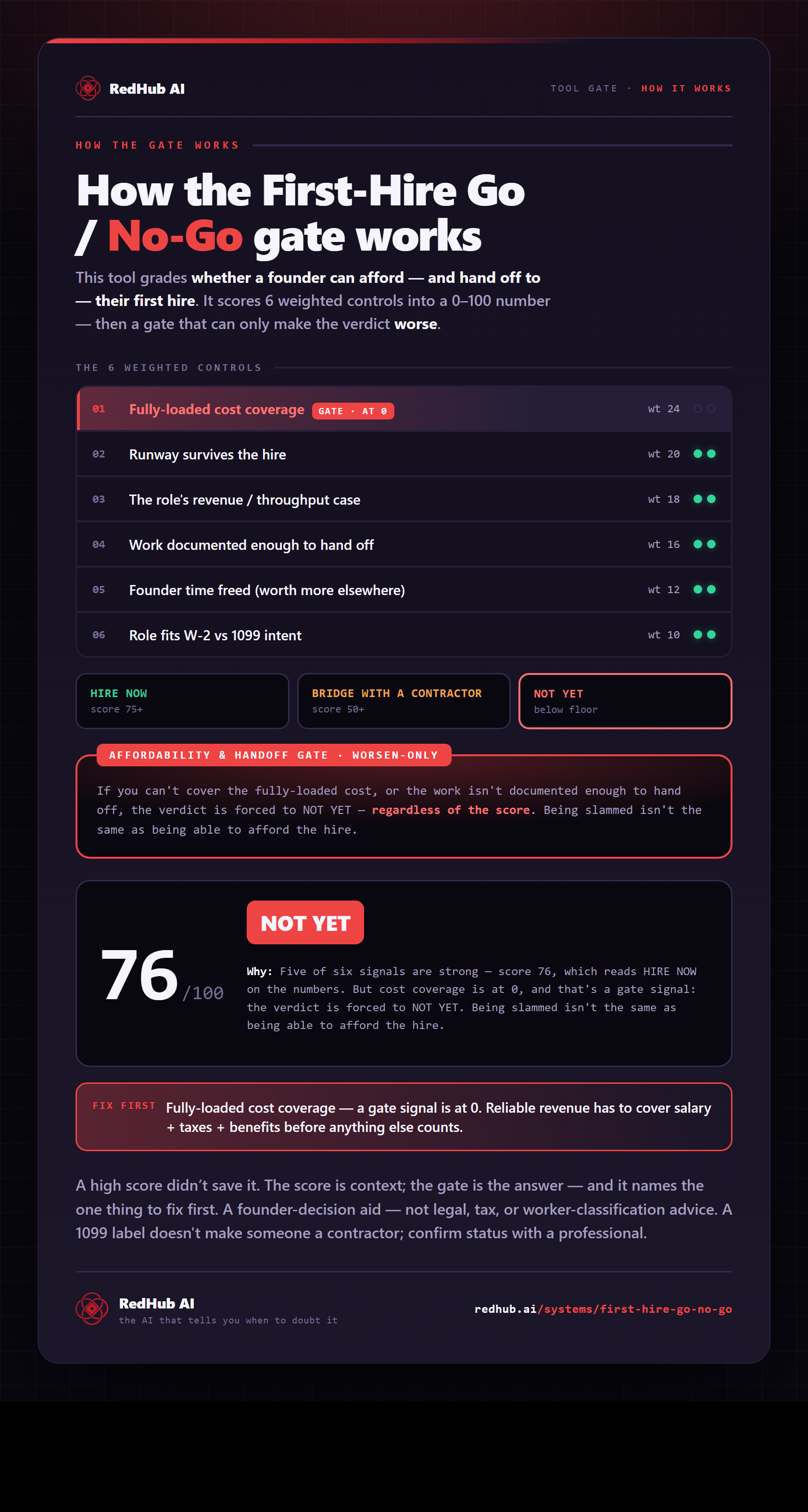
How the gate works, in one image
Six weighted signals scored into a 0–100 number and the affordability gate that forces NOT YET when you can't cover the fully-loaded cost — the same math the demo runs, as a diagram you can share or embed anywhere.
View & embed the full diagramOne command, every role you're weighing, an honest verdict.
The zero-dependency Python engine reads your list of roles and prints the same verdict the workbook and demo produce. The drowning-founder Ops assistant below scores 76 and still reads NOT YET — strong everywhere except the one thing that matters most: can you cover it.
The First-Hire Go/No-Go
====================================================
Ops assistant (drowning founder)  76/100  NOT YET                   [GATE -> NOT YET]
    fix first: Fully-loaded cost coverage (salary + taxes + benefits)
Senior account exec            100/100  HIRE NOW
Bookkeeper                      69/100  NOT YET                   [GATE -> NOT YET]
    fix first: The work is documented enough to hand off
Part-time marketer (contractor)  72/100  BRIDGE WITH A CONTRACTOR
    note: This is a capacity result, not a determination or recommendation
          that anyone qualifies as an independent contractor. It means only
          that temporary outside capacity may be worth considering before a
          full-time hire—which could come from an agency, vendor,
          professional firm, or properly classified contractor. Confirm the
          actual arrangement under applicable federal and state standards
          before engaging anyone.
    fix first: Fully-loaded cost coverage (salary + taxes + benefits)
Customer support rep            50/100  BRIDGE WITH A CONTRACTOR
    note: This is a capacity result, not a determination or recommendation
          that anyone qualifies as an independent contractor. It means only
          that temporary outside capacity may be worth considering before a
          full-time hire—which could come from an agency, vendor,
          professional firm, or properly classified contractor. Confirm the
          actual arrangement under applicable federal and state standards
          before engaging anyone.
    fix first: Fully-loaded cost coverage (salary + taxes + benefits)
Full-time engineer              35/100  NOT YET
    fix first: Runway survives the hire
----------------------------------------------------
Portfolio: HOLD HIRING
3 of 6 role(s) read NOT YET.
Worker classification depends on the applicable law and the facts of the
actual working arrangement. A contract or Form 1099 label does not by itself
determine status.Six signals, weighted to 100 — two of them gates.
No fully-loaded coverage OR undocumented work forces NOT YET regardless of score. Either one alone triggers the gate — and the gate only worsens a verdict, never lifts one.
BRIDGE WITH A CONTRACTOR is the band between drowning and over-committing. This is a capacity result, not a determination or recommendation that anyone qualifies as an independent contractor. It means only that temporary outside capacity may be worth considering before a full-time hire—which could come from an agency, vendor, professional firm, or properly classified contractor. Confirm the actual arrangement under applicable federal and state standards before engaging anyone. Worker classification depends on the applicable law and the facts of the actual working arrangement. A contract or Form 1099 label does not by itself determine status.
Close the cash floor or document the work and the gate releases — the verdict returns to whatever the score earned. Where something is still short, the thing to fix first is named.
A decision aid, not your CPA or your lawyer.
- A deterministic go/no-go verdict on a hire, from your own marks.
- A way to catch the premature hire before it catches you.
- A rollup that sequences several roles — who to hire first, who to hold.
- Offline — engine, workbook, and demo agree to the verdict.
- Not financial, tax, or legal advice, and not a classification ruling.
- Not connected to your books — you bring the coverage and runway read.
- Not a scoring of any candidate or employee — it grades a decision.
- Not a substitute for your CPA on affordability or counsel on employee vs. independent-contractor classification.
Not financial, tax, or legal advice. This decision aid scores the strength of a first-hire case using only your answers and the stated planning assumptions. It does not determine what you can afford, or whether any worker may lawfully be treated as an independent contractor. Federal and state worker-classification tests examine the facts of the actual working arrangement, not merely the label, and the applicable standards vary and may change. Confirm affordability with your CPA or other qualified financial professional, and worker classification with qualified employment counsel.
Owners standing at the edge of their first hire.
The rest of the founder's decision desk.
The AI CFO that grades runway and burn — the cash reality this hire has to fit inside.
ViewSometimes the answer to 'I can't afford the hire' is a price move, not a headcount move.
ViewSix Claude skills for the one-person company — get more leverage before you add a head.
ViewThe honest answers.
Whether a specific role you're considering is a real go right now. You mark six signals 0/1/2 — fully-loaded cost coverage, runway after the hire, the role's revenue case, whether the work is documented enough to hand off, the founder time it frees, and whether the actual engagement has been reviewed for employee vs. independent-contractor classification — and it returns HIRE NOW, BRIDGE WITH A CONTRACTOR, or NOT YET, with, where a signal is short, the one thing to fix first. BRIDGE WITH A CONTRACTOR is a capacity result, not a determination or recommendation that anyone qualifies as an independent contractor. It means only that temporary outside capacity may be worth considering before a full-time hire—which could come from an agency, vendor, professional firm, or properly classified contractor. Confirm the actual arrangement under applicable federal and state standards before engaging anyone. Score several roles and it rolls them up so you know which to sequence. It grades a hiring decision, never a person.
Because two signals are gates. If reliable revenue can't cover the fully-loaded cost (salary + payroll taxes + benefits, not just the headline salary) for a couple of months, or the work is still entirely in your head, the verdict is NOT YET no matter how high the score. The most common first-hire mistake is hiring on exhaustion and then not making payroll; the second is hiring before the work is documented, so you pay a salary and still do the job. The shipped 'drowning founder' Ops-assistant sample scores 76 and still reads NOT YET — everything's strong except coverage.
It's the middle band: you're busy enough and the role has a real case, but coverage is tight or runway thins, so a full-time employee hire is premature. This is a capacity result, not a determination or recommendation that anyone qualifies as an independent contractor. It means only that temporary outside capacity may be worth considering before a full-time hire—which could come from an agency, vendor, professional firm, or properly classified contractor. Confirm the actual arrangement under applicable federal and state standards before engaging anyone. Worker classification depends on the applicable law and the facts of the actual working arrangement. A contract or Form 1099 label does not by itself determine status.
It scores whether the actual engagement has been reviewed for classification — but it is not a legal determination. Worker classification depends on the applicable law and the facts of the actual working arrangement, including how the work is directed, performed, integrated, and structured. Federal tax, federal wage-and-hour, state wage, unemployment, workers’ compensation, and other standards may differ and may change. A contract or Form 1099 label does not by itself determine status. Document the proposed arrangement and confirm uncertain or consequential classifications with qualified employment counsel. The kit keeps the signal classification-test-agnostic.
Neither — it's deterministic and offline. You enter your own 0/1/2 marks on what you actually know about coverage, runway, and the role; it computes the verdict and connects to nothing. The same logic runs in the workbook, the Python engine, and the on-page demo, so all three agree to the number. Bring your fully-loaded cost figure from your own books where you have one. As an initial planning assumption, the tool uses approximately 1.25–1.4× salary. Actual fully loaded cost may be higher and varies by role, location, benefits, insurance, equipment, recruiting expense, and business circumstances.
No. It's a decision aid that helps you pressure-test a hire before you make it — it doesn't tell you what you can afford, certify a classification, or replace your CPA or attorney. Use it to find the gap that would make a hire premature, and confirm the affordability and classification specifics with your own advisors.
Know before you
sign the offer.
One purchase, lifetime access, 12 months of updates. $129, once.
Not financial, tax, or legal advice. This decision aid scores the strength of a first-hire case using only your answers and the stated planning assumptions. It does not determine what you can afford, or whether any worker may lawfully be treated as an independent contractor. Federal and state worker-classification tests examine the facts of the actual working arrangement, not merely the label, and the applicable standards vary and may change. Confirm affordability with your CPA or other qualified financial professional, and worker classification with qualified employment counsel.
Sold by RedHub AI LLC · Secured by Stripe · redhub.ai