Know how many monthsyou actually have.
Your bank balance feels fine — $640K sounds like plenty. But that’s thirteen months of runway or four, depending entirely on your burn. Cash-Flow Sentinel grades your cash on runway and trajectory, returns an honest verdict — HEALTHY, TIGHT, AT RISK, or CRITICAL — and names the fix. A static runway number lies when burn is climbing. Read-only — you make the calls.
Your bank balance feels fine. Your runway might not be.
$640K feels like plenty. But $640K is thirteen months of runway or four, depending entirely on your burn — and the balance in the bank never tells you which one you're living in.
Headcount, tools, a few one-off months — burn climbs quietly. The static runway number you checked last quarter is optimistic the moment burn starts accelerating, and nobody re-checks it in time.
By the time the balance looks scary, you're months into the problem with fewer options. A CFO catches it when the trajectory turns — not when the cash is nearly gone.
Set this month's spend — and watch an 8-month runway fall out of “fine.”
This is the read, live. $640K in the bank, burn ran $50K/mo. Push this month's spend up and the runway shrinks while the trajectory turns — at $80K/mo the 8-month runway is bumped to AT RISK because burn is accelerating. Cut it back toward $50K and it returns to HEALTHY. Same math as the engine and workbook.
Cash read · live demo
$640K in the bank. Set June’s spend — and watch an 8-month runway fall out of “fine.”
Verdict
AT RISK
Under 6 months, or burn is accelerating. Cut burn or extend runway before it's critical.
runway 8.0 mo · burn $80K/mo (trailing avg $50K/mo) · accelerating ← bumped one level worse
June spend
revenue fixed at $72K · net burn $80K/mo
The fix: at your trailing-average burn ($50K/mo) you’d have 12.8 months. Hold monthly burn at or below $53K to restore a healthy 12-month runway; below $107K to clear the 6-month risk line.
Burn is accelerating — the runway number above is optimistic. Stop the climb first.
The trajectory gate is the point: at $80K/mo the 8-month runway is bumped to AT RISK because burn is accelerating — a static runway number lies when burn is climbing. Cut June back toward $50K/mo of burn and it returns to HEALTHY. Same math as the engine and workbook. It reads and computes; you make the calls.
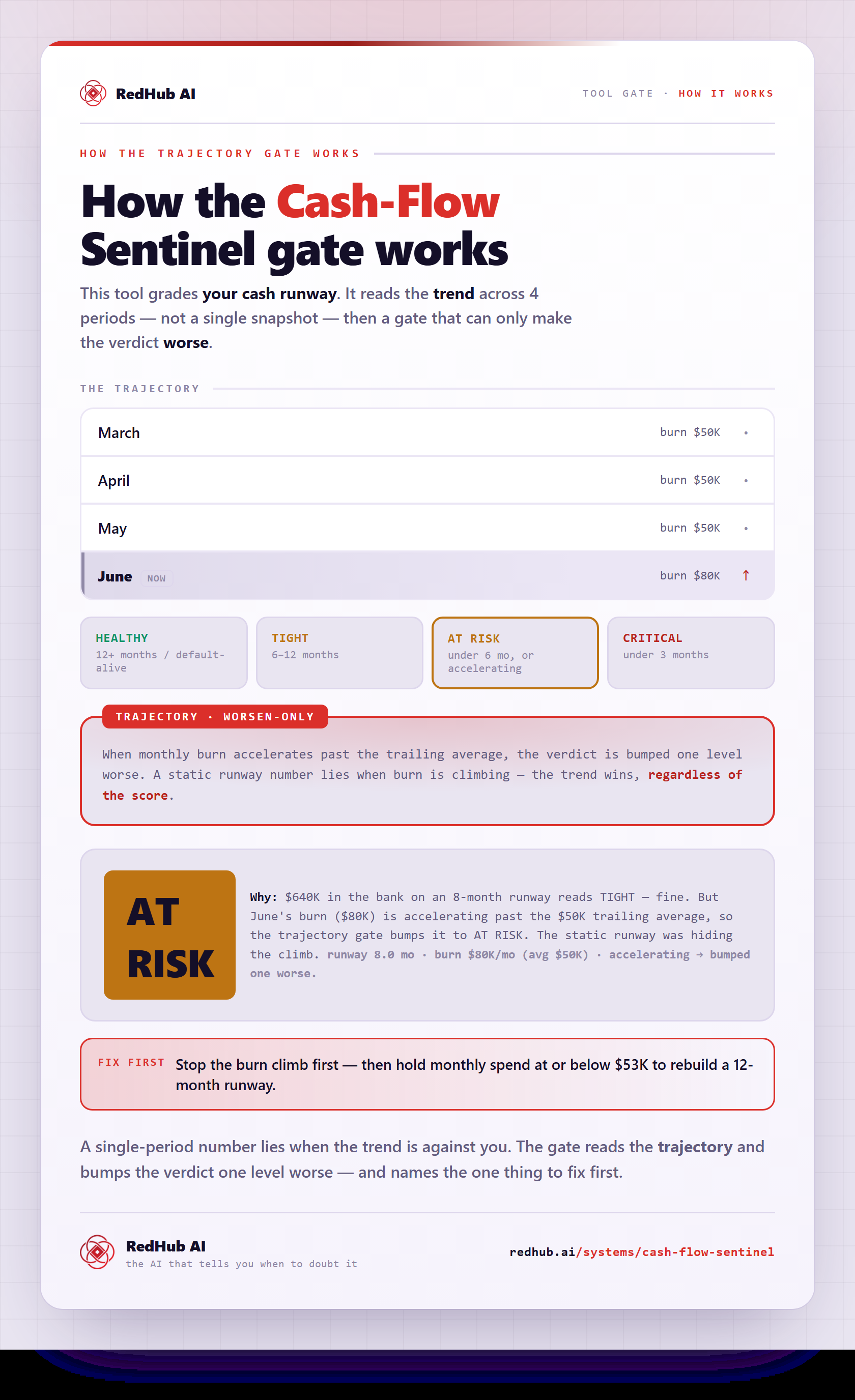
How the gate works, in one image
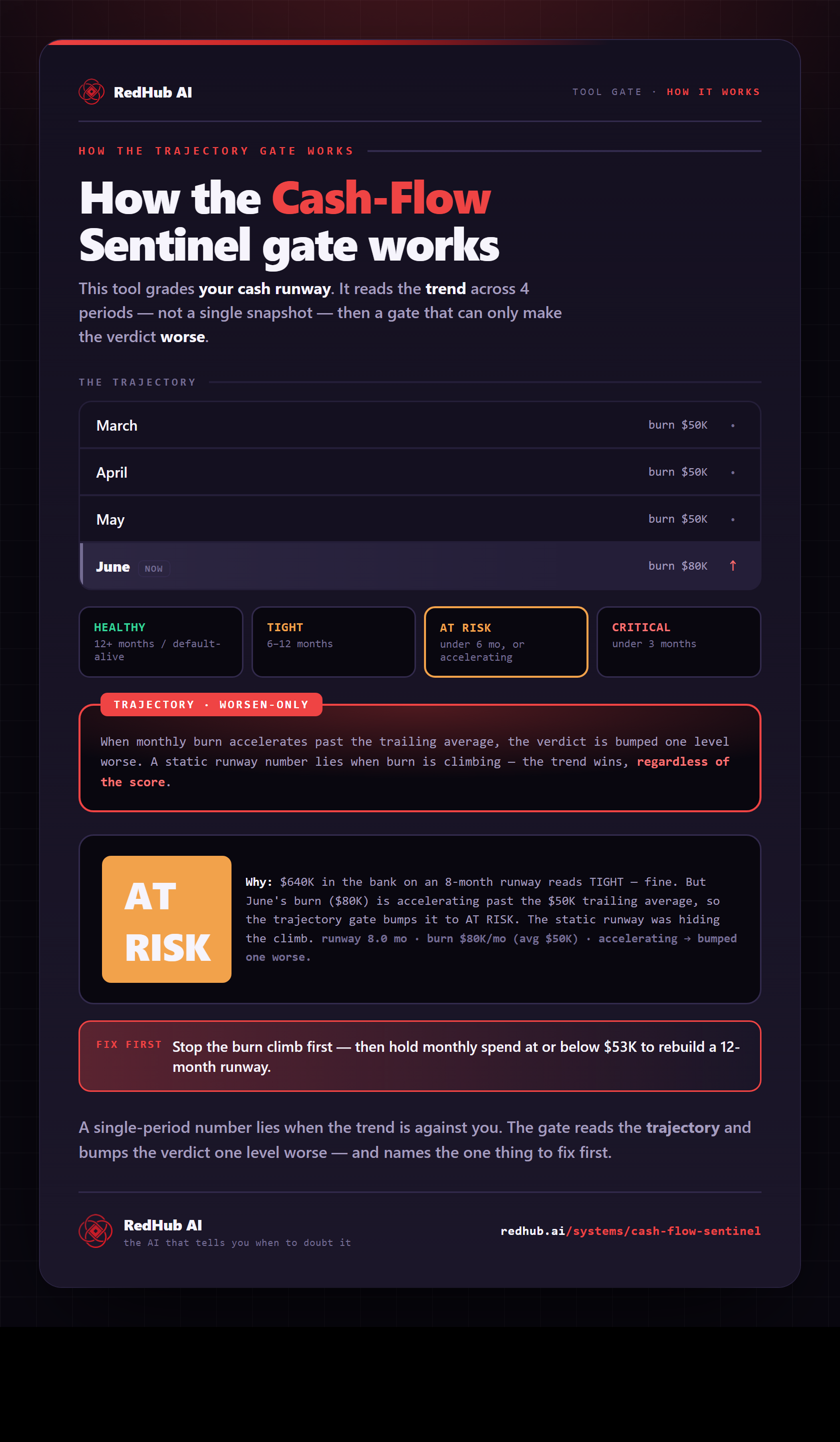
The four-month burn trajectory and the gate that bumps the verdict one level worse when burn is accelerating — why an 8-month runway still reads AT RISK. The same math the demo runs, as a diagram you can share or embed anywhere.
View & embed the full diagramCompute the runway. Grade it honestly. Know the fix.
The burn-rate-analyst pulls your recent months and computes net burn, the current rate versus the trailing average, revenue coverage, and runway — normalizing one-off spikes (a tax payment, an annual renewal) so the burn figure is representative, not a lumpy month masquerading as your run rate.
The runway-grader applies the floors and the trajectory gate to return the verdict: HEALTHY, TIGHT, AT RISK, or CRITICAL. It won't call an 8-month runway fine when burn jumped 60% last month — a comfortable balance doesn't change the months left.
The scenario-planner turns the verdict into levers: the monthly burn that restores a healthy runway, how many months a cut or a raise buys, and the path to default-alive — tied to your current burn so the gap is concrete.
The cash-tracker logs each month, reports whether burn and runway are trending the right way, and produces the one-line cash status for your operating report — so a slow bleed shows up before it's an emergency.
Plus a runnable Python engine with the worked sample, a spreadsheet that reproduces the same runway and verdict, the cash-position one-pager template, and two playbooks — reading your runway, and connecting your numbers plus the anti-happy-ears method.
Three rules a CFO holds to.
The verdict is the months you have at the real burn rate, not how big the number in the bank looks. The same $640K is thirteen months or four depending entirely on burn — the balance is the number that makes founders complacent.
Under three months of runway is CRITICAL no matter the trajectory — the non-negotiable. And accelerating burn bumps the verdict one level worse, because a static runway number is optimistic while burn is climbing.
It reads your numbers and delivers the read to you — it never moves money, pays a bill, edits your books, or transacts. It models the scenarios and the burn targets; you decide and execute. Not financial advice.
A CFO cash read — clear about its limits.
- A cash read that grades runway and trajectory and returns an honest verdict with the concrete fix.
- The read — Skills, the engine, a workbook, a template, and playbooks — on top of your own numbers and AI tool, on the open Skills standard.
- Built to see past a comfortable bank balance and catch the runway turning before it's an emergency.
- Not accounting software and not a bank — it reads your numbers read-only and never moves money, pays a bill, or edits your books.
- Not financial, accounting, investment, or tax advice — a runway call, a raise, or a cost cut carries consequences only you own.
- Not a guesser — it never invents numbers, and it flags lumpy months so you use a representative burn.
Built for the founder whose survival runs on cash.
- A founder or operator whose survival depends on cash — and who wants the truth about how many months you have.
- Tired of a comfortable-looking balance that hides a shrinking runway, and want the trajectory caught early.
- Willing to connect your numbers, normalize the lumpy months, and act on the burn targets.
- Read the bank balance, feel fine, and would rather not know the runway.
- Won't connect your numbers, or won't normalize a one-off month when it flatters the figure.
- Want something to manage the money for you — it tells you the read; you make the calls.
From the revenue that funds it to the cash line on Monday.
The revenue side of the same coin — the defensible number that has to clear your burn and fund the runway.
The Suite hub. Your runway verdict surfaces as the cash line in the Monday operating report.
The pipeline behind the revenue that funds the runway — graded on qualification, not stage or amount.
The honest answers, before you buy.
Your own numbers: recent monthly revenue and expenses (a few months is enough), plus your cash on hand. You can paste them in, point a Claude Skill at an exported CSV, or wire your accounting tool in — Cash-Flow Sentinel is the read-and-grade layer on top, and it never includes or resells your data. It reads the numbers you connect and never invents any. The included sample ledger and workbook show the exact shape it expects.
On runway and trajectory, not the bank balance. It computes net burn per month (expenses minus revenue), your current burn rate versus the trailing average, revenue coverage, and runway (cash divided by current burn), then returns a verdict — HEALTHY, TIGHT, AT RISK, or CRITICAL. The anti-happy-ears core is two gates: a hard runway floor (under three months of runway is CRITICAL regardless of trajectory) and a trajectory gate (burn rising more than 15% over the trailing average bumps the verdict one level worse, because a static runway number is optimistic while burn is climbing). In the worked sample, $640K and an 8-month runway would read TIGHT — but burn jumped from $50K to $80K, so the trajectory gate bumps it to AT RISK.
Because the balance is the number that makes founders complacent. The same $640K is thirteen months of runway or four, depending entirely on your burn — and the balance never tells you which one you're living in. A sharp CFO reads the months you have at your real burn rate and whether that number is even trustworthy, not how big the number in the bank looks. That's the whole point of the system: see past a comfortable balance and catch the runway turning before it's an emergency.
No — it's read-only. It reads your numbers and delivers the cash read to you; it never moves money, pays a bill, edits your books, transacts, or manages anything. It models the scenarios — the monthly burn that restores a healthy runway, how many months a cut or a raise buys, the path to default-alive — and you decide and execute. The read is the product; the calls are yours.
It flags exactly that. A single month can be lumpy — a tax payment, an annual renewal, a one-off — and a lumpy month masquerading as your run rate would distort the read. Cash-Flow Sentinel reports the current burn against the trailing average so an outlier is visible, and the method (in the included playbook) tells you to normalize one-off spikes so the burn figure is representative. It won't quietly let a single spike — or a single quiet month — set your runway.
They're two sides of the same coin. The Forecast Floor computes the defensible revenue number — the money that has to clear your burn and fund the runway. Cash-Flow Sentinel grades the cash side: how many months that funding actually buys you and whether burn is eating it faster than it looks. Run the Forecast Floor to defend the number; run Cash-Flow Sentinel to know how long it lasts. Both also surface as lines in the Operating Cadence Engine's Monday report — CFS is the cash line, Pipeline Commander is the pipeline line.
No on both. It tells you the honest read on the numbers you give it — but a runway depends on what you actually spend and raise from here, which is on you, so nothing is guaranteed. The HEALTHY/AT-RISK verdicts are cash and runway hygiene, not financial, accounting, investment, or tax advice: a cost cut, a raise, or how you report any of it carries consequences only you own. It never invents numbers, and it grades only the numbers you bring it.
Stop trusting the balance.
Know your runway.
One purchase, lifetime access, 12 months of updates. $249, once. Connect your numbers and see the runway honestly.
Sold by RedHub AI LLC · Secured by Stripe · redhub.ai