Know which dealsare real.
Your pipeline looks great until the quarter ends and half of it didn’t close. Pipeline Commander grades every open deal on qualification — not the stage or amount a rep entered — calls your pipeline HEALTHY, THIN, or EXPOSED against quota, and — where anything needs working — names the deal to work first. A deal with no economic buyer is AT RISK no matter how it’s staged. Read-only — you work the deals.
Your pipeline looks great. Then the quarter ends.
Every deal in the pipe has a reason it'll close — until it doesn't. The forecast ends up built on hope dressed as stages, and nobody wants to be the one who calls it.
A deal in 'Negotiation' for $120K looks like money. But if no one has met the person who signs, it's not a deal — it's a hope with a big number and a late stage attached.
The pipeline that looked like 1.5x coverage was 0.5x commit-grade. By the time the quarter closes, there's nothing left to do about the deals that were never real.
Set whether you've met the buyer — and watch a $120K deal fall out of commit.
This is the review, live. Acme is a $120K deal in Negotiation. With no economic buyer it's AT RISK and the deal to work first — stage and size don't make it real. Engage the buyer and it climbs to COMMIT; commit then covers the quota and the whole pipeline moves EXPOSED → THIN. Same math as the engine and workbook.
Pipeline review · live demo
Quota $250K. Score Acme’s qualification — and watch a $120K deal fall out of commit.
Pipeline
EXPOSED
Commit-grade deals don't cover quota, or too much pipeline is fantasy.
commit $130K (0.52x quota) · 58% at-risk-or-not-real
Work this first: Acme Corp ($120K, AT RISK) — no economic buyer; rescue it or stop forecasting it.
Acme Corp · $120K · Negotiation
The disqualifier gate is the point: a deal missing an economic buyer or a next step is AT RISK whatever its stage or size — engage the buyer and Acme climbs to COMMIT, and the pipeline moves EXPOSED → THIN. Same math as the engine and workbook. It reads and grades; you work the deals.
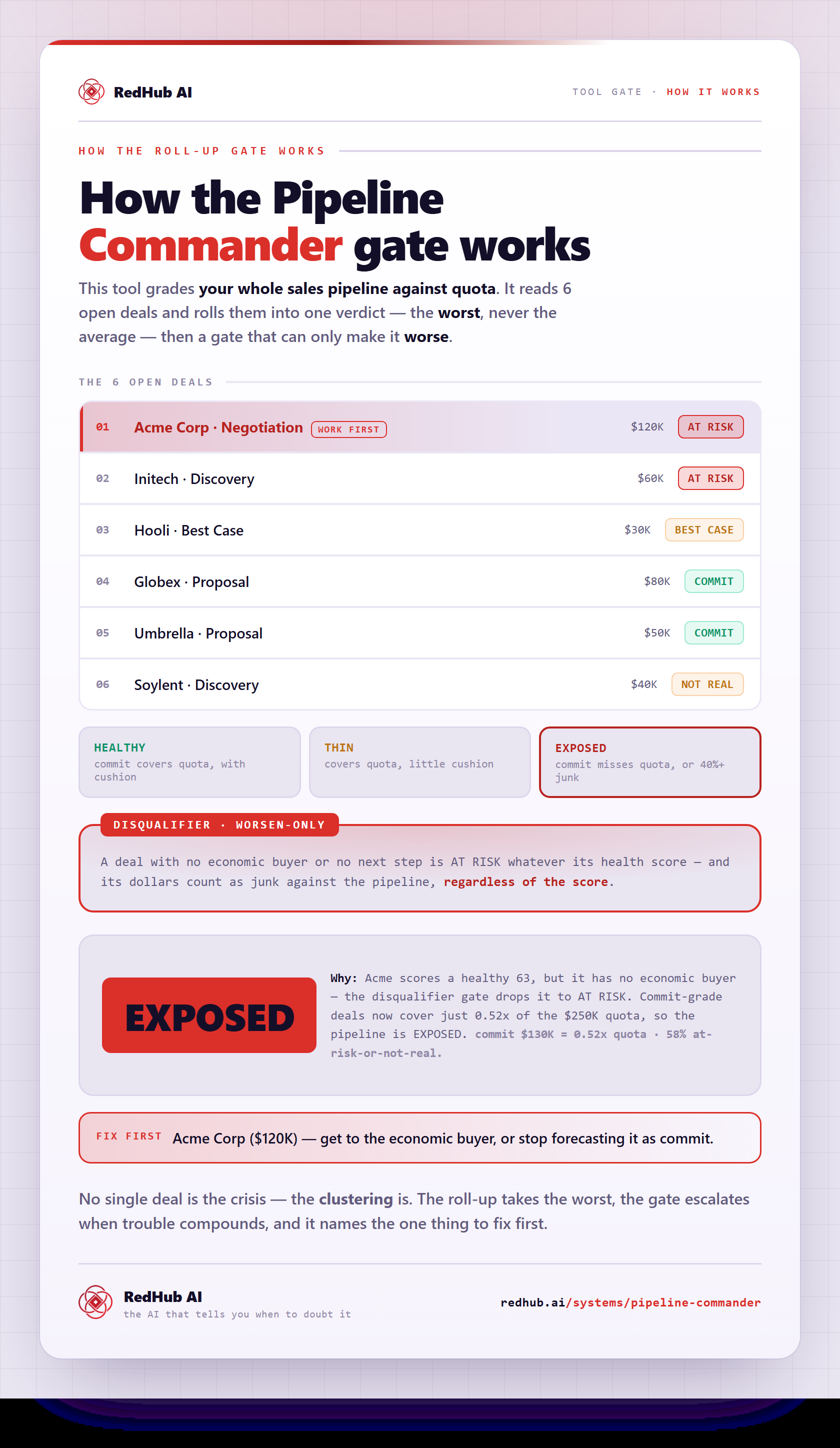
How the gate works, in one image
The six open deals rolled into one pipeline verdict and the disqualifier gate that drops any deal with no economic buyer or next step to AT RISK — the same math the demo runs, as a diagram you can share or embed anywhere.
View & embed the full diagramInspect every deal. Grade the pipeline. Know what to work.
The deal-qualifier pulls your open deals and scores each on the five dimensions — economic buyer, next step, champion, pain, compelling event — grading on qualification, not the stage or amount a rep entered. If the signal for a dimension isn't in the record, it scores it low rather than assuming the best.
The pipeline-grader rolls the deals into the verdict against your quota: commit coverage, the at-risk and not-real dollars, and the fantasy share. A $380K pipeline that's 58% at-risk-or-not-real against a $250K quota is EXPOSED — and it says so, instead of reporting the raw number as healthy.
The rescue-planner, where anything needs working, names the one deal to work first — a real deal about to die outranks pushing upside — and the specific play for each at-risk deal: get to the economic buyer through the champion, set a concrete next step, multithread before your one contact leaves.
The pipeline-tracker logs the week and compares to last — what advanced, what slipped, whether the rescues worked, and which deals have been 'closing next week' for a month. That pattern is a deal that isn't real, however it's staged.
Plus a runnable Python inspection engine with the worked sample, a spreadsheet that reproduces the same health scores and pipeline verdict, the pipeline-review one-pager template, and two playbooks — running the review, and connecting your CRM plus the anti-happy-ears method.
Three rules a VP of Sales holds to.
The two fields reps inflate most — the stage on the board and the number in the amount field — don't drive the grade. Whether you've engaged the signer and have a real next step does. The point is to see through an inflated pipeline.
An engaged economic buyer and a concrete next step are the two non-negotiables. A deal missing either is AT RISK no matter its stage, its size, or its health score — a late-stage six-figure deal with no access to the signer is a hope, not a deal.
It reads your CRM and delivers the review to you — it never edits a deal, changes a stage, writes a note, or sends an email. It tells you what to work and how; you run the plays. It doesn't guarantee what closes.
A VP-of-Sales inspection — clear about its limits.
- A pipeline inspection that grades every open deal on qualification and calls the pipeline against your quota.
- The review — Skills, scoring, a template, and playbooks — on top of your own CRM and AI tool, on the open Skills standard.
- Built to see through an inflated pipeline and tell you which deal to work first where anything is at risk — and which to stop forecasting.
- Not a CRM and not a closer — it reads your CRM read-only and never edits a deal, changes a stage, or sends anything.
- Not a forecast guarantee — it improves the odds and tells you the truth; the customer decides and the forecast is yours.
- Not financial advice, and it never invents deals — your pipeline comes from your CRM.
Built for the founder who forecasts from the pipeline.
- A founder or sales-led operator with a pipeline you forecast from — and a quarter riding on it.
- Tired of a board that looks healthy and a quarter that misses, and want the truth about what's real.
- Willing to connect a CRM (read-only) and act on the rescue plays instead of nursing dead deals.
- Want the pipeline to look good more than you want it to be real.
- Won't connect a CRM, or won't score deals honestly when the answer is uncomfortable.
- Want a tool to work the deals for you — it tells you what to do; you do it.
From an honest pipeline to a number you can defend.
The perfect complement. The commit-grade deals this qualifies become the number you can defend.
The Suite hub. Your pipeline-health verdict surfaces as the pipeline line in the Monday operating report.
The AT RISK and gone-dark deals from the review become a structured re-engagement queue.
The honest answers, before you buy.
Your own CRM (HubSpot or GoHighLevel) via MCP, for your open deals — Pipeline Commander is the grading-and-review layer on top, and it never includes or resells your data. It reads the deals you connect; it doesn't invent any. You can also run it against an exported CSV of open deals if you'd rather not connect the CRM live. Either way, you score each deal's qualification (or let the deal-qualifier skill propose scores from your notes) and the engine does the grading.
On qualification, not the stage or amount a rep entered — those are the two fields reps inflate most. Each open deal is scored 0–5 on five dimensions — economic buyer, next step, champion/multithread, pain/value, and a compelling event — weighted to sum 100 for a 0–100 health score, then graded COMMIT (75+), BEST CASE (50–74), or NOT REAL (under 50). The anti-happy-ears core is the disqualifier gate: the economic buyer and a concrete next step are non-negotiable, so a deal missing either is AT RISK no matter its stage, size, or health. A late-stage six-figure deal with no access to the signer is AT RISK, not commit — qualification makes a deal real, not stage and amount.
It rolls the deals up against your quota. The pipeline is HEALTHY when commit-grade deals cover the quota with cushion (3× total coverage), THIN when commit covers the number but without much cushion, and EXPOSED when commit-grade deals can't cover quota or too much of the pipeline is at-risk-or-not-real (40%+). In the worked example, $130K of commit can't cover a $250K quota and 58% of the pipeline is junk, so it reads EXPOSED — and it names the deal to work first: a real $120K deal about to die for lack of an economic buyer.
No — it's read-only. It reads your open deals and delivers the pipeline review to you; it never edits a deal, changes a stage, writes a note, sends an email, or updates the CRM. You work the deals. It gives you the honest grade, the pipeline verdict, and — where anything needs working — the one deal to work first; the calls and the work are yours.
They're complements on the same pipeline. Pipeline Commander is the deal-by-deal inspection and what-to-work: it grades qualification and tells you which deals are real and, where anything is at risk, which one to rescue first. The Forecast Floor computes the defensible forecast number from your committed deals. Run Pipeline Commander to inspect and work the pipeline; run the Forecast Floor to defend the number — PCM's commit-grade deals are exactly what feed FFL's floor. Both also surface as lines in the Operating Cadence Engine's Monday report.
No on both. It tells you which deals are real and which are hope dressed up as pipeline, but whether a deal closes depends on you and the buyer — outcomes are never guaranteed. The COMMIT/AT-RISK grades are sales-pipeline hygiene, not financial or accounting advice: the forecast, and how you report it, are your own call. It never invents a deal, and it grades only the deals you bring it.
Stop forecasting hope.
Know what's real.
One purchase, lifetime access, 12 months of updates. $249, once. Connect your CRM and see the pipeline honestly.
Sold by RedHub AI LLC · Secured by Stripe · redhub.ai