Should I Raise My Prices?
Model one price change, see how much volume you can actually afford to lose, and get a straight verdict — raise, hold and test, or restructure.
TL;DR
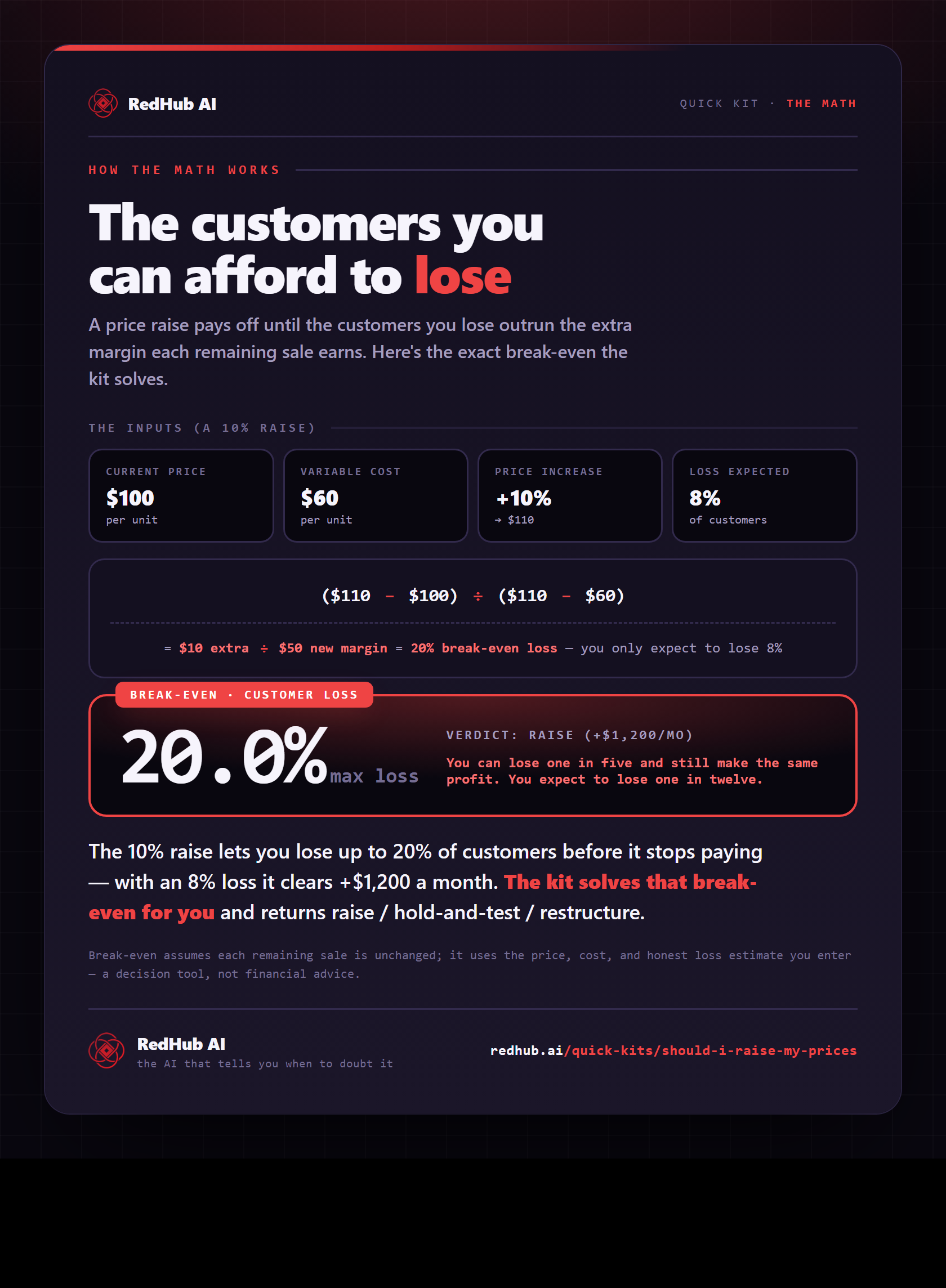
A higher price means each sale earns more, so you can lose some customers and still come out ahead. This kit calculates exactly how many you can lose, compares it to what you expect to lose, and tells you to raise, hold, or restructure. The example: a 10% raise nets +$1,200/mo even after losing 8% of customers.
instant download · .xlsx · 30-day guarantee
The problem
You know you're underpriced. You're scared to move.
Raising prices feels like the fastest way to lose customers, so it gets put off for years — usually leaving real profit on the table. The fear is about a number almost no one calculates: how many customers can you actually lose before a price increase stops paying off?
Answer that, and the decision stops being a gut call. Often you can lose far more than you'd guess — and sometimes the honest answer is don't raise yet, restructure instead.
of small business owners struggle with pricing decisions
of poorly chosen prices are set too low, not too high
lever: pricing is the fastest way to lift profit without spending a dollar
in the example, a 10% raise lets you lose up to 20% of customers and stay even
Sources: StartupOwl 2026 (pricing strategies for small business); Harvard Business School Online (willingness to pay).
What's inside
Four tabs, one decision.
One .xlsx — open it in Excel, Google Sheets, or Numbers and decide today.
Your Numbers
Enter current price, variable cost per unit, units per month, and the increase you're weighing. The sheet computes your new margin, the break-even volume loss you can absorb, your projected profit, and the verdict.
Increase Scenarios
A side-by-side of +5% through +25% — new price, the loss each one can absorb, projected profit, and a verdict per step — so you can find the sweet spot instead of guessing a number.
The verdict
One clear call — Raise, Hold-and-test, or Restructure — driven by whether your expected customer loss fits inside what the price increase lets you absorb. With the cushion shown in plain percentage points.
Playbook & scripts
Five rules for raising prices without losing the room, plus copy-paste scripts: the customer notice, a grandfather offer, a pushback reframe, and AI prompts to build tiers or pressure-test the call.
How the verdict works
Headroom decides it
The kit calculates the volume loss your increase can absorb (the break-even), then subtracts the loss you expect. That cushion is your headroom — and it sets the verdict:
- Raise — comfortable cushion — the math clears it
- Hold & test — too close to call — pilot it on new customers first
- Restructure — a flat raise loses money — use tiers, value, or cost cuts
It's deliberately conservative near the line — because a raise you have to walk back costs more than the one you waited a quarter to test.
The built-in example · a 10% raise
Verdict: Raise
Try it
Find your headroom on a price raise
You can absorb
20.0%
customer loss, break-even
Headroom
+12.0 pts
cushion vs. expected
Profit change
+$1,200
per month
Profit after
$9,200
per month
This is the live engine. Your numbers here reset when you reload. The kit saves them, runs every increase scenario side by side, and gives you the script for each verdict — the raise announcement, the test plan, the restructure steps.
Get the kit — $49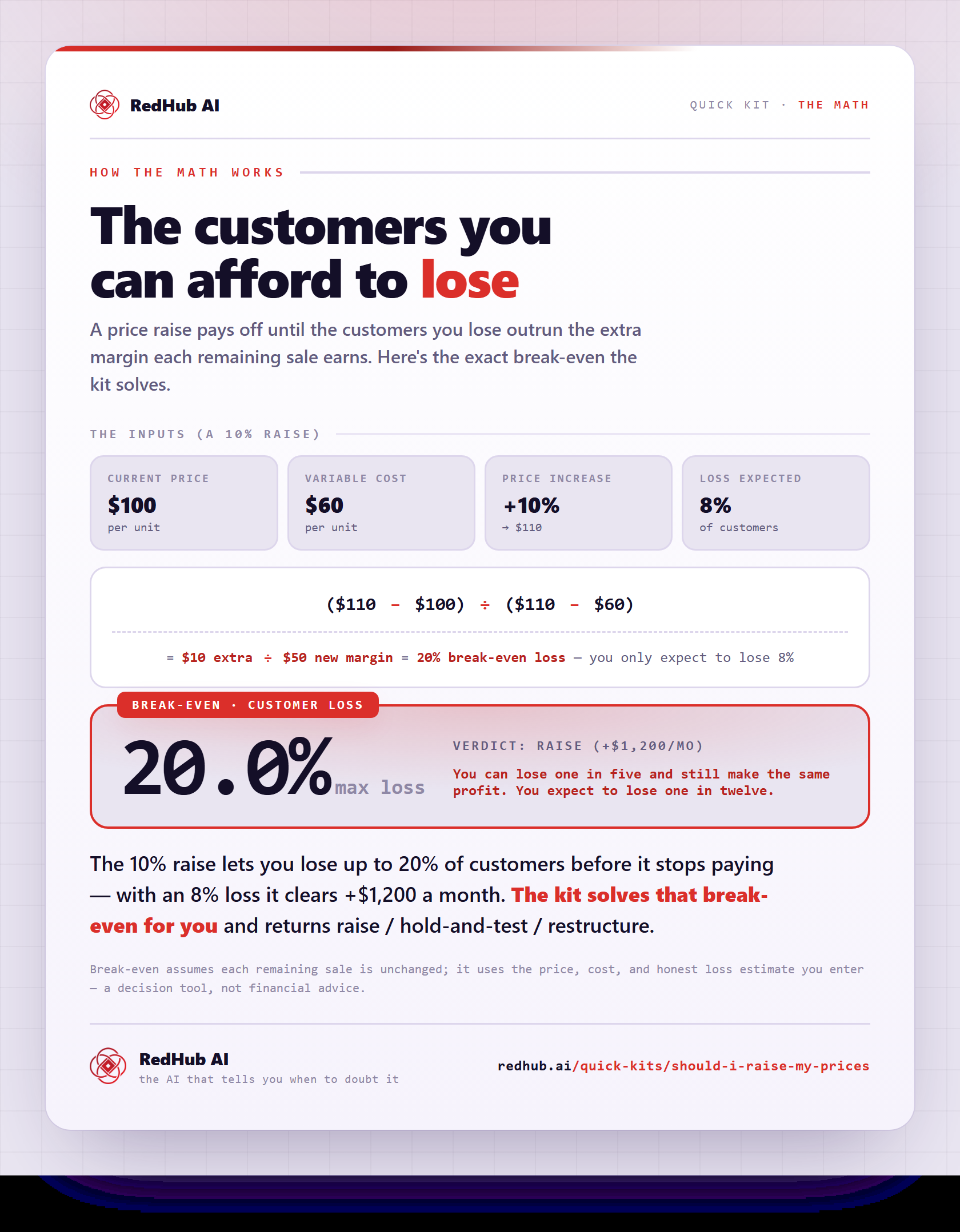
The math behind it, in one image
See the price-raise break-even: at a 10% raise you can absorb losing 20% of customers, but you only expect to lose 8% — a Raise.
See the full calculationWhy it's different
It won't just cheerlead a price hike
Says hold when it's close
Near the break-even line the verdict is test, not raise — because a raise you reverse costs more than waiting a quarter.
Restructure, not just raise
When a flat increase loses money, it points you to tiers and value instead of pretending the hike works.
A tool, not advice
It does the math and shows the risk on your own numbers. You make the call — it's not a substitute for your accountant.
The question was never “will I lose customers?” — you will. It's “how many can I lose and still win?”
Who it's for
Clear about the lane. No inflated promises.
Built for you if…
- You run a service, SaaS, ecommerce, or product business with a price you set
- You suspect you're underpriced but the fear of churn keeps you frozen
- You want a defensible number, not a gut call, before you move
- You'd rather know the break-even loss than guess and hope
Not for you if…
- You need full price-elasticity modeling or conjoint analysis
- Your costs per sale are so variable you can't estimate them at all
- You want done-for-you pricing rather than a decision you run
Common Questions
The questions founders actually ask before raising prices.
It's a one-time spreadsheet that turns a nerve-wracking judgment call into a math problem. You model a price increase; it calculates the volume loss you can absorb and still make the same profit, compares that to the loss you actually expect, and returns a verdict: raise, hold-and-test, or restructure.
One .xlsx that opens in Microsoft Excel, Google Sheets, or Apple Numbers — no subscription, no login. It's pre-loaded with a worked example so it makes sense the moment you open it; clear it and enter your own numbers.
No. You need four things: your current price, your variable cost per unit (what each sale costs you), roughly how many units you sell a month, and your honest guess at how much volume you'd lose. It's a ten-minute exercise, not a bookkeeping project.
It's the percentage of customers or units you can lose after a price increase and still make the same total profit — because every remaining sale now earns more. Most owners never calculate it, so they under-raise out of fear. In the built-in example, a 10% increase lets you lose up to 20% of customers before the raise stops paying off.
No. It's a decision tool: it does the math and flags the risk, but you make the call. It isn't a substitute for an accountant or financial advisor, and it uses the inputs you provide — so the verdict is only as good as your numbers.
The Profit Leak Finder identifies clients who land on a 'reprice' verdict — thin margins or rising cost to serve. This kit is what you run on each one before you actually send the new price: it tells you how much customer loss the raise lets you absorb, so the reprice conversation rests on math instead of nerve. Run Profit Leak Finder to see who needs a raise; run this to decide how much.
Yes — a 30-day money-back guarantee. If it doesn't give you a clearer pricing decision, request a refund within 30 days.
Before you commit to a new price, red-team it. The Devil's-Advocate Board pressure-tests a big decision from five skeptical board lenses — part of the founder-grade Executive Suite. $199.
Get the kit
Decide this afternoon.
Instant download, yours to keep, 12 months of updates. One good pricing decision pays for it many times over.
- 4-tab .xlsx: your numbers, scenarios, verdict, playbook
- Break-even-loss engine + raise / hold / restructure verdict
- Copy-paste price-increase scripts + tier-building AI prompts
- Works in Excel, Google Sheets, or Numbers · 30-day guarantee