Get an advisorthat says no.
Bring one decision — a pivot, a price change, a raise, a new market. Five skeptical board members each build the strongest case against it and score how well the case survives, for an honest verdict: GO, GO WITH CONDITIONS, NOT YET, or NO-GO. The anti-sycophancy core is a veto gate — one fatal objection kills a GO no matter how high the score. A stress-test, not a decision-maker; the call is yours.
Everyone around you agrees with you. That's the problem.
Your team, your investors, even your AI tools have a reason to tell you the plan is good. Honest dissent is the scarcest thing a founder has — and the most valuable.
Ask a chatbot whether to pivot and it calls it promising. Describe the same idea as a competitor's and it says the same thing. That's not judgment — it's a mirror with a vocabulary.
The pivot, the raise, the new market — the decisions that can kill a company are exactly the ones that feel most like progress. Excitement is not evidence.
Score the case — and watch one fatal objection veto a 64/100 decision.
This is the board, live. The decision scores a respectable 64/100 — but the CFO scores the downside a 1, a fatal objection, so the verdict is NO-GO, vetoed. Raise the CFO to clear the veto and watch it climb to NOT YET, then GO. Drop any lens to 1 and a different objection vetoes the whole thing. Same math as the engine and workbook.
The board · live demo
Decision: pivot from SMB to enterprise. Score each lens — and watch one fatal objection veto the whole thing.
NO-GO· vetoed
The case doesn't survive as it stands. Resolve the objection or it's dead.
64
conviction / 100
The objection to beat: The CFO (1/5) — a fatal objection; resolve it or the decision is dead, whatever the score.
The Skeptic
weight 22 · Is the evidence real, or a story you like?
The Customer
weight 22 · Do customers actually want this — with budget?
The CFO
vetoweight 20 · What's the cost if you're wrong — can you survive it?
The Operator
weight 18 · Can you execute with the team, time, and money you have?
The Contrarian
weight 18 · What's the single strongest reason this fails?
The veto gate is the point: any lens at or below 1 is a fatal objection that forces NO-GO however high the score — raise the CFO to clear the veto and watch it climb to NOT YET, then GO. Same math as the engine and workbook. A stress-test, not a decision-maker; the call is yours.
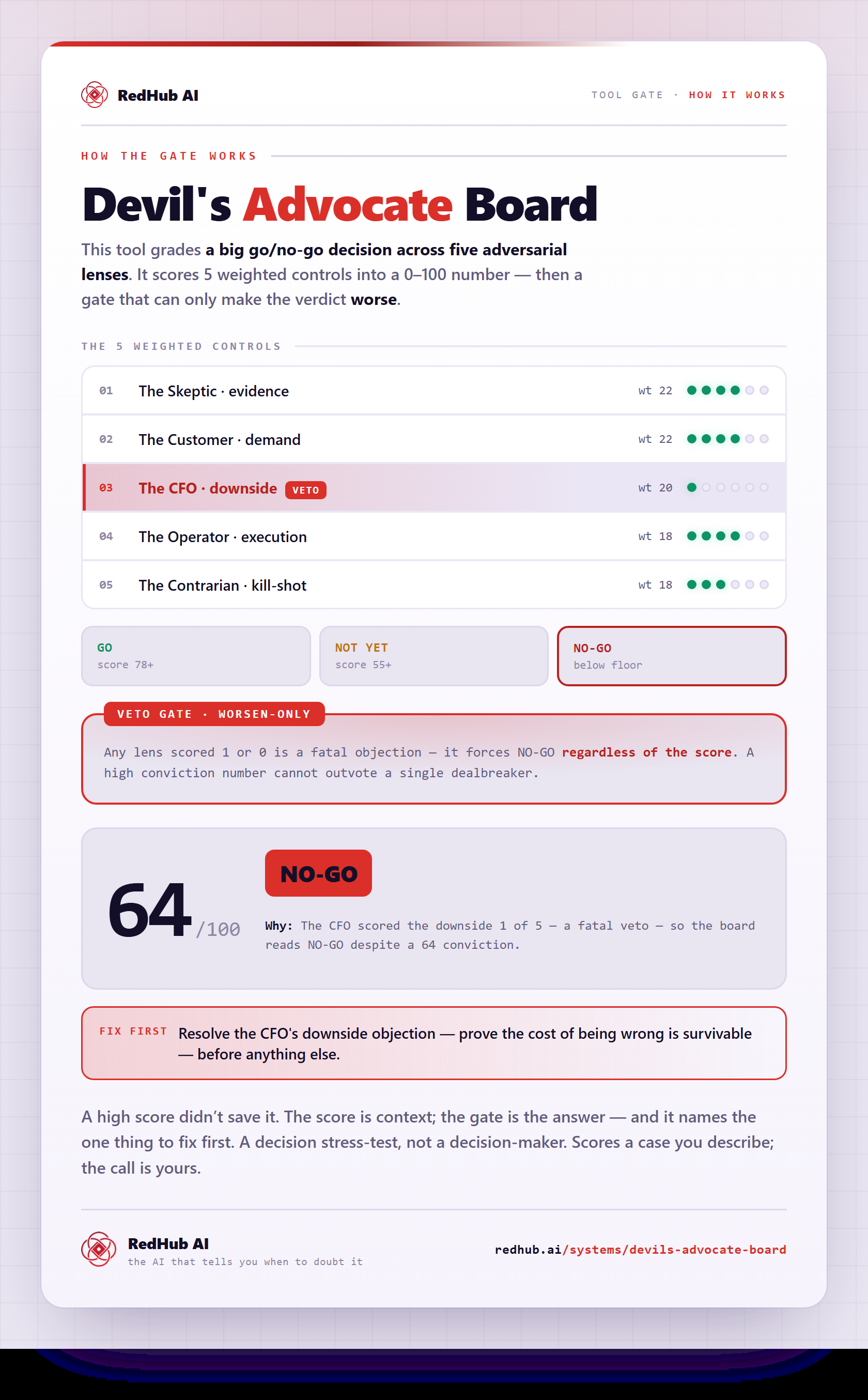
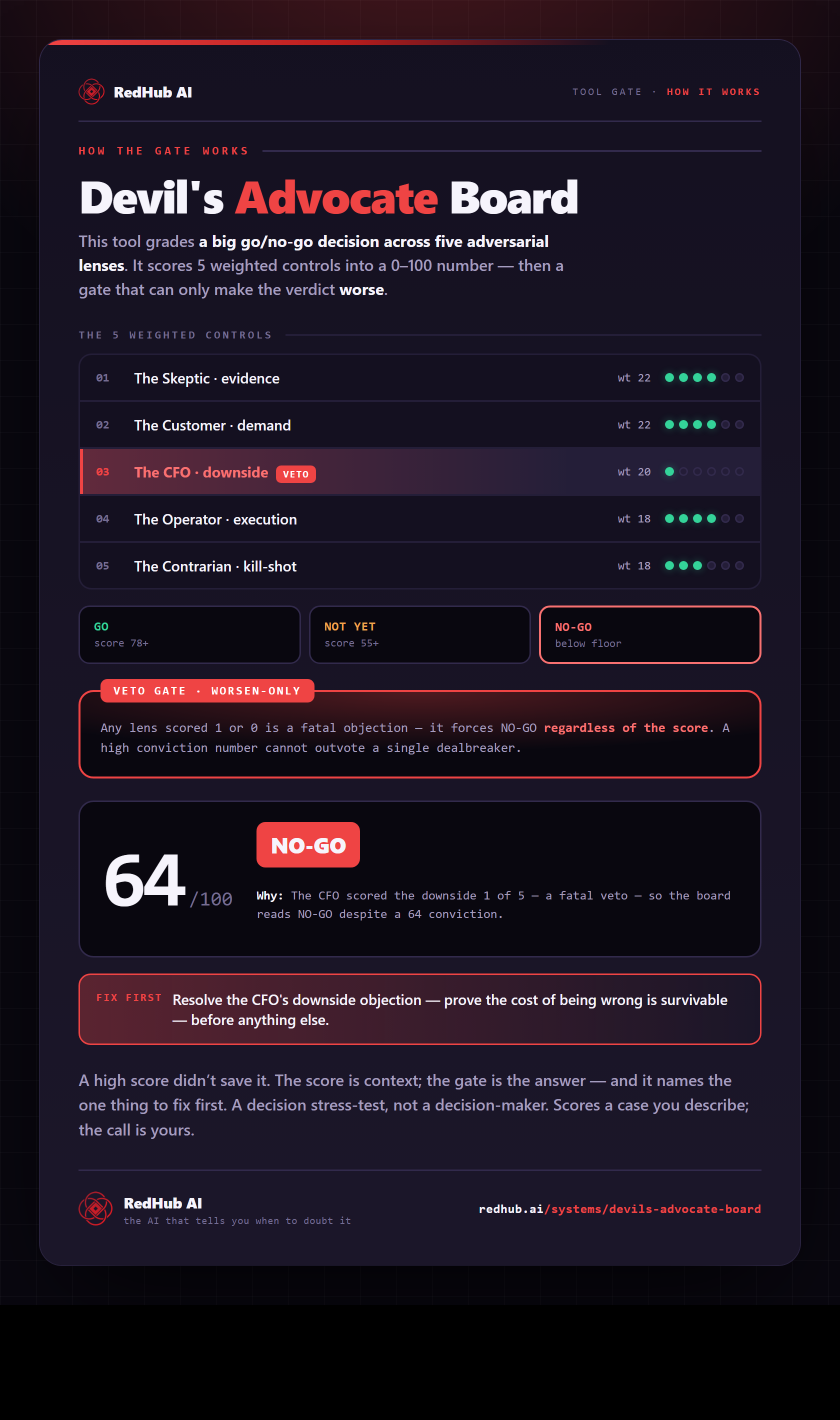
How the gate works, in one image
The five adversarial lenses weighted into a 0–100 conviction, and the veto gate where one fatal objection forces NO-GO — the same math the demo runs, as a diagram you can share or embed anywhere.
View & embed the full diagramOne decision, five skeptics, one honest verdict.
The decision-framer turns a fuzzy decision into one sharp, time-boxed question, surfaces the real options you're skipping (the smaller test, doing nothing), and lists the assumptions the case rests on — each tagged evidenced, assumed, or hoped. A fog can't be stress-tested; a specific choice can.
The board convenes. Each of the five lenses — The Skeptic, The Customer, The CFO, The Operator, The Contrarian — writes the strongest case against the decision, then scores 0–5 how well it survives. The challenge comes before the number, and the rival test keeps the scores honest.
The verdict-synthesizer rolls the five scores into a conviction score, applies the veto gate, and returns the verdict, the objection to beat where a lens is short, and any conditions — matching the engine and the workbook to the number. It never softens a veto to make the answer easier to hear.
The decision-journal logs the decision, its verdict, and the assumptions it rested on, and re-tests it later when an assumption breaks — so a past GO that rested on demand showing up becomes a NO-GO when it doesn't, and you find out before it costs you.
Plus a runnable Python stress-test engine with the worked sample, a spreadsheet that reproduces the same conviction score and veto gate, the board-verdict one-pager template, and two playbooks — how to run the board, and bringing a decision plus the anti-sycophancy method.
Three rules the board holds to.
Each lens writes the strongest argument against your decision before it scores — so the number rests on a real objection, not a vibe. The board applies the rival test: would it score the move the same if a competitor made it?
Any member who scores the case at or below 1 has raised a fatal objection — and one fatal objection forces NO-GO no matter how high the conviction score. A strong total can't paper over the one thing that kills you.
It returns an honest verdict — including no — the objection to beat where a lens is short, and the conditions to clear. You decide, and you own the consequences. It never invents evidence in your favor to make you feel good.
A way to red-team one decision honestly — clear about its limits.
- A structured way to stress-test one high-stakes decision from five skeptical lenses and get an honest verdict.
- The board — Skills, scoring, a template, and playbooks — on top of your own AI tool, on the open Skills standard.
- Built to find the strongest case against your decision, not to validate it — and to tell you no when no is the answer.
- Not a decision-maker — it returns a verdict and, where a lens is short, the objection to beat; you decide and own the consequences.
- Not a yes-machine — it will tell you no, and a single fatal objection vetoes a high overall score.
- Not financial, legal, or investment advice, and it never invents evidence in your favor to make you feel good.
Built for the call you can't easily take back.
- A founder weighing a high-stakes, hard-to-reverse decision — a pivot, a raise, a price change, a new market.
- Tired of advisors and tools that agree with you, and want honest dissent before you commit.
- Willing to bring real evidence and to sit with a NO-GO instead of arguing your way past it.
- Want reassurance and confidence, not scrutiny — this is built to find what kills the decision.
- Won't bring the evidence, or won't accept a verdict you don't like.
- Want a tool to make the decision for you — the call, and the consequences, stay yours.
The decisions worth bringing to the board.
The Suite hub. Bring the high-stakes calls your Monday operating report surfaces straight to the board.
Pressure-test the forecast, then bring the bet that rests on it — the raise, the hire — to the board.
Decide which dead accounts are worth chasing before you spend the team's week re-engaging them.
The honest answers, before you buy.
You bring one high-stakes decision — a pivot, a price change, a raise, a new market — and a five-member skeptical board red-teams it. Each lens (The Skeptic on evidence, The Customer on demand, The CFO on downside, The Operator on execution, The Contrarian on the kill-shot) writes the strongest case against the decision, then scores 0–5 on how well the case survives that challenge — not how good it sounds. The scores roll up to a 0–100 conviction score and an honest verdict: GO, GO WITH CONDITIONS, NOT YET, or NO-GO. It runs as a prompt, a Claude skill, or a Claude Project on your own AI tool — there's no data connection to set up.
Three ways, all structural. First, each lens builds the case against your decision before it scores, so the number rests on a real objection instead of a vibe. Second, the rival test is written into the red-team skill: it asks whether it would score the move the same if a competitor proposed it — which strips out the optimism that comes from it being your idea. Third, the veto gate: any single lens scoring the case at or below 1 is a fatal objection that forces NO-GO no matter how high the overall score. A strong total can't paper over the one thing that kills you.
Each board member scores 0–5. A 1 or 0 is a fatal objection — the case does not survive that challenge — and one fatal objection vetoes the decision to NO-GO regardless of the conviction score. A score of exactly 2 is a caution: not fatal, but a condition you must address, which turns an otherwise-GO into GO WITH CONDITIONS. In the worked example a pivot from SMB to enterprise scores a respectable 64/100, but the CFO scores the downside a 1 — so the verdict is NO-GO, vetoed. Raise the downside and it climbs to NOT YET, then GO. Any of the five lenses can veto, not just a chosen few.
No — and that's deliberate. It's a stress-test, not a decision-maker. It returns an honest verdict (including no), the single objection to beat where a lens is short, and the conditions you'd have to clear first — but you make the call and you own the consequences. It never invents evidence in your favor to make the answer easier to hear, and it's not financial, legal, or investment advice. The point is to hear the strongest case against your decision before you commit, not to outsource the decision.
It's built for the hard-to-reverse calls — a pivot, a raise, a price change, a new market, a big hire. Inside: four Claude Skills (decision framer, red-team board, verdict synthesizer, decision journal), a runnable Python stress-test engine with the worked sample, the same conviction score and veto gate as an Excel workbook, a board-verdict one-page template, and two playbooks — how to run the board, and bringing a decision plus the anti-sycophancy method. The decision journal re-tests a past verdict later when an assumption breaks.
It means the case didn't survive the board as it stands — usually because of one fatal objection. A NO-GO names the exact objection to beat, so it's a map, not a wall: resolve that objection with real evidence and re-run the board, and the verdict can move to NOT YET or GO. What it won't do is let you argue your way past a fatal objection without addressing it. The honest answer, including no, is the product.
Stop getting told what you want to hear.
Get told the truth.
One purchase, lifetime access, 12 months of updates. $199, once. Bring one decision and let the board try to kill it.
Sold by RedHub AI LLC · Secured by Stripe · redhub.ai