You're the bottleneck.Which tasks prove it?
Founders don't get trapped by one big thing — they get trapped by a plate full of small things they keep doing because it's faster themselves. Score each task and get one verdict: OFF YOUR PLATE, DOCUMENT FIRST, or KEEP — with gates that catch the two ways a delegation quietly fails: handing off the task but keeping the decision, and trying to give away the work that was only ever yours.
The trap of being needed.
of founders are poor at delegating — bottlenecking their own companies. The instinct that built the business becomes the ceiling on it.
the hidden cost of doing everything: a high-value founder spending hours on tasks someone else could do at a fraction of the rate. You're paying not to delegate.
the most-cited delegation failure: you hand off the task but keep the decision. The delegate escalates everything, and you've built a more expensive version of yourself.
This grades each task on your plate for the leverage you'd gain by removing it — and refuses to call something "off your plate" when you won't release the decision, or when it was never yours to give away.
Score a task and watch the trap gates hold.
The shipped Refund-approvals task scores 72 — squarely a delegation candidate — and still reads KEEP, because the founder won't release the decision. Flip that one signal and watch the verdict change.
Mark each signal. The score is the leverage you'd gain by removing it — same math as the workbook.
Not the vision, key relationships, judgment, or revenue-defining work only you can carry. A 0 means it's core — it stays with you.
Someone at a fraction of your cost could do it 80%+ as well. 0 = only you, at this level.
Hours per month you'd genuinely feel back. 0 = trivial; 2 = a meaningful recurring drain.
Written down / repeatable enough that someone could run it from the docs, not your head.
Delegation transfers task + decision + accountability together. A 0 means you'd keep approving every call — so it routes back to you.
If someone does it 85% as well, the downside is tolerable — no brand, legal, or relationship blow-up.
On the other signals this scores in the DOCUMENT FIRST band — but you won't release the decision, so it's forced to KEEP. Hand off the task while keeping the decision and it just routes back through you — a more expensive version of doing it yourself. Release the decision, or accept that it stays.
Fix first: Willing to transfer the decision, not just the task
Your marks only · grades how your time is spent, not a person
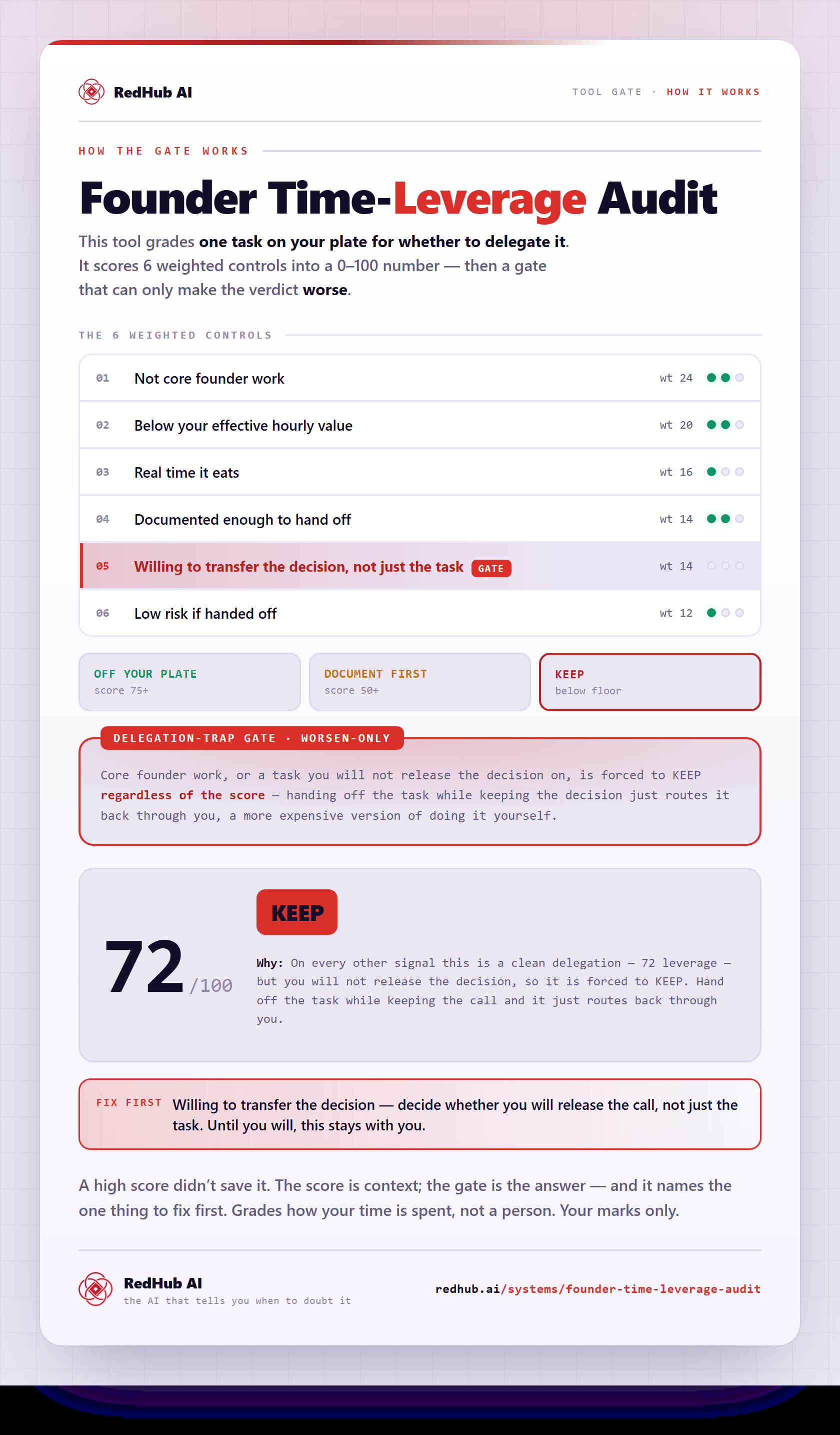
How the gate works, in one image
The six weighted delegation signals and the trap gate that forces KEEP on core founder work — or any task you won't release the decision on — the same math the demo runs, as a diagram you can share or embed anywhere.
View & embed the full diagramOne command, your whole plate, an honest read.
The zero-dependency Python engine reads your task list and prints the same verdict the workbook and demo produce. Two tasks below score like delegation candidates and still read KEEP — one is core, the other you won't release the decision on.
The Founder-Time Leverage Audit
====================================================
Investor updates (write monthly)    53/100  KEEP              [GATE -> KEEP]
    fix first: Not core founder work
Bookkeeping & invoice reconciliation 100/100  OFF YOUR PLATE
Approving every customer refund     72/100  KEEP              [GATE -> KEEP]
    fix first: Willing to transfer the decision, not just the task
Social media scheduling & captions  72/100  DOCUMENT FIRST
    fix first: Documented enough to hand off
First-line customer support replies  50/100  DOCUMENT FIRST
    fix first: Not core founder work
Closing key enterprise deals        16/100  KEEP
    fix first: Not core founder work
----------------------------------------------------
Portfolio: FOUNDER-BOUND
3 of 6 task(s) could come off your plate.Six signals, weighted to 100 — two of them gates.
Core founder work (you can't give away the vision) OR an unreleased decision (phantom delegation) each force KEEP regardless of score — and only ever worsen a verdict, never lift one.
The middle band names the real blocker: a task should come off your plate, but it lives in your head. Write the SOP before you hand it off, or it comes back.
The portfolio rollup folds in the catch every framework names: reclaimed hours only become leverage if you spend them on higher-value work.
A leverage read, not a management consultant.
- A deterministic verdict on each task: off your plate, document first, or keep.
- A catch for the two ways a delegation fails before you make it.
- A portfolio read of how leveraged or founder-bound you actually are.
- Offline — engine, workbook, and demo agree to the number.
- Not financial, legal, or management advice.
- Not a decision about who to hire — it's the step before that.
- Not connected to your tools — you bring the marks on your own tasks.
- Not a scoring of any person — it grades how your time is spent.
Not financial, legal, or management advice. This grades how your time is spent from your own marks — it doesn't manage your team, set your rates, or decide what's core to your business for you. Reclaimed hours only become leverage if you redeploy them to higher-value work. Use it to surface the decision; the call is yours.
Founders ready to stop being the bottleneck.
The rest of the founder's decision desk.
Once tasks are off your plate, this builds the weekly rhythm that keeps you out of the weeds.
ViewKnow what you can afford to offload — the cash reality behind every delegation decision.
ViewSix Claude skills to do more yourself — and to make the tasks you keep take less time.
ViewThe honest answers.
For each task on your plate, what to do with it: OFF YOUR PLATE (high leverage — delegate or eliminate it), DOCUMENT FIRST (worth offloading, but not handoff-ready yet), or KEEP (low leverage, or genuinely yours). You mark six signals 0/1/2 — whether it's core founder work, whether it's below your effective hourly value, the real time it eats, whether it's documented, whether you'll transfer the decision (not just the task), and the risk of handing it off. The score is the leverage you'd reclaim by removing it. Score your whole plate and the rollup tells you how leveraged or founder-bound you are.
Because two traps each override the score. A task that looks delegable can still be undelegable for one of two reasons, and the gate catches both. The CORE-WORK trap: if it's genuinely yours — the vision, key relationships, or revenue-defining work — handing it off destroys value, so it's KEEP no matter how many hours it eats. The PHANTOM-DELEGATION trap: if you won't transfer the decision, only the doing, the task just routes back through you — a more expensive version of doing it yourself — so it's KEEP until you'll release the call. The shipped Refund-approvals sample scores 72 and still reads KEEP because the founder won't release the decision.
There's no DELEGATE band — there's OFF YOUR PLATE, which means delegate or eliminate it, it's ready to go. DOCUMENT FIRST is the honest in-between: the task should come off your plate, but it isn't handoff-ready yet, usually because it lives in your head. The most-cited reason delegations fail is handing off a task without documenting it first, so the verdict tells you to write the SOP or record the walkthrough before you hand it over. Skip that step and the work comes back to you.
FOUNDER-BOUND means half or more of what you do could come off your plate but hasn't — the business is bottlenecked on you doing things others could. That's the leverage sitting unclaimed. But here's the catch the rollup reminds you of: reclaimed hours only become leverage if you spend them on higher-value work. Delegating bookkeeping so you can scroll isn't leverage; delegating it so you can sell, build, or set strategy is. The audit finds the hours — what you do with them is the actual return.
Not directly — it tells you what should come off your plate, which is the step before the hire. Often the right first move isn't a full-time employee at all; it's temporary outside capacity (an agency, vendor, professional firm, or properly classified contractor), a fractional specialist, or an automation for the specific tasks that score OFF YOUR PLATE. Once you know which tasks to offload and you've documented them, the hiring question gets much clearer (and our First-Hire decision tool picks up there).
No. It's a deterministic decision aid that grades how your time is spent from your own marks — it doesn't manage your team, set your rates, or replace your own judgment about what's core to your business. Use it to surface the tasks trapping you and the two reasons a delegation would fail before you make it. Not financial, legal, or management advice.
Get off your own
plate.
One purchase, lifetime access, 12 months of updates. $79, once.
Not financial, legal, or management advice. This grades how your time is spent from your own marks — it doesn't manage your team, set your rates, or decide what's core to your business for you. Reclaimed hours only become leverage if you redeploy them to higher-value work. Use it to surface the decision; the call is yours.
Sold by RedHub AI LLC · Secured by Stripe · redhub.ai