If one person vanished,would the business survive?
Replacing a key employee runs 100–300% of their salary, and acquirers visibly discount a business with single points of failure. This audit scores each key person on six continuity dimensions and tells you exactly where you're dangerously dependent — and the one move that fixes it.
The risk that's invisible until the day it isn't.
of annual salary is the typical cost to replace a key employee — and that's before counting the institutional knowledge that walks out with them.
of companies report significant operational disruption after a key person leaves unexpectedly. Resignation, illness, leave, or a competitor's offer — the cause rarely gives notice.
Investors and acquirers visibly mark down a business with single points of failure. A low bus factor is a direct threat to the deal.
Most owners can name their key people instantly. What they can't answer with confidence is the next question: for each one, is the dependency managed — or is the business one resignation away from a stall? This audit makes that answer explicit, person by person.
Score one key person. Watch the kill-chain.
The preset is the founder-led rainmaker: holds the top relationships, the deal context lives in their head, and there's no backup. It reads SINGLE POINT OF FAILURE. Now train a backup — flip that one dimension to 2 — and watch the verdict release, even while everything else stays load-bearing. That's the whole insight: a single point of failure needs both halves.
Mark each dimension 0–2. Same math as the workbook — nothing is sent anywhere.
Holds the primary relationships; no one else has a real one
Critical processes exist only in their head — nothing written
Primary authority, but a backup approver exists
No one trained to cover the core work — if they're out, it stops
No continuity plan and no key-person insurance
Personally drives a large, concentrated share that wouldn't survive their absence
Kill-chain fired. This person is both load-bearing (holds irreplaceable relationships or knowledge) and has no trained backup — the two conditions that define a true single point of failure. The cheapest release is to train and test a backup.
Fix first
Train and test a backup owner for the core work
Grades a continuity posture, not a person. Not an HR action, a performance review, or grounds for any employment decision — it identifies where the business is over-dependent so you can document, cross-train, and back up critical work.
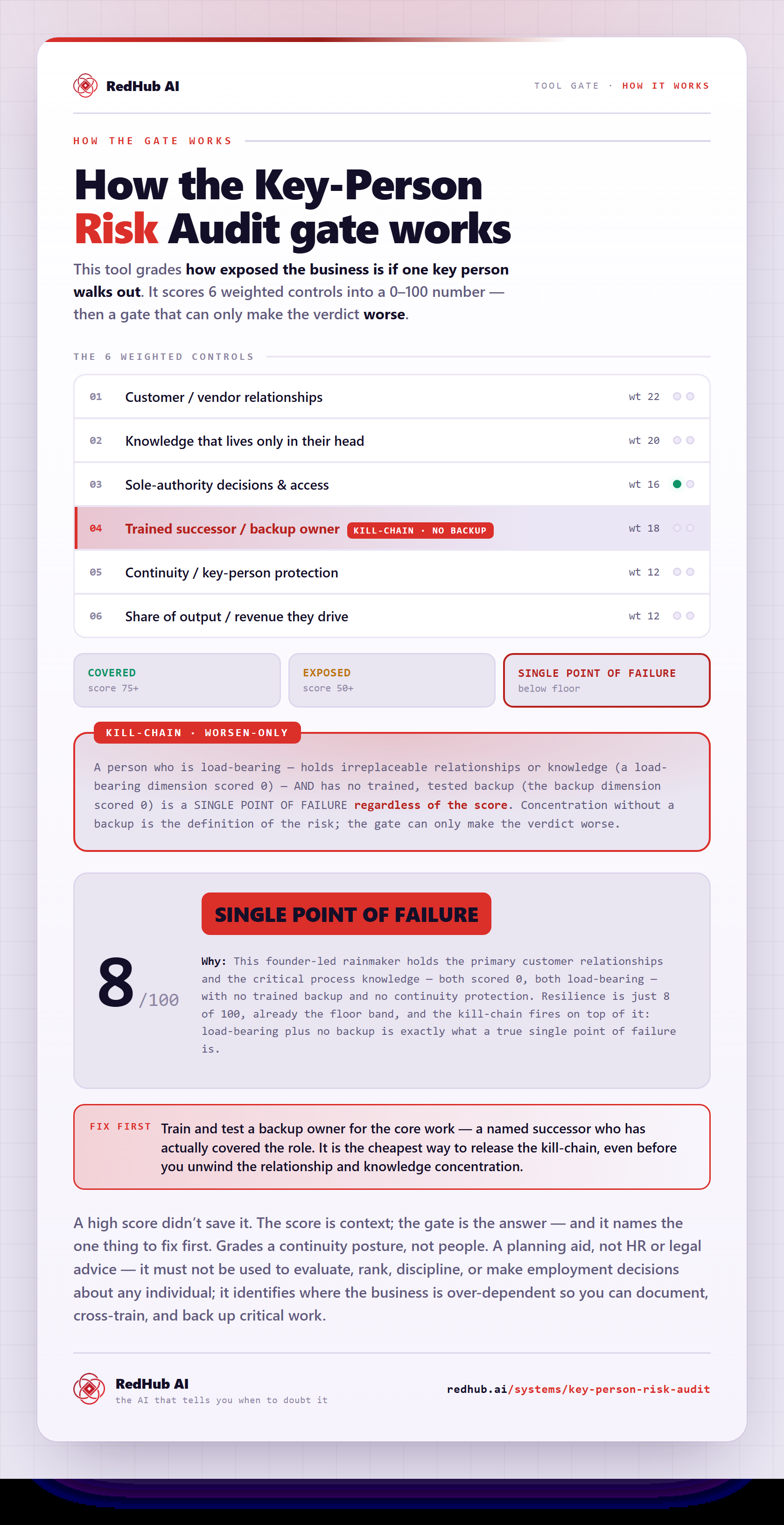
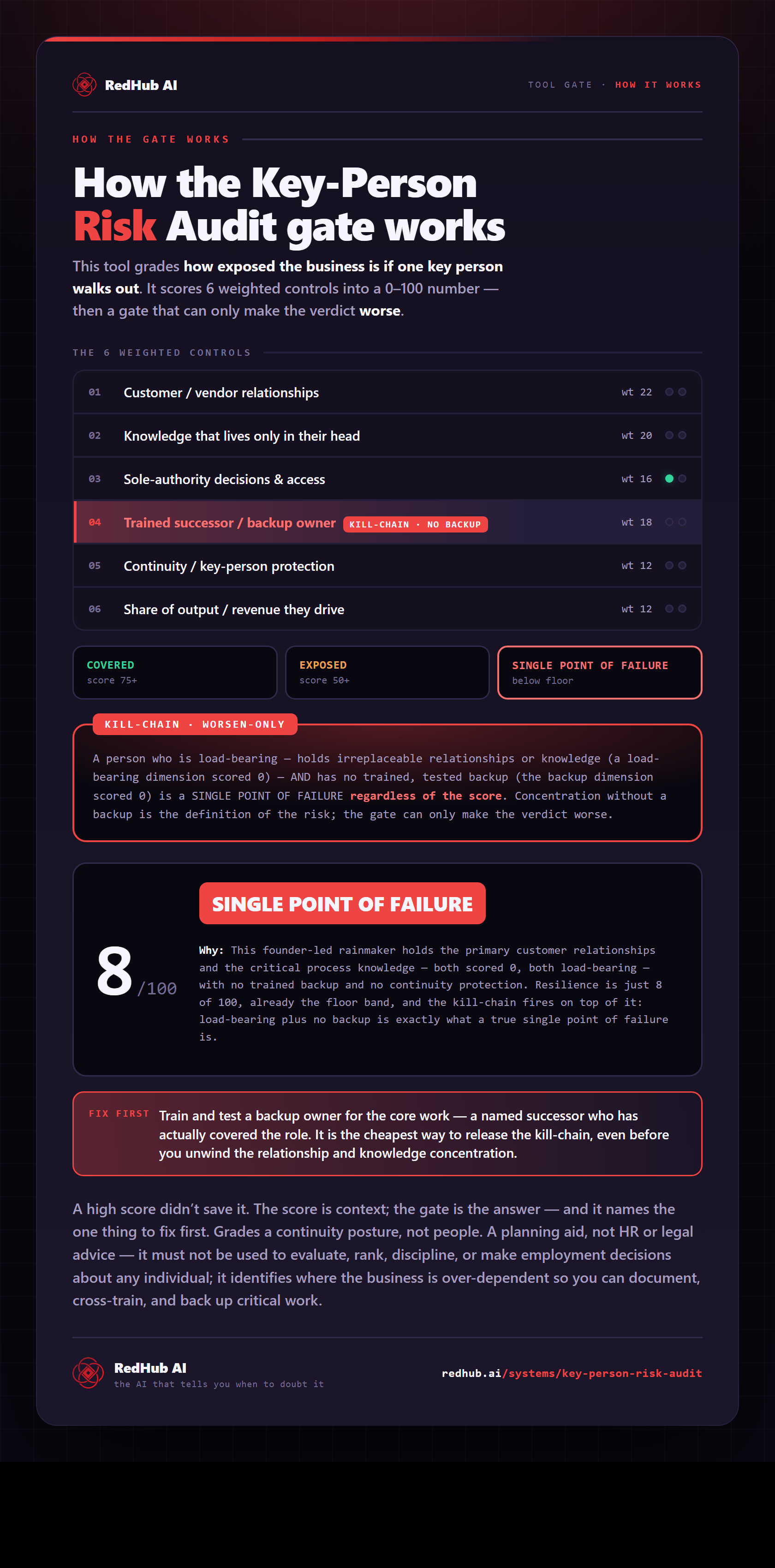
How the gate works, in one image
How the Key-Person Risk Audit scores single-person exposure and forces SINGLE POINT OF FAILURE when a load-bearing person has no backup — the same math the demo runs, as a diagram you can share or embed anywhere.
View & embed the full diagramThe same verdict, from the command line.
The scoring engine ships as a zero-dependency script. Point it at your roster, get the company bus-factor verdict and every fix-first. This is the verified output on the six-person sample — the workbook and the demo reproduce it exactly.
The Key-Person Risk Audit
==============================================================
Founder-led top-account rainmaker          8/100  SINGLE POINT OF FAILURE  [KILL-CHAIN]
    fix first: Train and test a backup owner for the core work
Lead engineer fully backed                84/100  COVERED
    fix first: Document the process in an accessible SOP / runbook
Sole bookkeeper load-bearing but backed   58/100  EXPOSED
    fix first: Document the process in an accessible SOP / runbook
Operations manager broadly shared         94/100  COVERED
    fix first: Put a continuity plan and key-person coverage in place
Key salesperson unbacked but not irreplaceable  59/100  EXPOSED
    fix first: Train and test a backup owner for the core work
Sole admin of the core platform           28/100  SINGLE POINT OF FAILURE  [KILL-CHAIN]
    fix first: Train and test a backup owner for the core work
--------------------------------------------------------------
Company bus-factor verdict: FRAGILE
2 of 6 key people are single points of failure.

Grades a continuity posture, not a person. Not an HR action or grounds for
any employment decision.Six dimensions. One kill-chain.
Who owns the customer, vendor, and partner relationships — and whether anyone else could step in.
Whether critical processes live in accessible SOPs or only in one person's head.
Whether one person is the only one who can authorize, sign, or access something critical.
Whether a named successor can carry the core work — and whether it's actually been tested.
Whether a continuity plan and key-person coverage cushion an unexpected loss.
How concentrated the person's share of output or revenue really is.
A person is forced to SINGLE POINT OF FAILURE only when two conditions are present at once: they're load-bearing (hold irreplaceable relationships or knowledge) and unbacked (no trained, tested successor). That's the precise bus-factor definition — key and irreplaceable. The gate releases the moment either half clears, which is why the cheapest fix is almost always to train a backup: it stops the bleeding before you've untangled the dependency itself.
A continuity check, not a verdict on anyone.
- A per-person continuity verdict with the one thing to fix first where a dimension is short.
- A company bus-factor rollup: RESILIENT, KEY-PERSON GAPS, or FRAGILE.
- A precise gate that fires only on a genuine single point of failure.
- Offline and deterministic — engine, workbook, and demo agree to the number.
- Not a performance review or a judgment of anyone's worth.
- Not grounds for any hiring, firing, pay, or promotion decision.
- Not connected to your systems — you mark each person yourself.
- Not insurance or legal advice; it points you to the fixes.
Grades a continuity posture, not people. This is a planning aid, not HR or legal advice. It must not be used to evaluate, rank, discipline, or make employment decisions about any individual — it identifies where the business is over-dependent so you can document, cross-train, and back up critical work.
Owners who'd feel it most if someone left.
- · Founders whose business runs through a handful of people — often including themselves.
- · Owners preparing for a raise, sale, or diligence, where single points of failure get discounted.
- · Operators who just had a scare — a near-resignation, an illness, a long leave.
- · Teams with a "bus factor of one" on a critical system, relationship, or process.
The rest of the resilience desk.
When something does break, is the postmortem finished and the action items closed?
ViewThe meeting and review rhythm that surfaces dependency before it becomes a crisis.
ViewThe other continuity risk — is the cash runway as resilient as the team?
ViewThe honest answers.
For each key person — anyone whose sudden absence would hurt — it scores six continuity dimensions (customer/vendor relationships, knowledge that lives only in their head, sole-authority decisions and access, a trained successor, continuity/key-person protection, and the share of output they personally drive) into a 0–100 resilience score and a verdict: COVERED, EXPOSED, or SINGLE POINT OF FAILURE. Then every person rolls up to a company bus-factor verdict — RESILIENT, KEY-PERSON GAPS, or FRAGILE. It answers the one question owners and acquirers actually care about: could the business keep running if this person vanished for a week?
Because being critical isn't the same as being a single point of failure — and conflating the two is the mistake this audit is built to avoid. The real bus-factor definition is precise: a person only creates that risk if they are BOTH key/irreplaceable AND unbacked. So the kill-chain gate forces SINGLE POINT OF FAILURE only when two conditions are present at once — the person holds irreplaceable relationships or knowledge (a load-bearing dimension marked 0) AND there's no trained, tested backup (the backup dimension marked 0). A brilliant, load-bearing person with a documented successor is covered; an unbacked role that holds nothing irreplaceable is survivable. Only the intersection actually halts the business, so only the intersection fires the gate.
Clear either half of the kill-chain — and the cheaper half is usually the backup. Train and test a successor for the core work and the gate releases even while the person stays load-bearing, because the fall now has somewhere to land. Or reduce the concentration itself: document the knowledge into accessible SOPs, or introduce a second owner on the key relationships. The audit names the single highest-leverage fix per person (it points to the backup first when the gate fired), so where a dimension is short you know the one move that changes the verdict. Most teams close the backup half first to stop the bleeding, then work down the dependency over time.
No — and it must not be used that way. It grades a continuity posture, not a person's worth, performance, or value. A SINGLE POINT OF FAILURE verdict is a statement about how the business has organized its knowledge and relationships, not a judgment of the individual — in fact it usually reflects that the person is trusted with too much and backed by too little. It is not an HR action, a performance review, or grounds for any employment decision. Use it to decide where to document, cross-train, and back up critical work — the fixes protect the business and the person both.
It's fully offline and deterministic — it connects to nothing. You get a runnable scoring engine, a workbook that reproduces it exactly (a Start Here guide, a Dashboard, and a Key-Person Scorecard with the mark definitions built into each column), a six-person worked sample, and two playbooks: a Key-Person Risk Audit playbook (how to identify your key people and mark them honestly) and a De-Risking runbook (how to close the gaps — backup ownership, knowledge documentation, relationship sharing, continuity protection). The on-page demo, the workbook, and the engine all run the same math and agree to the number.
The Founder-Time Leverage Audit is about what the founder should hand off to free their own time — a delegation and leverage decision. The Key-Person Risk Audit is about continuity: if any key person (founder or not) disappeared, would the business survive, and where is it dangerously dependent? One is about offloading work you shouldn't be doing; the other is about backing up work that would stop if the person were gone. They pair well — what you delegate in one often needs a documented backup in the other — but they answer different questions.
Find the single points of failure.
Before they find you.
One purchase, lifetime access, 12 months of updates. $99, once.
Grades a continuity posture, not people. This is a planning aid, not HR or legal advice. It must not be used to evaluate, rank, discipline, or make employment decisions about any individual — it identifies where the business is over-dependent so you can document, cross-train, and back up critical work.
Sold by RedHub AI LLC · Secured by Stripe · redhub.ai