A thorough postmortemisn't a closed incident.
Teams close incidents on a good writeup, then hit the same failure a month later because the fix was never finished. This gate grades the postmortem on six sections of a blameless writeup — then refuses to close it while a single critical action item is still open.
"We wrote it up" is not "we fixed it."
The same class of incident comes back because the preventive action — the thing that actually stops it — was logged and never finished.
A complete, well-written postmortem feels like resolution. It isn't. The document is done; the work that prevents a repeat may not be.
It's usually one critical action — a missing guardrail, an unbuilt alert — sitting open while the incident gets quietly marked closed.
Score the writeup. Watch the open action hold the close.
Open-critical-action gate: 1 critical action item is still open. The incident can't close until the critical fixes are done — however complete the writeup is.
Tap a section (0–3) or change the open-critical count and watch the verdict move. Worked example as of 2026-06-25.
Same math as the workbook: weighted completeness across six sections, plus a gate that forces NOT CLOSEABLE on any open critical action — the way the shipped example scores 100 yet still can't close. It grades the document and the remediation state, not people. Not legal advice.
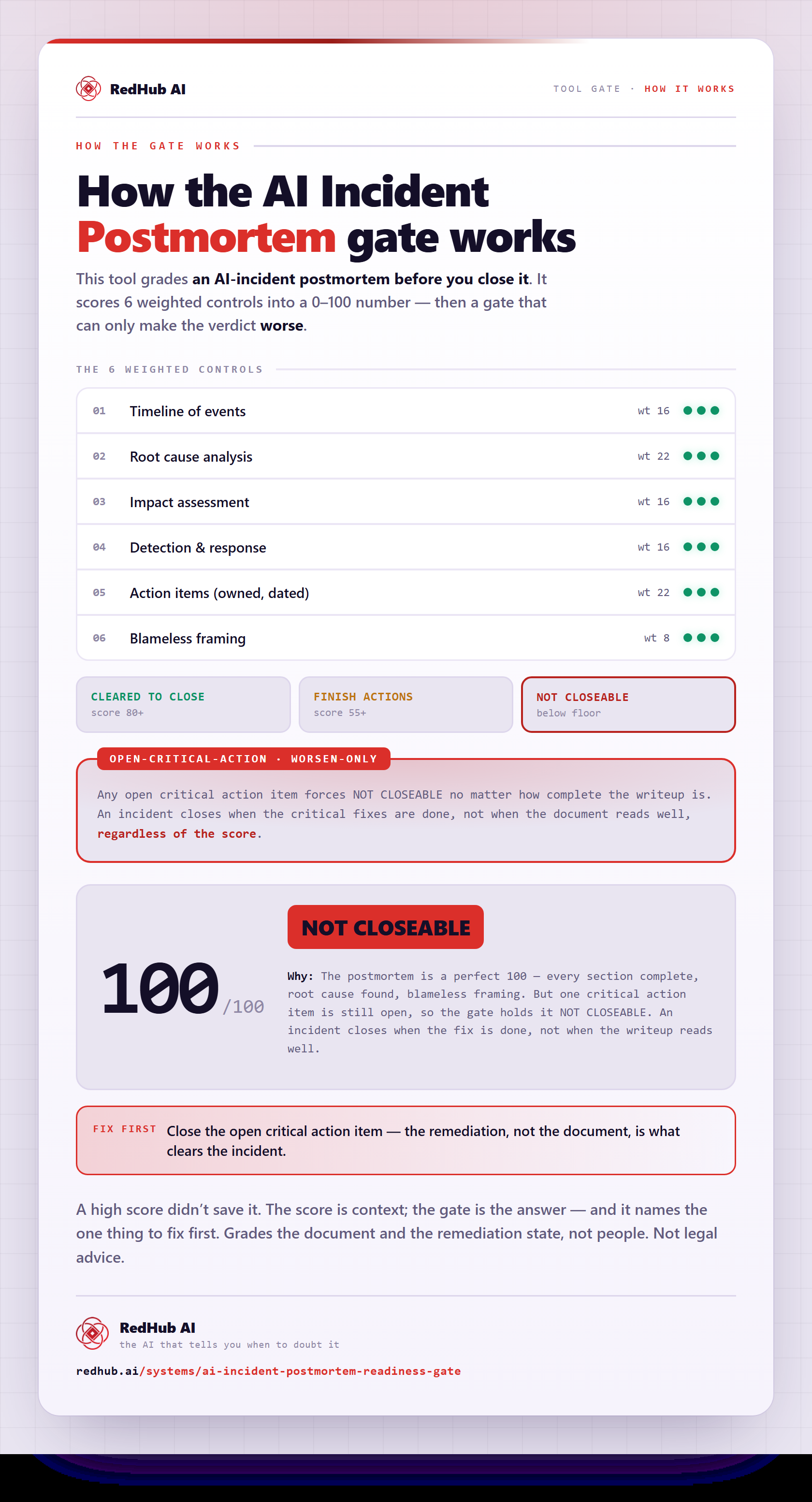
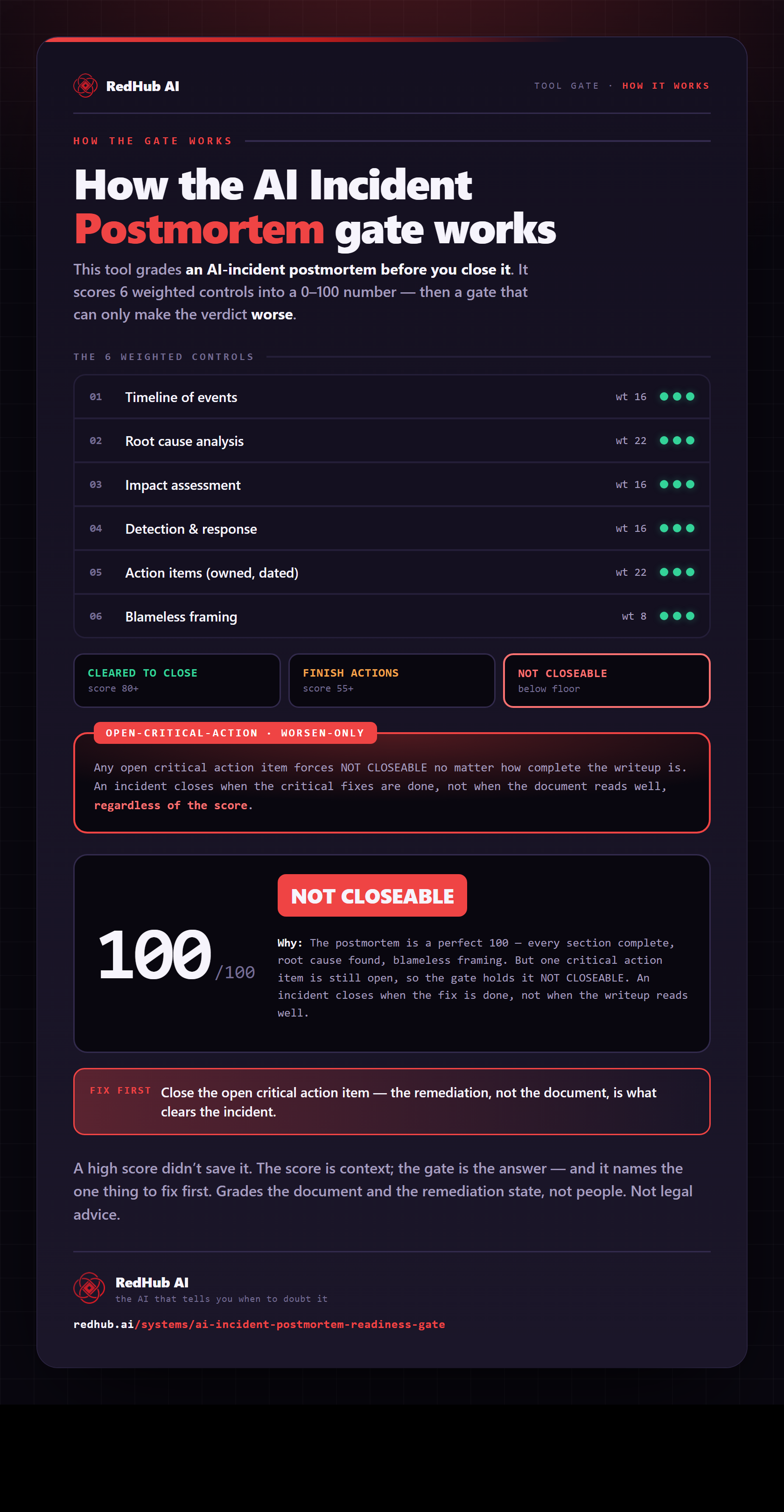
How the gate works, in one image
The six weighted sections scored into a 0–100 completeness number and the gate that forces NOT CLOSEABLE while any critical action item is still open — the same math the demo runs, as a diagram you can share or embed anywhere.
View & embed the full diagramSix incidents. One perfect writeup that can't close.
Six incidents, each scored by the rule the workbook and the demo both run. The workbook grades one postmortem at a time; these are six runs of it. Read the prompt-injection incident: a flawless 100/100 postmortem that's still NOT CLOSEABLE, because one critical action item remains open. The document was perfect; the incident wasn't closed.
AI Incident Postmortem & Readiness Gate  (as-of 2026-06-25)
Grades the postmortem document and remediation state, not people.
==========================================================================
6 incidents  |  CLEARED 2   FINISH 1   NOT CLOSEABLE 3
--------------------------------------------------------------------------
Prompt-injection data leak   completeness 100  ->  NOT CLOSEABLE  [GATE: 1 open critical action]
Model fallback outage        completeness  92  ->  CLEARED TO CLOSE AS DESCRIBED
Hallucinated refund approvals completeness 67  ->  FINISH ACTIONS
Vendor API silent failure    completeness  33  ->  NOT CLOSEABLE
RAG index corruption         completeness  95  ->  CLEARED TO CLOSE AS DESCRIBED
Rate-limit cascade           completeness  37  ->  NOT CLOSEABLE  [GATE: 2 open critical action]
Three rules keep the close-out honest.
Six sections of a blameless writeup, scored on completeness — never the people in the incident. The scoring rewards systems-and-process framing.
Any critical action item still open forces NOT CLOSEABLE — regardless of how complete the writeup is. The fix, not the writeup, closes the incident.
It can lower a verdict to NOT CLOSEABLE; it never lifts an incomplete postmortem. A clean close has to be earned on both completeness and finished work.
A close-out gate, not a blame report.
- A completeness grade for a blameless postmortem document.
- A gate that blocks close while a critical action is open.
- A template and runbook to drive incidents to a clean close.
- A score, ranking, or assessment of the people involved.
- An incident-management platform or a pager.
- A determination of any regulatory reporting duty — confirm those separately.
A working aid for incident close-out discipline. It grades the postmortem document and the remediation state, not people, and it is not legal advice. Some incidents carry regulatory or contractual reporting duties. This result grades postmortem and remediation readiness only; confirm reporting duties separately with the appropriate legal, privacy, security, or compliance owner.
Anyone who has to call an incident "closed."
The reliability & governance stack.
Catch the failures before they become incidents — the upstream half of this loop.
ViewWhere your incident process lives inside a broader governance program.
ViewThe record-keeping discipline that makes a postmortem reconstructable.
ViewEverything else you'd ask before buying.
Two things: how complete the postmortem document is, and whether the remediation is actually finished. It scores a blameless writeup across six sections — timeline, root cause, impact, detection & response, action items (owned and dated), and blameless framing — into a 0–100 completeness score, and separately counts the critical action items still open. The verdict is CLEARED TO CLOSE AS DESCRIBED, FINISH ACTIONS, or NOT CLOSEABLE. It grades the document and the remediation state, never the people in the incident.
Because a complete writeup isn't a finished fix. The open-critical-action gate is dispositive: if even one critical action item is still open, the incident is NOT CLOSEABLE no matter how thorough the document is — because the thing that actually prevents a repeat hasn't shipped yet. In the worked example, the prompt-injection postmortem scores a perfect 100 but has one critical action still open, so it can't close. A clean close has to be earned on both completeness ≥ 80 and zero open critical actions.
The preventive work that stops the same class of incident from recurring — a missing guardrail, an unbuilt alert, a rollback path that wasn't there. You mark which action items are critical; the gate only counts those. Non-critical follow-ups (a doc update, a nice-to-have) are tracked but don't block the close. The point is to separate "we wrote it up" from "we shipped the fix that matters."
Blameless framing is one of the six scored sections, and the whole rubric rewards systems-and-process language over individual fault. It grades the document and the remediation state, not the people in the incident — there is no per-person score or assessment anywhere in it. That's deliberate: people only report what really happened when the review isn't a search for someone to blame, so the scoring is built to reinforce that.
No. It doesn't page, detect, or manage live incidents — it's the close-out discipline that runs after the firefight, when you're deciding whether the incident is actually done. It pairs with the upstream tools: the Agent Reliability Harness catches failures before they become incidents, and the AI Output Audit-Trail Kit gives you the record-keeping that makes a postmortem reconstructable. This is the gate at the end that refuses to call it closed early.
One .xlsx scoring workbook (the six-section completeness score + the open-critical gate + the verdict), a Facilitator Playbook, a Postmortem Template & Close-Out Runbook, and a worked six-incident example. It's deterministic and offline — opens in Excel, Google Sheets, or Numbers. It's a working aid for incident close-out discipline, not legal advice; some incidents carry regulatory or contractual reporting duties, so confirm those separately with the appropriate owner.
Close it when it's fixed,
not when it's written up.
One purchase, lifetime access, 12 months of updates. $79, once.
Sold by RedHub AI LLC · Secured by Stripe · redhub.ai