Prove who used AI,for what, and who checked it.
Audit your record of AI usage - not the output itself - for whether each entry is defensible: who generated it, with what tool, when, for what decision, who reviewed it, and where the source is.
The decision shipped. Can you show your work?
Who?
An AI output drove a real decision - and no one recorded who generated it or who stands behind it.
Checked?
A high-impact call rode on an AI draft nobody reviewed, with no source attached.
98%
A log can be almost complete and still have no trail where it matters most - the average hides it.
Toggle a field. Watch the gate.
Live audit · toggle a field on any entry
Six logged AI outputs, 98% complete — yet the organization is UNRECORDED, because OUT-003 is a high-impact pricing decision with no reviewer recorded. Add its reviewer and watch the gate lift.
| Entry | High-impact | Fields recorded | Score | Verdict |
|---|---|---|---|---|
| OUT-001 | 100 | LOGGED | ||
| OUT-002 | 100 | LOGGED | ||
| OUT-003 | high-stakes: missing reviewer | 92 | NO TRAIL | |
| OUT-004 | no source ref | 94 | PARTIAL | |
| OUT-005 | 100 | LOGGED | ||
| OUT-006 | 100 | LOGGED |
Org verdict
UNRECORDED
completeness 98 · 4 LOGGED / 1 PARTIAL / 1 NO TRAIL · fix first: OUT-003
Why UNRECORDED at a 98
A structural gap — a missing required field, or a high-impact decision with no reviewer and no source — is dispositive: it makes the org UNRECORDED no matter how complete the log looks. The completeness average hides the one gap that matters most.
Audits a record's completeness, not the AI output's quality and not people. Not legal advice; confirm your own record-keeping requirements with counsel.
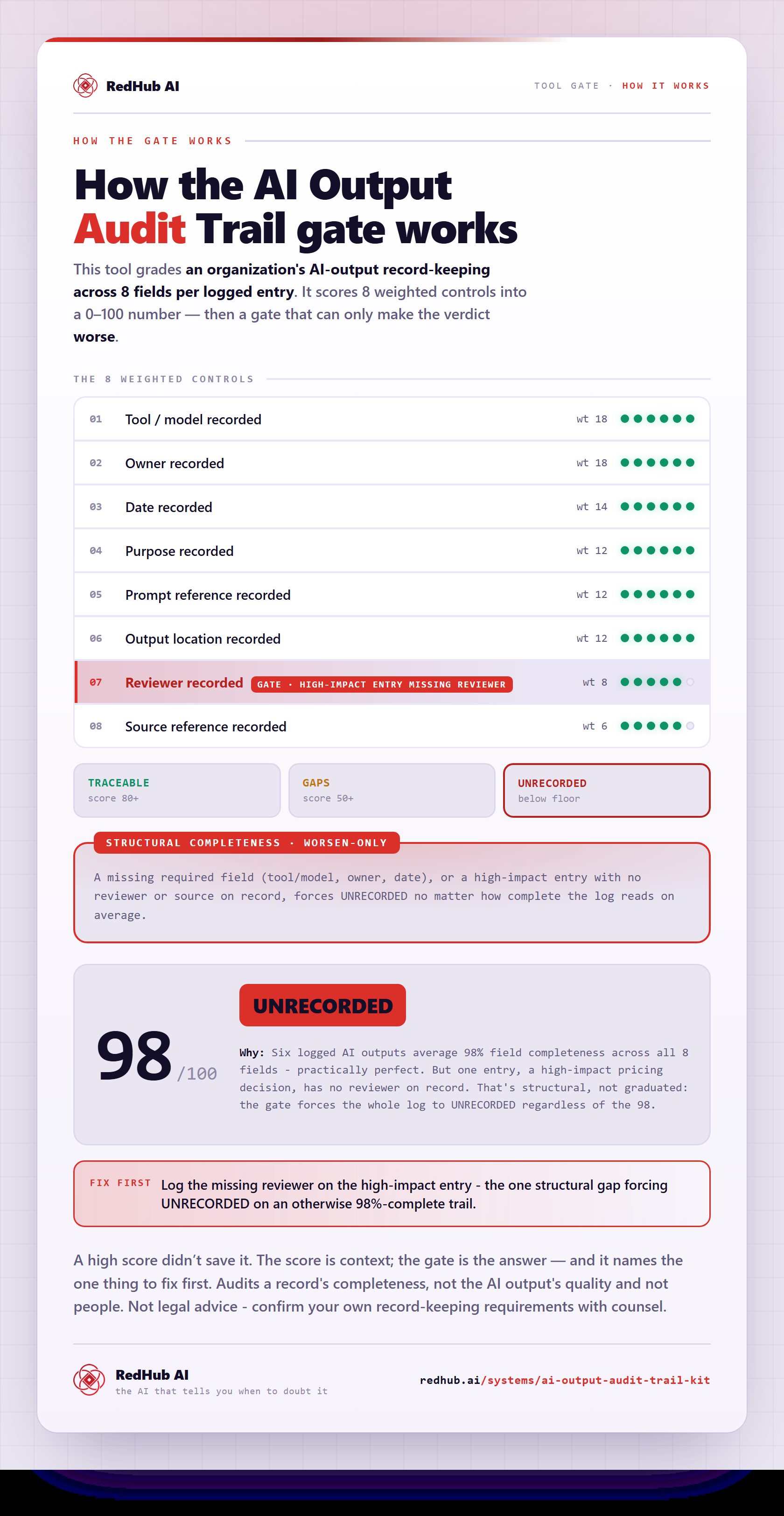
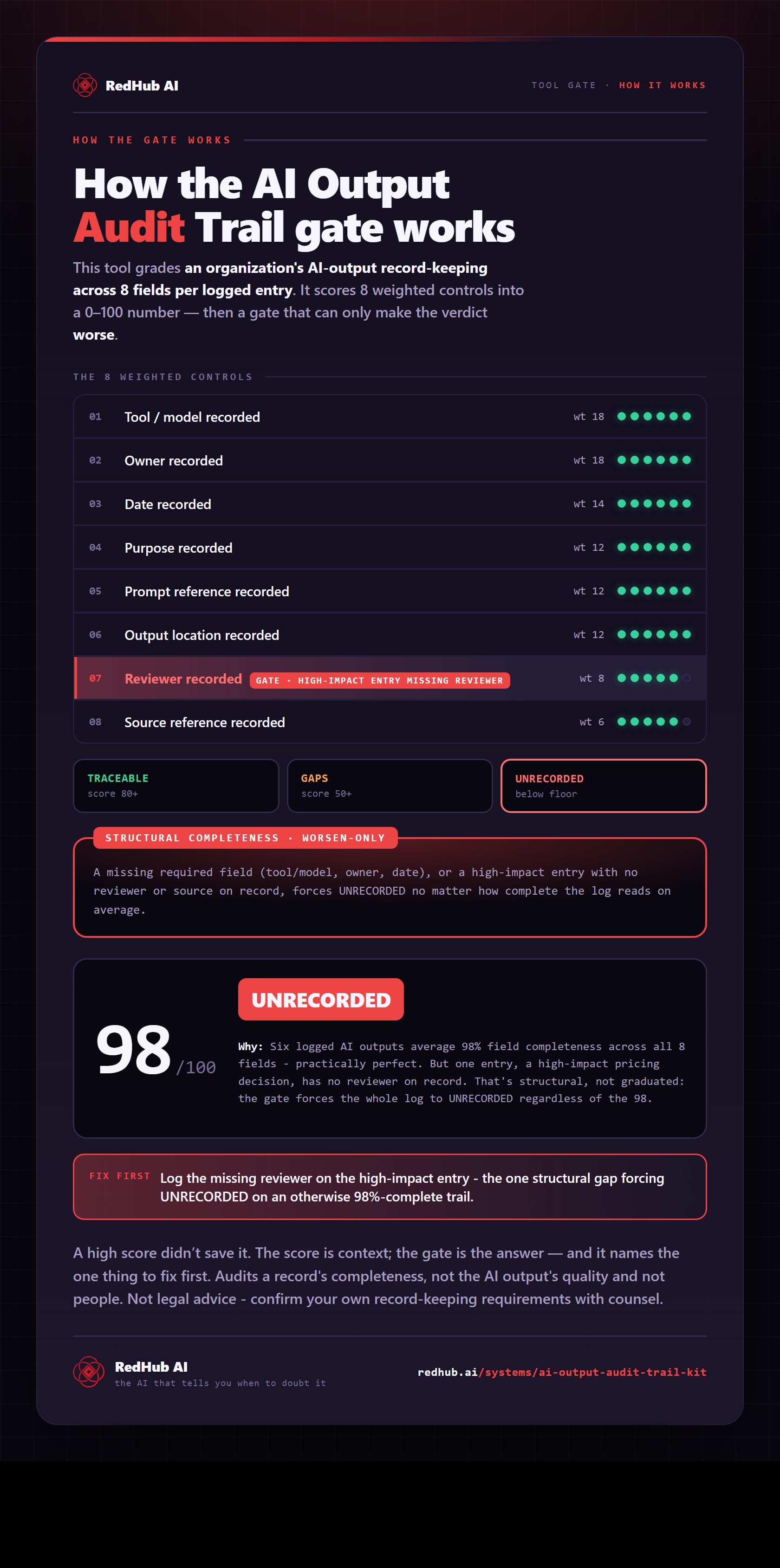
How the gate works, in one image
How the AI Output Audit Trail Kit turns 8 recordkeeping fields and a structural reviewer gate into one verdict — the same math the demo runs, as a diagram you can share or embed anywhere.
View & embed the full diagramPoint it at your log. Here is the verbatim output.
The shipped sample is a six-entry log that is 98% complete - four entries fully LOGGED. The auditor still calls the org UNRECORDED, because one high-impact pricing analysis has no reviewer recorded. A high score is not a trail.
AI Output Audit-Trail & Record-Keeping Kit  (AOA-079)
as-of: 2026-06-24   log: sample_log.csv
----------------------------------------------------------------------
entry 1   LOGGED     score 100  OUT-001
entry 2   LOGGED     score 100  OUT-002
entry 3   NO TRAIL   score  92  OUT-003 [high-stakes]
           -> high-stakes: missing human reviewer named
entry 4   PARTIAL    score  94  OUT-004
           -> no source / citation kept
entry 5   LOGGED     score 100  OUT-005
entry 6   LOGGED     score 100  OUT-006
----------------------------------------------------------------------
completeness: 98   LOGGED 4 / PARTIAL 1 / NO TRAIL 1   (n=6)
structural failure present: True
ORG VERDICT: UNRECORDED
fix first: entry 3

Audits the record's completeness, not the AI output's quality and not people. Not legal advice; confirm record-keeping requirements with counsel.Two tiers of gap, one honest gate.
Structural gaps are dispositive
A missing required field (tool, owner, date), or a high-impact decision with no reviewer and no source, forces NO TRAIL - and one NO TRAIL entry makes the whole org UNRECORDED, regardless of completeness.
Graduated gaps only flag
A missing optional field or a stale entry marks an entry PARTIAL and lowers the score. On its own it never breaks the trail - it tells you what to tighten.
Completeness never overrides the gate
The org completeness is the mean of the entry scores, shown for context. One NO TRAIL entry makes the org UNRECORDED at any completeness. A clean average can't rescue a missing trail.
A record-keeping discipline, not a compliance certificate.
- · A completeness auditor for your record of AI usage
- · A runnable Python tool plus a workbook that reproduces the gate
- · Deterministic and offline - same log, same verdict, every time
- · A check on whether the AI output is correct - it audits the record
- · A compliance certification, and it cites no statute or deadline
- · A way to score or rank people - it grades a record's completeness
Record-keeping discipline, not legal advice. This audits the completeness of your record, not the AI output's quality and not people; it cites no statute or deadline. Confirm your own record-keeping and documentation requirements with qualified counsel.
Anyone who has to account for how AI is used.
- Ops and governance leads standing up AI accountability
- Founders who need a defensible record before a customer or investor asks
- Teams adopting AI fast and want the paper trail to keep up
- Anyone who'd struggle to answer “who reviewed that?” today
The rest of the governance stack.
AI Governance & Acceptable Use Starter Kit
$39Set the policy this trail operationally records against - acceptable use, roles, and the rules of the road.
NIST AI RMF / US Governance Readiness Kit
$149Stand up governance mapped to Govern / Map / Measure / Manage - the framework your record-keeping feeds.
EU AI Act Readiness Kit
$249Inventory and classify AI systems and produce the documents - where formal logging obligations get scoped.
AI Agent & Connector Access Auditor
$99Audits what your AI agents and connectors can reach - the access side of the same accountability.
The questions operators actually ask before they have to show their work.
No — and that distinction is the whole point. The AI Output Audit-Trail & Record-Keeping Kit audits the completeness of your record, not the quality of the output. For each logged AI-assisted output it asks whether the entry is defensible: is the tool or model named, the accountable human named, the date valid, the purpose and prompt captured, the output's location recorded, and — for a decision that matters — was it reviewed and is the source kept. Whether the output itself was correct is your team's judgment; this proves you can show your work.
Because completeness is an average, and an average hides the one gap that matters most. The six-entry sample has four fully LOGGED entries and a 98 mean — but OUT-003, a competitor-pricing analysis that drove a real pricing decision (marked high-impact), has no reviewer recorded. A high-impact decision with no reviewer and no source isn't a trail, so that single structural gap forces the entry to NO TRAIL and the whole organization to UNRECORDED, regardless of the average. Add OUT-003's reviewer and the gate lifts.
Structural gaps are dispositive; graduated gaps only flag. A missing required field (the AI tool/model, the accountable human, or a valid date), or a high-impact entry with no reviewer and no source, is structural — it makes the entry NO TRAIL and the org UNRECORDED no matter how complete everything else is. A missing optional field (purpose, prompt, output location, or reviewer/source on a non-high-impact entry) or a stale entry older than 90 days is graduated — it marks the entry PARTIAL and lowers the score, telling you what to tighten without breaking the trail.
No. It's a deterministic, offline auditor: you keep a log — one row per AI-assisted output that drove a real decision or deliverable — and the runnable Python tool (plus a workbook that reproduces every number) grades that log. Same log, same verdict, every time. The included Standards & Logging Playbook tells you what to capture and the Backfill & Maintenance Runbook helps you reconstruct a trail you don't have yet. Nothing is uploaded and no system is connected.
No. The kit cites no statute or deadline and never certifies that you are compliant — it grades record-keeping completeness as a business-judgment discipline so you can answer “who used AI, for what, and who checked it” when a customer, investor, or auditor asks. If you need formal frameworks, it pairs with the AI Governance & Acceptable Use Starter Kit (set the policy), the NIST AI RMF Readiness Kit (stand up the framework), and the EU AI Act Readiness Kit (where formal logging obligations get scoped). Record-keeping discipline, not legal advice — confirm your own requirements with counsel.
They audit different surfaces. The Agent & Connector Access Auditor grades what your AI agents and connectors can reach — the standing access risk. This kit grades the record of what AI actually produced and who stood behind it — the after-the-fact paper trail. One asks “what could it touch?”, the other asks “did we log what it did?” They're complementary halves of operational AI accountability, and both ship a runnable engine with a workbook that reproduces it.
Keep a record
that holds up.
One purchase, lifetime access, 12 months of updates. $79, once.
Record-keeping discipline, not legal advice. This audits the completeness of your record, not the AI output's quality and not people; it cites no statute or deadline. Confirm your own record-keeping and documentation requirements with qualified counsel.
Sold by RedHub AI LLC · Secured by Stripe · redhub.ai