If your biggest supplier failedtomorrow, could you survive?
You screen for customer concentration. The mirror risk is sharper: lose a critical supplier and you don't lose a slice of revenue — you can't make the product. This gate computes how concentrated your supply base really is, and whether each dependency is locked down or one handshake away from a crisis.
A crisis on day one, not a dip next quarter.
The share at which buyers flag a single supplier — lower than the customer line, because a supplier failure stops production, it doesn't just trim revenue.
The aggravating factor. 40% from one vendor on a handshake is the canonical disaster: it can reprice, change terms, get acquired, or fail, and you inherit the crisis.
A supplier-risk assessment is routine in M&A. Supply-chain concentration ranks among the top reasons buyers walk away or demand a discount.
Resilient supply chains are a value driver; fragile ones get priced as fragile. This gate finds the single-source exposure before a buyer, a lender, or a bad week finds it first.
Edit the base. Watch the contract release the gate.
The preset is a six-supplier base reading SUPPLY-SHOCK RISK. The sole-source manufacturer is 31% of spend with no contract — the gate fires. Flip its contract to Yes and watch the verdict release, even though the share doesn't change. That's the whole insight: a material supplier is only a single point of failure when it's also uncontracted.
Edit spend and contract status. The math is the workbook's — nothing is sent anywhere.
| Supplier | Annual spend | Contract | Alt. source | Share | Score | Verdict | |
|---|---|---|---|---|---|---|---|
| 31.0% | 0 | SINGLE-SOURCE RISK | |||||
| 20.0% | 50 | EXPOSED | |||||
| 19.0% | 55 | EXPOSED | |||||
| 12.0% | 90 | SECURED | |||||
| 10.0% | 100 | SECURED | |||||
| 8.0% | 100 | SECURED |
Flip Sole-source manufacturer's contract to Yes and watch its verdict release from SINGLE-SOURCE RISK — the gate fires on a material share only when it's also uncontracted. A big supplier you've locked under a contract is a managed dependency, not a single point of failure.
Grades a supply structure, not a deal. Not financial, accounting, or investment advice. It computes concentration from the numbers you enter — confirm true switching costs and break-even impact with your own advisors.
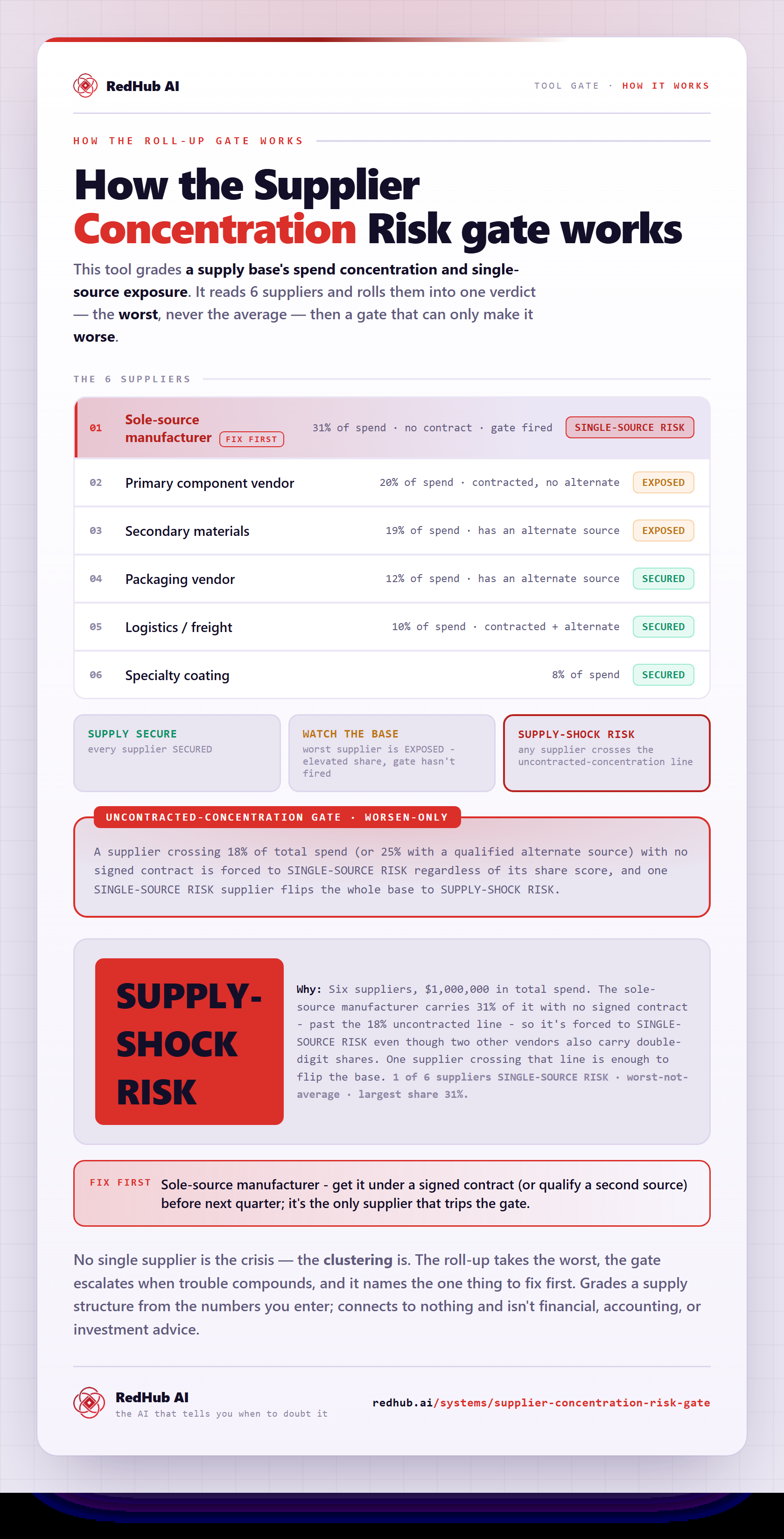
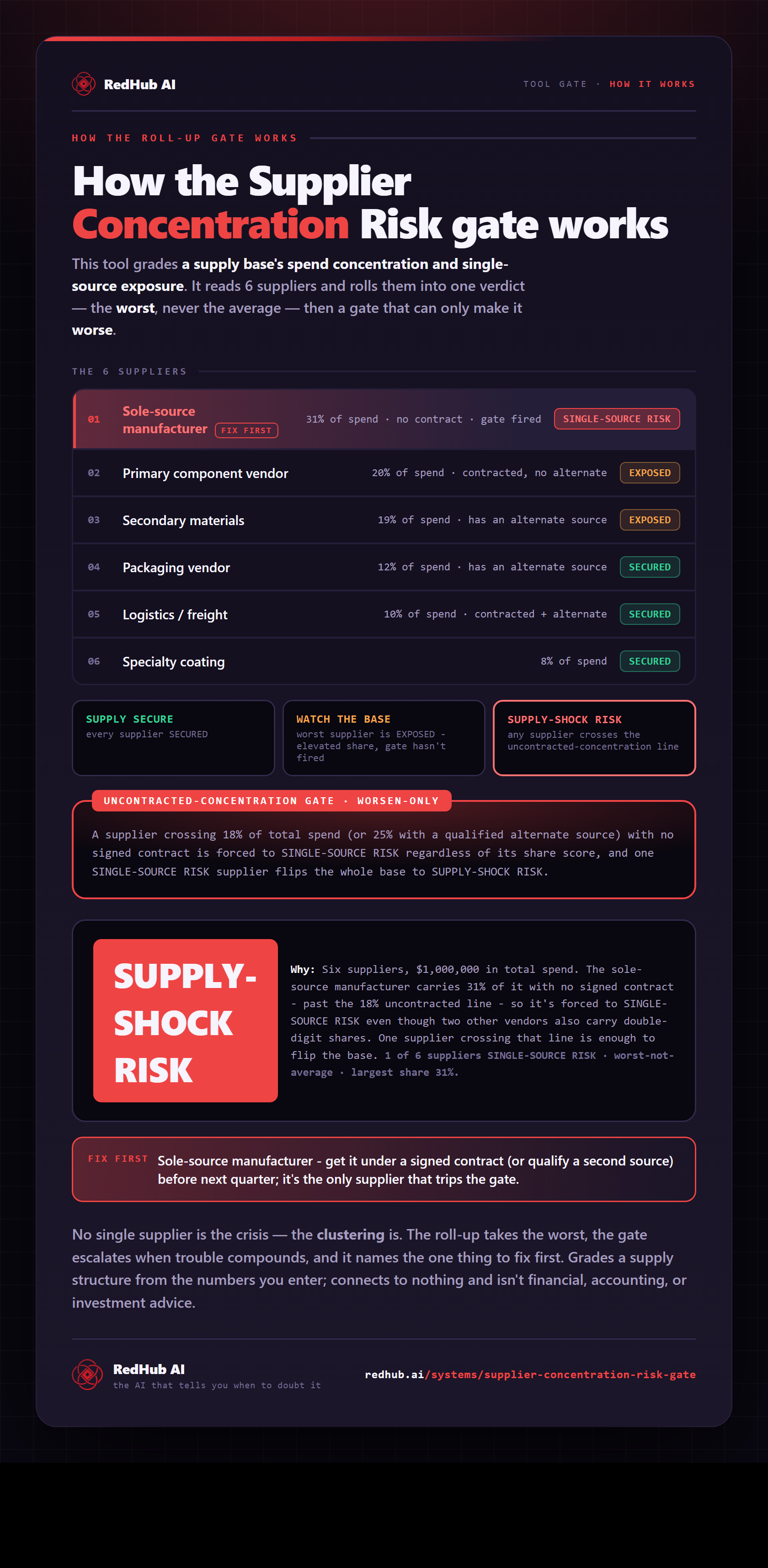
How the gate works, in one image
How the Supplier-Concentration Risk Gate's uncontracted-concentration gate turns spend share, contract status, and alternate sourcing into a per-supplier verdict and a worst-not-average base rollup — the same math the demo runs, as a diagram you can share or embed anywhere.
View & embed the full diagramThe same verdict, from the command line.
The engine ships as a zero-dependency script. Enter your spend by supplier, get the supply-base verdict and, where a supplier is short, the fix-first. This is the verified output on the six-supplier sample — the workbook and the demo reproduce it exactly.
The Supplier-Concentration Risk Gate
==============================================================
Sole-source contract manufacturer (uncontr  31.0%    0/100  SINGLE-SOURCE RISK  [SINGLE-SOURCE]
Primary component vendor (contracted)       20.0%   50/100  EXPOSED
Secondary materials supplier                19.0%   55/100  EXPOSED
Packaging vendor                            12.0%   90/100  SECURED
Logistics / freight partner                 10.0%  100/100  SECURED
Specialty coating shop                       8.0%  100/100  SECURED
--------------------------------------------------------------
Largest supplier: 31% of spend   Top-3: 70%   HHI: 2030
Supply-base verdict: SUPPLY-SHOCK RISK
Fix first: Put Sole-source contract manufacturer (uncontracted) on a long-term contract or qualify a second source - it's a material, uncontracted single point of failure.

Grades a supply structure from your own numbers, not a person or a company's
value. A planning aid - confirm switching costs and break-even with your advisors.
Not financial advice.
Share, contract, survival.
Your largest supplier's share of total spend — the headline, weighted heaviest because it's the one that can sink you.
How concentrated the base is overall, with an HHI-style spread for context even when no single supplier is extreme.
Whether a material supplier is locked under a long-term contract — the release valve that turns a dependency into a managed risk.
Whether a ready qualified second source exists, which genuinely reduces single-source danger and relaxes the line.
A 0–100 score on the lower supplier diligence line — 100 under 10% of spend, 0 by about 30%.
Forces SINGLE-SOURCE RISK when a supplier is both material AND uncontracted — regardless of the score.
A supplier is forced to SINGLE-SOURCE RISK regardless of its score only when two things are both true: it's material (at or above the 18% line) and uncontracted. The contract is the release valve — lock a material supplier under a long-term contract and the dependency becomes managed, not fatal. A ready second source relaxes the line. Leave the contract status blank and the gate runs in threshold mode, flagging any single supplier over 18% on share alone.
A concentration computer, not a crystal ball.
- A per-supplier verdict with the one thing to fix first where a supplier is short.
- A supply-base rollup: SUPPLY SECURE AS DESCRIBED, WATCH THE BASE, or SUPPLY-SHOCK RISK.
- A survival gate that fires only on genuine single-source risk.
- Offline and deterministic — engine, workbook, and demo agree to the number.
- Not financial, accounting, or investment advice.
- Not a company valuation or a supplier solvency check.
- Not a contract audit — you tell it whether a contract exists.
- Not connected to anything — you bring the spend figures.
Not financial advice. This is an operational and financial-risk planning aid, not financial, accounting, investment, or legal advice, and not a guarantee of any valuation, lending, or deal outcome. It computes concentration from the numbers you enter; it does not value your company, audit your contracts, or assess a supplier's solvency. Confirm switching costs, contract terms, and break-even impact with your own advisors.
Operators who'd rather find it first.
- · Product, manufacturing, and physical-goods businesses with a real supplier base.
- · Founders heading into a raise or a sale, where supply concentration gets scrutinized.
- · Operators who just had a supplier scare and want to see the whole exposure.
- · Anyone who already runs the Customer-Concentration Risk Gate and wants the other half.
The full risk desk.
The mirror on the revenue side: if your biggest customer left, could you survive? Run both before diligence.
ViewThe people-side single point of failure — could the business keep running if a key person vanished?
ViewWhen the offer comes, supply concentration is one of the first things diligence digs into. Pre-empt it.
ViewThe honest answers.
You enter your annual spend by supplier and, ideally, whether each supplier is locked under a long-term contract. The gate computes each supplier's share of your total spend, scores your supply base 0–100 (driven mainly by your single largest supplier), and returns a per-supplier verdict — SECURED, EXPOSED, or SINGLE-SOURCE RISK — plus a supply-base rollup (SUPPLY SECURE AS DESCRIBED / WATCH THE BASE / SUPPLY-SHOCK RISK) and, where a supplier is short, the one thing to fix first. It answers the question a customer-concentration check doesn't: if your biggest supplier reprices, changes terms, gets acquired, or fails, are you exposed to a day-one crisis?
Because a supplier failure is operationally worse than a customer loss. Lose a big customer and revenue dips next quarter; lose a critical supplier and you may not be able to make the product at all — that's a crisis on day one. Buyers and lenders reflect this: where a single customer above 25–30% of revenue draws scrutiny, a single supplier is commonly flagged at 15–20% of spend. The gate uses that lower line — the supply-security score reaches zero by the time one supplier hits about 30% of spend, tighter than a customer-concentration curve.
Because the contract is what converts a raw percentage into a managed risk. A supplier that's 30% of your spend but locked under a multi-year fixed-terms contract can't reprice or walk away on short notice — that dependency is managed. An 18% supplier on a handshake can vanish next month. So the single-source survival gate fires only when a supplier is BOTH material (over the diligence line) AND uncontracted. Lock a material supplier under a contract and the gate releases — the score still reflects the concentration, but it's no longer a single point of failure. That's the supplier-specific honesty: the percentage alone doesn't tell you whether you're actually exposed.
It degrades gracefully. Leave the contract field blank for a supplier and the gate runs in threshold mode — it can't test the contract half, so it conservatively flags any single supplier at or above the 18% line on share alone (the same line acquirers and lenders use) and tells you it did. The qualified-alternate field is optional too: mark it only when you genuinely have a ready second source you could switch to without a long requalification, and the gate relaxes the material line a little for that supplier. Leave it blank and the gate won't soften a verdict it can't justify.
It's the deliberate mirror. The Customer-Concentration Risk Gate asks 'if your biggest customer left, could you survive?' This asks the same question about the other side of the business — your suppliers. They share the computed-from-numbers shape (shares of a total, a worsen-only survival gate, a portfolio rollup) so the pair reads as one risk lens, but the supplier version uses the lower diligence line and adds the contract as the release valve, because supply risk behaves differently from revenue risk. Run both before a raise, an acquisition, or a lender review — diligence teams check both.
No to both. It's a deterministic, offline planning aid — it computes concentration from the numbers you type, connects to nothing, contacts no supplier, audits no contract, and doesn't assess any supplier's solvency or value your company. It is not financial, accounting, investment, or legal advice and guarantees no valuation, lending, or deal outcome. It flags where your supply base is structurally exposed so you can confirm true switching costs, contract terms, and break-even impact with your own finance and operations read. You get a runnable engine, a workbook that reproduces it, a concentration-audit playbook, a de-risking runbook, and a six-supplier worked sample.
Find the single-source risk.
Before a buyer does.
One purchase, lifetime access, 12 months of updates. $99, once.
Not financial advice. This is an operational and financial-risk planning aid, not financial, accounting, investment, or legal advice, and not a guarantee of any valuation, lending, or deal outcome. It computes concentration from the numbers you enter; it does not value your company, audit your contracts, or assess a supplier's solvency. Confirm switching costs, contract terms, and break-even impact with your own advisors.
Sold by RedHub AI LLC · Secured by Stripe · redhub.ai