The LOI isn't the finish line.How ready is the business for buyer diligence?
Many signed transactions do not reach closing, and diligence findings can lead to withdrawal, repricing, additional structure, or delay. The outcome varies materially by market, deal size, buyer, financing, and the quality of the seller's records. Grade the business, from your own marks, against six conditions commonly examined in buyer diligence and get one verdict — DEAL-READY AS DESCRIBED, GAPS TO CLOSE, or DILIGENCE GAPS — so you find your own gaps first, when many are cheaper to address. It does not predict whether a buyer will close, withdraw, re-trade, change structure, or change price.
Diligence tests what the price rests on.
Many signed transactions do not reach closing, and diligence findings can lead to withdrawal, repricing, additional structure, or delay. The outcome varies materially by market, deal size, buyer, financing, and the quality of the seller’s records.
Transactions that continue may still be repriced, restructured, delayed, or subjected to additional protections based on diligence findings. The size and effect of a re-trade vary materially by the issue discovered, purchase-price mechanics, financing, leverage, and the parties’ alternatives.
Many seller-side documentation, financial, transferability, and disclosure gaps are cheaper to address before an LOI, although not every transaction risk is preventable or within the seller’s control.
Buyer diligence commonly examines whether earnings are supported, durable, and transferable. This audit grades the business, from your own marks, against selected conditions in those areas, and it will not return DEAL-READY AS DESCRIBED when you mark the validating financial evidence, or the management and transition evidence, as absent. It does not predict whether a buyer will close, withdraw, re-trade, change structure, or change price.
Score a business and watch the gate conditions fire.
The shipped agency marks well across the board and scores 75 — and still receives the DILIGENCE GAPS result, because owner independence is marked 0. Flip owner independence off zero and watch the verdict change.
Mark each dimension a buyer's team will stress-test. The verdict updates live — same math as the workbook.
Reviewed or audited books, clean personal/business separation, add-backs documented to support a QoE review. A 0 means the user has not marked the specified validating financial evidence as present; the audit treats that as a gate condition.
Runs without you — SOPs not memory, a management layer, a transition plan. A 0 means the user has marked the business as lacking the documented management, process, or transition evidence this audit checks; the audit treats that as a gate condition.
No single-point-of-failure customer. One customer at roughly a third or more, unmitigated, may affect price, structure, protections, or a buyer’s willingness to proceed.
Transferable contracts (no consent-to-assign blockers), no undisclosed litigation, clean classification, clear IP, resolved tax.
An organized data room built before going to market. Slow, scrambling responses can invite further questions and price pressure.
A defined, defensible working-capital peg and supportable projections — before they become a point of dispute.
Your marks show one or more gaps against the evidence and readiness conditions this audit checks. The result does not predict whether a particular buyer will proceed, change terms, request additional diligence, or withdraw.
On the surface this scores in the DEAL-READY AS DESCRIBED band — but owner independence is marked 0, a gate condition, so the result is DILIGENCE GAPS. Build the management layer and a transition plan before you go to market.
Fix first: Owner independence / transferability
Your marks only · sell-side diligence on yourself · grades a deal, not a person
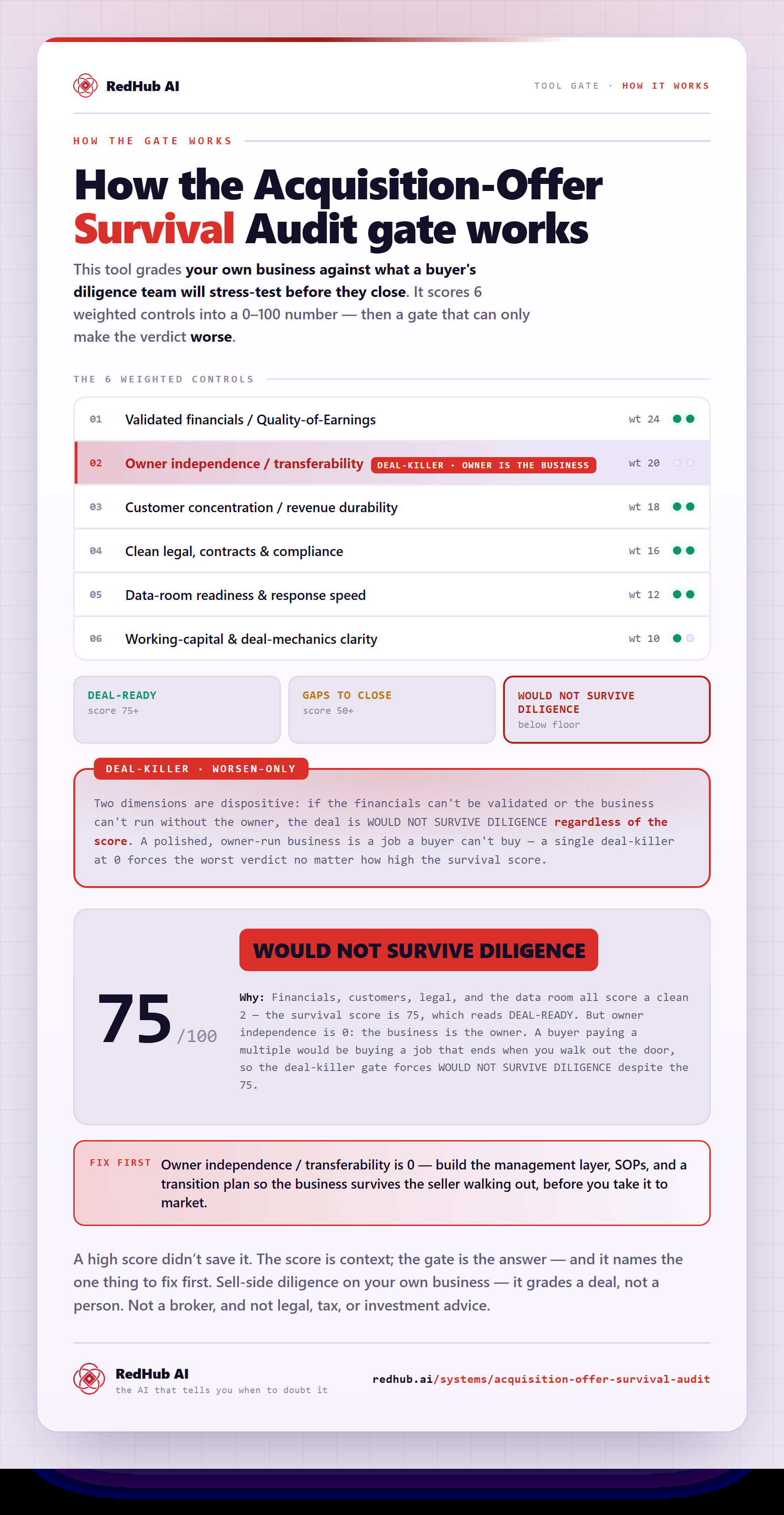
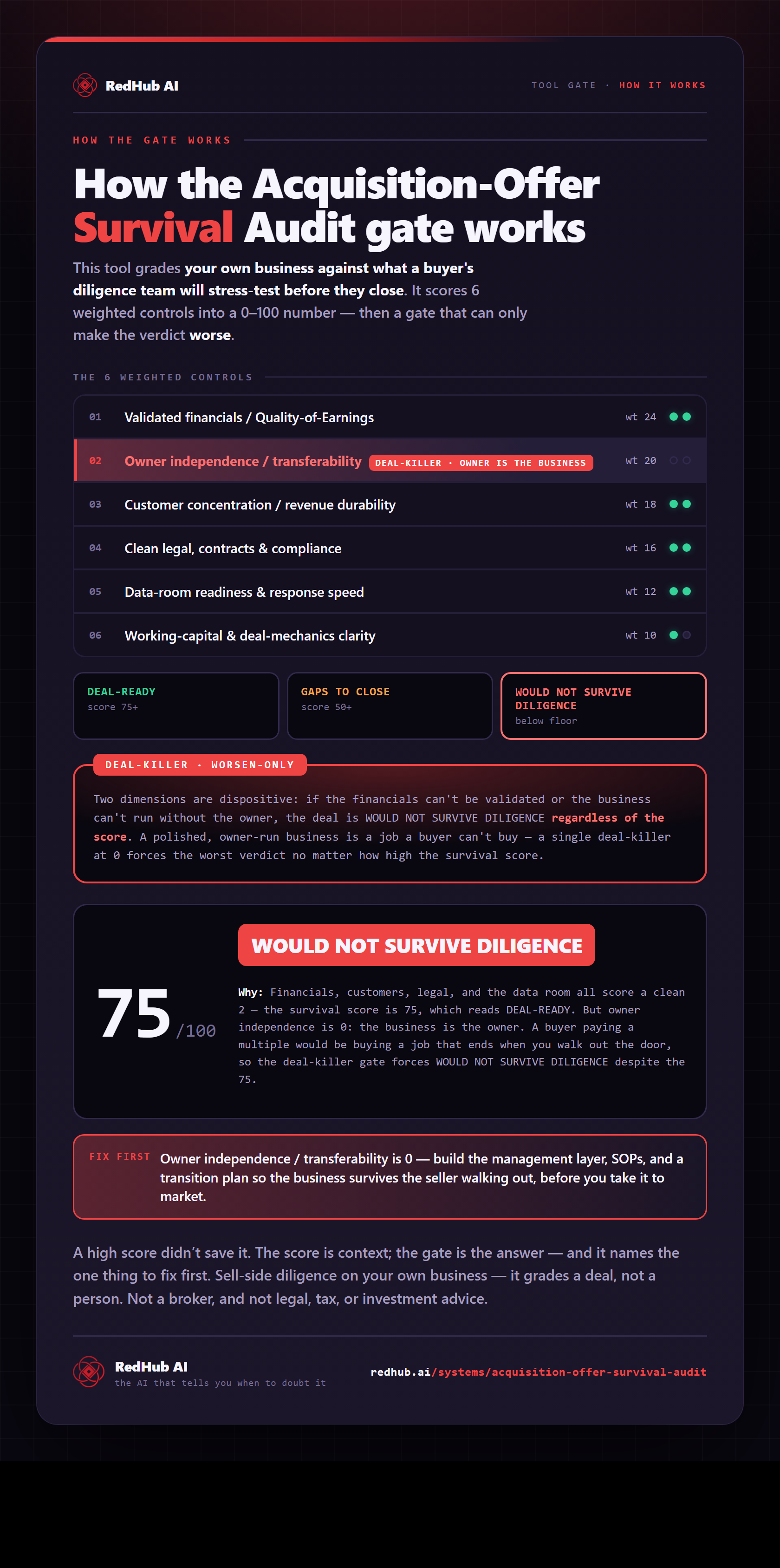
How the gate works, in one image
How the Acquisition-Offer Diligence Readiness Audit scores a business and returns DILIGENCE GAPS when owner independence is marked 0 — the same math the demo runs, as a diagram you can share or embed anywhere.
View & embed the full diagramOne command, every business you might sell, an honest read.
The zero-dependency Python engine reads your list and prints the same verdict the workbook and demo produce. Two businesses below score like candidates and still receive DILIGENCE GAPS — one is marked 0 on owner independence, the other on validated financials.
The Acquisition-Offer Diligence Readiness Audit
============================================================
Polished but owner-run agency       75/100  DILIGENCE GAPS                [GATE]
    fix first: Owner independence / transferability
Institution-ready SaaS             100/100  DEAL-READY AS DESCRIBED
Unvalidated add-backs               52/100  DILIGENCE GAPS                [GATE]
    fix first: Validated financials / Quality-of-Earnings
Concentrated but otherwise solid    74/100  GAPS TO CLOSE
    fix first: Customer concentration / revenue durability
Mid-prep lower-middle-market co     50/100  GAPS TO CLOSE
    fix first: Validated financials / Quality-of-Earnings
Not ready to go to market           14/100  DILIGENCE GAPS
    fix first: Validated financials / Quality-of-Earnings
------------------------------------------------------------
Portfolio: DILIGENCE GAPS
3 of 6 businesses receive DILIGENCE GAPS.Six dimensions, weighted to 100 — two of them gate conditions.
A 0 on validated financials (the validating financial evidence is not marked present) or a 0 on owner independence (the management, process, or transition evidence is not marked present) each returns DILIGENCE GAPS — and a gate only ever worsens a verdict, never lifts one.
Concentration is heavily weighted, not an automatic gate. Depending on the buyer and facts, it may affect price, structure, protections, or willingness to proceed.
Mark the evidence present — reviewed books, or a built transition layer — and the gate releases; the verdict returns to whatever the score earned. Where something is still short, the thing to fix first is named.
Sell-side diligence, not a valuation.
- A deterministic grade of the business, from your own marks, against selected conditions commonly examined in buyer diligence.
- Sell-side diligence on yourself — find your skeletons before the buyer does.
- A named first fix where a dimension is short, and the two gate conditions that override the score.
- Offline — engine, workbook, and demo agree to the number.
- Not a business valuation or a sale-price estimate.
- Not a broker, and not legal, tax, or investment advice.
- Not connected to your books — you bring the marks on each dimension.
- Not a scoring of any person — it grades a deal's readiness.
- Not a prediction of whether a buyer will close, withdraw, re-trade, change structure, or change price.
Not a business valuation, brokerage, or legal, tax, or investment advice. This grades a deal's readiness from your own marks — it doesn't value your business, structure your transaction, or replace your M&A advisor, Quality-of-Earnings accountant, or counsel. It names the gaps; the people you hire to sell the business fix them. Use it to find the gaps early, when many are cheaper to address.
Owners 12–36 months from a sale.
The rest of the founder's decision desk.
The contract landmines — non-assignable clauses, change-of-control — that a buyer's lawyers will find.
ViewThe AI CFO behind the earnings story diligence stress-tests — clean, predictable cash flow.
ViewBuild the conservative, supportable projections that hold up against a buyer's scrutiny.
ViewThe honest answers.
How the business grades, from your own marks, against six conditions commonly examined in buyer diligence — validated financials / Quality-of-Earnings, customer concentration, owner independence, clean legal and contracts, working-capital clarity, and data-room readiness. It returns DEAL-READY AS DESCRIBED, GAPS TO CLOSE, or DILIGENCE GAPS, with, where a dimension is short, the one thing to fix first. It does not predict whether a buyer will close, withdraw, re-trade, change structure, or change price. It's sell-side diligence run on yourself, and it grades a business's readiness, never a person.
Because two dimensions are gate conditions, and each overrides the score. A 0 means the user has not marked the specified validating financial evidence as present; the audit treats that as a gate condition. A 0 means the user has marked the business as lacking the documented management, process, or transition evidence this audit checks; the audit treats that as a gate condition. Either one returns DILIGENCE GAPS whatever the score. The shipped 'polished agency' sample marks well across the board and scores 75 — and still receives DILIGENCE GAPS, because owner independence is marked 0.
No. Customer concentration may lead a buyer to reduce price, add structure or protections, require mitigation, or decline to proceed. This audit treats concentration as a heavily weighted factor rather than an automatic gate. If concentration is your issue, the Customer-Concentration Risk Gate gives you the deeper read and the diversification target.
Run it 12 to 36 months before you go to market, not the week a buyer appears. It is not a valuation and doesn't estimate your sale price — a valuation estimates what the business might be worth; this grades the business against conditions commonly examined in buyer diligence. The two work together: get a sense of value elsewhere, then use this to find gaps to address before diligence. Many seller-side documentation, financial, transferability, and disclosure gaps are cheaper to address before an LOI, although not every transaction risk is preventable or within the seller’s control.
Neither. It's deterministic and offline — you enter your own 0/1/2 marks on what you actually know about the six dimensions, and it computes the verdict. It reads nothing, connects to nothing, and invents no multiple or price. The same logic runs in the workbook, the Python engine, and the on-page demo, so all three agree to the number. Bring your own read of each dimension; where you're unsure, that uncertainty is itself a signal to get your QoE accountant or M&A advisor involved.
No. It's a preparation aid that helps you pressure-test a deal before diligence does — it doesn't value your business, structure your transaction, or replace your M&A advisor, Quality-of-Earnings accountant, or counsel. It names the gaps; the people you hire to sell the business fix them. Use it to find the gaps early, when many are cheaper to address. Not a business valuation, brokerage, or legal, tax, or investment advice.
Find your skeletons
before the buyer does.
One purchase, lifetime access, 12 months of updates. $149, once.
Not a business valuation, brokerage, or legal, tax, or investment advice. This grades a deal's readiness from your own marks — it doesn't value your business, structure your transaction, or replace your M&A advisor, Quality-of-Earnings accountant, or counsel. It names the gaps; the people you hire to sell the business fix them. Use it to find the gaps early, when many are cheaper to address.
Sold by RedHub AI LLC · Secured by Stripe · redhub.ai