Know which clause isa deal-breaker before you sign.
Most of a contract can be fine and the document still unsignable. Two clauses — uncapped liability and a full grab of your pre-existing IP — can transfer existential exposure no matter how clean the rest reads. This gate grades any inbound contract or SOW across six clause-risk areas and returns one honest verdict: SIGN, NEGOTIATE, or UNSIGNABLE AS DRAFTED — with a hard stop on those two deal-breakers.
Not legal advice. This kit grades a contract’s risk surface from your own reading to help you decide what to escalate and redline. It does not interpret the contract, determine your legal rights or obligations, or replace review by a qualified attorney. Have counsel review any contract before you sign.
A contract isn’t safe because most of it is fine.
A scoring checklist that averages everything hides exactly the clauses that should stop a signature. This gate refuses to let a single deal-breaker average away: uncapped liability or a full pre-existing-IP assignment forces UNSIGNABLE AS DRAFTED, even on a contract that’s otherwise clean — so the worst-case clause is the first thing you see, not the last.
Mark six clauses. Watch one deal-breaker override the score.
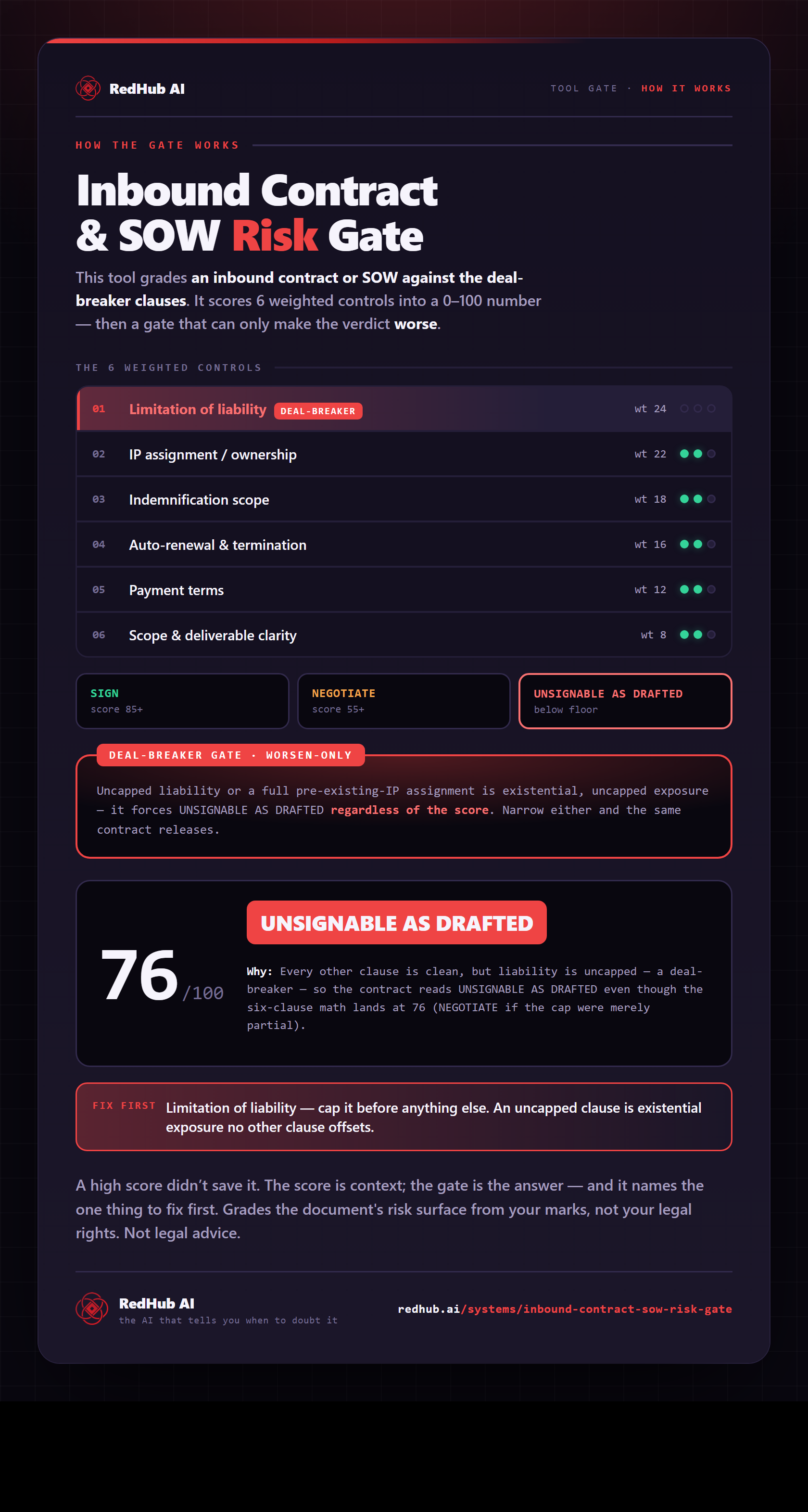
Deal-breaker gate: uncapped liability is present — existential, uncapped exposure. UNSIGNABLE AS DRAFTED regardless of score.
Mark six clause-risk areas
Same math as the workbook and the Python engine: six clauses weighted to 100, SIGN at 85+, NEGOTIATE at 55+, and a deal-breaker gate that forces UNSIGNABLE AS DRAFTED on uncapped liability or a full pre-existing-IP grab — the exact gap that releases to SIGN once you narrow it. It grades the document’s risk surface from your marks, not your legal rights. Not legal advice.
This is the live engine. Triage every inbound contract in one workbook + a runnable engine Catch the deal-breaker clause before your signature does Where a control is short, walk into counsel knowing the one clause to redline first
Get the kit — $99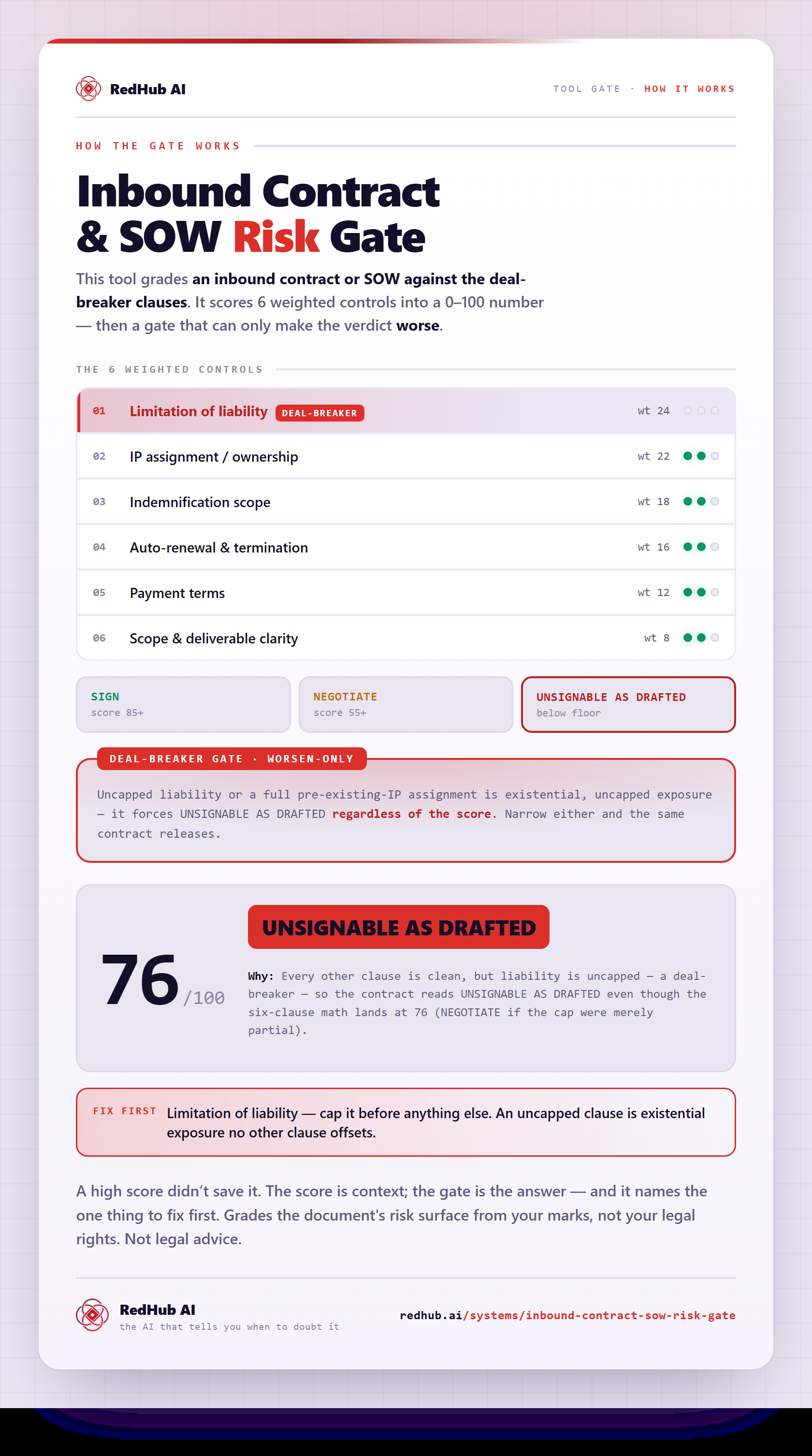
How the gate works, in one image
The six weighted clause-risk areas and the deal-breaker gate that forces UNSIGNABLE AS DRAFTED on uncapped liability or a full pre-existing-IP grab — the same math the demo runs, as a diagram you can share or embed anywhere.
View & embed the full diagramThe same verdict, offline, from your terminal.
The workbook and the Python engine share one config — same weights, same thresholds, same deal-breaker gate. Run it against the shipped seven-contract sample:
$ python3 engine/icr_engine.py engine/sample_contracts.csv

Inbound Contract & SOW Risk Gate
========================================
Portfolio: HARD STOPS

Enterprise SaaS MSA (uncapped liability)
  score 76/100  ->  UNSIGNABLE AS DRAFTED   [GATE: uncapped liability -> UNSIGNABLE AS DRAFTED]
  redline first: Limitation of liability

Enterprise SaaS MSA (liability narrowed)
  score 88/100  ->  SIGN
  redline first: Limitation of liability

Design agency SOW (full IP grab)
  score 65/100  ->  UNSIGNABLE AS DRAFTED   [GATE: full pre-existing-IP assignment -> UNSIGNABLE AS DRAFTED]
  redline first: IP assignment / ownership

Clean mutual services agreement
  score 100/100  ->  SIGN

Vendor reseller agreement
  score 62/100  ->  NEGOTIATE
  redline first: IP assignment / ownership

Offshore dev contract (open scope)
  score 31/100  ->  UNSIGNABLE AS DRAFTED
  redline first: Indemnification scope

Standard consulting SOW
  score 91/100  ->  SIGN
  redline first: Indemnification scope

Grades the document's risk surface from your own marks.
It is the risk gate, not your lawyer. NOT LEGAL ADVICE.
Rows 1 and 2: the same five clean clauses, liability 0 vs 1. The gate is the only difference between UNSIGNABLE AS DRAFTED and SIGN.
Six clauses, weighted to 100, with two that can override the rest.
Worst-case first
Liability and IP carry the most weight and the deal-breaker flag, because they decide what happens when the deal goes wrong — not the day-to-day terms.
A gate, not a curve
Uncapped liability or a full pre-existing-IP grab forces UNSIGNABLE AS DRAFTED. The gate does distinct work: narrow that one clause and the same contract releases to NEGOTIATE.
One redline per contract
Where a control is short, the verdict names the single clause to change first, and the runbook gives the standard ask and the fallback to take to counsel.
A risk triage. Not a lawyer, not a contract reader, not a verdict on your rights.
- A fast, consistent first-pass triage of a contract’s risk surface from your own reading.
- A way to walk into the legal conversation already knowing the one clause that matters most.
- A repeatable standard for separating sign-it-today contracts from ones that can’t be signed as written.
- Legal advice or a determination of your legal rights and obligations.
- An automatic contract reader — you mark the clauses; it doesn’t parse the document for you.
- A substitute for counsel — it gets you to a clean draft fast, then a lawyer signs it off.
Not legal advice. This kit grades a contract’s risk surface from your own reading to help you decide what to escalate and redline. It does not interpret the contract, determine your legal rights or obligations, or replace review by a qualified attorney. Have counsel review any contract before you sign.
Anyone who has to decide what to escalate.
Sign it clean, then run the engagement.
The Client-Onboarding Runway
Once the SOW is signed, onboard the client without dropping the ball. $129.
ViewMargin Leak Auditor
Find where signed work quietly bleeds margin — scope creep, write-offs, leakage. $79.
ViewAI Vendor & Sub-Processor Data-Flow Register
Track which vendors touch which data once the contracts are in place. $89.
ViewWhat people ask before they buy.
Because a single clause can carry existential risk that an averaged score quietly buries. Two clauses are deal-breakers: uncapped liability and a full assignment of your pre-existing IP. Either one can transfer exposure that exceeds the entire value of the deal — so the gate forces UNSIGNABLE AS DRAFTED whenever one is present, no matter how clean the other five clauses are. A contract that scores in the 70s on everything else is still unsignable as written if its liability cap is missing. The gate exists precisely so the worst-case clause is the first thing you see, not something the average rounds away.
Liability and IP, then indemnification. Limitation of liability decides what you owe when something goes wrong — an uncapped or gutted cap means one dispute can exceed the whole deal. IP assignment decides what you walk away owning — 'in connection with' language can sweep your own pre-existing tools and templates into a full assignment. Those two carry the most weight and the deal-breaker flag. Indemnification is the next tier: a one-sided 'any and all claims' indemnity with no defense control is dangerous, but it scores down rather than hard-stopping. The gate weights the document so the clauses that decide the worst case dominate the day-to-day terms.
No. This is a triage tool that grades a contract's risk surface from your own reading — it helps you decide what to escalate and redline first. It does not interpret the contract, determine your legal rights or obligations, or replace review by a qualified attorney. The output is an operational decision (sign it, negotiate it, or don't sign it as written) plus, where a control is short, the one clause to raise first, so you walk into the legal conversation already knowing where the risk is. Have counsel review any contract before you sign. Not legal advice.
One verdict per contract — SIGN, NEGOTIATE, or UNSIGNABLE AS DRAFTED — plus, where a control is short, a single redline-first that names the clause to change before anything else. You mark six clause-risk areas (limitation of liability, IP assignment, indemnification, auto-renewal & termination, payment terms, scope clarity) on a 0–2 scale from your own reading. A structural gate hard-stops the two deal-breakers. A portfolio rollup grades a stack of contracts together as PORTFOLIO CLEAR, REDLINES NEEDED, or HARD STOPS. It ships a workbook, a runnable Python engine that reproduces the verdict offline, a reviewer playbook, a redline negotiation runbook, and a seven-contract worked sample.
You read it; the gate grades your marks. It is deliberately not an automatic contract reader — you (or your reviewer) mark each of the six clause areas based on what the document actually says, and the engine then applies the same weighting and the same deal-breaker gate every time, deterministically and offline. That keeps the judgment with a human and the consistency with the tool: anyone on your team running the same contract through it lands on the same verdict and the same redline-first, which is what makes it a repeatable standard rather than one person's gut call.
Different sides of the signature. This Risk Gate runs before you sign — it triages whether a contract or SOW is safe to sign as written and, where a control is short, what to redline first. The Client-Onboarding Runway runs after you sign — it's the system for onboarding the client cleanly once the SOW is in place, without dropping the ball in the first 30 days. Order matters: clear the contract here, then run the engagement there. They're sequential, not substitutes.
Catch the deal-breaker clause
before your signature does.
One purchase, lifetime access, 12 months of updates. $99, once.
Not legal advice. This kit grades a contract’s risk surface from your own reading to help you decide what to escalate and redline. It does not interpret the contract, determine your legal rights or obligations, or replace review by a qualified attorney. Have counsel review any contract before you sign.
Sold by RedHub AI LLC · Secured by Stripe · redhub.ai