Every new client,cleared for takeoff.
Four Claude Skills read your signed deal, check whether the engagement is truly ready to start, and draft the whole onboarding packet — welcome, kickoff, scope recap, plan, and setup — into your own Drive. It drafts and stages; you share and send. And it won't clear a kickoff while the contract, deposit, or scope is still open.
The riskiest week of any engagement is the first one.
A fumbled onboarding — missing docs, fuzzy scope, a slow kickoff — tells a new client exactly what working with you will feel like. Day one is where trust is won or quietly lost.
Eager to start, you kick off before the deposit lands or the scope is locked — then spend the whole engagement chasing payment or fighting scope creep you could have headed off.
Folders, docs, access requests, the kickoff agenda, the plan — every new client is the same scramble, rebuilt by hand, while the clock on their first impression is already running.
Score the client — and never start on an open blocker.
This is the readiness core, live. Set how ready each onboarding item is and watch the engagement verdict and the next gap update. The blocker gate is the honest part: drop the deposit, the contract, or the scope and the kickoff holds — however high the score climbs everywhere else.
Kickoff readiness · live demo
Score one client’s onboarding. Drop a blocker and watch the kickoff hold.
HOLD KICKOFF
A blocker (contract, deposit, scope) isn't locked. Don't start yet.
76
/ 100
Close this next: Deposit / first payment — blocker; must be locked before kickoff.
Signed agreement
blockerweight 20 · READY
Deposit / first payment
blockerweight 18 · BLOCKER
Scope & deliverables confirmed
blockerweight 18 · READY
Access & credentials
weight 16 · IN PROGRESS
Primary contact & comms channel
weight 14 · READY
Kickoff scheduled
weight 14 · READY
The blocker gate is the point: a blocker below READY holds the kickoff however high the score, while a non-blocker gap only lowers it. Same math as the engine and workbook. It reads and drafts only — you share, send, and start.
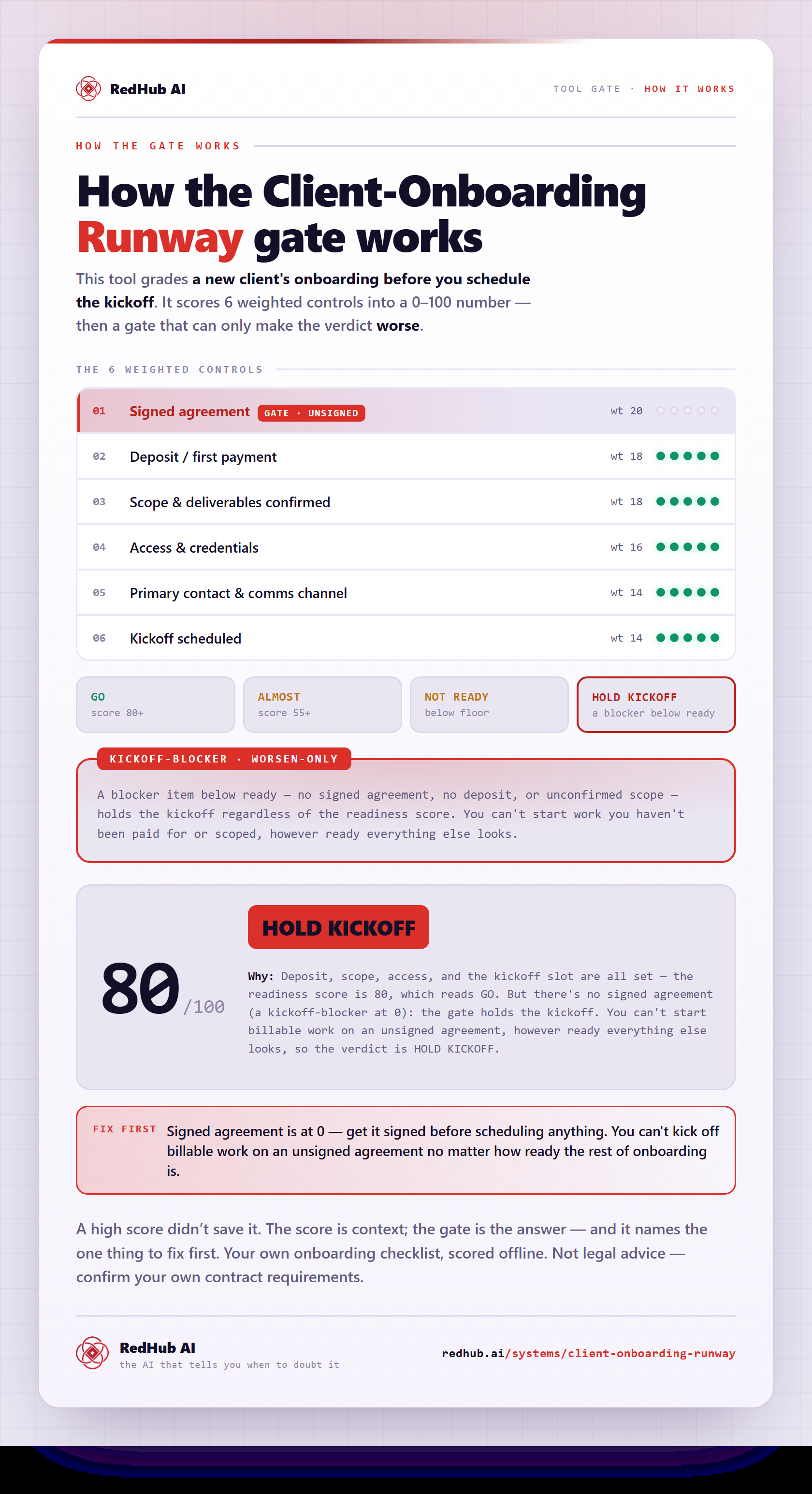
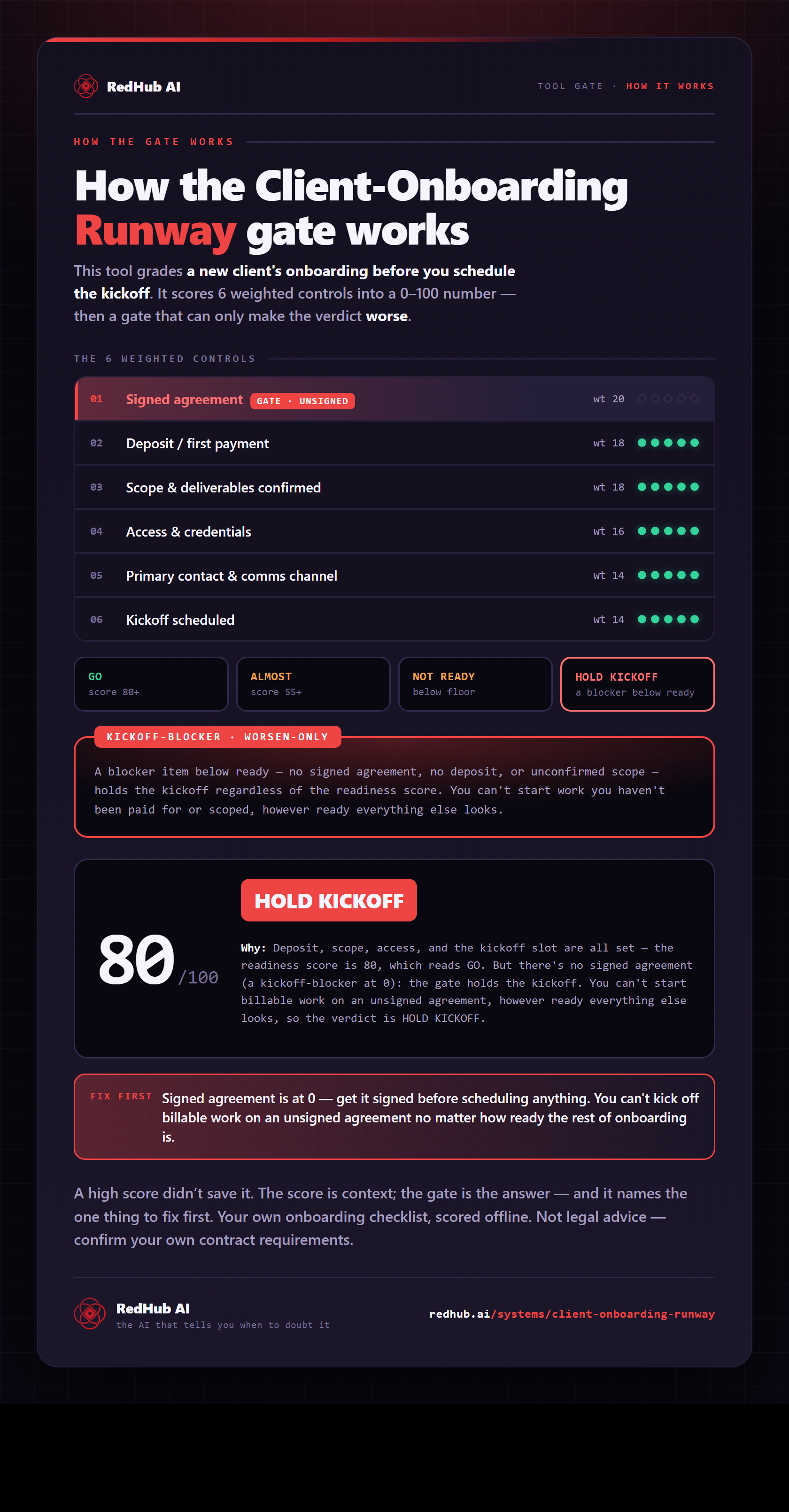
How the gate works, in one image
Six onboarding items scored into a 0–100 readiness number and the kickoff-blocker gate that holds the kickoff on a missing signed agreement — readiness scoring 80 still can't start. The same math the demo runs, as a diagram you can share or embed anywhere.
View & embed the full diagramOne runway, four Skills, from signed to in-flight.
The scout reads the signed deal via your HubSpot or GoHighLevel MCP and scores the onboarding checklist, returning GO / ALMOST / NOT READY / HOLD KICKOFF and, where an item is still open, the next gap to close.
The architect drafts the client-facing materials — welcome, kickoff agenda, scope recap, and onboarding plan — in your voice, grounded in the actual deal, with anything unconfirmed flagged [confirm].
The setup drafter stubs the client folder and docs in your own Drive — unshared — and drafts the access/intake checklist. It never shares a doc with or grants the client access.
You share, send, and start; the tracker re-scores, flags stalls — an unpaid deposit, missing access — and surfaces what's still blocking the kickoff, with a draft nudge you can send.
Plus a runnable Python readiness engine with a worked sample, a spreadsheet that reproduces the same math and blocker gate, the kickoff-packet template, and two playbooks — the end-to-end runway and a CRM + Drive MCP setup & safe-onboarding guide.
Three rules the runway holds to.
Readiness runs on your actual CRM and Drive through the MCP. It never fabricates a scope, a payment status, a contract status, or a deliverable — and stops rather than guessing if the connection is missing.
It reads and drafts only. It may stage unshared drafts in your own Drive, but it never shares a doc with or grants the client access, sends the welcome, edits a live deal, or deletes. Those are yours.
No kickoff clears while a blocker — contract, deposit, scope — is below READY, however polished the rest of the packet is. Refusing to start the work before you're paid and signed is the point.
An orchestration layer on top of your CRM and Drive — honest about its limits.
- A repeatable runway that scores kickoff-readiness and drafts the whole onboarding packet into your stack.
- The orchestration layer — Skills, scoring, a template, and playbooks — on top of your CRM + Google Drive + Claude.
- Built to protect the relationship: it won't let you start the work on an open blocker.
- Not a CRM, a Drive, or a contract — you bring your own accounts, MCP connections, and agreements.
- Not an auto-pilot: it reads and drafts only, stages unshared drafts, and never shares, sends, grants access, or edits a live deal on its own.
- Not the SaaS email-sequence kit, not a guaranteed smooth onboarding, and not legal or financial advice — use your own contracts, counsel, and judgment.
Built for the handoff from signed to started.
- An agency, consultant, studio, or service business onboarding signed clients one by one.
- Tired of rebuilding the same kickoff scramble — and of starting before the deposit or scope is locked.
- Willing to connect your CRM and Drive MCPs and stay the one who shares, sends, and grants access.
- Want a bot that auto-creates client accounts, grants access, and emails the welcome on its own.
- Won't connect a CRM or Drive, or review drafts before sharing and sending.
- Are onboarding self-serve SaaS users to an activation milestone — that's the email-sequence kit, not this.
Set the scope, sound like you, capture the kickoff.
Defend the scope you set in onboarding — SOWs, change orders, and status updates once the work is underway.
Codify your voice so the welcome, agenda, and plan sound like you — not generic AI.
Turn the kickoff call itself into clean decisions, owners, and follow-ups.
The honest answers, before you buy.
A CRM — HubSpot or GoHighLevel (it works with either) — for the signed deal, and Google Drive, where the client folder and draft docs get staged. Google Calendar is optional, for drafting the kickoff invite. You bring your own accounts and connect them to Claude via MCP; the Runway is the orchestration layer on top — it never includes or resells your CRM or storage.
It scores a six-item onboarding checklist — signed agreement, deposit/first payment, scope confirmed, access & credentials, primary contact, kickoff scheduled — each rated 0–5 on readiness, with weights that sum to 100. That yields a 0–100 score and one verdict: GO (≥ 80, every blocker locked), ALMOST (55–79), NOT READY (< 55), or HOLD KICKOFF. The honest part is the blocker gate: a blocker — contract, deposit, or scope — below READY forces HOLD KICKOFF no matter how high the score. In the worked example everything's ready except the deposit, so it scores 76 but still reads HOLD KICKOFF; collect the deposit and it clears to GO at 87. The checklist, weights, and blocker flags are all yours to edit.
No — and that's deliberate. It reads your CRM and Drive and drafts the onboarding kit, and it may stage unshared drafts in your own Drive (like an unsent draft email). It never shares a doc with or grants the client access, never sends the welcome or an intake request, never edits or moves a live deal, and never deletes anything. Sharing, sending, granting access, and updating the CRM are yours to do after you review.
That kit is a content library of SaaS-style activation email sequences — welcome, activation, adoption — for getting a self-serve user to an activation milestone. The Runway is a connected workflow for agencies and service businesses onboarding a signed client: it reads the deal, scores kickoff-readiness, and drafts the whole intake-and-setup packet into your stack. Different audience, different scope, different mechanism — they're complementary. You could run the Runway to start the engagement and borrow the Sequence Kit's email patterns inside it.
Four Claude Skills (readiness scout, kickoff-packet architect, workspace setup drafter, onboarding tracker), a runnable Python scoring engine with the worked sample, the same scorer as an Excel workbook, a kickoff-packet template, and two playbooks — the onboarding workflow and a CRM + Drive MCP setup-and-safe-onboarding guide. You supply the CRM and Drive accounts.
No on both. It surfaces what's ready, what's a gap, and what's blocking the kickoff — but a clean start still depends on you and the client, and outcomes are never guaranteed. And the GO/HOLD verdict is operational kickoff-readiness, not legal or financial advice: use your own contracts, counsel, and judgment for anything contractual or financial.
Stop scrambling at the start.
Clear every client for takeoff.
One purchase, lifetime access, 12 months of updates. $129, once. Bring your own CRM + Google Drive MCP.
Sold by RedHub AI LLC · Secured by Stripe · redhub.ai