If your biggest customerleft tomorrow, would you survive?
Customer concentration is the risk that doesn't show up in a monthly report — until a renewal goes sideways and a third of your revenue walks. Paste your revenue-by-customer list, add your cost base, and get one honest verdict: DIVERSIFIED, CONCENTRATED, or DANGER — with a gate that asks the only question that matters. Not the percentage. Whether you'd survive the loss.
The risk that hides until it's fatal.
the discount a heavily concentrated customer base commonly takes off a sale price — concentration is one of the first things diligence stress-tests.
when one account can sink you, you can't walk away from a bad renewal. Concentration quietly hands your biggest customer the leverage.
a 28% customer you can't survive losing is more dangerous than a 35% customer you can. The percentage alone doesn't tell you which one you are.
This computes your real concentration from the revenue you actually bill — then tests the one thing the percentage can't: whether you'd still clear break-even if your largest account walked.
Paste a book and watch the survival gate decide.
The shipped Consultancy book scores 51 — solidly CONCENTRATED on the percentages — and still reads DANGER, because losing its 28% anchor would drop it below break-even. Change the cost base and watch the verdict move.
Paste customers and revenue. Add a monthly cost base for the survival test — same math as the workbook.
The score reads better than this — but losing Anchor client would leave 720,000, below your 936,000 break-even. The survival gate forces DANGER. Concentration is only as dangerous as your ability to absorb the loss.
Address first: Anchor client. Growing other accounts by about 120,000 would bring them under 25% of revenue without firing anyone.
Your numbers only · computed offline · grades a revenue mix, not a person
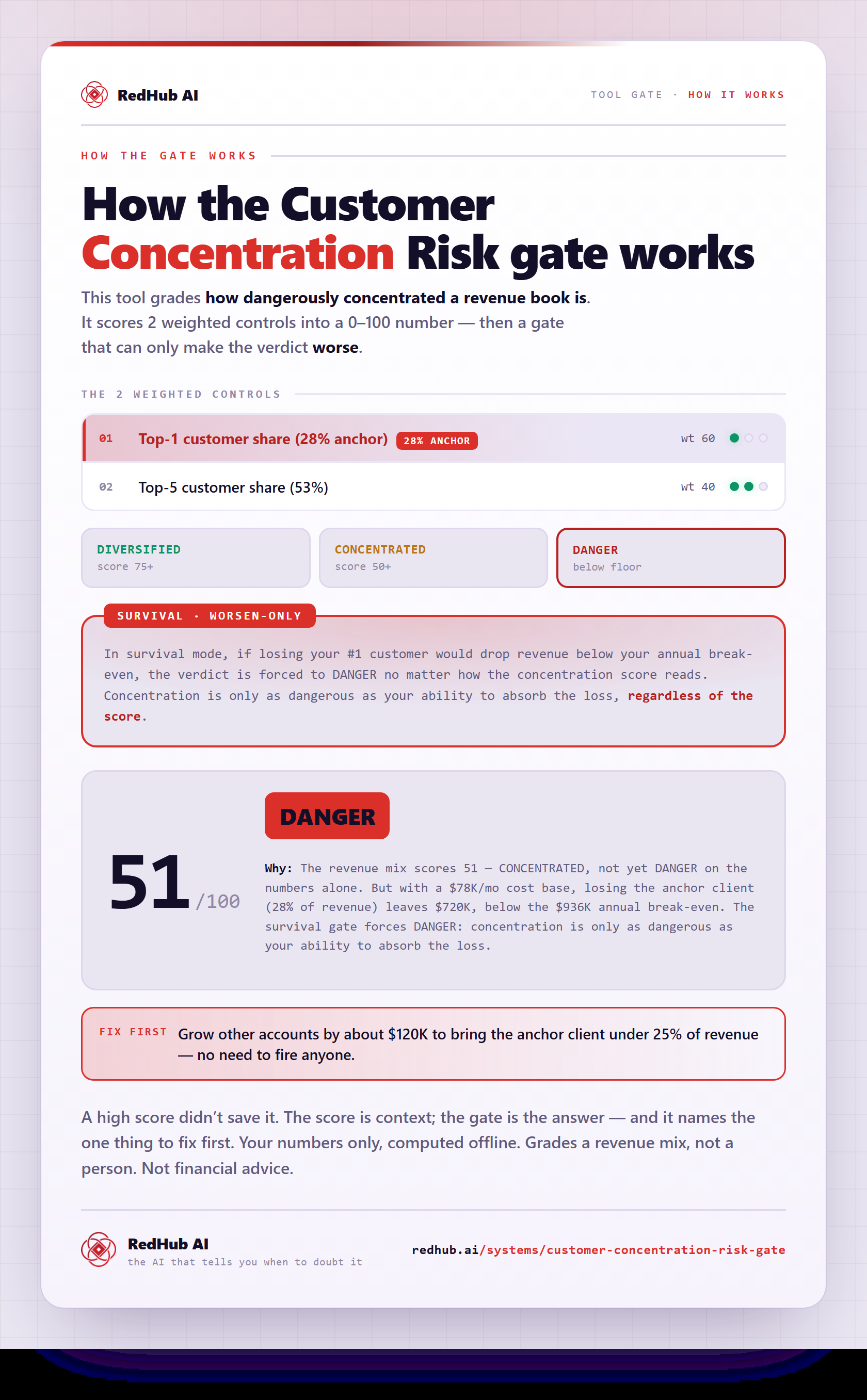
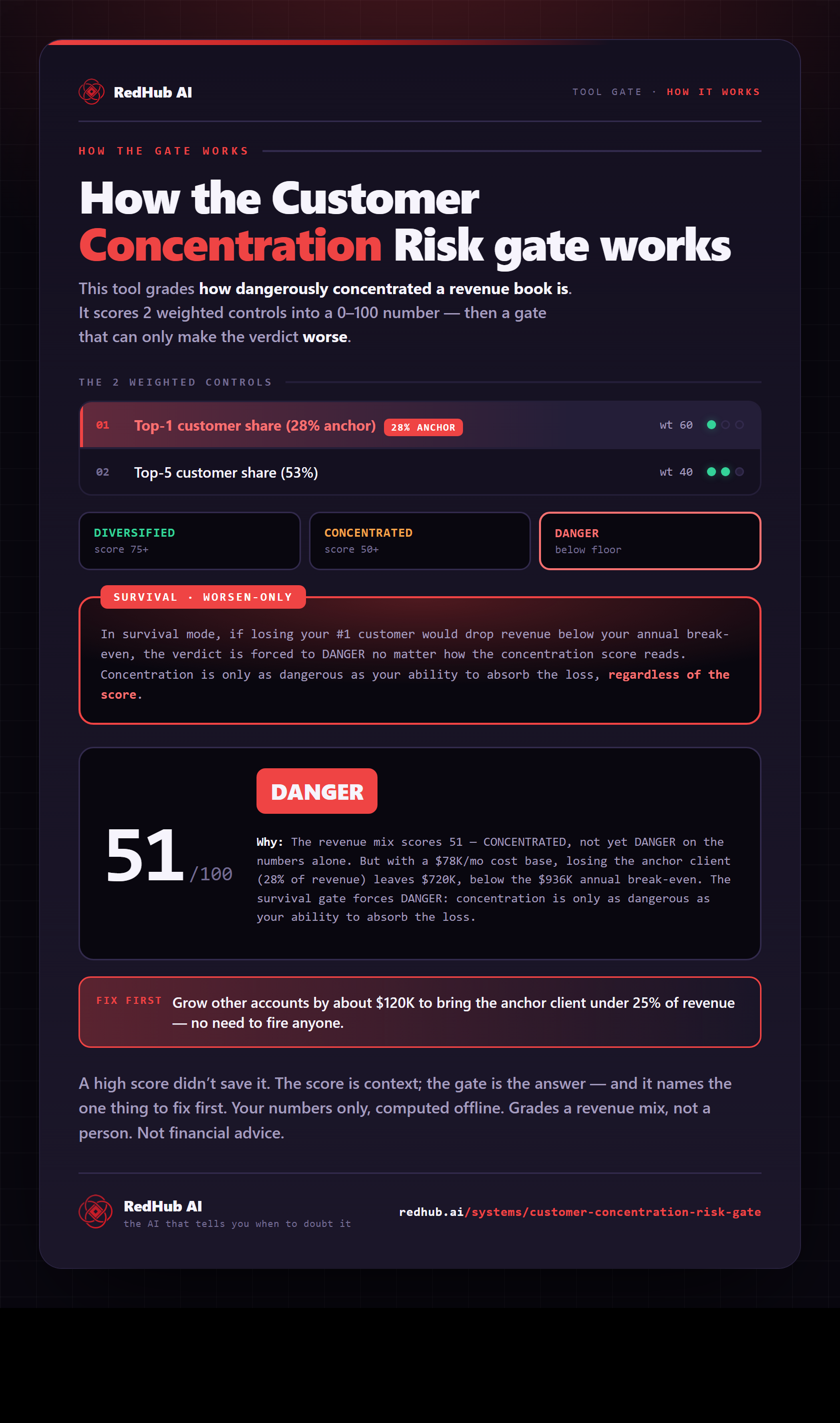
How the gate works, in one image
Top-1 and top-5 customer share scored into a 0–100 number and the survival gate that forces DANGER when losing your #1 would drop you below break-even — the same math the demo runs, as a diagram you can share or embed anywhere.
View & embed the full diagramOne command, every business you run, an honest read.
The zero-dependency Python engine reads your revenue list and prints the same verdict the workbook and demo produce. The Consultancy below scores 51 and still reads DANGER — the survival gate at work.
Customer-Concentration Risk Gate
====================================================
Agency (one whale)               0/100  DANGER
    top-1 48% (BigCo MSA), top-5 94%
    fix first: grow other accounts ~1,380,000 to bring BigCo MSA under 25%
SaaS (healthy spread)           94/100  DIVERSIFIED
    top-1 11% (Account A), top-5 45%
Consultancy (hidden danger)     51/100  DANGER        [GATE -> DANGER]
    top-1 28% (Anchor client), top-5 53%
    survival: losing Anchor client leaves 720,000 vs 936,000 break-even
    fix first: grow other accounts ~120,000 to bring Anchor client under 25%
Studio (no cost base entered)    0/100  DANGER
    top-1 41% (Lead sponsor), top-5 100%
    fix first: grow other accounts ~640,000 to bring Lead sponsor under 25%
Manufacturer (thin cushion)     14/100  DANGER
    top-1 33% (Distributor One), top-5 100%
    fix first: grow other accounts ~320,000 to bring Distributor One under 25%
E-commerce (well diversified)   85/100  DIVERSIFIED
    top-1 12% (Wholesale partner), top-5 52%
----------------------------------------------------
Portfolio: DANGER PRESENT
4 of 6 entities read DANGER.Two metrics for the score. One gate for survival.
Your largest account as a fraction of revenue — weighted heavier, because it's the one that can sink you.
The combined weight of your five biggest accounts — how broad the rest of the book really is.
Enter a cost base, and it tests whether losing your #1 drops you below break-even. If it does, DANGER — regardless of score.
It names the revenue you'd need from other accounts to bring your top customer under 25% — without firing anyone.
It can force DANGER on a book that scored CONCENTRATED — the difference between a risk and a fatal one. Worsen-only: it never lifts a verdict, only lowers it.
No cost base? It falls back to flagging any single customer over 35% — the line acquirers and lenders price against — and tells you it used threshold mode.
Grow the rest of the book past break-even and the gate releases — the verdict returns to whatever the percentages earned. Where there is concentration left to unwind, the account to address first is named.
A risk read, not a valuation.
- A deterministic concentration read computed from your own revenue list.
- A survival test: would you clear break-even if your #1 customer left?
- A named diversification target and, where there is concentration left to unwind, the account to address first.
- Offline — engine, workbook, and demo agree to the number.
- Not financial, investment, or accounting advice.
- Not a business valuation or a sale-price estimate.
- Not connected to your accounting — you paste the revenue and cost base.
- Not a margin analysis on its own — it reads revenue; layer margin next.
Not financial, investment, or accounting advice. This computes customer concentration from your own numbers and flags survivability — it doesn't value your business, estimate a sale price, or replace your CPA or advisor. Bring your own cost-base figure; a CPA can confirm your true break-even.
Owners whose revenue leans on a few names.
The rest of the founder's decision desk.
The AI CFO that reads your real monthly numbers — the break-even this gate tests against.
ViewBuild the conservative revenue floor that a concentrated book makes dangerously optimistic.
ViewThe matched pair on the cost side: if your biggest supplier failed, could you still make the product? Run both before diligence.
ViewThe honest answers.
How exposed your business is to losing its biggest customers. You paste your revenue-by-customer list, and it computes the single largest customer's share of revenue, your top-five share, and a 0–100 safety score, then returns DIVERSIFIED, CONCENTRATED, or DANGER. Add your monthly cost base and it also runs a survival test: would you still clear break-even if your #1 customer walked? It grades a revenue mix, not a person, and connects to nothing.
Because the percentages aren't the whole story — survivability is. The score reflects how concentrated the book looks; the survival gate reflects whether you could absorb the loss. The shipped Consultancy sample has a 28% top customer, which scores in the CONCENTRATED band (51) — but its cost base means losing that anchor would leave it below break-even, so the gate forces DANGER. A 28% customer you can't survive losing is more dangerous than a 35% customer you can. That's the honest version of concentration risk.
The survival test is the sharp one: if you enter your monthly cost base, it checks whether the revenue left after your largest customer leaves still covers break-even. If it doesn't, that's DANGER regardless of score. If you leave the cost base blank, it falls back to a simpler rule — any single customer over 35% of revenue (the line acquirers and lenders price against) reads DANGER — and tells you it used threshold mode. The tool works with just a revenue list, but the one extra number unlocks the more honest answer.
Because it's a single point of failure on your revenue. Concentration is one of the first things acquirers and lenders stress-test — a heavily concentrated book commonly takes a material discount at sale (often cited around 20–35%) and can trigger tighter terms or a pulled credit line at renewal. It also weakens you in every negotiation with that account: when one customer can sink you, you can't walk away from a bad renewal. Fixing it before you raise, sell, or borrow is worth real money.
Revenue is what this tool reads, because it's the number everyone has and it's what concentration is conventionally measured on. But the deeper risk is margin contribution — a large, low-margin account is a different exposure than a large, high-margin one. The playbooks walk through layering margin on top once you've found your concentration. If a customer is both your biggest revenue line and your biggest profit line, that's the one to diversify away from first.
No. It's a deterministic decision aid — it computes concentration from your own numbers and flags survivability; it doesn't tell you what to do, value your business, or replace your CPA or advisor. Bring your own cost-base figure (a CPA can confirm your true break-even), and use the verdict to decide whether diversifying your customer base should move up your priority list. Not financial, investment, or accounting advice.
Find the risk before
a buyer does.
One purchase, lifetime access, 12 months of updates. $99, once.
Not financial, investment, or accounting advice. This computes customer concentration from your own numbers and flags survivability — it doesn't value your business, estimate a sale price, or replace your CPA or advisor. Bring your own cost-base figure; a CPA can confirm your true break-even.
Sold by RedHub AI LLC · Secured by Stripe · redhub.ai