If a co-founder left tomorrow,who keeps the equity?
Skipping vesting is the single most-regretted founder decision — because the co-founder who leaves at month 11 still holding a big stake becomes a cap-table problem you pay for at every future round. This check grades each founder's equity structure against the standard and names the one thing to fix first where a dimension is short.
Not legal, tax, or investment advice. Equity, vesting, and cap-table changes are governed by corporate and tax law — securities rules, the irreversible 30-day 83(b) deadline, board and shareholder approvals — and changing terms retroactively requires agreement from all affected parties. This check grades a structure and flags where it's exposed; it does not value the company, set or change ownership, draft documents, or tell you how to restructure. Bring a specific, documented question to a startup lawyer. It grades structure, never people.
The handshake that costs you the company.
In 2026 founder research, skipping vesting was the single most-cited regret. "We trust each other" is the most expensive sentence a founding team says.
A co-founder leaves before the would-be cliff, holding a material stake outright. Now an absent ex-founder owns a slice of your cap table — and contributes nothing.
Nearly all venture investors require four-year vesting with a one-year cliff as a condition of investment. Without it, they force a buyout or retroactive vesting — costing equity, legal fees, and months.
The fix is cheap and standard if you do it early, and expensive or impossible if you do it late. This check tells you, founder by founder, exactly where the structure is exposed — while it's still a conversation, not a lawsuit.
Score one founder. Watch the dead-equity gate.
The preset is the 50/50 handshake: a material stake, no vesting, no cliff, nothing documented. It reads DEAD-EQUITY RISK. Now flip the vesting dimension to 2 — put them on a schedule — and watch the verdict release, even while the stake stays large. That's the whole insight: dead equity needs both a material stake and no vesting.
Mark each dimension 0–2. Same math as the workbook — nothing is sent anywhere.
No vesting schedule at all - shares were issued outright and are fully owned regardless of tenure.
No cliff - equity began vesting (or vested) immediately, so an early departure still keeps a chunk.
Holds a large, material ownership stake - the kind whose loss to an absent founder would visibly damage the cap table and spook investors.
No acceleration clause - on an acquisition, the founder could be terminated and lose years of unvested equity.
Uncertain whether 83(b) was filed / filed late / unconfirmed.
The split and terms are a handshake - nothing is papered in a founders' agreement or stock-restriction agreement.
Dead-equity kill-chain fired. This founder holds a material stake and has no vesting schedule — the equity is owned outright and cannot be clawed back if they walk. The release that protects the cap table is to put them on a vesting schedule (with counsel).
Fix first
Put the founder on a standard vesting schedule (and paper it)
Grades an equity structure, not a deal or a person. Not legal, tax, or investment advice. Equity changes touch corporate and tax law and the irreversible 30-day 83(b) deadline — bring a specific, documented question to a startup lawyer.
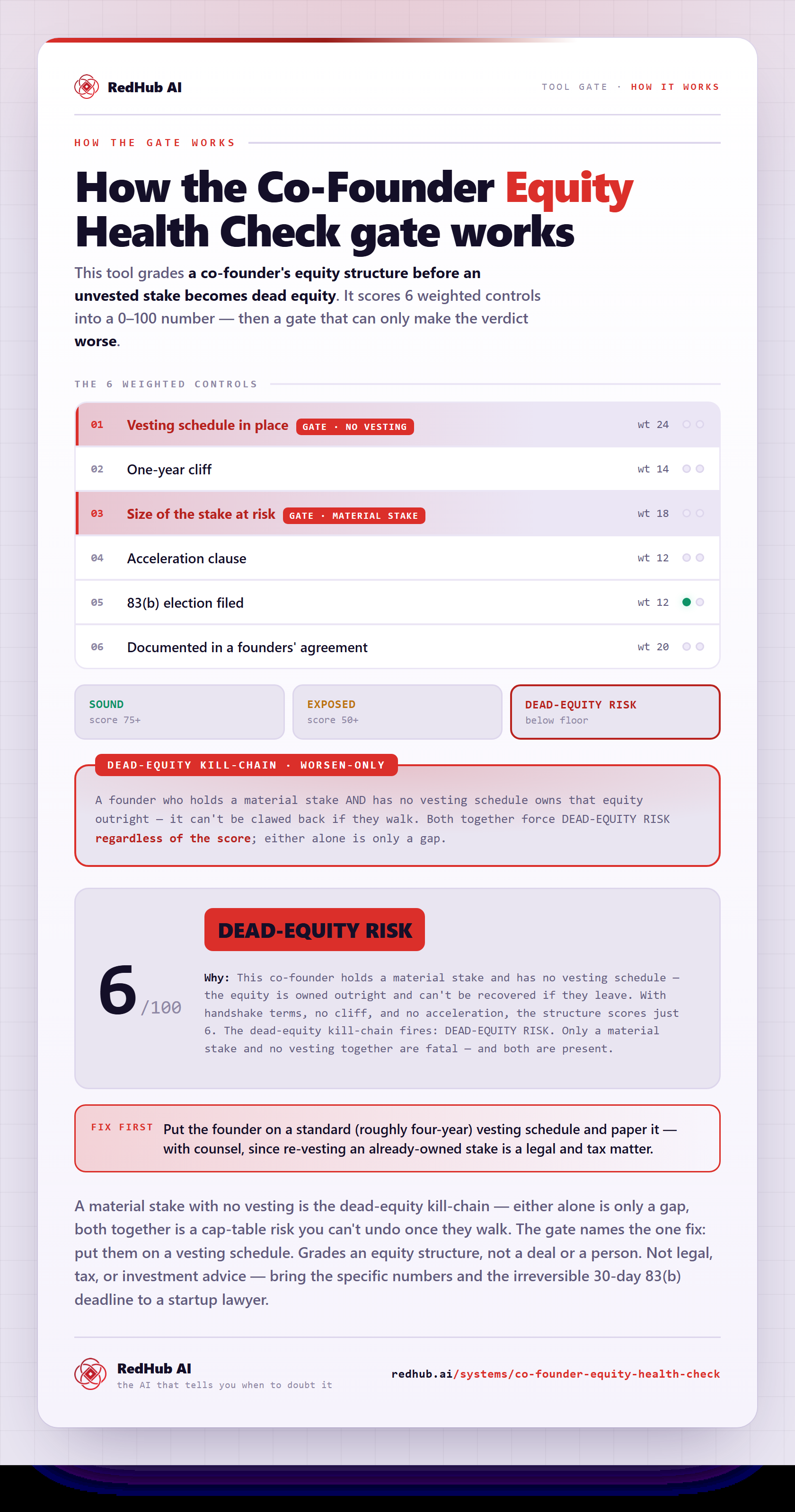
How the gate works, in one image
How the Co-Founder Equity Health Check scores an equity structure and forces DEAD-EQUITY RISK when a material stake has no vesting — the same math the demo runs, as a diagram you can share or embed anywhere.
View & embed the full diagramThe same verdict, from the command line.
The scoring engine ships as a zero-dependency script. Mark your founders, get the cap-table verdict and every fix-first. This is the verified output on the six-founder sample — the workbook and the demo reproduce it exactly.
The Co-Founder Equity Health Check
==============================================================
Departed co-founder no vesting (the trap)   6/100  DEAD-EQUITY RISK  [DEAD-EQUITY]
    fix first: Put the founder on a standard vesting schedule (and paper it)
Standard-vested active co-founder         82/100  SOUND
Small unvested advisor-founder            63/100  EXPOSED
    fix first: Put the founder on a standard vesting schedule (and paper it)
Fully-papered solo founder                82/100  SOUND
Non-standard vesting missed 83(b)         54/100  EXPOSED
    fix first: Confirm the 83(b) election (or raise the miss with a tax advisor)
Handshake equal-split co-founder           6/100  DEAD-EQUITY RISK  [DEAD-EQUITY]
    fix first: Put the founder on a standard vesting schedule (and paper it)
--------------------------------------------------------------
Cap-table verdict: FRACTURED
2 of 6 founder(s) carry dead-equity risk.

Grades an equity structure, not a person or a deal. Not legal or tax advice;
have a startup lawyer review and paper any equity change.Six dimensions. One dead-equity gate.
Whether equity is still being earned over time — or was issued outright and can't be clawed back.
Whether nothing is earned before a founder proves a year of commitment.
How material the stake is — the consequence-sizer that decides whether mis-structuring actually hurts.
Whether double-trigger acceleration protects the founder if they're terminated after an acquisition.
Whether the irreversible 30-day election was filed — a miss can mean a large tax bill at exit.
Whether the split, vesting, and exit terms are papered in a signed founders' agreement.
A founder is forced to DEAD-EQUITY RISK only when two conditions are present at once: they hold a material stake and there's no vesting schedule — the equity is owned outright and can't be clawed back if they leave. That's the precise dead-equity pattern. A large stake that's properly vesting is protected; a tiny unvested stake is survivable. The gate releases the moment either half clears, which is why the fix it names is almost always "put them on a vesting schedule" — though once shares are owned outright, that's a change only counsel can paper.
A structure check, not a lawyer.
- A per-founder equity-structure verdict with the one thing to fix first where a dimension is short.
- A cap-table rollup: CLEAN CAP TABLE, GAPS TO FIX, or FRACTURED.
- A precise gate that fires only on genuine dead-equity risk.
- Offline and deterministic — engine, workbook, and demo agree to the number.
- Not legal, tax, or investment advice — and not a substitute for counsel.
- Not a tool that sets your split or tells you how to restructure equity.
- Not a company valuation, and not a guarantee of any investor outcome.
- Not connected to your cap table — you mark each founder yourself.
Not legal, tax, or investment advice. Equity, vesting, and cap-table changes are governed by corporate and tax law — securities rules, the irreversible 30-day 83(b) deadline, board and shareholder approvals — and changing terms retroactively requires agreement from all affected parties. This check grades a structure and flags where it's exposed; it does not value the company, set or change ownership, draft documents, or tell you how to restructure. Bring a specific, documented question to a startup lawyer. It grades structure, never people.
Founding teams who'd rather fix it early.
- · Co-founders who split equity on a handshake and never papered vesting.
- · Teams heading into a first priced round, where investors will require a clean structure.
- · Solo founders who want the structure investors expect before they raise.
- · Anyone who just had a co-founder wobble and realized the cap table isn't protected.
The rest of the founder's desk.
When an offer comes, how ready is the business for buyer diligence — including how the cap table is structured?
ViewThe other founder-money question: is the salary you pay yourself defensible to the IRS?
ViewStress-test the hard founding-team calls before they calcify into a cap-table problem.
ViewThe honest answers.
For each co-founder (or early equity holder), it scores six dimensions of equity-structure health — whether a vesting schedule is in place, whether there's a one-year cliff, the size of the stake at risk, whether there's an acceleration clause, whether the 83(b) election was filed in time, and whether it's all documented in a signed founders' agreement — into a 0–100 equity-health score and a verdict: SOUND, EXPOSED, or DEAD-EQUITY RISK. Every founder rolls up to a cap-table verdict — CLEAN CAP TABLE, GAPS TO FIX, or FRACTURED. It answers the question every founding team should ask before it matters: is our equity structured to survive one of us leaving?
Dead equity is a stake held by someone who's no longer contributing — the co-founder who leaves at month 11 still holding a big chunk of the company. It's the failure mode founders most regret: in 2026 founder research, skipping vesting was the single most-cited regret. The gate forces DEAD-EQUITY RISK only when two conditions are both present — the founder holds a material stake AND there's no vesting schedule at all, so the shares are owned outright and can't be clawed back if they walk. That's the precise pattern that nukes a cap table and forces an expensive buyout or retroactive vesting at your next raise. A big stake that's properly vesting is fine; a tiny unvested stake is survivable. Only the intersection is a gate condition, so only the intersection fires the gate.
Yes — and the check grades against it. The industry standard, which nearly all venture investors require as a condition of investment, is four-year vesting with a one-year cliff: nothing vests for the first 12 months, then 25% vests at the cliff, and the remaining 75% vests monthly over the next three years. Add double-trigger acceleration (so you're protected if you're terminated after an acquisition), file your 83(b) election within 30 days of the grant, and document everything in a founders' agreement. The check marks each founder against that standard and, where a founder falls short of it, names the biggest gap. What it deliberately does not do is tell you the 'right' equity split or how to restructure — those are decisions for you and your lawyer.
Not unilaterally, and this is exactly where the check hands you off to counsel rather than pretending to solve it. Putting an already-issued, fully-owned stake onto a vesting schedule is a retroactive change — it requires the agreement of the affected founder, possibly board and shareholder approval, and it can have real tax consequences. The check will flag the founder as DEAD-EQUITY RISK and name 'put them on a vesting schedule' as the fix, but the actual move is a legal and tax matter to bring to a startup lawyer with the specific numbers. The value here is surfacing the exposure early — while it's still a conversation, not a lawsuit.
No. This is a planning and diligence aid, not legal, tax, or investment advice, not a substitute for a lawyer, and not a guarantee of any investor or legal outcome. Equity, vesting, and cap-table changes are governed by corporate and tax law — securities rules, the irreversible 30-day 83(b) deadline, board and shareholder approvals — and the details matter enormously. The check grades a structure and flags where it's exposed so you can bring a specific, documented question to a startup lawyer or tax advisor. It grades structure, never the people, and it never tells you how to restructure equity.
It's fully offline and deterministic — it connects to nothing and reads no cap-table software. You get a runnable scoring engine, a workbook that reproduces it exactly (a Start Here guide, a Dashboard, and an Equity-Health Scorecard with the mark definitions built into each column), a six-founder worked sample, and two playbooks: an equity-health audit playbook (how to read your own cap table and mark each founder honestly) and a de-risking runbook (how to close the gaps — vesting, cliffs, acceleration, 83(b), documentation — and when to bring in counsel). The on-page demo, the workbook, and the engine all run the same math and agree to the number.
Catch the dead equity.
While it's still a conversation.
One purchase, lifetime access, 12 months of updates. $79, once.
Not legal, tax, or investment advice. Equity, vesting, and cap-table changes are governed by corporate and tax law — securities rules, the irreversible 30-day 83(b) deadline, board and shareholder approvals — and changing terms retroactively requires agreement from all affected parties.
Sold by RedHub AI LLC · Secured by Stripe · redhub.ai