The Owner-Pay Defensibility Kit
Is the salary you pay yourself defensible to the IRS — and is the distribution even safe to pull? Enter your own figures and get a verdict: DEFENSIBLE, THIN, or RECLASSIFICATION RISK, plus a dispositive DO NOT DISTRIBUTE check on the draw itself.
instant download · .xlsx · yours to keep
Not tax or legal advice. Reasonable compensation is a facts-and-circumstances determination with no safe harbor and no IRS-approved ratio; this kit hard-codes no number and grades your split only against the market wage you supply. It is not a CPA opinion or an audit shield, sets no salary, and files nothing. Have a CPA or tax advisor review and document your reasonable-compensation position; figures and enforcement posture change.
The problem
The cheapest tax move is the one the IRS audits most.
There's no IRS-approved salary ratio. The 60/40 rule is folklore. Reasonable compensation is what an unrelated employer would pay for your work — facts and circumstances, not a formula.
of the reclassified amount is the typical total cost when the IRS recharacterizes distributions as wages: back FICA (15.3%), a 20% accuracy penalty, interest, and audit-defense fees.
In 2026, S-corp audit selection is AI-assisted. Zero or token salary against real distributions on owner-generated revenue is a near-certain flag.
This kit runs the check on yourself first: it grades how defensible your split is against your own market-wage estimate, and — separately — whether the draw is even safe to pull after taxes, working capital, and S-corp proportionality.
See it work
Your numbers, an honest verdict.
The preset is the classic trap: a $30k salary against a $150k distribution on a one-person service business valued at $120k. It reads RECLASSIFICATION RISK. Raise the salary toward the market wage and watch the verdict change — then push the distribution past your reserve and watch the cash override take over.
Enter your own figures. The verdict updates live — same math as the workbook. Nothing is sent anywhere.
Salary is below half the market wage you set for your own role — the documented reclassification pattern. The IRS can reclassify your distributions as wages, with back FICA, penalties, and interest.
Not tax or legal advice. No safe harbor exists; reasonable compensation is facts-and-circumstances, graded only against the market wage you supply. Have a CPA review and document your position.
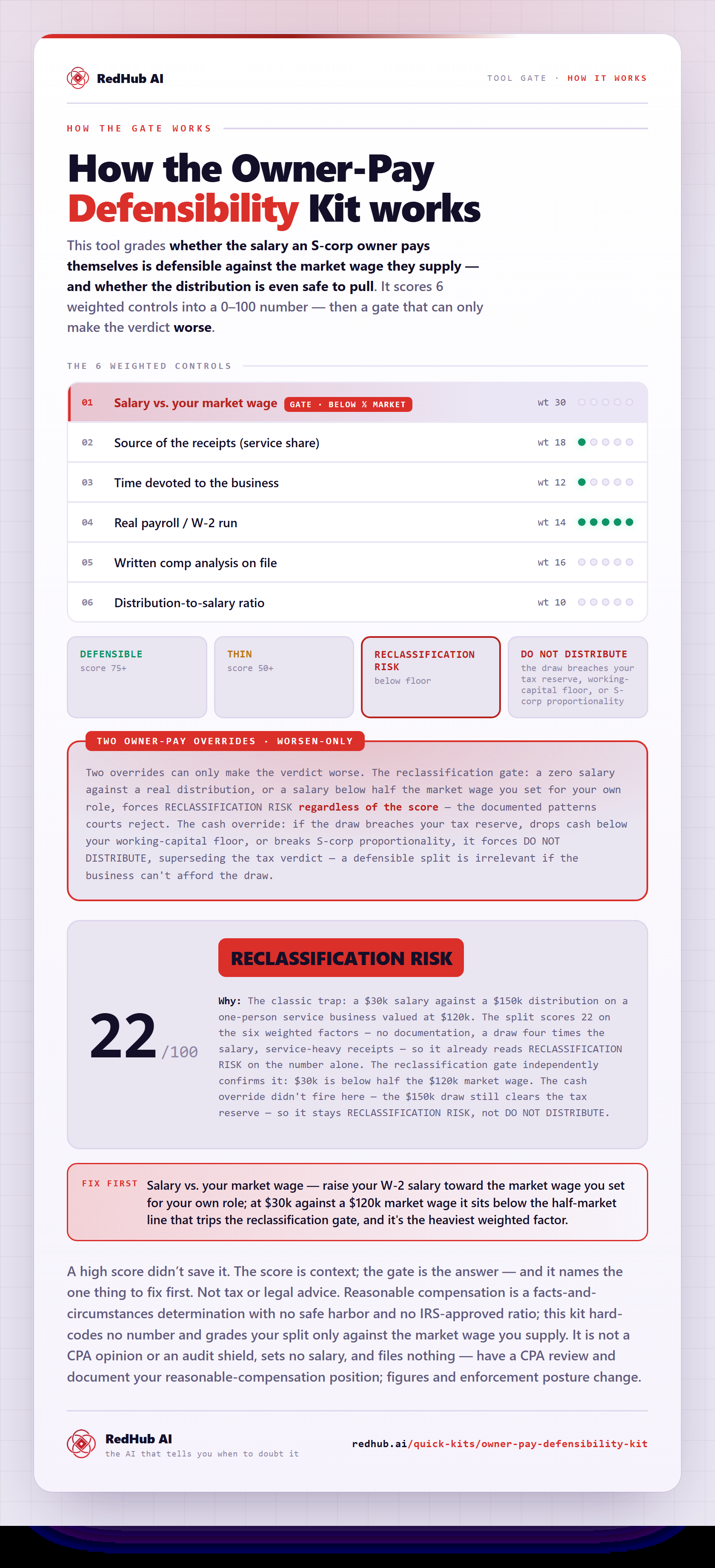
How the gate works, in one image
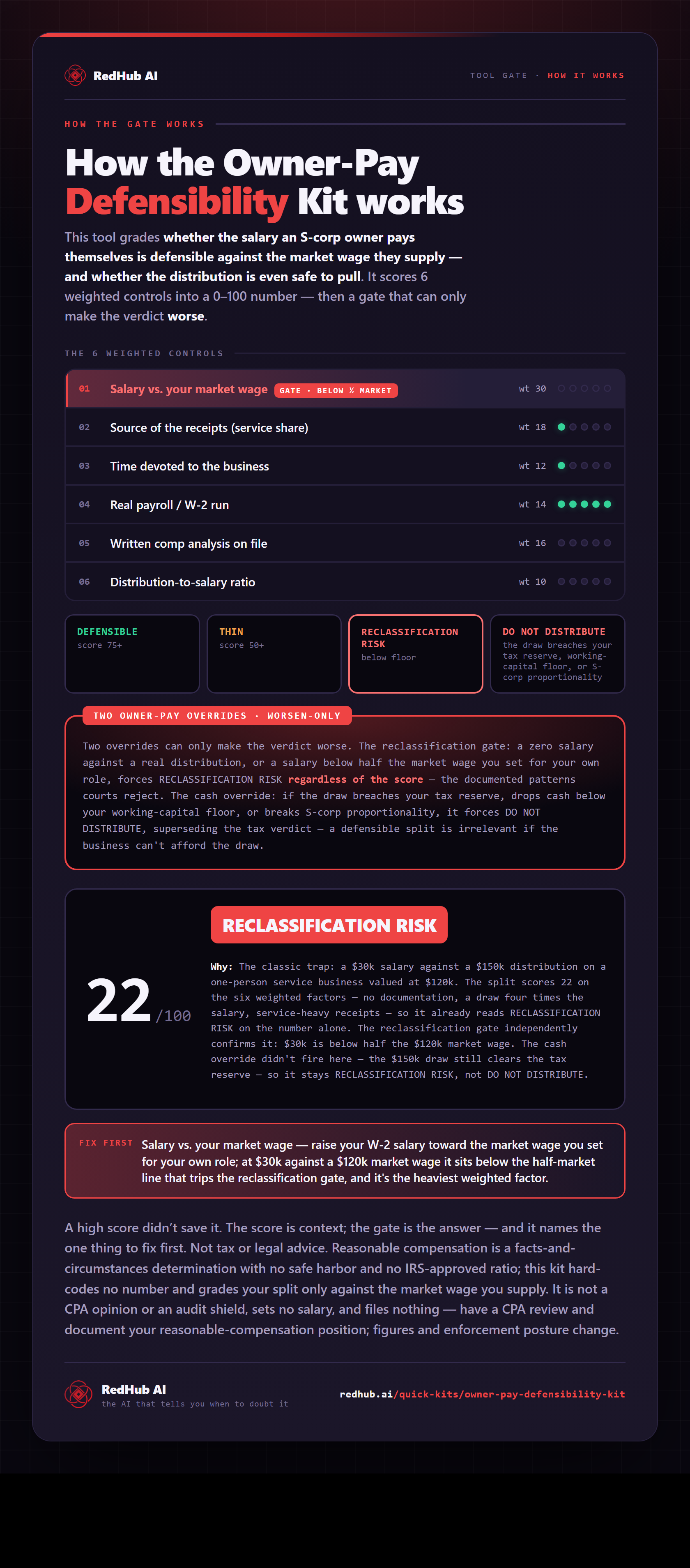
How the Owner-Pay Defensibility Kit scores an owner's salary/draw split and flags RECLASSIFICATION RISK when the salary is far below a reasonable wage — the same math the demo runs, as a diagram you can share or embed anywhere.
View & embed the full diagramThe standard
Six factors, two gates, no invented number.
The heaviest factor and the core of the Watson standard: what you'd pay an outside hire for your role. You set it; nothing is hard-coded.
The more profit comes from your own services (vs capital and employees), the higher the salary the IRS expects — a capital-heavy business can defend a lower one.
Your hours, whether you run a real W-2 (a draw isn't a salary), and whether a written analysis is on file — the practical audit defense, since there's no safe harbor.
Zero salary with a draw, or salary below half your market wage, forces RECLASSIFICATION RISK regardless of the rest — the documented patterns courts reject.
A tax-defensible split is irrelevant if the business can't afford the draw. The cash gate forces DO NOT DISTRIBUTE — superseding the tax verdict — when the distribution breaches your tax reserve, drops cash below your working-capital floor, or breaks S-corp proportionality (which can jeopardize S-corp status). In the sample, a split that scores 95 and reads DEFENSIBLE still reads DO NOT DISTRIBUTE because the draw isn't safe to pull.
What this is — and isn't
A defensibility check, not a CPA in a box.
- A verdict on how defensible your split is against your own market wage.
- A dispositive cash-safety check on the distribution itself.
- A way to find the gaps before an examiner does — and document the position.
- Offline and deterministic — worksheet, demo, and engine agree to the number.
- Not tax or legal advice, and not a CPA opinion or audit shield.
- Not an IRS-approved ratio — there isn't one; it invents no number.
- Not connected to your books or the IRS — you bring the figures.
- Not a scoring of any person — it grades a compensation position.
Not tax or legal advice. Reasonable compensation is a facts-and-circumstances determination with no safe harbor and no IRS-approved ratio; this kit hard-codes no number and grades your split only against the market wage you supply. It is not a CPA opinion or an audit shield, sets no salary, and files nothing. Have a CPA or tax advisor review and document your reasonable-compensation position; figures and enforcement posture change.
Pairs well with
The rest of the owner's money desk.
The AI CFO that keeps the cash reality straight — what's actually safe to pull, all year.
ViewConservative, supportable projections — so your reserve and draw plans hold up.
ViewCatch a runaway spend before it eats the reserve you were going to distribute.
ViewCommon questions
The honest answers.
Two things at once. First, whether the salary you pay yourself is defensible against the IRS reasonable-compensation standard — it returns DEFENSIBLE, THIN, or RECLASSIFICATION RISK from your own numbers. Second, and separately, whether the distribution you're about to take is even safe to pull — a dispositive DO NOT DISTRIBUTE check against your tax reserve, working-capital floor, and (for multi-owner S-corps) proportionality. A split can be perfectly tax-defensible and still be a draw the business can't afford, so the kit grades both and tells you which problem you have.
No — that's the most important thing to understand. The 60/40 rule (and the 50/50 rule) is folklore with no basis in the Internal Revenue Code, the Treasury Regulations, or any IRS guidance. There is no safe harbor and no approved ratio. Reasonable compensation is a facts-and-circumstances test: what an unrelated employer would pay for the same services in the same area, for the work you actually perform — the standard from Watson v. Commissioner. Using a percentage of profit as a formula can itself invite scrutiny if it produces a salary that diverges from market wages for your role. That's why this kit hard-codes no number and grades your split only against the market wage you supply. This is a planning and documentation aid, not tax or legal advice and not a CPA opinion — take a documented position to your CPA.
Because two configurations are dispositive on their own, and the gate catches them regardless of the score. A $0 salary while taking distributions is the single biggest documented red flag — courts have uniformly ruled against zero-salary S-corps. And a salary set below half the market wage you entered for your own role is the core reclassification pattern. When either fires, the verdict is RECLASSIFICATION RISK no matter how strong the other factors look, because services performed for the S-corp must first be paid as reasonable W-2 wages before distributions. The fix is to raise the salary toward your market wage and document the rationale.
No, and keeping them separate is the point. DO NOT DISTRIBUTE is about cash and structure, not taxes: it fires when the draw would break your tax reserve (you'd be spending money you owe the IRS), drop cash below your working-capital floor (which a lender expects to see and your operations need), or — for a multi-owner S-corp — break the proportionality S-corps must maintain, which can jeopardize S-corp status entirely. It supersedes the tax verdict because a defensible split is irrelevant if the business can't afford the draw. The kit shows the cash reason so you know to cut the draw, separate from any salary fix. Planning and documentation aid, not tax or legal advice — take a documented position to your CPA.
No. It's deterministic and offline — you enter your own dollar figures and it computes the verdict locally. It performs no IRS lookup, queries no wage database, uses no AI, files nothing, and grades a compensation position, not a person. The same math runs in the workbook, the on-page demo, and (under the hood) the spreadsheet, so all of them agree to the number. You bring the inputs — especially your own honest estimate of the market wage for your role — and it surfaces how defensible your numbers are so you can take a documented position to your CPA.
No. This is a planning and documentation aid, not tax or legal advice, not a CPA opinion, and not an audit shield. It does not set your salary, prepare your payroll, or file your return, and reasonable-compensation rules and enforcement posture change over time. Use it to pressure-test your own numbers and surface the gaps before an examiner does — then have a CPA or tax advisor review and document your reasonable-compensation position. Reasonable compensation is one of the most-scrutinized small-business tax issues, and in 2026 audit selection is AI-assisted; a documented, market-aligned position reviewed by your advisor is the actual defense.
Pay yourself defensibly
Run the check before the IRS does.
- · Tax-defensibility verdict from your own numbers
- · Dispositive cash-safety check on the draw
- · One fix-first per entity, ready for your CPA
Not tax or legal advice. Reasonable compensation is a facts-and-circumstances determination with no safe harbor and no IRS-approved ratio; this kit hard-codes no number and grades your split only against the market wage you supply.
Sold by RedHub AI LLC · Secured by Stripe · redhub.ai