Own your executive team.See the whole board.
Four green lights and one red feels fine — every dashboard averages it away. The Agentic Executive Harness won’t: it ties your executive systems into one honest company status, reports the worst executive, not the average, and escalates to CRITICAL when two domains are at risk at once. Where an executive is short, it names the one binding constraint and Monday’s top item. Orchestration only — you run the company.
Most companies don’t fail on one red light. They fail on two at once.
You run separate systems for sales, finance, strategy, and operations — and each one tells you the truth about its own corner. But you read them one at a time, and your brain averages: three green, one amber, mostly fine.
The dangerous state isn’t the single red light. It’s the combination no single tool can see — sales exposed and runway tightening in the same week. Each looks survivable alone. Together they’re how companies die.
So you find out too late — when the quarter closes light and the runway that looked fine is suddenly the only thing that matters. No one was watching the whole board at once.
Two executives green, two at risk — and the company is CRITICAL.
Set where each executive stands. The company status is the worst of them — and when two domains hit AT RISK at once, the compounding gate escalates it to CRITICAL, even though no single executive is. Drop one back and the gate releases. Same math as the engine and the workbook.
Board briefing · live demo
Set where each executive stands — and watch two at-risk domains compound to CRITICAL.
Company status
CRITICAL
Act now.
Compounding: 2 domains at AT RISK or worse at once (sales, finance). Individually serious; together critical.
Binding constraint: Finance (finance)
Cash is the binding constraint — it gates every other plan. Sequence every decision behind extending the runway.
Monday’s top item: resolve finance first — and treat the compounding as the reason this is the whole board's problem, not one function's.
The compounding gate is the point: two domains at AT RISK at once force CRITICAL even though no single executive is — cool one back below AT RISK and the gate releases. Company status is the worst, never the average. Same math as the engine and workbook. It synthesizes and routes; you run the company.
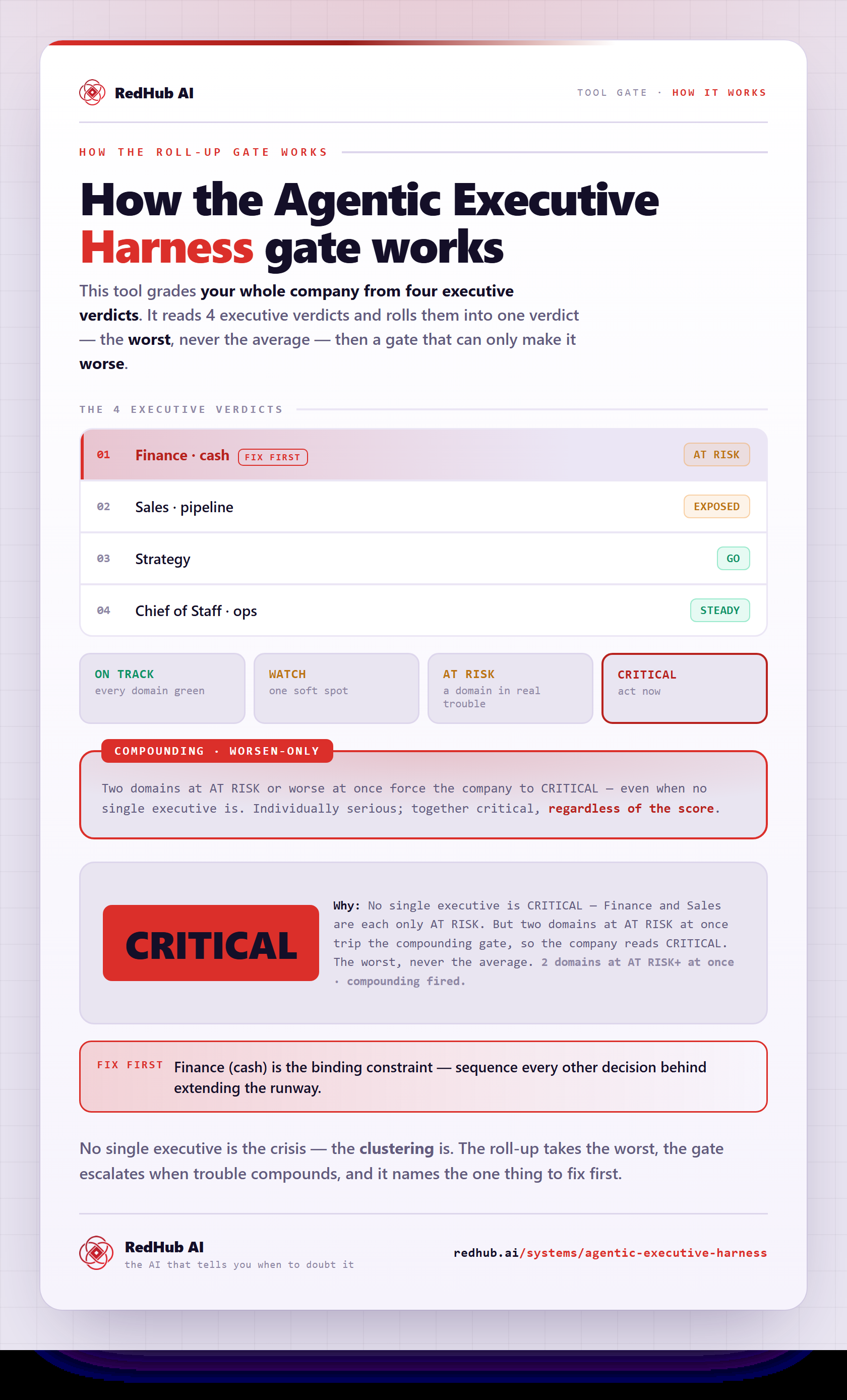
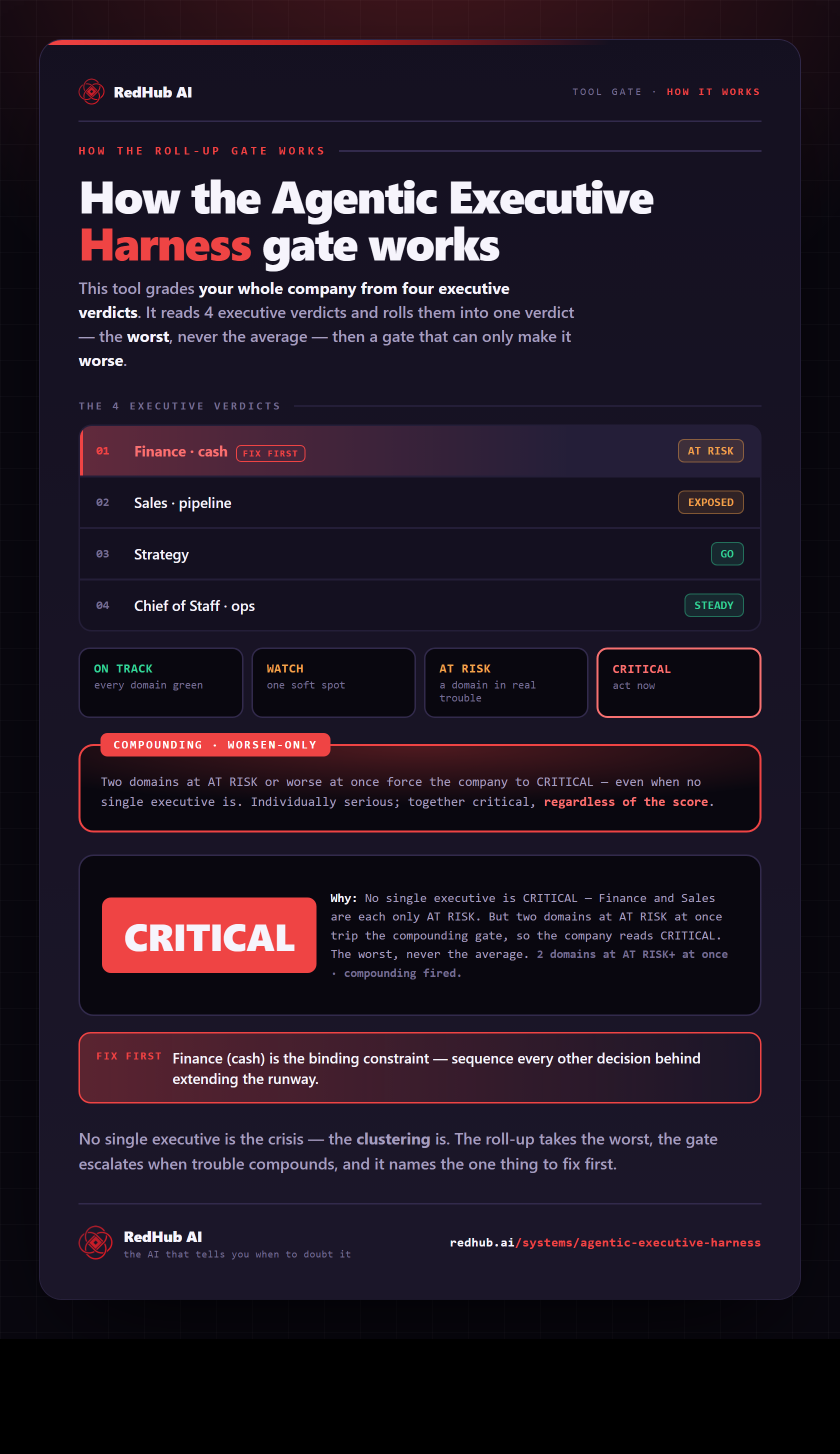
How the gate works, in one image
The four executive verdicts rolled into one company status — worst, never the average — and the compounding gate that forces CRITICAL when two domains hit AT RISK at once. The same math the demo runs, as a diagram you can share or embed anywhere.
View & embed the full diagramFour steps from four verdicts to one board briefing.
The executive-intake convenes the board: it collects each system's current verdict — STEADY, GO, EXPOSED, AT RISK — and maps it to one common 0–3 severity via the shared contract. It takes the latest real read, not last week's and not a hopeful version, and never runs the systems for you.
The board-synthesizer rolls the severities into one company status — the max, not the average — then applies the compounding gate: two or more domains at risk at once escalate the company to CRITICAL. It refuses to report a calm company when one executive is screaming, or to average a red away.
The constraint-router, where an executive is short, names the binding constraint — the highest-severity executive, ties broken toward the domain that kills fastest — states the cross-functional throughline in plain language, and sets Monday's single top item. One constraint, one priority; it points, it doesn't decide.
The briefing-tracker is the board's memory: it logs each week's verdicts, the company status, and the binding constraint, then reports what escalated or eased, whether the constraint moved, and whether last week's top item got resolved — so a constraint red for a month becomes impossible to ignore.
In the box: a runnable orchestration engine with the shared verdict contract, the same briefing as an Excel workbook with live formulas, the board-briefing one-pager template, and two playbooks — running the harness, and wiring your executive team with the board-level honesty method. You supply the executive verdicts.
A board-level honesty your dashboards don’t have.
The worst, not the average
Company status is the max of the executives' severities — a red function is the company's status no matter how many greens surround it. Three green and one red is a red company. The greens are noted; the red is the headline.
The compounding gate
Two or more domains at risk at once escalate the company to CRITICAL — even when no single executive is critical. Cross-functional problems compound: a weak pipeline and a short runway at the same time is existential, and it's the state no single tool flags.
Synthesizes; you run the company
It reads each system's verdict and hands you the board briefing. It never runs the systems, changes their inputs, moves money, or takes an action — and it synthesizes rather than invents. The decisions are yours. Not financial, legal, or investment advice.
An orchestration layer — not an autopilot.
- Reads each executive system’s current verdict and maps it to one common severity scale.
- Reports one honest company status — the worst, not the average — and escalates when domains compound.
- Where an executive is short, names the single binding constraint, the cross-functional throughline, and Monday’s top item.
- Works standalone with whatever verdicts you have, or with the full Executive Suite feeding it.
- It doesn’t run the underlying systems, change their inputs, or write back to them.
- It doesn’t make the decision, move money, or take an action — it routes; you decide.
- It doesn’t invent a status — the company read is only as honest as the verdicts you feed it.
- It isn’t financial, legal, or investment advice. You run the company.
For the founder who is the whole C-suite.
Founders and operators wearing every executive hat, who need the one read that says where to look first.
Anyone already running the Executive Suite systems who wants them working as one coordinated team, not four tabs.
Operators who’d rather hear “you’re CRITICAL and here’s why” than a dashboard that lets them feel fine.
The executives it orchestrates.
The operations executive and the Suite hub — the AI Chief of Staff whose weekly read becomes the operations line on the board.
The sales executive — your AI VP of Sales, grading the pipeline on qualification. Its verdict is the sales line on the board.
The finance executive — your AI CFO, grading cash on runway and trajectory. Its verdict is the finance line, and cash usually wins the tie.
The fourth executive is the Devil’s-Advocate Board (strategy) — its GO / NO-GO is the strategy line on the harness. Run all four and the board briefs itself; run a subset and the harness orchestrates whatever’s present.
The honest answers, before you buy.
No — it works standalone with whatever executive verdicts you have. You feed it each domain's current status (operations, strategy, sales, finance, or any executives you run) and it synthesizes the company status, binding constraint, and Monday's top item. It's at its best with the full Suite feeding it — Operating Cadence Engine for operations, Devil's-Advocate Board for strategy, Pipeline Commander for sales, Cash-Flow Sentinel for finance — because then the board briefs itself from the systems you already trust. But the harness orchestrates whatever's present; you can run it with two executives or all five.
It maps each executive's native verdict to one common 0–3 severity (the shared verdict contract — STEADY/GO/HEALTHY map to 0, NEEDS ATTENTION/THIN/TIGHT/GO WITH CONDITIONS to 1, AT RISK/EXPOSED/NOT YET to 2, OFF PLAN/NO-GO/CRITICAL to 3), then the company status is the maximum of those severities — the worst, not the average. Three green and one red is a red company. On top of that sits the compounding gate: if two or more domains are AT RISK (severity 2) or worse at the same time, the company is escalated to CRITICAL even when no single executive is critical — because a weak pipeline and a short runway at once is existential. In the worked sample, sales is EXPOSED and finance is AT RISK, so the company reads CRITICAL.
Because averaging is how companies talk themselves into comfort. A scorecard that blends four domains into one number lets a red function disappear behind three green ones — and the red function is the one that ends you. The harness states the green executives, then states plainly that the red one is the company's status. That's the anti-happy-ears principle applied at the board level: you can't be 'mostly fine' when one executive is screaming.
It's the novel mechanic. Rather than vetoing on a missing input or discounting a metric, the harness escalates on a combination: two or more domains at AT RISK or worse, at the same time, force the company to CRITICAL — even if no single executive is critical. The reasoning is cross-functional: you can't out-sell a cash crisis when the pipeline itself is exposed, and you can't cut your way safe if sales can't refill the top. The dangerous state isn't one red light; it's the pair no single tool can see. The gate fires when the pair appears and releases the moment one domain cools back below AT RISK.
No — it's orchestration only. It reads each system's verdict and delivers the board briefing to you; it never runs the underlying systems, changes their inputs, writes back to them, moves money, or takes an action. Where an executive is short, it names the binding constraint and Monday's top item, but it points — it doesn't decide. The founder and the relevant system make the call. And it synthesizes rather than invents: the company status is a function of the verdicts you feed it, so it can't be argued greener than its inputs.
A dashboard shows all the lights and lets you average them in your head — every status side by side, equal weight, no opinion. The harness reports the worst, compounds the dangerous combinations, and, where an executive is short, names one binding constraint and one top item. It's the difference between a wall of gauges and a chief of staff who walks in and says 'finance is the problem this week, here's why, do this first.' It has a point of view about where to look — that's the product.
No. The harness synthesizes the reads from your own executive systems into one board-level view — it routes the decision; it doesn't give domain advice or compute a regulated figure. The company status is only as honest as the verdicts feeding it, and the decisions and their consequences are yours. It's a board-level orchestration tool for founders and operators, not advice.
Stop reading four dashboards.
See the whole board.
One purchase, lifetime access, 12 months of updates. $299, once. Own your executive team — don’t rent bots.
Sold by RedHub AI LLC · Secured by Stripe · redhub.ai