Could you defend your AI hiring toolif a regulator asked tomorrow?
Automated employment decision tools now sit inside a patchwork that is in force — NYC bias audits, Illinois notice rules, California recordkeeping. Score the evidence dossier for each tool you deploy and get one verdict — DOSSIER READY AS DESCRIBED, SHORTFALL, or EVIDENCE GAP — with a gate that won't let a tool pass on paperwork while the load-bearing controls are missing.
Not legal advice. This is a readiness aid that grades a deployer's evidence dossier from your own marks — not a bias audit, certification, opinion of counsel, or safe harbor. AEDT obligations vary by jurisdiction and change often; it connects to nothing and scores no candidate or employee. Confirm your specific obligations with a qualified employment attorney.
Update notice — version 1.1.0 (2026-09-23). This package replaces version 1.0 of the AEDT Deployer Compliance Dossier. The dossier's scope is now described as a composite US readiness baseline, the legal-reference and notice text is revised, and the audit-publication control is renamed "Audit-publication requirement assessed" and re-scaled. Scoring is unchanged: the same marks produce the same score and verdict as in version 1.0. Existing buyers: the download link in your original purchase email now serves version 1.1.0.
The dashboard says you're compliant. The file says otherwise.
NYC penalties run up to $500 for a first violation and $500–$1,500 for each subsequent violation, accruing per day. A December 2025 New York State Comptroller audit found DCWP falling short in enforcing the law: its complaint intake was ineffective, and auditors reviewing the same companies identified potential non-compliance DCWP’s own review had missed. DCWP disagreed with some findings and agreed to adopt most of the recommendations in part or in full.
a gate-triggering gap to check for: a vendor's own “bias report” passed off as the audit. For NYC Local Law 144, the required audit must be conducted by an auditor who satisfies NYC’s independence criteria. A vendor’s internal self-assessment is not, by itself, that independent audit — though a vendor may arrange for a qualifying independent auditor to audit the tool.
NYC, Illinois, California, soon Connecticut — each with different notice, audit, and recordkeeping rules. A tool defensible in one place can be exposed in another.
This grades the evidence you can actually produce against a composite US readiness baseline, and refuses to let a tool with a stack of paperwork but no independent audit, or no candidate notice, read as defensible. These controls combine selected obligations and governance practices drawn from multiple US jurisdictions. Not every control is legally required for every tool, employer, location, or employment decision. Confirm scope and applicable requirements before treating a missing control as legally required.
Score a tool and watch the gate do its job.
Mark each control. The verdict updates live — same math as the workbook.
For NYC Local Law 144, a bias audit must have been completed within the year before use by an auditor who satisfies NYC’s independence criteria. A vendor may arrange the audit, but the vendor’s internal self-assessment is not itself the required independent audit.
Where an applicable rule requires notice, document the covered recipients, required content, delivery method, applicable lead time or response period, and evidence of delivery. Where NYC Local Law 144 applies, covered candidates or employees must receive the required notice at least 10 business days before AEDT use.
2 = Applicability documented; where notice is required, the applicable recipients, content, timing, and delivery evidence are recorded
Where a rule requires publication, a current audit summary posted on the public site in the manner that rule specifies.
2 = Applicability documented and, where required, current publication evidence recorded
A real person reviews adverse outcomes; candidates can appeal or request an alternative.
Records kept for the period the applicable rule sets — retention periods differ by jurisdiction.
Input sources documented and reviewed for potential proxies for protected classes. Illinois law specifically prohibits using ZIP codes as a proxy for protected classes in covered AI employment decisions.
Scores in the DOSSIER READY AS DESCRIBED band, but a gate control is at 0 — so the verdict is forced to EVIDENCE GAP. With no independent audit, or candidates never notified, a strong file elsewhere can't clear this instrument's evidence gate. That does not establish that the control is legally required or that the deployment violates applicable law.
Close first: Independent bias audit on file
Your marks only · no benchmark · grades the dossier, not people
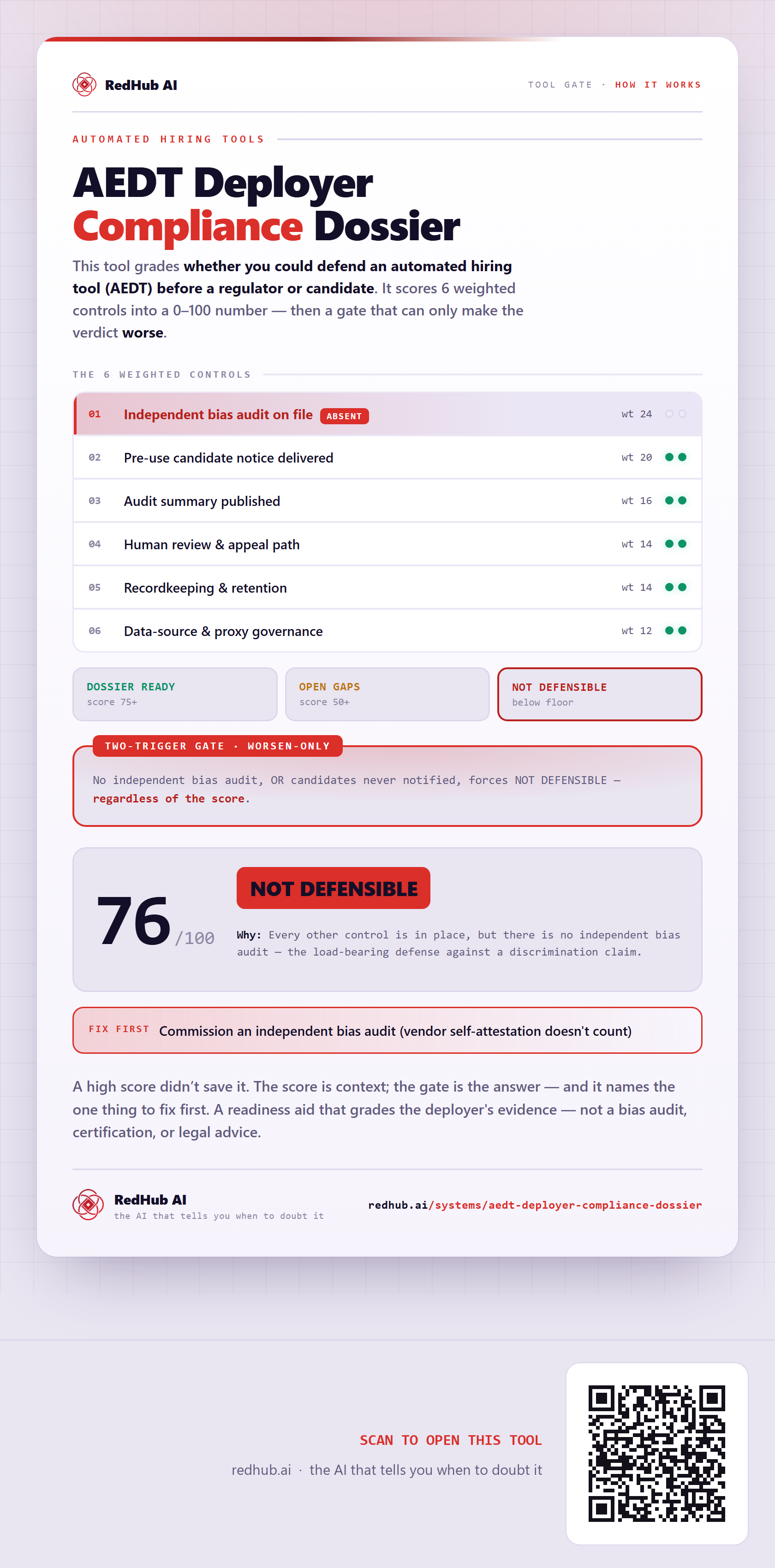
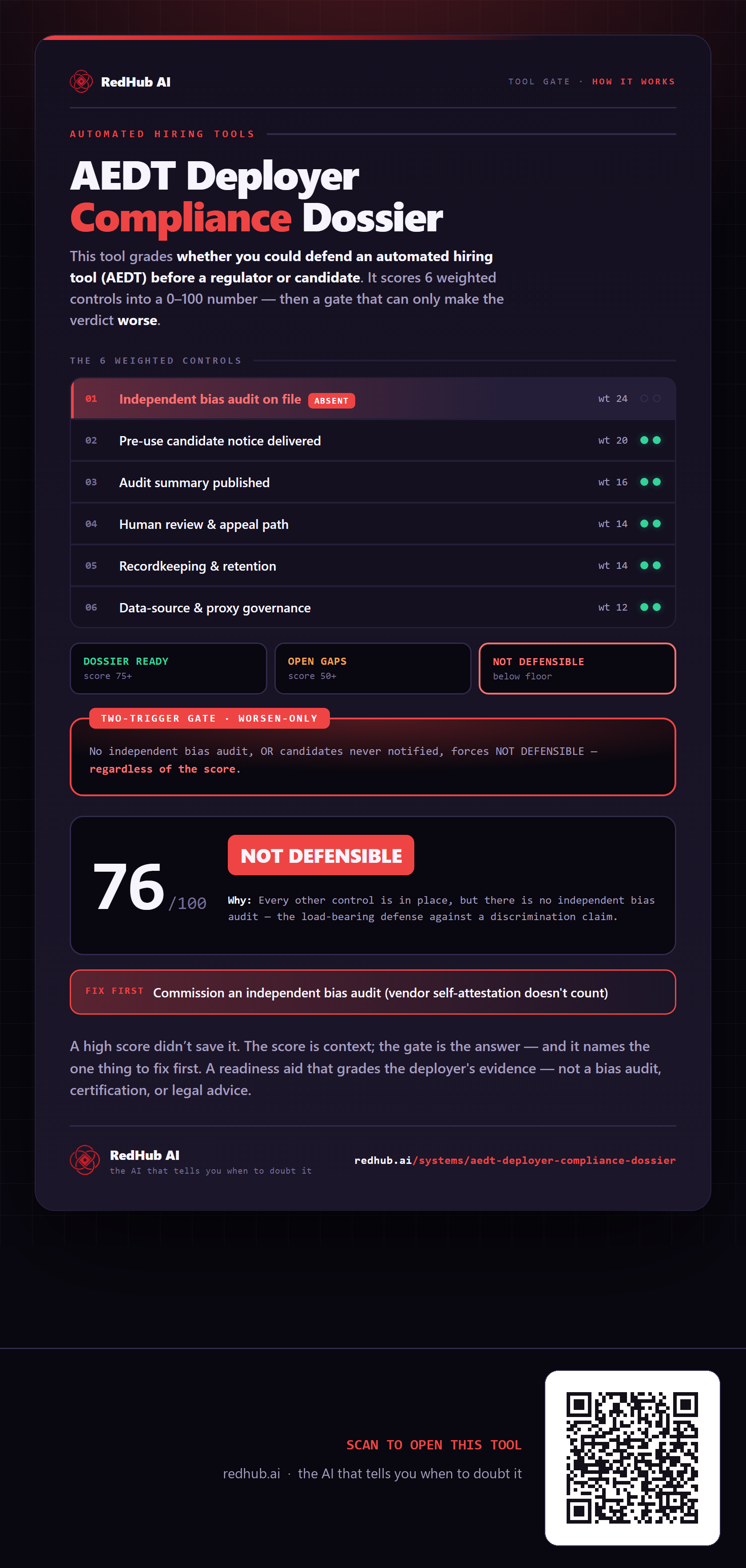
How the gate works, in one image
The six weighted controls, the band thresholds, and the two-trigger gate that forces EVIDENCE GAP — the same logic the demo runs, as a diagram you can share or embed anywhere.
View & embed the full diagramOne command, every tool, an auditable verdict.
The zero-dependency Python engine reads your tool list and prints the same verdict the workbook and demo produce. The Resume screener below scores 76 and still reads EVIDENCE GAP — the only audit on file is the vendor's own.
AEDT Deployer Compliance Dossier
====================================================
Resume screener (NYC)       76/100  EVIDENCE GAP     [GATE -> EVIDENCE GAP]
    fix first: Independent bias audit on file (within the last year)
Video-interview analyzer    52/100  EVIDENCE GAP     [GATE -> EVIDENCE GAP]
    fix first: Pre-use candidate notice delivered
Promotion-scoring model     94/100  DOSSIER READY AS DESCRIBED
    fix first: Data-source & proxy-discrimination governance
Candidate-matching engine   50/100  SHORTFALL
    fix first: Independent bias audit on file (within the last year)
Chatbot assessment          48/100  EVIDENCE GAP
    fix first: Audit-publication requirement assessed
Internal mobility scorer   100/100  DOSSIER READY AS DESCRIBED
----------------------------------------------------
Portfolio: REVIEW BEFORE CONTINUED USE
3 of 6 tool(s) read EVIDENCE GAP.
One or more tools triggered this instrument’s
evidence gate. Determine whether the missing control
is applicable and whether continued use is
appropriate before relying on the portfolio result.
This result does not itself direct suspension or
establish a legal violation.Six controls, weighted to 100 — two of them gates.
No independent audit OR no candidate notice forces EVIDENCE GAP regardless of score. Either one alone triggers the gate. The user's mark triggers this instrument's evidence gate. That does not establish that the control is legally required or that the deployment violates applicable law. The gate only worsens a verdict, never lifts one.
These controls combine selected obligations and governance practices drawn from multiple US jurisdictions. Not every control is legally required for every tool, employer, location, or employment decision. Confirm scope and applicable requirements before treating a missing control as legally required.
Close a gate control and the gate releases — the verdict returns to whatever the score earned. Where a control is still short, the control to close first is named.
A readiness aid, not a bias audit or a safe harbor.
- A deterministic dossier-readiness verdict from your own marks.
- A way to find a gate-triggering gap before a regulator or candidate does.
- A portfolio rollup that, where a tool is short, names the worst one to act on first.
- Offline — engine, workbook, and demo agree to the verdict.
- Not a bias audit, certification, opinion of counsel, or safe harbor.
- Not connected to your hiring tool — it runs no audit and reads nothing live.
- Not a scoring of any candidate or employee — it grades the deployer's file.
- Not a substitute for an employment attorney on your specific obligations.
Not legal advice. This is a readiness aid that grades a deployer's evidence dossier from your own marks — not a bias audit, certification, opinion of counsel, or safe harbor. AEDT obligations vary by jurisdiction and change often; it connects to nothing and scores no candidate or employee. Confirm your specific obligations with a qualified employment attorney.
Anyone who has to stand behind an AI hiring tool.
Run hiring well, verify the claims, defend the tool.
Run the hiring lifecycle itself — bias-checked JDs, structured screens, lawful-question flags.
ViewVerifies what a candidate claims — the verification lane beside this compliance lane.
ViewThe liability-triage pattern for any customer-facing AI surface, not just hiring.
ViewThe honest answers.
The evidence dossier you, the deployer, can produce for an automated employment decision tool (AEDT) used in hiring or promotion — the independent bias audit, the candidate notices, the published summary, the human-review and appeal path, the recordkeeping, and the data-source / proxy governance. It returns DOSSIER READY AS DESCRIBED, SHORTFALL, or EVIDENCE GAP per tool. It scores the file, never a candidate or employee.
Because two controls are gates. If there is no independent bias audit on file, or candidates were never notified before the tool evaluated them, the verdict is EVIDENCE GAP no matter how strong everything else is. For NYC Local Law 144, the required audit must be conducted by an auditor who satisfies NYC’s independence criteria — a vendor’s internal self-assessment is not, by itself, that audit, though a vendor may arrange for a qualifying independent auditor. The shipped Resume-screener sample scores 76 and still reads EVIDENCE GAP for exactly that reason. Confirm what the independence criteria require for your tools with qualified employment counsel.
It grades against a composite US readiness baseline rather than any single statute. These controls combine selected obligations and governance practices drawn from multiple US jurisdictions. Not every control is legally required for every tool, employer, location, or employment decision. Confirm scope and applicable requirements before treating a missing control as legally required. Where NYC Local Law 144 applies, the employer or employment agency must ensure that a qualifying independent bias audit was completed within the year before use; a vendor’s internal self-assessment is not itself that audit. If the law applies, covered NYC-resident candidates must receive the required notice. Candidate residence alone does not establish coverage. Illinois HB 3773 (effective January 2026) requires notice and bars protected-class proxies like ZIP code; a four-year retention period appeared in the Illinois Department of Human Rights' proposed notice rules rather than in the statute itself. California's FEHA automated-decision-system regulations (effective October 2025) make the scope and recency of anti-bias testing relevant evidence in discrimination claims and require four-year retention. A properly scoped bias audit can produce adverse-impact data relevant to discrimination-risk review. Its existence does not establish that a tool is nondiscriminatory or provide a defense or safe harbor under Title VII or other law. The dossier treats a current independent bias audit as a load-bearing evidence control. Federal enforcement priorities on disparate impact have moved since 2025, and state-law and private claims are a separate question. Confirm what applies to your jurisdiction and your tools with qualified employment counsel.
Yes — and that's exactly why the dossier isn't pinned to one statute. Colorado's original SB 205 was repealed and replaced by SB 26-189 before it ever took effect; the replacement takes effect January 1, 2027 and uses a disclosure-and-human-review model rather than mandating a bias audit by name. The dossier doesn't assume a Colorado audit mandate. It grades against a composite US readiness baseline rather than one statute. These controls combine selected obligations and governance practices drawn from multiple US jurisdictions. Not every control is legally required for every tool, employer, location, or employment decision. Confirm scope and applicable requirements before treating a missing control as legally required.
No. It is deterministic and offline. You enter your own marks on what evidence you actually hold, and it computes the verdict — it never connects to a tool, runs an audit, or scores anyone. The same logic runs in the workbook, the Python engine, and the on-page demo, so all three agree to the number. It is a readiness aid, not a bias audit, certification, opinion of counsel, or safe harbor.
No. This is a full-regulated domain and obligations vary by jurisdiction and change often. This tool organizes your evidence and flags gaps; it does not certify compliance, create a safe harbor, or substitute for counsel. Confirm your specific obligations — and anything the verdict surfaces — with a qualified employment attorney before you rely on it.
Find the gate-triggering gap
before they do.
One purchase, lifetime access, 12 months of updates. $99, once.
Not legal advice. This is a readiness aid that grades a deployer's evidence dossier from your own marks — not a bias audit, certification, opinion of counsel, or safe harbor. AEDT obligations vary by jurisdiction and change often; it connects to nothing and scores no candidate or employee. Confirm your specific obligations with a qualified employment attorney.
Sold by RedHub AI LLC · Secured by Stripe · redhub.ai