If your AI invents a policy,the company is bound by it.
A support bot makes up a refund policy. A product page overstates certified performance. An FAQ generator states eligibility terms it invented. The customer relies on it — and the company wears the consequences, not the model. This triage grades every customer-facing AI surface on liability exposure and returns LOW, REVIEW, or HIGH RISK.
The model isn't liable. You are.
rate the ability for a customer to reach a human as important — yet AI surfaces routinely ship with no exit ramp.
is all it takes. A bot states a refund or eligibility rule that doesn't exist, the customer relies on it, and the company is held to it.
is how it ships. A surface can pass a casual review on tone and disclosure while the two controls that actually create liability are wide open.
The exposure is local — one surface that can invent policy with no human to catch it. A surface-by-surface triage forces you to look at each one and won't let a polished average hide the one that's a lawsuit waiting to happen.
Triage each surface — and watch a well-controlled bot still gate to HIGH RISK.
fix first: Policy-invention control
Marks are control marks: 2 = well-controlled, 0 = wide open. Policy-invention and human-exit are the gate — a surface with both at 0 is HIGH RISK regardless of the rest. A risk-triage aid for your own surfaces — it grades the surface, never people, and routes risk to human review. Not legal advice.
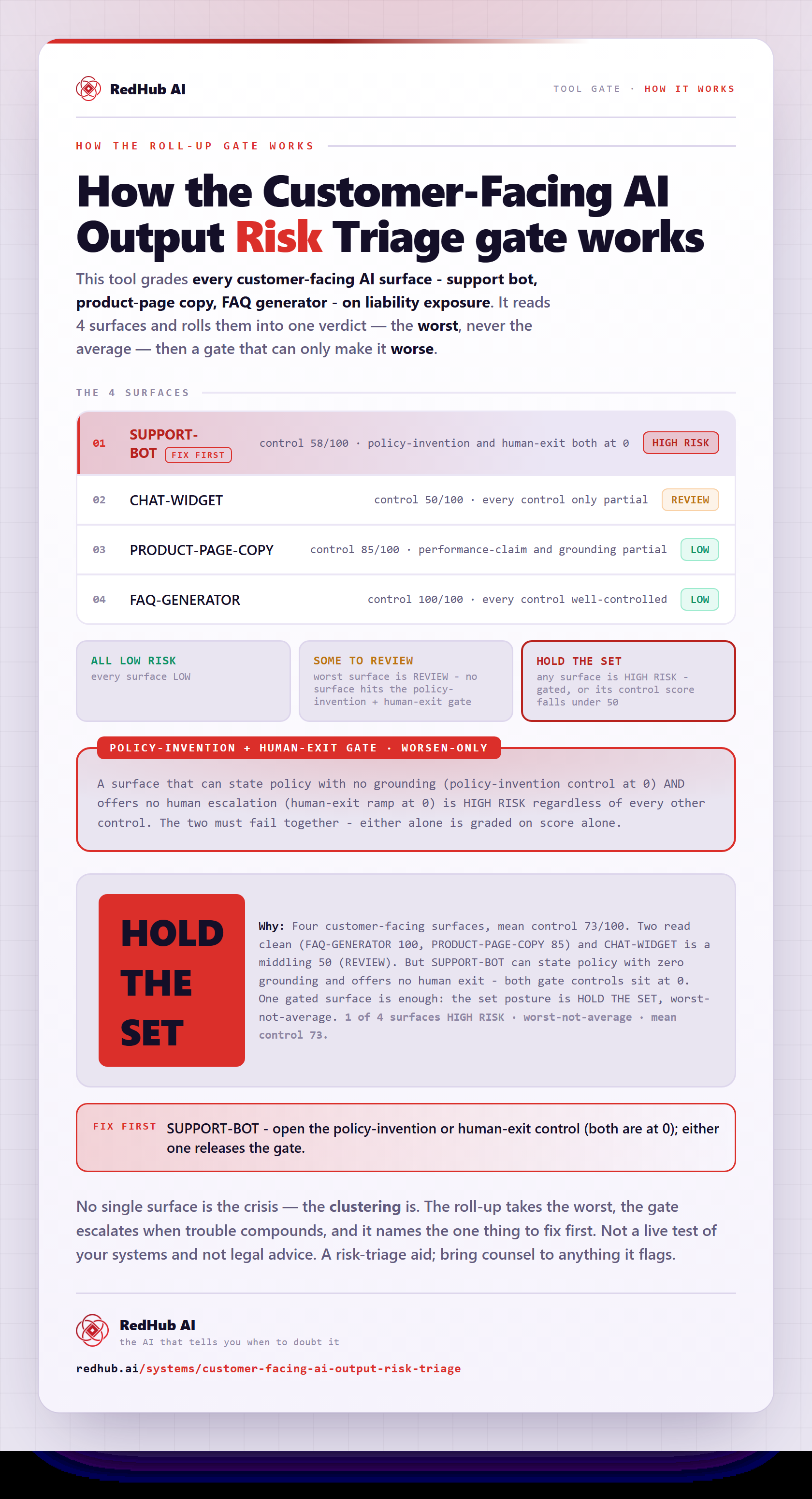
How the gate works, in one image
How the Customer-Facing AI Output Risk Triage rolls up four AI surfaces worst-not-average and forces HIGH RISK when a surface invents policy with no human exit — the same math the demo runs, as a diagram you can share or embed anywhere.
View & embed the full diagramSUPPORT-BOT control 58/100 [ HIGH RISK ]
GATE FIRED: states policy with no grounding AND offers no human escalation.
fix first: policy_invention_control
regulated_claim_control 2 controlled
policy_invention_control 0 UNCONTROLLED (gate)
human_exit_ramp 0 UNCONTROLLED (gate)
performance_claim_control 2 controlled
source_grounding 2 controlled
scope_and_disclosure 2 controlledThe support bot has four of six controls fully green and still reads HIGH RISK: it can state policy with no grounding and offers no human escalation. The control score is context; the gate is the verdict.
One engine, one workbook, two playbooks, one worked sample.
A zero-dependency Python CLI: feed it a surfaces CSV and it returns per-surface LOW / REVIEW / HIGH RISK, the keystone gate, the set posture, and the highest-risk surface. Runs anywhere Python does; nothing connects to your live systems.
Start Here → Dashboard → Surface Triage. Enter the six control marks per surface; the same score, the same gate, the same verdict — live formulas, weights summing to 100. Opens in Excel, Google Sheets, or Numbers.
How to list every customer-facing AI surface you actually run (the ones nobody remembers shipped) and mark its six controls honestly.
What to do with a HIGH RISK: ground policy answers to an approved source, add the human exit ramp, fence regulated and performance claims — and re-triage.
Three rules keep the verdict honest.
A surface that can state policy with no grounding AND has no human exit is HIGH RISK regardless of score. The gate does work the average can't: it finds the liability pattern a polished surface hides.
Either gap alone is serious and drags the score — but the dispositive gate needs both: the surface can invent policy AND no human can catch it. Close one and the gate releases. That mirrors how the liability actually happens.
No AI grades your surfaces, no benchmark is baked in, nothing touches your live systems. The engine applies the same scoring and gate every time, and every HIGH RISK routes to human review — never a clearance.
A liability triage for AI surfaces, not a compliance certificate.
- A deterministic, offline triage for every customer-facing AI surface — bots, page copy, FAQ generators, widgets.
- A per-surface verdict with a keystone gate that catches the airline-chatbot liability pattern.
- The liability companion to the Support Deflection Kit (escalation design) and the EU AI Act Kit (disclosure).
- Not a compliance certification or a clearance — every HIGH RISK routes to human review, never a green light.
- Not a grader of people; it scores the surface's controls, never a customer or an agent.
- Not a live test of your systems and not legal advice. A risk-triage aid; bring counsel to anything it flags.
Anyone whose AI talks to customers.
Triage the risk, then close it.
Designs the escalation workflow — deflect the repetitive, always offer a person. Builds the human exit ramp this triages.
ViewGrades AI-surface transparency obligations (is it disclosed as AI?). The disclosure layer; this is the liability layer.
ViewThe operator's go/no-go on an agent's guardrails. This triages the customer-facing output the surface produces.
ViewAnswers before you buy.
Courts have held companies to what their support chatbot told a customer — including a refund policy the bot effectively invented — on the reasoning that the customer reasonably relied on it. The model isn't the liable party; the business that put the surface in front of customers is. The Customer-Facing AI Output Risk Triage grades each surface for exactly that exposure: it returns LOW / REVIEW / HIGH RISK per surface and routes every HIGH RISK to human review. It's a risk-triage aid, not legal advice — bring counsel to anything it flags.
Because the control score is context and the keystone gate is the verdict. A surface that can state policy with no grounding AND offers no human escalation is HIGH RISK regardless of score — that's the exact pattern behind the support-bot liability cases. The shipped sample scores 58/100 with four of six controls fully green and still gates, because those two specific gaps, together, are how the liability actually happens. A high average can't buy back a surface that can invent a binding answer with no human to catch it.
Inventory every customer-facing AI surface — support bot, chat widget, AI product-page copy, FAQ generator — and mark each on six controls (0 = wide open, 2 = well-controlled): regulated-claim control, policy-invention control, human exit ramp, performance-claim control, source grounding, and scope/disclosure. The engine returns a per-surface verdict, the keystone gate, the set posture, and, where a surface is short, the highest-risk one to fix first. The control-hardening runbook then walks you through grounding policy answers, adding the human exit, and fencing regulated and performance claims.
Deflection design builds the escalation workflow — deflect the repetitive, always offer a person. This triages the liability the surface carries whether or not you've designed that workflow yet. They pair: the AI Support Deflection Kit builds the human exit ramp this triage checks for, and the EU AI Act Readiness Kit covers the disclosure layer (is the surface disclosed as AI). This is the liability layer — what happens when the surface states something binding with no human to catch it.
No. It grades the surface's controls as you describe them, entirely offline — the Python engine and the workbook run on your machine and nothing touches your live systems. It scores the surface's controls, never a customer or an agent, and every HIGH RISK is a route to human review, never a clearance or a green light. The same logic runs in the engine, the workbook, and the on-page demo, byte-exact, so the verdict is reproducible.
You get a runnable zero-dependency Python triage engine, a workbook that reproduces it (Excel / Google Sheets / Numbers), a surface-inventory playbook, a control-hardening runbook, and a 4-surface worked sample — a one-time purchase with lifetime access and 12 months of updates. It's a risk-triage aid for your own customer-facing AI surfaces; it grades the surface's controls, never people, and routes risk to human review. It is not a compliance certification and not legal, safety, or compliance advice — bring counsel to anything it flags.
Find the surface that invents a policy
before a customer relies on it.
Triage every customer-facing AI surface before the next answer goes out. One purchase, lifetime access, 12 months of updates. $79, once.
Sold by RedHub AI LLC · Secured by Stripe · redhub.ai