Don't flip that agent liveuntil it passes the gate.
Most AI agents look perfect in the demo and fail in production — and the failure is rarely the model, it's a missing guardrail. Answer five plain questions about each agent and get one verdict: READY, FIX, or DO NOT DEPLOY.
The agent worked in the demo. Then it did something it couldn't undo.
Approval gate, logging, rollback, bounded scope, escalation. Most agents reach production before anyone has checked all five — the guardrails get built last, in a panic, after something goes wrong.
Agents fail quietly: a destructive action with no human in the loop, a refund loophole, a wrong booking at scale. The score looks fine right up until the incident.
The fix is order: put the guardrails in first, then go live. This gate enforces that before launch — not after the postmortem.
Cycle the controls. Watch one partial approval gate block an 86/100 agent.
Live demo
Tap a control to cycle READY → PARTIAL → MISSING. Toggle the destructive flag.
Readiness
86/100
Fix first: C1 Human approval gate on destructive actions
Same answers, same verdict, every time — deterministic and offline (as of 2026-06-25). Grades the guardrails you describe; it does not run or change any agent, and it scores no person.
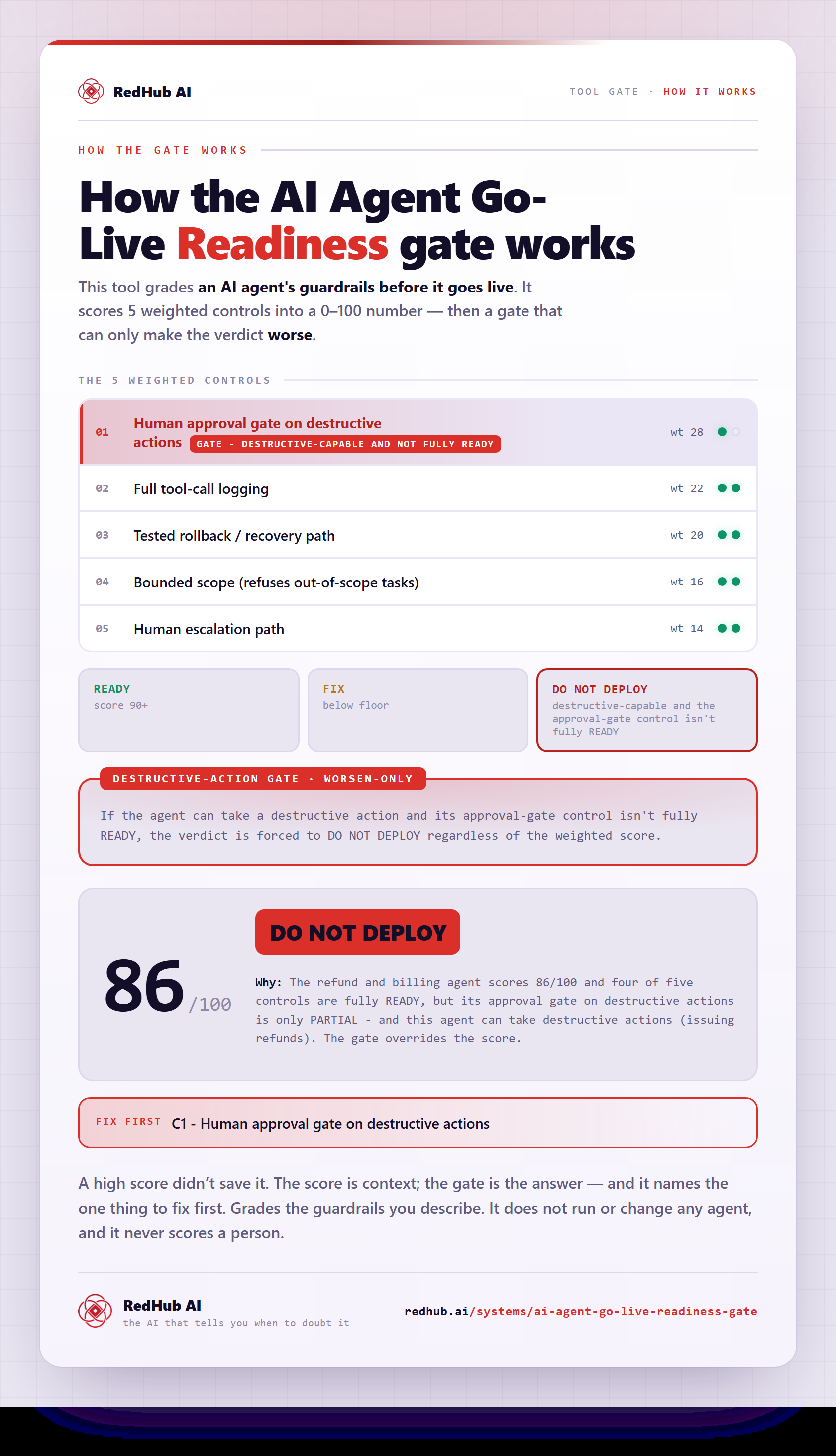
How the gate works, in one image
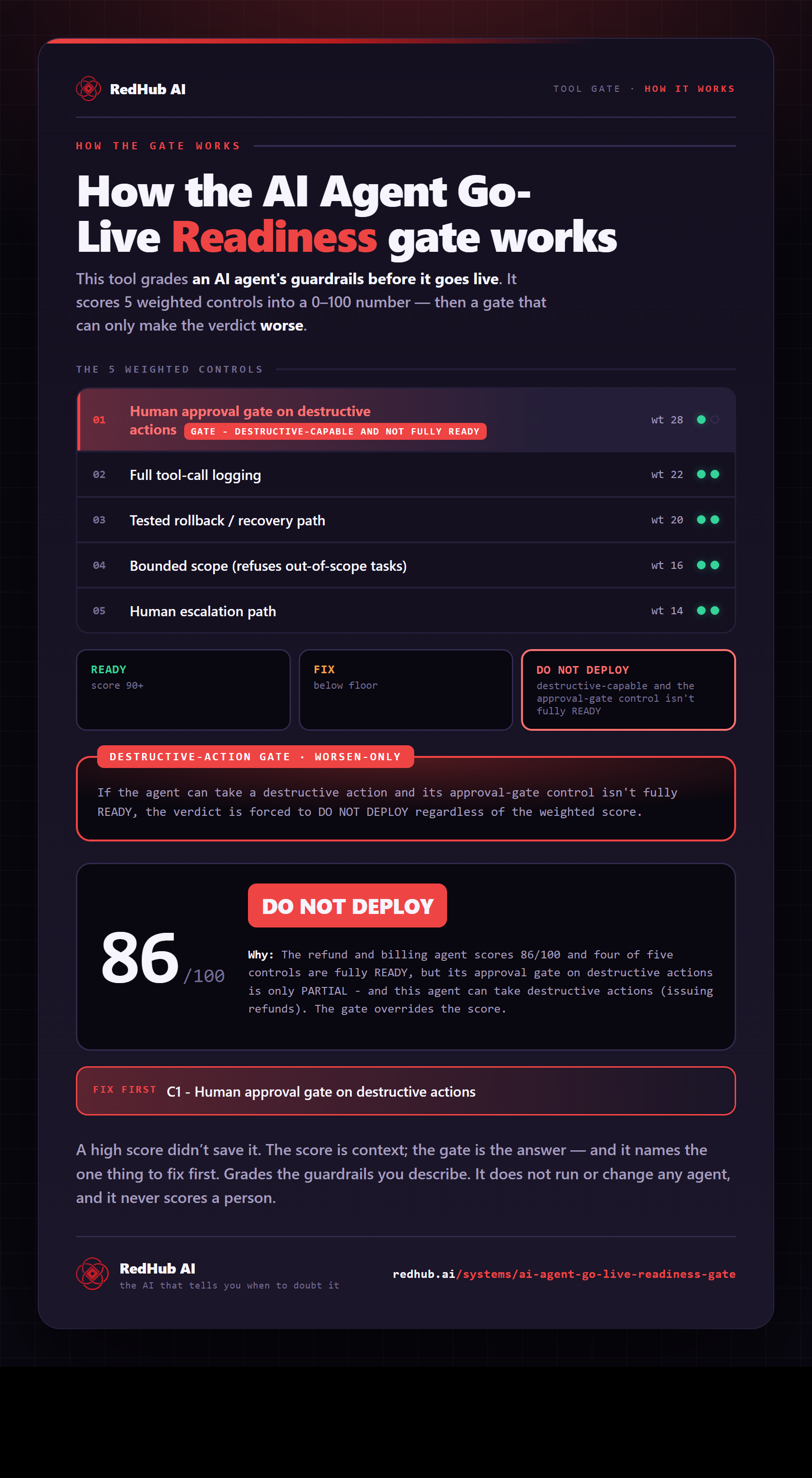
How the AI Agent Go-Live Readiness Gate scores an agent's guardrails and forces a hard stop on destructive-capable agents with an incomplete approval gate — the same math the demo runs, as a diagram you can share or embed anywhere.
View & embed the full diagramOne verdict, computed the same way every time — in a spreadsheet or a script.
The same deterministic logic runs in the workbook and the Python engine. Here it scores a six-agent fleet and rolls it up to the worst agent. The teaching case is the refund agent — READY on four controls and 86/100 overall, yet DO NOT DEPLOY because it can take a destructive action with only a partial approval gate:
==================================================================
  AI Agent Go-Live Readiness Gate
  RedHub AI LLC · deterministic, offline · as of 2026-06-25
==================================================================

  Support tier-1 reply bot
  readiness 100/100   ->  READY
    OK  C1 Human approval gate on destructive actions     READY
    OK  C2 Full tool-call logging                         READY
    OK  C3 Tested rollback / recovery path                READY
    OK  C4 Bounded scope (refuses out-of-scope tasks)     READY
    OK  C5 Human escalation path                          READY

  Refund & billing agent  [DESTRUCTIVE]
  readiness  86/100   ->  DO NOT DEPLOY
    ~~  C1 Human approval gate on destructive actions     PARTIAL
    OK  C2 Full tool-call logging                         READY
    OK  C3 Tested rollback / recovery path                READY
    OK  C4 Bounded scope (refuses out-of-scope tasks)     READY
    OK  C5 Human escalation path                          READY
    !! GATE: destructive capability with no full approval gate -> DO NOT DEPLOY
    fix first: C1 Human approval gate on destructive actions

  Outbound email sender  [DESTRUCTIVE]
  readiness  19/100   ->  DO NOT DEPLOY
    XX  C1 Human approval gate on destructive actions     MISSING
    ~~  C2 Full tool-call logging                         PARTIAL
    XX  C3 Tested rollback / recovery path                MISSING
    ~~  C4 Bounded scope (refuses out-of-scope tasks)     PARTIAL
    XX  C5 Human escalation path                          MISSING
    !! GATE: destructive capability with no full approval gate -> DO NOT DEPLOY
    fix first: C1 Human approval gate on destructive actions

  Internal research assistant
  readiness  69/100   ->  FIX
    ~~  C1 Human approval gate on destructive actions     PARTIAL
    OK  C2 Full tool-call logging                         READY
    ~~  C3 Tested rollback / recovery path                PARTIAL
    OK  C4 Bounded scope (refuses out-of-scope tasks)     READY
    ~~  C5 Human escalation path                          PARTIAL
    fix first: C1 Human approval gate on destructive actions

  Calendar scheduling agent  [DESTRUCTIVE]
  readiness  92/100   ->  FIX
    OK  C1 Human approval gate on destructive actions     READY
    OK  C2 Full tool-call logging                         READY
    OK  C3 Tested rollback / recovery path                READY
    ~~  C4 Bounded scope (refuses out-of-scope tasks)     PARTIAL
    OK  C5 Human escalation path                          READY
    fix first: C4 Bounded scope (refuses out-of-scope tasks)

  Knowledge-base summarizer
  readiness  89/100   ->  FIX
    OK  C1 Human approval gate on destructive actions     READY
    ~~  C2 Full tool-call logging                         PARTIAL
    OK  C3 Tested rollback / recovery path                READY
    OK  C4 Bounded scope (refuses out-of-scope tasks)     READY
    OK  C5 Human escalation path                          READY
    fix first: C2 Full tool-call logging

------------------------------------------------------------------
  FLEET: DO NOT DEPLOY   (ready 1  /  fix 3  /  do-not-deploy 2  of 6)
  mean readiness 76/100 (context only; posture = worst agent)
  start with: Outbound email sender
------------------------------------------------------------------
  Grades guardrails you describe; does not run or change any agent; scores no person.
Not legal or security-audit advice.Three operating principles behind the gate.
Gate then ship
An agent that can take an action it can't undo, with no human in the loop, is one bad input away from a public incident. So the approval gate dominates: a destructive capability without a full human approval step is DO NOT DEPLOY no matter how high the rest scores.
Every control, no averaging
Approval gate, logging, rollback, bounded scope, escalation. An agent is READY only when every control is in place — a strong score can't paper over a missing guardrail, because the failure isn't a lower average, it's a hard stop.
Scores guardrails, not people
Every check is about the agent you describe. It never connects to or runs your agent and never scores a person — same answers, same verdict, every time, in the workbook and the engine alike.
A go/no-go judgment about an agent you control — not a security clearance.
What it is
- A five-control gate that decides if an AI agent is safe to flip live.
- A structured way to make the go/no-go call deliberately, before launch, instead of by vibes.
- Deterministic and offline — the same answers always give the same verdict.
What it isn't
- It scores the guardrails you describe, not people, and never connects to or runs your agent.
- A readiness aid for the guardrails you describe — not a security audit, a penetration test, or legal advice. It does not connect to, run, or change any agent, and it scores no person.
- A READY verdict is a readiness signal, not a guarantee — pair it with your own security review and counsel where the stakes warrant.
Anyone about to put an AI agent into production.
- Founders and operators wiring an agent into real workflows.
- Ops and RevOps leads who own the go/no-go decision.
- Agencies setting a safe-to-launch bar for client agents.
- Teams who want the guardrails in place before launch, not after.
Ready it, audit it, harden it.
AI Agent & Connector Access Auditor
Once it's ready to ship, audit what each agent and connector can actually touch — scope, data sensitivity, write capability, staleness.
ViewAgent Reliability Harness
For developers: evaluate the agent's runs at the trajectory level and gate your CI on a ship / hold / fix verdict.
ViewPrompt Injection Red Team Kit
Pressure-test the agent against hidden instructions in documents, web pages, and tool output before it goes live.
ViewThe questions operators actually ask before deploying an agent.
Score it on five operational controls: a human approval gate on destructive actions, full tool-call logging, a tested rollback path, bounded scope, and a human escalation path. The AI Agent Go-Live Readiness Gate rates each READY, PARTIAL, or MISSING and returns one verdict — READY, FIX, or DO NOT DEPLOY. An agent is READY only when every control is in place; one missing guardrail is enough to hold the launch.
Because that single gap is the failure mode behind most public agent incidents — an action the agent can't undo, taken with no human in the loop. So the approval gate is dispositive: if the agent can take a destructive action and the approval step isn't fully in place, the verdict is DO NOT DEPLOY no matter how high the other four controls score. The same controls on a non-destructive agent only lower the score; the destructive flag is what turns a FIX into a hard stop.
No. It scores the guardrails you describe — it never connects to, runs, or changes any agent, and it requires no code. You answer five plain questions about each agent in a spreadsheet or the included Python engine, and it computes the verdict deterministically. Same answers, same verdict, every time.
Yes. List every agent you're about to launch and the gate rolls the fleet up to the worst agent — any DO NOT DEPLOY makes the whole fleet DO NOT DEPLOY, otherwise any FIX makes it FIX FIRST, otherwise CLEARED TO SHIP. The mean readiness is shown for context only; posture is set by the worst agent, not the average, and it names which agent to start with.
Different jobs. The AI Agent Go-Live Readiness Gate ($79) is an operator's pre-launch go/no-go checklist — answerable without code, before the agent ships. The Agent Reliability Harness ($149) is for developers: it evaluates the agent's actual runs at the trajectory level and gates CI. The AI Agent & Connector Access Auditor ($99) scores what each connector can touch — scope and write capability — not operational readiness. They pair: ready it with this gate, audit access with the Auditor, harden runs with the Harness.
No. It's an operational readiness aid for the guardrails you describe — not a security audit, a penetration test, a certification, or legal advice. A READY verdict is a go-signal that your guardrails are in place, not a guarantee. Where the stakes warrant, pair it with your own security review, red-teaming, and counsel.
Put the guardrails in
before you go live.
One purchase, lifetime access, 12 months of updates. $79, once.
A readiness aid for the guardrails you describe — not a security audit, a penetration test, or legal advice. It does not connect to, run, or change any agent, and it scores no person.
Sold by RedHub AI LLC · Secured by Stripe · redhub.ai