Resume-Claim Verification Checklist Gate
Go through a resume claim by claim and mark what's actually verifiable. The checklist returns VERIFIED, VERIFY FIRST, or UNVERIFIABLE on each claim — and holds the whole thing the moment one material claim has a source nobody can reach.
It scores the claim, not the candidate. Every verdict — including HOLD TO VERIFY — routes you to verify the claim with the candidate, never to a reject. People decide; this just tells you what to check.
one-time · instant download · yours to keep
The problem
"I'll verify it later" is where it goes wrong.
It's rarely the small stuff. It's the degree, the title, or the headline result — the one material claim a decision rests on that nobody actually confirmed.
A claim isn't verified because it sounds right. It's verified when a real, reachable source confirms it. No reachable source means not yet verifiable.
Verifying different things for different candidates is where fairness problems start. A checklist makes you check the same material claims for everyone.
What's inside
One workbook. Three tabs. Every claim checked.
What material, evidence, and reachable mean, and how to read each verdict and the roll-up.
A row per claim: material, evidence (0–3), reachable → a per-claim verdict and the verify-first action.
The checklist roll-up — CHECKLIST CLEAR / OPEN ITEMS / HOLD TO VERIFY — pulled live from the checklist.
The standard
Three rules keep it honest — and lawful.
Every verdict is about whether a claim can be confirmed — never the candidate's quality, fit, or worth.
A material claim with no reachable source is UNVERIFIABLE and holds the checklist — a stack of confirmed claims can't lift it.
HOLD TO VERIFY means 'go verify the material claims', never 'do not proceed'. Give the candidate a fair chance to supply a source.
A verification checklist for resume claims — not a hiring, screening, or ranking tool, not a background check, and not legal advice. It scores the claim, not the candidate, and every verdict routes to verification, never to a reject. Using AI to screen or rank people raises EEOC adverse-impact issues; acting on verification findings can trigger FCRA duties. Confirm your process with HR and qualified counsel.
How it works
Re-rate a claim. Watch the checklist hold or clear.
The roll-up follows the weakest material claim — confirmed minor claims can't clear an unconfirmed material one.
A material claim's source can't be reached, so it's UNVERIFIABLE — verify it directly with the candidate before relying on it. This is a verification instruction, not a decision about the person.
Tap material, evidence (0–3), or reachable to re-rate a claim. Worked example as of 2026-06-25.
| Claim | Material | Evidence | Reachable | Verdict |
|---|---|---|---|---|
| MS Computer Science, Stanford | UNVERIFIABLE material · unreachable | |||
| 8 yrs backend at named employer | VERIFIED | |||
| Led migration to Kubernetes | VERIFIED | |||
| AWS Solutions Architect cert | VERIFIED | |||
| Conversational Spanish | VERIFY FIRST | |||
| Open-source contributor | VERIFIED |
Same logic as the workbook: each claim gets a verification status, a material claim with no reachable source is UNVERIFIABLE, and the weakest material claim drives the roll-up — the way the example holds at HOLD TO VERIFY even with three material claims already verified. It scores the claim, not the candidate. Every verdict routes to verification; none is a hiring decision or a reject. Not legal advice.
This is the live engine. A reusable per-claim checklist for every resume Catches the one material claim nobody can confirm VERIFIED / VERIFY FIRST / UNVERIFIABLE on each claim
Get the kit — $49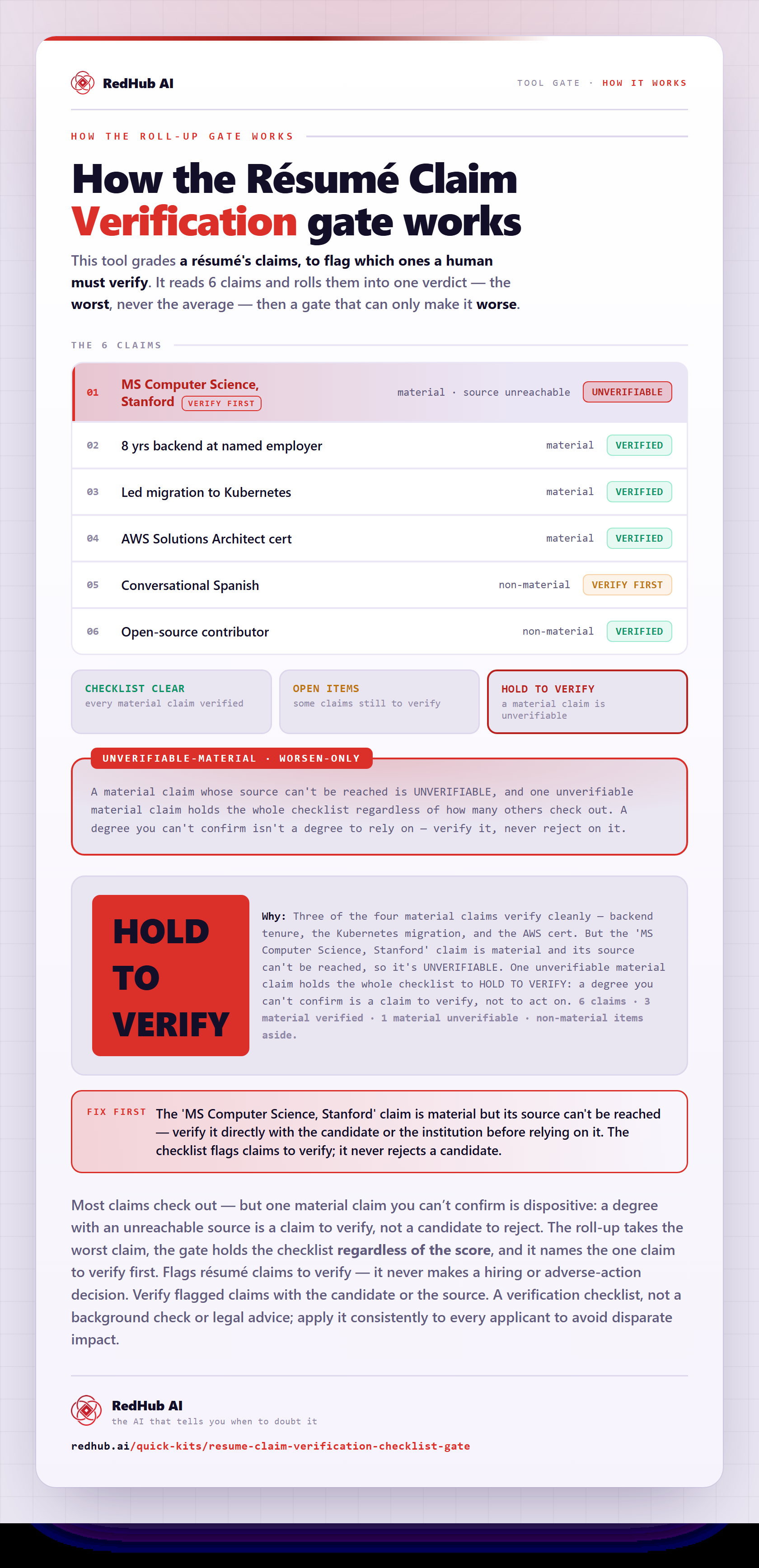
How the gate works, in one image
Each claim rolled up to the worst and the gate that holds the checklist when one material claim's source can't be reached — the same logic the demo runs, as a diagram you can share or embed anywhere. It flags claims to verify; it never rejects a candidate.
View & embed the full diagramWhat you'll see
The claim that holds a clean-looking checklist.
The employment history, the Kubernetes migration, and the AWS certification all have corroborating evidence and a reachable source. Confirmed, on file, done.
The degree is material and its source can't be reached, so it's UNVERIFIABLE — and it holds the whole checklist at HOLD TO VERIFY. Three confirmed claims can't clear one unconfirmed material one. The next step is to ask the candidate for a source, not to decline them.
Who it's for
For whoever has to confirm what a resume says.
- You verify finalists' claims before an offer.
- You want a consistent, repeatable per-claim checklist.
- You need to know which one claim is holding things up.
- You want it to screen, rank, or decide on candidates — it won't.
- You expect a background check or an AI detector — it's neither.
- You want a hire/no-hire verdict. People make that call, not this gate.
Common Questions
Common questions.
No — and it's built so it can't. It scores the verification status of each individual claim on a resume, never the candidate, and there is no hire/no-hire output. Every verdict, including HOLD TO VERIFY, routes to a verification step — "go confirm this claim with the candidate" — never to a reject or a "do not proceed." People make the hiring decision; the checklist only tells you what to verify. That separation is deliberate: using AI to screen or rank people raises EEOC adverse-impact issues this tool stays clear of by scoring claims, not people.
Because the roll-up follows the weakest material claim, not the average. A material claim whose source can't be reached is UNVERIFIABLE, and that holds the checklist at HOLD TO VERIFY no matter how many other claims are confirmed — a stack of verified claims can't lift one material claim nobody can confirm. In the worked example, three of four material claims are VERIFIED but the degree claim has an unreachable source, so the checklist holds. A clean-looking resume resting on one unconfirmable material claim is exactly the case a simple count would wave through.
You do — material is a buyer-set flag for the claims a decision actually rests on: the degree, the title, the headline result, the certification. Mark those material and minor claims (a language, a hobby) stay scored for context but never gate the checklist. The discipline that keeps it fair is consistency: decide what's material for the role up front and apply the same checklist to every candidate at the same stage, rather than verifying different things for different people.
Per claim: VERIFIED (corroborating evidence and a reachable source), VERIFY FIRST (some evidence but not yet confirmed — reach the source or ask for primary-source confirmation), and UNVERIFIABLE (no evidence, or a material claim with no reachable source). The checklist rolls up to CHECKLIST CLEAR (all material claims verified), OPEN ITEMS (material claims still in progress), or HOLD TO VERIFY (a material claim is UNVERIFIABLE). Every flag comes with the next verification action, and the kit names the one claim holding things up.
They pair. The Application Fabrication-Risk & Verification Triage ($79) scores the whole application's verifiability as a 0–100 read and tells you an application needs verifying. This checklist is the per-claim drill-down you work through to actually do it — list each claim, mark its evidence and source reachability, and get a verdict and a verify-first action on each. Triage at the document grain, checklist at the claim grain; run the triage to know which applications to dig into, run this to dig.
Treat it as a verification checklist, not a decision-maker: verify the same material claims for every candidate at the same stage, and use a verdict only to decide what to confirm — never as a reason to reject. Acting on what verification turns up can trigger FCRA / background-check duties, and AI-in-hiring is regulated federally and by a growing set of state laws, so confirm your process with HR and qualified counsel. The kit states no dated statutory figures by design; the regulatory framing is the part to review with counsel for your jurisdiction. It's a decision aid, not legal advice.
Pairs well with
Build the hiring-verification stack.
The whole-application triage this checklist drills into, claim by claim.
ViewBias-checked JDs, structured screening, lawful interview kits.
ViewScore your team's verification skill — the habit this gate depends on.
ViewGet the gate
Check the claim before you trust it.
- A per-claim verdict on every resume claim.
- The one material claim holding the checklist, named.
- A consistent verification habit you apply to everyone.
A verification checklist for resume claims — not a hiring, screening, or ranking tool, not a background check, and not legal advice. It scores the claim, not the candidate, and every verdict routes to verification, never to a reject. Using AI to screen or rank people raises EEOC adverse-impact issues; acting on verification findings can trigger FCRA duties. Confirm your process with HR and qualified counsel.
Sold by RedHub AI LLC · Secured by Stripe · redhub.ai