A perfect-looking applicationisn't a verified one.
AI makes a fabricated application read as cleanly as a true one. This triage scores how verifiable an application is — the document, not the person — and tells you exactly what to verify. It never scores or ranks the candidate. Every verdict, including HIGH-RISK, routes to one thing: go verify the claims.
This triages the application document's verifiability — not the candidate. It is not a hiring, screening, or ranking tool, not a background check, and not legal advice. Every verdict routes to verification, never to a reject. Using AI to screen or rank people raises EEOC adverse-impact issues; acting on verification findings can trigger FCRA duties. Confirm your process with HR and qualified counsel.
The polish that used to signal effort now signals nothing.
Of employers report having onboarded someone whose application later proved fabricated. The resume looked fine; the facts weren't checked.
A fabricated application can be specific, consistent, and well-written. Surface polish stopped being evidence the moment AI could generate it.
It often comes down to a single load-bearing claim — a degree, a title, a headline result — that nobody can independently confirm.
Re-rate the signals. Get a to-verify list.
Keystone gate: the core claims can't be corroborated. HIGH-RISK regardless of the score — verify the core claims directly with the candidate before relying on them.
Tap a signal (0–3) to re-rate the application and watch the verdict move. 0 = unverifiable, 3 = independently verifiable. Worked example as of 2026-06-25.
Core claims corroborable — ask for an independent source for the core claim and confirm it.
Same math as the workbook: weighted verifiability with a keystone gate that forces HIGH-RISK when the core claims can't be corroborated — the way the shipped example scores 76 yet still flags for verification. This triages the application document, not the candidate. Every verdict routes to verification; none is a hiring decision, a candidate score, or a reject. Not legal advice.
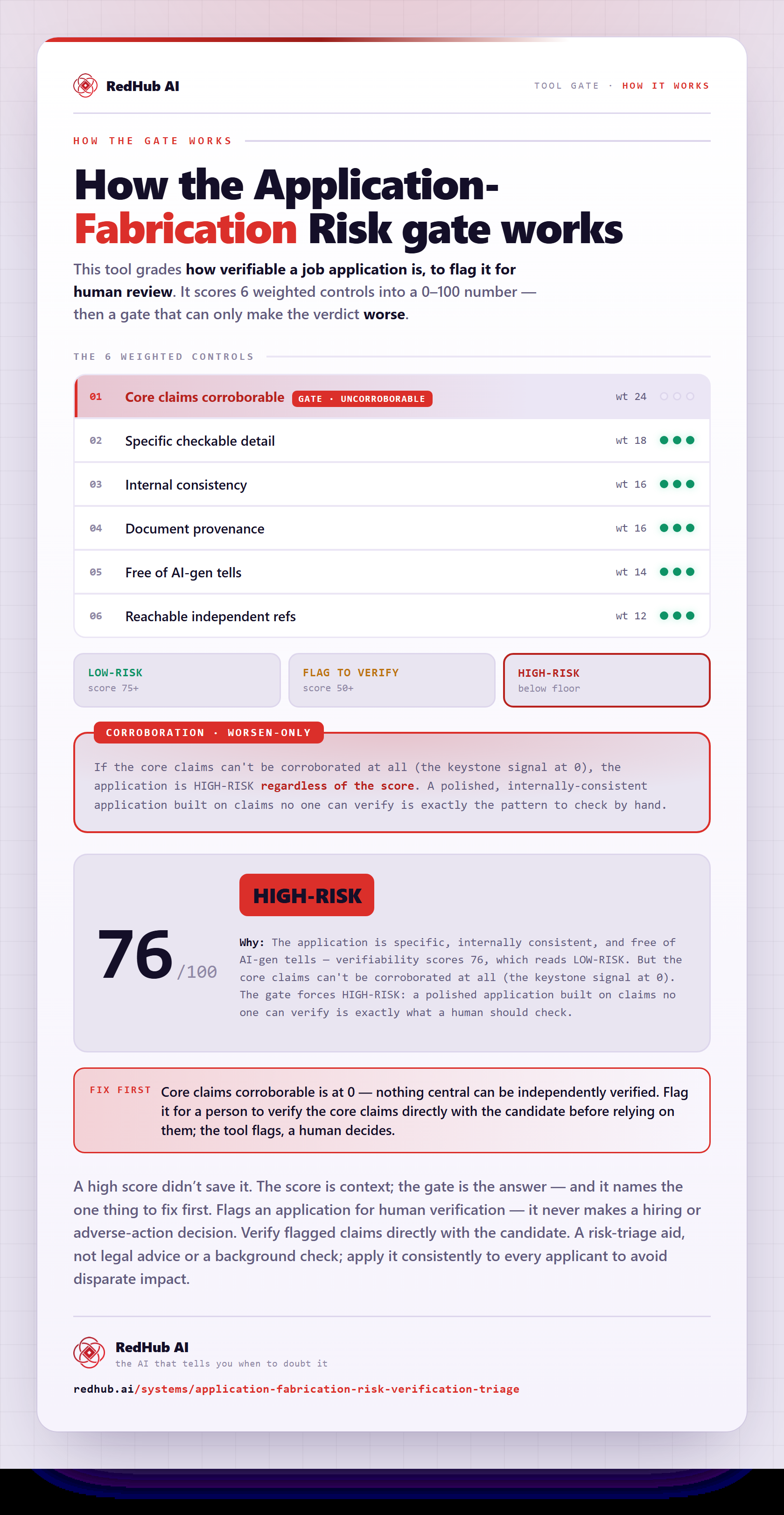
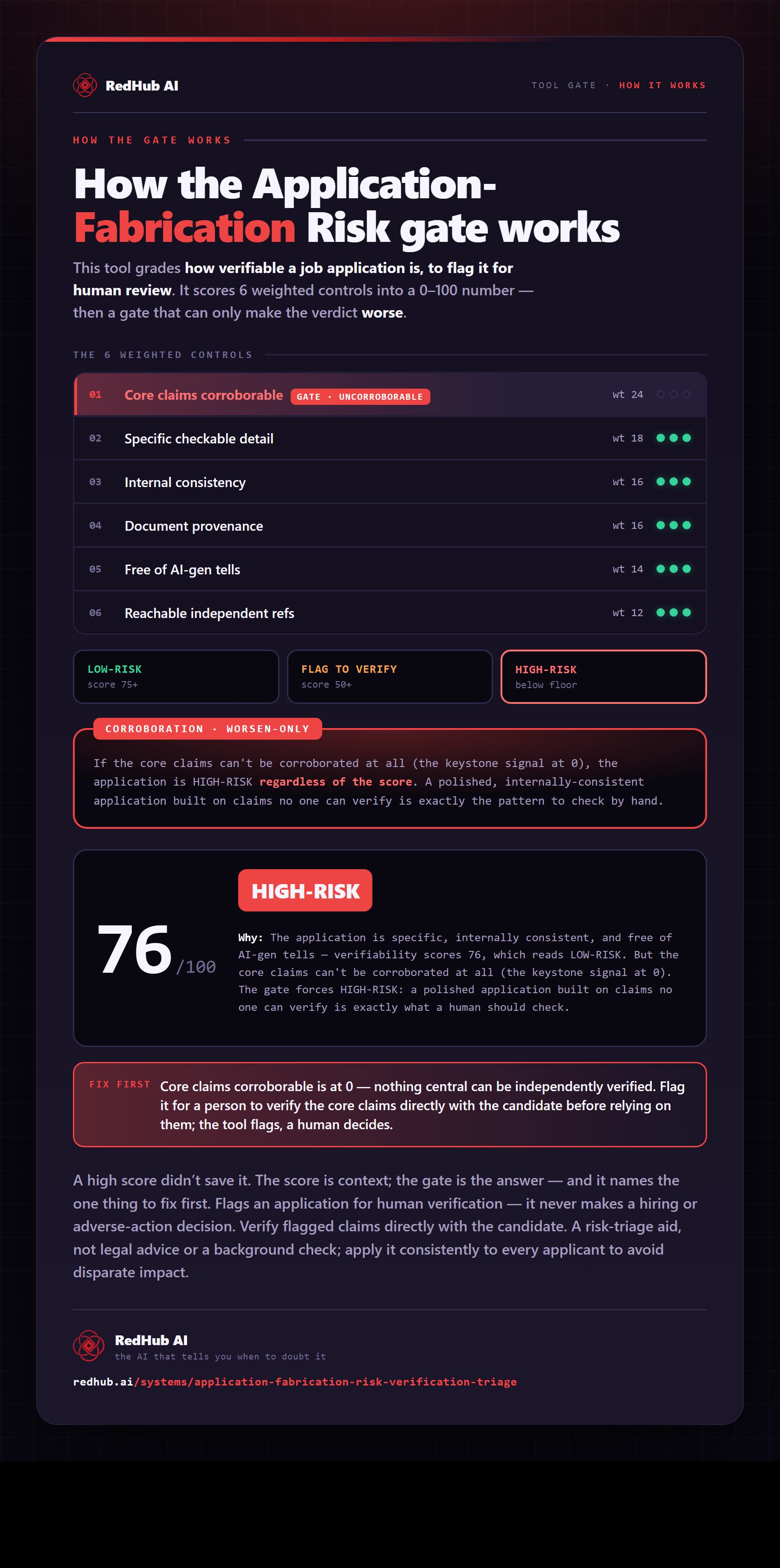
How the gate works, in one image
Six signals scored into a 0–100 verifiability number and the corroboration gate that flags HIGH-RISK when core claims can't be corroborated — the same math the demo runs, as a diagram you can share or embed anywhere. It flags for human review; a person decides.
View & embed the full diagramSix applications. One that hides in plain sight.
This is the shipped example, scored by the rule the workbook and the demo both run. Read APP-1001: it scores 76 on verifiability — above the LOW-RISK floor — and still lands HIGH-RISK, because its core claim can't be corroborated. The verdict isn't a judgement of the applicant. It's an instruction: verify that claim before you rely on it.
Application Fabrication-Risk & Verification Triage  (as-of 2026-06-25)
Scores the application's verifiability, not the candidate. Every verdict routes to verification.
==============================================================================
6 applications  |  LOW-RISK 2   FLAG 1   HIGH-RISK 3
------------------------------------------------------------------------------
APP-1001  Senior Engineer  verifiability  76  ->  HIGH-RISK  [GATE: core claim not corroborable]
APP-1002  Data Analyst     verifiability  90  ->  LOW-RISK
APP-1003  Marketing Lead   verifiability  62  ->  FLAG TO VERIFY
APP-1004  Sales Rep        verifiability  29  ->  HIGH-RISK
APP-1005  Designer         verifiability 100  ->  LOW-RISK
APP-1006  Ops Manager      verifiability  43  ->  HIGH-RISK
Three rules keep it honest — and lawful.
Every signal is about whether a claim can be verified — never the candidate's quality, fit, or worth. The output is a to-verify list.
If the core claims can't be corroborated by any independent source, it's HIGH-RISK — however clean the rest of the application looks.
HIGH-RISK means 'verify the core claims', never 'reject'. Many flags resolve once the candidate provides a source. People decide, not the score.
A verification compass, not a candidate verdict.
- A triage of how verifiable an application document is.
- A keystone gate that catches uncorroborable core claims.
- A runbook mapping each flag to a fair, consistent verification step.
- A candidate score, a ranking, a screen, or a reject signal.
- A background check, an AI detector, or a hiring decision.
- Legal advice. Your people verify and decide; counsel rules on your process.
This triages the application document's verifiability — not the candidate. It is not a hiring, screening, or ranking tool, not a background check, and not legal advice. Every verdict routes to verification, never to a reject. Using AI to screen or rank people raises EEOC adverse-impact issues; acting on verification findings can trigger FCRA duties. Confirm your process with HR and qualified counsel.
Anyone who has to trust what an application says.
The lawful-hiring and verification stack.
Bias-checked JDs, structured screening, lawful interview kits for the full funnel.
ViewScore your team's verification skill — the habit this triage depends on.
ViewTrain the instinct to check a confident claim instead of trusting it.
ViewEverything else you'd ask before buying.
No — and that's deliberate. It scores the verifiability of the application document, never the candidate's quality, fit, or worth. There is no candidate score, no ranking, and no reject output; every verdict, including HIGH-RISK, routes to one thing: go verify the claims. Using AI to screen or rank people raises EEOC adverse-impact issues this tool is built to stay clear of, which is exactly why it judges the artifact and points your verification effort instead of judging the person.
It means "verify the core claims before you rely on this application," not "reject this person." HIGH-RISK is a flag that the document has claims that can't be independently corroborated from what's in front of you — the place to spend your verification effort. Many HIGH-RISK applications resolve completely the moment the candidate provides a source. The verdict points your checking; a human still verifies and decides.
Because one signal is a keystone. Core-claim corroboration carries a structural gate: if the central claim — a degree, a title, a headline result — can't be confirmed by any independent source, the application is HIGH-RISK no matter how specific, consistent, and polished the rest is. In the shipped example, APP-1001 scores 76 on overall verifiability but its keystone is zero, so it gates to HIGH-RISK. A clean-looking application resting on one uncorroborable claim is the exact fabrication pattern, and an average would hide it.
Treat it as a verification compass, not a decision-maker. Run it on the application document, apply the same verification steps to every candidate at the same stage (consistency is what keeps it fair), and never use a verdict as a reason to reject — use it to decide what to verify. Acting on what verification turns up can trigger FCRA / background-check duties, and AI-in-hiring is regulated at the federal and state level, so confirm your process with HR and qualified counsel. The kit states no dated statutory figures by design; the regulatory framing is the part to review with counsel for your jurisdiction.
No. AI-generated text is one of six signals, and a low score there only routes you to have the candidate speak to the experience in their own words — it never asserts "this was written by AI" or treats that as disqualifying. The kit's premise is the opposite of a detector: surface polish stopped being evidence the moment AI could generate it, so it scores what's independently verifiable rather than guessing how the document was produced.
One .xlsx Verification Triage workbook (the six-signal score, the keystone gate, and the per-flag verify-first step), plus a Facilitator Playbook and a Verification Runbook (both .docx) and a worked six-application example. It's deterministic and offline — opens in Excel, Google Sheets, or Numbers, with nothing uploaded. It's a verification-triage decision aid, not a hiring tool, a background check, an AI detector, or legal advice.
Verify the claim,
not the polish.
One purchase, lifetime access, 12 months of updates. $79, once.
This triages the application document's verifiability — not the candidate. It is not a hiring, screening, or ranking tool, not a background check, and not legal advice. Every verdict routes to verification, never to a reject. Using AI to screen or rank people raises EEOC adverse-impact issues; acting on verification findings can trigger FCRA duties. Confirm your process with HR and qualified counsel.
Sold by RedHub AI LLC · Secured by Stripe · redhub.ai