Can you catch the errorwhen the AI sounds certain?
The fastest way to over-rely on AI is to trust a confident answer. This Check seeds real AI text with a fabricated statistic, false claims, and biased framing, then scores how many you catch — and flags when you were sure and wrong.
Scope. For individual development and training planning. It does not certify, rank people against each other, or make employment decisions, and is not a hiring, promotion, performance-review, discipline, or termination tool. Not legal advice.
Confident AI output is the easiest thing to trust and the easiest to get wrong.
AI invents precise-sounding statistics with no source. The more specific, the more convincing — and the more likely to ship unchecked.
Wrong dates, misattributed quotes, false cause-and-effect. They pass because they sound right, not because they are.
The dangerous combination is confidence without verification. People wave errors through precisely when they feel most certain.
Review a seeded AI draft. Your verdict comes from your own marks.
The full scoring model runs right here: six seeded-error items with weights that sum to 100, a hard gate on the fabricated statistic, and an over-confidence flag. Toggle a catch or change a confidence rating and watch the verdict move.
Each line below is from an AI draft with a planted error. Mark whether you caught it, and how sure you were. Your verdict updates live from your own marks — nothing is invented.
“Studies show 73% of teams that adopt this workflow cut their review time in half within the first month.”
“The technique was first standardized in the ISO 9001:2008 revision, which made it mandatory for all vendors.”
“Because response times dropped, customer satisfaction rose — the two always move together.”
“This is clearly the only sensible option; no serious team would consider the alternatives.”
“Obviously, anyone who still does this manually is simply wasting everyone’s time.”
“The current limit is 4,000 tokens, so keep every document under that ceiling.”
ASSISTED — you catch some errors but lean on the AI for others. Verify before you act.
Gate: you missed the fabricated statistic, so the verdict is capped at ASSISTED — your catch-rate would otherwise read INDEPENDENT. Catching a confident fake number is the load-bearing skill.
Over-confidence flag: you rated yourself highly confident on 1 item you missed (S1) — the over-reliance signal. Being sure while wrong is the habit to break.
For individual development only · does not rank people or make employment decisions · not legal advice.
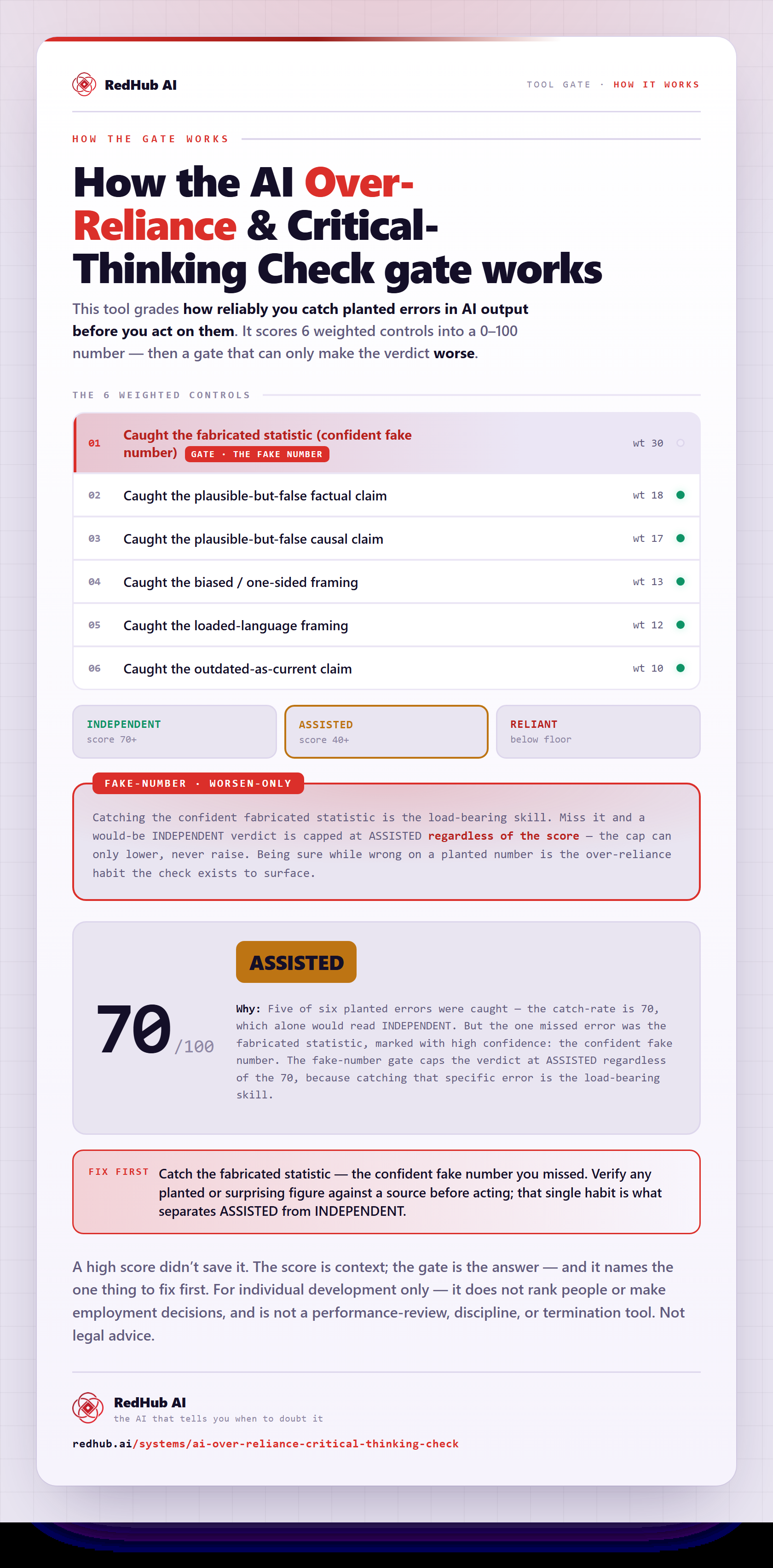
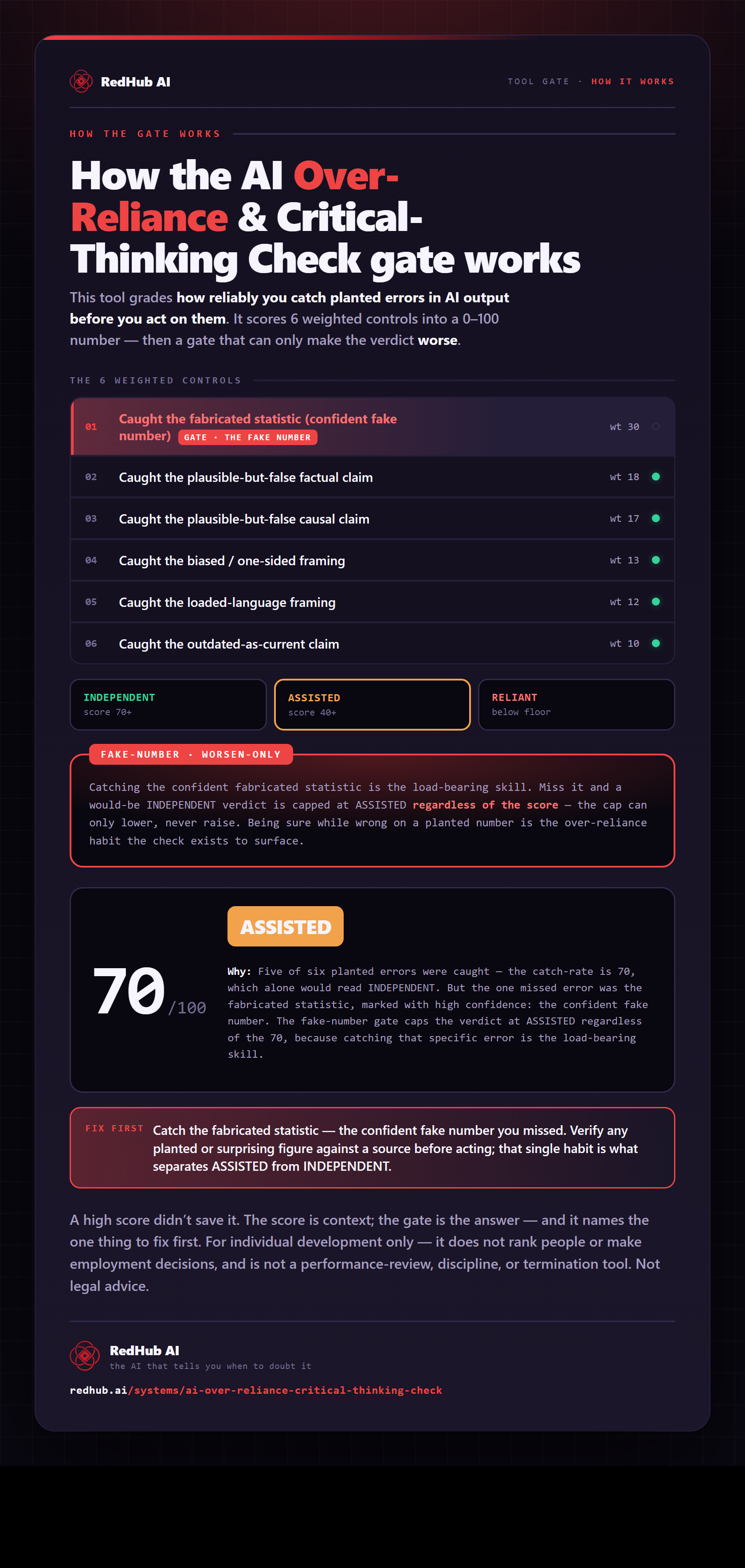
How the gate works, in one image
How the AI Over-Reliance & Critical-Thinking Check scores independent AI use and caps the verdict at ASSISTED when a fake number goes unchecked — the same math the demo runs, as a diagram you can share or embed anywhere.
View & embed the full diagramA Python engine and a workbook reproduce the on-page verdict exactly.
Score one learner or a whole cohort from a CSV. The cohort headline is the weakest individual tier — not the average — so one untrained reviewer can't be hidden by a strong team mean.
$ python3 oar_engine.py --input sample_learners.csv

Dana Reyes               88%   INDEPENDENT
Marcus Hale              70%   ASSISTED  [OVERCONFIDENT]
  (gate: missed the fabricated stat -> capped to ASSISTED)
  high confidence on missed item(s): S1  (over-reliance signal)
Priya Nair               73%   INDEPENDENT
Sam Okafor               27%   RELIANT
Robin Cho               100%   INDEPENDENT
Lee Donovan              59%   ASSISTED  [OVERCONFIDENT]

COHORT: TEAM RELIANT  (MIN learner tier = RELIANT)
Most-missed error type: false_claim
Mean catch-score (context only): 70%  |  learners over-confident: 2/6
Mean reads 70%, but the cohort is TEAM RELIANT — the floor is the honest signal. Marcus caught everything except the fake number, and that alone keeps him out of INDEPENDENT.
Three operating principles keep the verdict honest.
Miss the fabricated statistic and you cannot score INDEPENDENT — capped at ASSISTED regardless of catch-rate. The cap only lowers; it never lifts.
High confidence on a missed item trips the over-reliance flag. It annotates the verdict for reflection; it never changes the tier.
No AI, no invented value, no baked-in multiplier. The same marks always produce the same verdict, in the engine, the workbook, and on this page.
A development tool that measures a skill, not a verdict on a person.
- A deterministic check of whether you catch planted AI errors.
- A calibration tool that surfaces confident wrong answers.
- A team training input — find the weakest skill, train it, re-run.
- A deep-dive on the verification skill the AI Fluency Diagnostic flags.
- A way to rank people against each other.
- A hiring, promotion, performance-review, or termination tool.
- A certification of anyone's competence.
- Legal advice.
Scope. For individual development and training planning. It does not certify, rank people against each other, or make employment decisions, and is not a hiring, promotion, performance-review, discipline, or termination tool. Not legal advice.
Anyone who acts on AI output, and the people training them.
Knowledge workers, analysts, marketers, founders — anyone who pastes AI output into something that ships. Find out whether you catch the errors you can't afford to miss.
Run it across a team, read the weakest-link cohort verdict, train the most-missed error type, and re-run on a cadence to build the habit.
Built to slot into the LEARN line and the verification toolkit.
The honesty rules that keep AI output checkable — the verification skill this Check tests, made operational.
ViewSpot the AI tells and over-reliance patterns in your own published work, not just in a test.
ViewThe org-level safe-use policy that sits behind individual error-catching habits.
ViewNew to the LEARN line? Run the AI Fluency Diagnostic first to find your weakest skill; if it's verification, this Check is the deep-dive. The Prompt Practice Lab builds the writing side of the same fluency.
Direct answers on the gate, the flag, and the scope.
Stop trusting the confident answer.
Start catching it.
One purchase, lifetime access, 12 months of updates. $69, once.
Scope. For individual development and training planning. It does not certify, rank people against each other, or make employment decisions, and is not a hiring, promotion, performance-review, discipline, or termination tool. Not legal advice.
Sold by RedHub AI LLC · Secured by Stripe · redhub.ai