Find out how AI-fluentyou really are — at your weakest skill.
Six skills, scored from your own honest marks. The headline is your lowest skill, not your average — because that is the one that bites in real work. An essential gate holds back anyone who can't verify a fact or handle data safely, and the result points you at exactly what to learn next.
For development, not employment decisions. This kit is for individual development and training planning. It measures and places — it does not certify, rank people against each other, or make employment decisions, and it is not a hiring, promotion, performance-review, discipline, or termination tool. Not legal advice.
“Everyone's using AI” is not the same as everyone using it well.
The most common failure isn't not using AI — it's using it confidently without checking, and shipping a fabrication that sounded right.
A great prompter who never verifies looks 'advanced' on any blended score. The one weak skill is exactly the one that causes the incident.
Without a per-skill read, teams buy generic AI training nobody needed and skip the one skill that would have prevented the problem.
Move the sliders — the headline is the lowest skill, and the gate is live.
For individual development and training planning. It measures and places — it does not certify, rank people against each other, or make employment decisions. Resets on reload.
Drop Verification or Safety below 3 and watch the tier snap to AWARE even with every other skill maxed. That is the essential gate: an operator who can't verify a fact or handle data safely is not yet fluent, however good the prompting.
The fluency number is the minimum of the six skill scores. The mean is shown only for context — it never sets the verdict. Your weakest dimension routes you to the one RedHub drop that develops it.
The engine, the workbook, and this demo are verified to return the same tier, weakest dimension, and gate result from the same inputs. Nothing is invented.
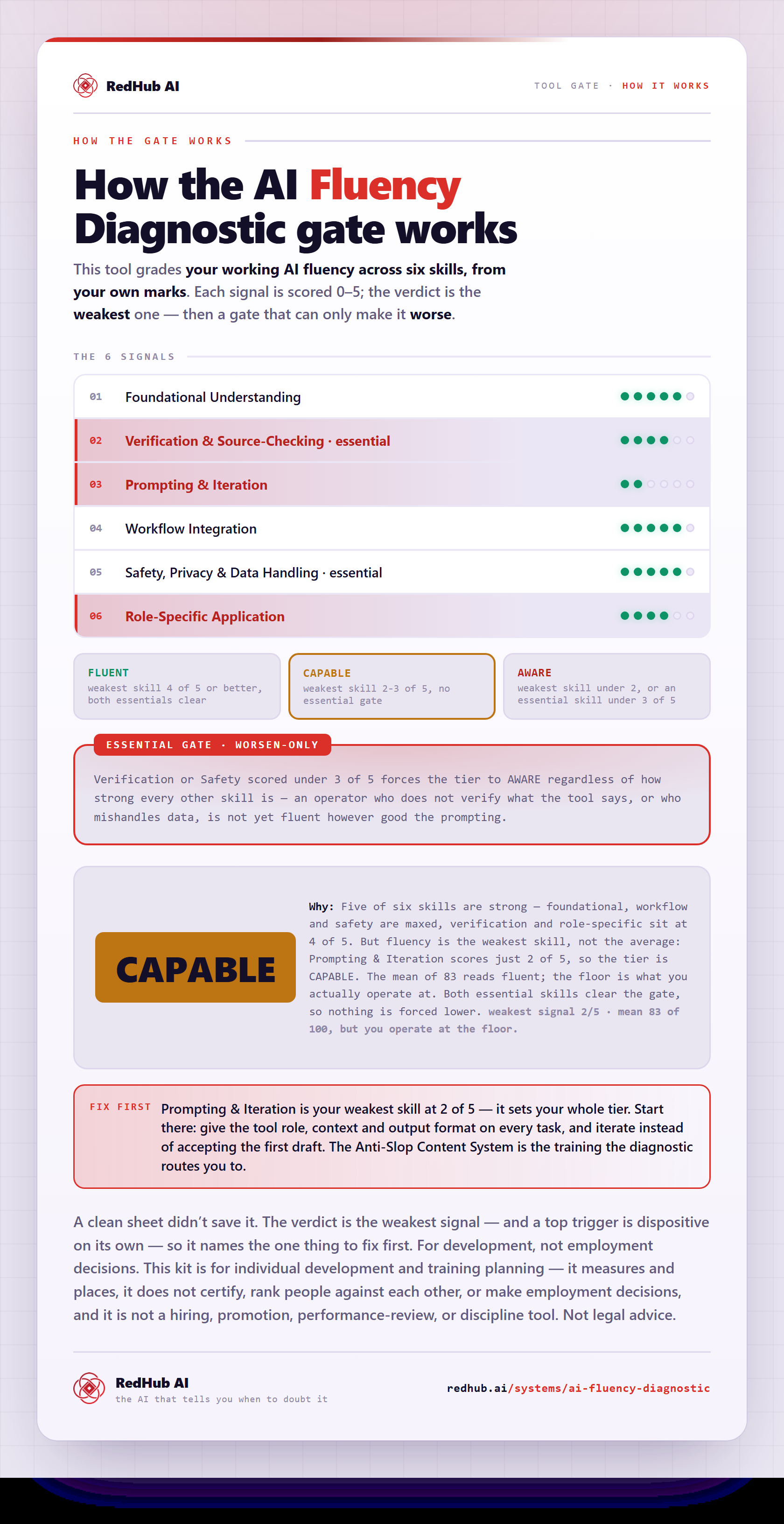
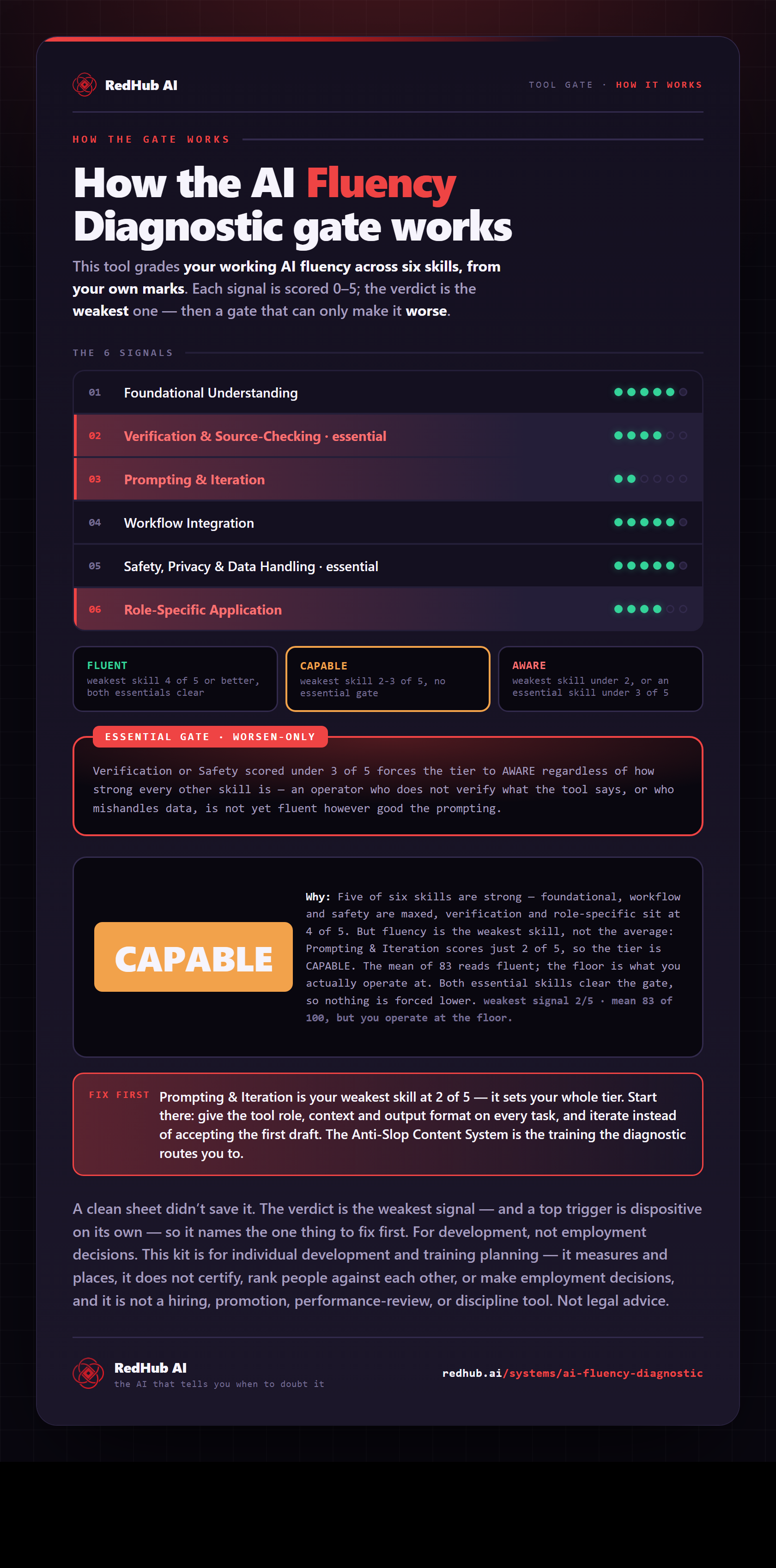
How the gate works, in one image
How the AI Fluency Diagnostic reads your fluency as the weakest of six skills and drops the tier to AWARE if Verification or Safety lags — the same math the demo runs, as a diagram you can share or embed anywhere.
View & embed the full diagramA runnable engine, a workbook that reproduces it, and the playbooks to act on it.
A zero-dependency Python tool that scores one person or a whole team from a CSV — tier, weakest dimension, essential gate, overconfidence flags, and a team roll-up.
Tabs Start Here → Dashboard → Diagnostic. Type 0–5 per skill; live formulas reproduce the engine exactly, including the MIN headline and the essential gate.
Thirty concrete tick-statements — five per dimension — so a score is a count of true statements, not a vibe. The same rubric drives the engine, workbook, and demo.
An individual development guide (read your result, pick the next skill) and a team rollout guide (run it across a group, read the roll-up, plan training).
Three operating principles keep the score honest.
The score is the minimum of the six dimensions. One weak skill sets the result, because that's the one that fails you in real work.
Verification and Safety below 3/5 hold the tier at AWARE regardless of score. The gate is deterministic — it holds below 3 and releases at 3.
Scores come from counting concrete tick-statements, and the overconfidence flag surfaces every gap between what you think and what you can show.
A development compass, not a verdict on a person.
- A per-skill read that names what to learn next.
- A team training-planning tool with an honest roll-up.
- A deterministic engine you can re-run and audit.
- A way to surface overconfidence before it costs you.
- A hiring, promotion, or performance-review tool.
- A certification or a credential.
- A ranking of people against each other.
- A test anyone passes or fails — it places, then points forward.
For development, not employment decisions. This kit is for individual development and training planning. It measures and places — it does not certify, rank people against each other, or make employment decisions, and it is not a hiring, promotion, performance-review, discipline, or termination tool. Not legal advice.
Anyone planning their own — or a team's — next step with AI.
- A team lead deciding what AI training to actually buy.
- A trainer who needs a per-skill baseline before and after.
- A solo operator who wants an honest read on where to improve.
- An ops or enablement owner standing up an AI-literacy program.
- To score candidates or rank employees — this isn't that tool.
- A certificate to hand a client or auditor.
- A test with a pass mark — it measures and points forward instead.
Diagnose the skill, then build it with the matching kit.
Run the training the diagnostic says your team needs — a turnkey literacy program.
The policy layer behind the Safety dimension — what may and may not go into a tool.
Ten role-specific Claude Projects for the Role-Specific Application dimension.
Straight answers about scoring, the gate, and what it's not for.
It scores six skills — Foundational Understanding, Verification, Prompting, Workflow Integration, Safety, and Role-Specific Application — each from 0 to 5 based on how many of five tick-statements the person can honestly check. Each becomes a 0–100 dimension score, and the headline is the LOWEST of the six, not the average. The weakest real skill is the one that bites in real work, so it sets the result: FLUENT (70–100), CAPABLE (40–69), or AWARE (0–39).
Because an average hides the skill that fails you. Someone can prompt beautifully and still paste an unverified, confident-sounding fabrication into a client deliverable — the average says 'great', the weakest skill says 'not yet'. The Diagnostic takes the minimum so the result reflects the skill most likely to cause a real problem, and names that exact dimension to develop next.
Two of the six skills — Verification and Safety — are treated as essential. If either scores below 3 out of 5, the tier is held at AWARE no matter how high the other skills are. An operator who does not check facts or mishandles data is not yet fluent, however strong their prompting or workflow habits. The gate is deterministic: it fires below 3 and releases at 3.
No. It is built for individual development and training planning. It measures where someone stands and points them at what to learn next — it does not certify anyone, rank people against each other, or feed any employment decision. It is not a hiring, promotion, performance-review, discipline, or termination tool, and using it that way is outside its design. Not legal advice.
Before counting ticks, a learner can enter a self-rating for each skill. If their self-rating exceeds the measured score by more than one point, that dimension is flagged OVERCONFIDENT. It is the most useful signal in the kit: the gap between what someone thinks they can do and what they can actually check is exactly where AI mistakes hide.
Both, and they agree. You get a runnable Python engine, a workbook that reproduces it formula-for-formula, two playbooks, and a sample team. The engine, the workbook, and the on-page demo are verified to produce the same tier, the same weakest dimension, and the same gate result from the same inputs — so the number you see is the number you get, with nothing invented.
Stop guessing how AI-fluent you are.
Measure it, then build the weakest skill.
One purchase, lifetime access, 12 months of updates. $79, once.
For development, not employment decisions. This kit is for individual development and training planning. It measures and places — it does not certify, rank people against each other, or make employment decisions, and it is not a hiring, promotion, performance-review, discipline, or termination tool. Not legal advice.
Sold by RedHub AI LLC · Secured by Stripe · redhub.ai