Your closed jobs already told you.Your open quotes aren't listening.
Layer 1 measures the drift between what you quoted and what jobs actually cost — per work type, per component, dollar-weighted. Layer 2 crosses it against the quotes sitting in buyers' inboxes right now. The headline is a dollar figure: open quotes priced on estimates your own data has already disproven.
The margin was never there. Your data knew.
Every closed job is a test of an estimating assumption against reality. Most shops file the result and price next month's quotes on the assumption the last four jobs just disproved.
A quote showing 18% margin on a labor standard running +22% hot is really showing low single digits. The spreadsheet looks healthy because it's computing from the disproven number.
In the shipped sample, 45.3% of the open quote book is priced on estimates the shop's own closed jobs disproved. That figure exists in your shop too — it just isn't on a dashboard yet.
Drag a drift across the tolerance. Watch $122,000 release.
Try it: drag Welded Assemblies' actual labor down until the drift crosses 15% — the type recalibrates and the $122,000 Ironline quote releases on its own. Or mark it repriced — same release, other path. This demo runs the same math as the workbook and engine, in memory only — it resets on reload, sets no price, and scores work types, never people.
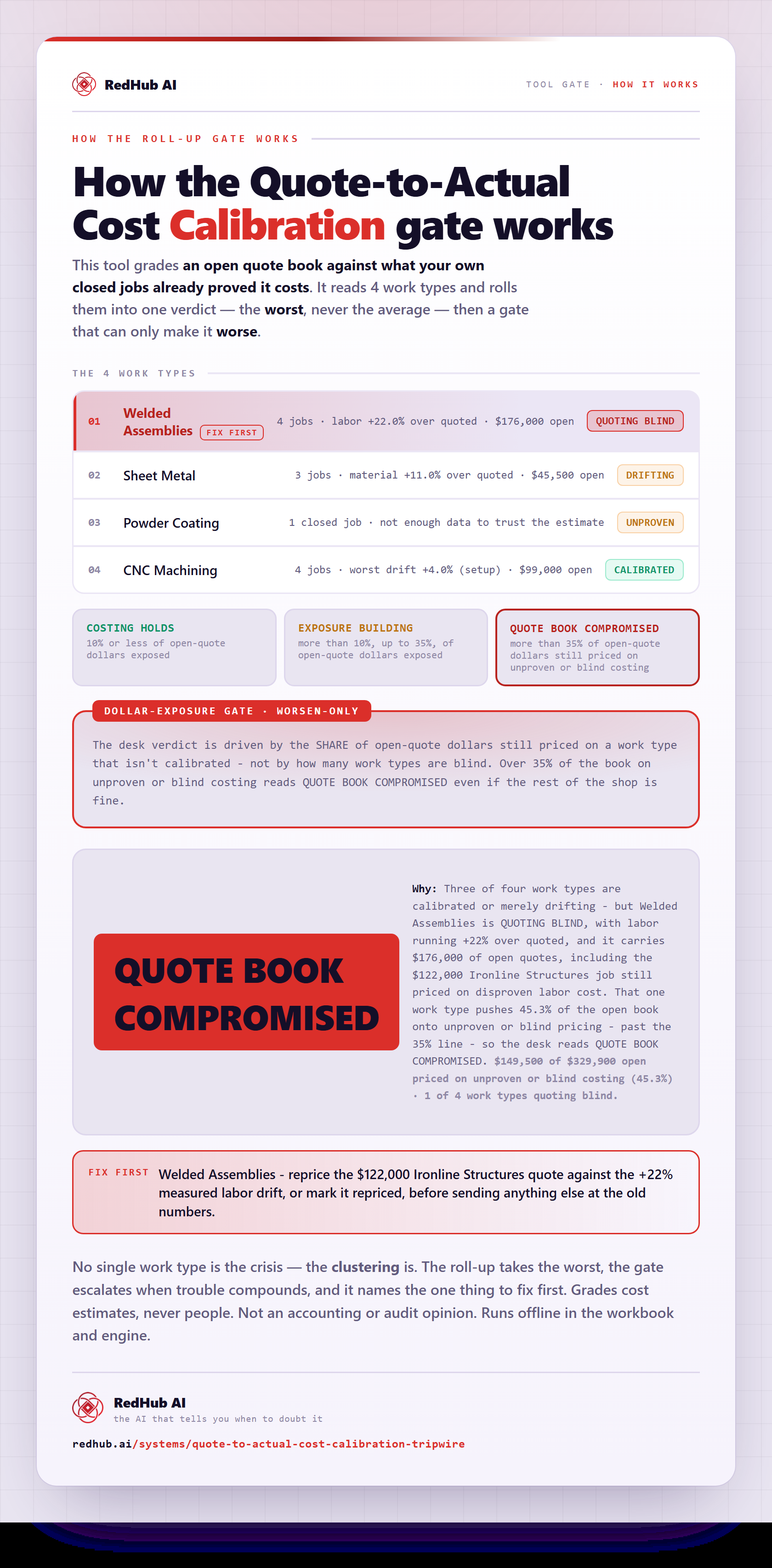
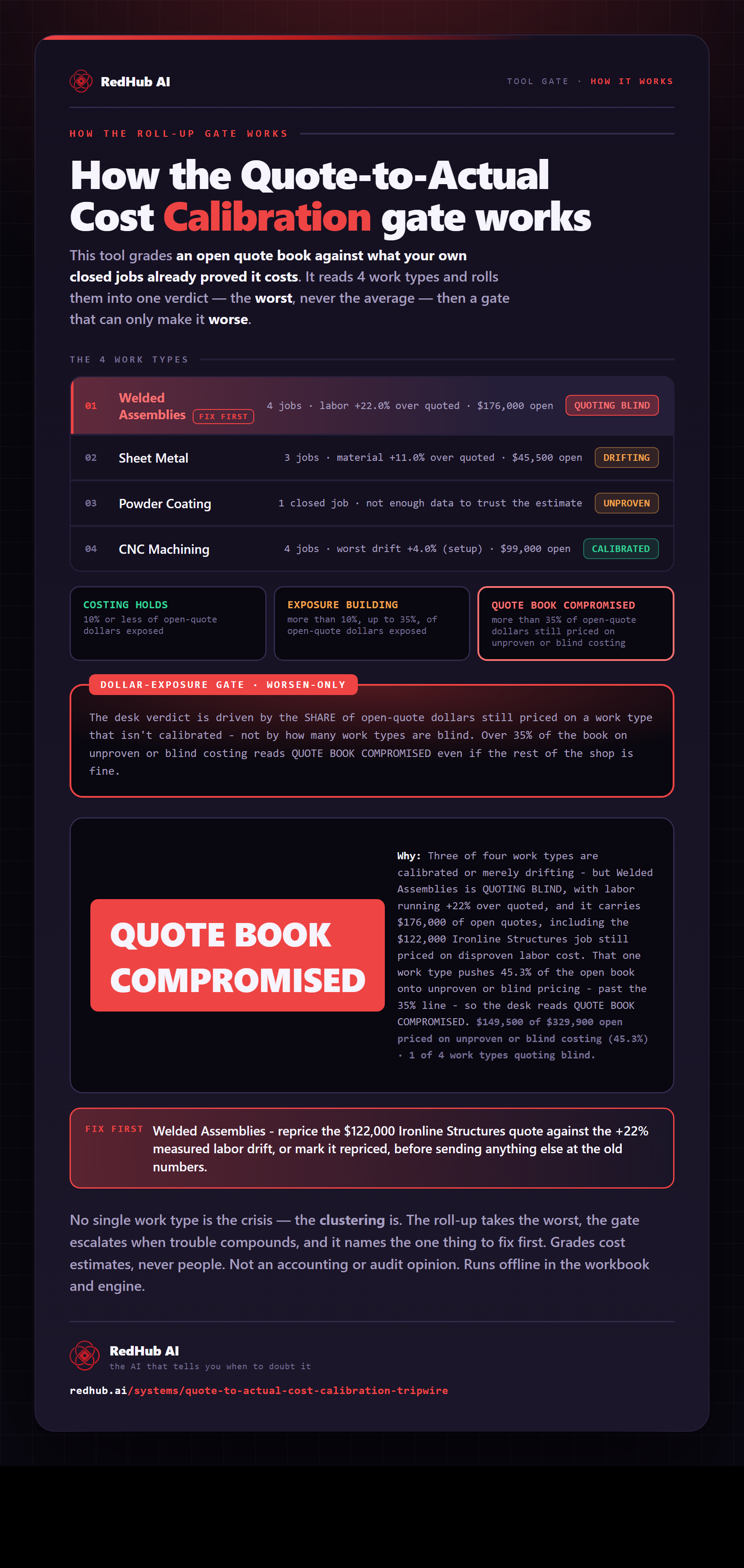
How the gate works, in one image
How the Quote-to-Actual Cost Calibration Tripwire rolls up work-type calibration into a desk-level verdict by dollar exposure — the same math the demo runs, as a diagram you can share or embed anywhere.
View & embed the full diagramRunnable, zero-dependency, and verified before it shipped.
The exact output below is from the engine running against the shipped sample — every boundary, verdict cell, and release path independently reproduced by a 137-assertion verifier before packaging. Two Welded Assemblies quotes are the teaching pair: same work type, one gates at $122,000, the repriced twin reads SEND.
QUOTE-TO-ACTUAL COST CALIBRATION TRIPWIRE — QCC-099
==============================================================================
LAYER 1 — what your closed jobs proved
  CNC Machining        CALIBRATED     jobs  4   labor     +3.0%  material     -2.0%  setup     +4.0%
  Welded Assemblies    QUOTING BLIND  jobs  4   labor    +22.0%  material     +8.0%  setup    +12.0%
  Sheet Metal          DRIFTING       jobs  3   labor     +9.0%  material    +11.0%  setup     +6.0%
  Powder Coating       UNPROVEN       jobs  1   labor     +2.5%  material     +4.0%  setup     +2.5%
------------------------------------------------------------------------------
LAYER 2 — your open quote book, inheriting that proof
  Q-2101   Meridian Valve Co        $    38,000   SEND
  Q-2102   Ironline Structures      $   122,000   DO NOT SEND AS PRICED  (worst: labor)
  Q-2103   Apex Rail Systems        $    54,000   SEND  (drift applied)
  Q-2104   Delta Conveyor           $    27,500   REPRICE FIRST  (worst: material)
  Q-2105   Harbor Marine            $    18,000   SEND  (drift applied)
  Q-2106   Grover Fabrication       $     9,400   UNPROVEN COSTING
  Q-2107   Statewide Utility        $    61,000   SEND
------------------------------------------------------------------------------
DESK: QUOTE BOOK COMPROMISED
$149,500 of $329,900 open quotes (45.3%) are priced on estimates your own closed jobs have already disproven.
SEND 4 / REPRICE FIRST 1 / DO NOT SEND AS PRICED 1 / UNPROVEN COSTING 1   biggest exposed: Q-2102
Three rules the verdict never breaks.
A work type dead-on for material and +22% on labor is QUOTING BLIND, not “about 10% off.” Averaging components is how a costing problem hides for a year; the worst component is named so you know which standard to rebuild.
Fewer than three closed jobs is anecdote, not calibration. An UNPROVEN type is never CALIBRATED by default — that is the tool refusing to guess — and its quotes read UNPROVEN COSTING until the proof gap closes.
DO NOT SEND AS PRICED lifts exactly two ways: the type recalibrates as corrected closed jobs accumulate, or the quote is repriced with the measured drift applied. There is no snooze.
A feedback loop, not a job-costing system.
- The closed-loop check your job-costing data already contains but nobody runs.
- Per-type, per-component drift — dollar-weighted — with the worst component named.
- A live exposure figure: the open dollars still priced as if the drift weren't proven.
- Deterministic and offline — engine and workbook compute identical results.
- Not a job-costing or ERP system — it reads the numbers yours already produces.
- Not a pricing tool — it corrects a cost basis; the price stays your call.
- Not a forecast — it measures what happened, which is exactly why it's hard to argue with.
- Not a grade on any estimator — work types are categories; no person field exists.
Honest boundary: this system is a deterministic costing-discipline aid. It measures drift between your quoted and actual costs by work type — never scoring an estimator, salesperson, or any person — sets no price, and connects to nothing. It is not financial, accounting, or legal advice; pricing decisions remain yours.
Built for the desk that owns the estimate.
The costing spine of the quote desk.
Drafts and grades a defensible quote before it reaches a buyer. This tripwire proves the cost basis that quote's margin math stands on.
The downstream check on the booked deal book — realized margin below floor. Calibrated costing upstream is how those leaks stop appearing.
The full formal-bid response process for the work that clears your desk — built on numbers this tripwire has already pressure-tested.
Straight answers before you buy.
It's the dollars of open quotes sitting in a work type whose estimating assumptions your own closed jobs have already disproven — either drifting (worst component beyond 5%) or quoting blind (beyond 15%, or a component quoted at $0 that showed up real in actuals) — and not yet repriced. In the shipped sample that's $149,500 of a $329,900 open book: 45.3%, QUOTE BOOK COMPROMISED. It is your data disagreeing with your prices, in dollars.
Because the margin math is built on the estimate — and the estimate is what your closed jobs disproved. If Welded Assemblies labor has run +22% against quote across four straight jobs, an open welded quote showing 18% margin on paper is really showing low single digits. The gate is dispositive and worsen-only: it forces the verdict regardless of the quote's own numbers, and releases when the type recalibrates or the quote is repriced with the measured drift applied.
A work type with fewer than three closed jobs hasn't been tested enough to call anything. Calling it CALIBRATED by default would be the tool guessing — and this tool never guesses. Quotes in an unproven type read UNPROVEN COSTING: an unknown drift can't be applied, so the move is to close the proof gap, not to reprice against a number that doesn't exist yet.
Dollar-weighted per component: total actual versus total quoted across the type's closed jobs, for labor, material, and setup separately. Summing before dividing means one small anomalous job can't swamp ten normal ones the way averaging per-job ratios would. The type's status is the worst absolute component — never the flattering average — and the worst component is named so you know exactly which standard to rebuild.
A runnable zero-dependency Python engine with a config.json and a worked sample (12 closed jobs, 7 open quotes), a workbook that reproduces the engine exactly (Start Here, Dashboard, Closed Jobs, Open Quotes — opens in Excel, Google Sheets, or Numbers), a Cost Calibration Playbook for the monthly meeting, and an Exposed Quote Rescue Runbook for working the exposed dollars largest-first. Engine and workbook compute identical results from identical inputs.
No — and it's built so it can't. Work types are categories of work; there is no estimator, salesperson, or person field anywhere in the inputs. It measures whether a costing system's assumptions survived contact with reality, sets no price, invents no benchmark, and connects to nothing. A costing-discipline aid, not financial or accounting advice.
Your data already voted.
Count it.
One purchase, lifetime access, 12 months of updates. $99, once.
Honest boundary: a costing-discipline aid, not financial or accounting advice — it measures drift in work types and never scores a person.
Sold by RedHub AI LLC · Secured by Stripe · redhub.ai