A clean total is nota sound model.
Audit a spreadsheet's formula layer - not its numbers - for the faults that silently corrupt a model: error cells, broken links, hardcoded magic numbers, copy-paste inconsistencies, and volatile dependencies.
The model looks right. That is exactly the danger.
#REF!
One deleted column leaves an error cell that silently feeds a total three columns over.
0.085
A tax rate baked into a formula instead of an input - invisible, and wrong the day it changes.
1 of N
One cell in a uniform row or column given a different formula is the classic error a totals check will never catch.
Toggle a fault. Watch the gate.
Live audit · toggle a fault on any cell
Ten formula cells from a small budget. Seven are clean and the grand total computes fine — yet the model is BROKEN, because Budget!E7 carries a #REF!. Clear the error on E7 and watch the gate fall to REVIEW.
| Cell | Formula | Faults | Score | Verdict |
|---|---|---|---|---|
| Budget!D3 | =B3*C3 | 100 | SOUND | |
| Budget!E3 | =D3*(1+0.085) | 60 | REVIEW | |
| Budget!D4 | =B4*C4+50 | 25 | REVIEW | |
| Budget!E4 | =D4*(1+$F$2) | 100 | SOUND | |
| Budget!D5 | =B5*C5 | 100 | SOUND | |
| Budget!E5 | =D5*(1+$F$2) | 100 | SOUND | |
| Budget!D6 | =B6*C6 | 100 | SOUND | |
| Budget!E6 | =D6*(1+$F$2) | 100 | SOUND | |
| Budget!D7 | =SUM(D3:D6) | 100 | SOUND | |
| Budget!E7 | =SUM(#REF!) | 100 | BROKEN |
Model verdict
BROKEN
integrity 89 · 7 SOUND / 2 REVIEW / 1 BROKEN · fix first: Budget!E7
Why BROKEN at an 89
A structural fault — an error cell or a broken link — is dispositive: it breaks the whole model no matter how high the integrity score. Hardcodes, inconsistencies, and volatile dependencies only flag a cell for review. A number built on a broken cell is already wrong.
Audits a spreadsheet's formulas, not the correctness of the numbers and not people. It flags what to fix and points to the cell; it never edits or repairs your file. Not accounting or audit advice.
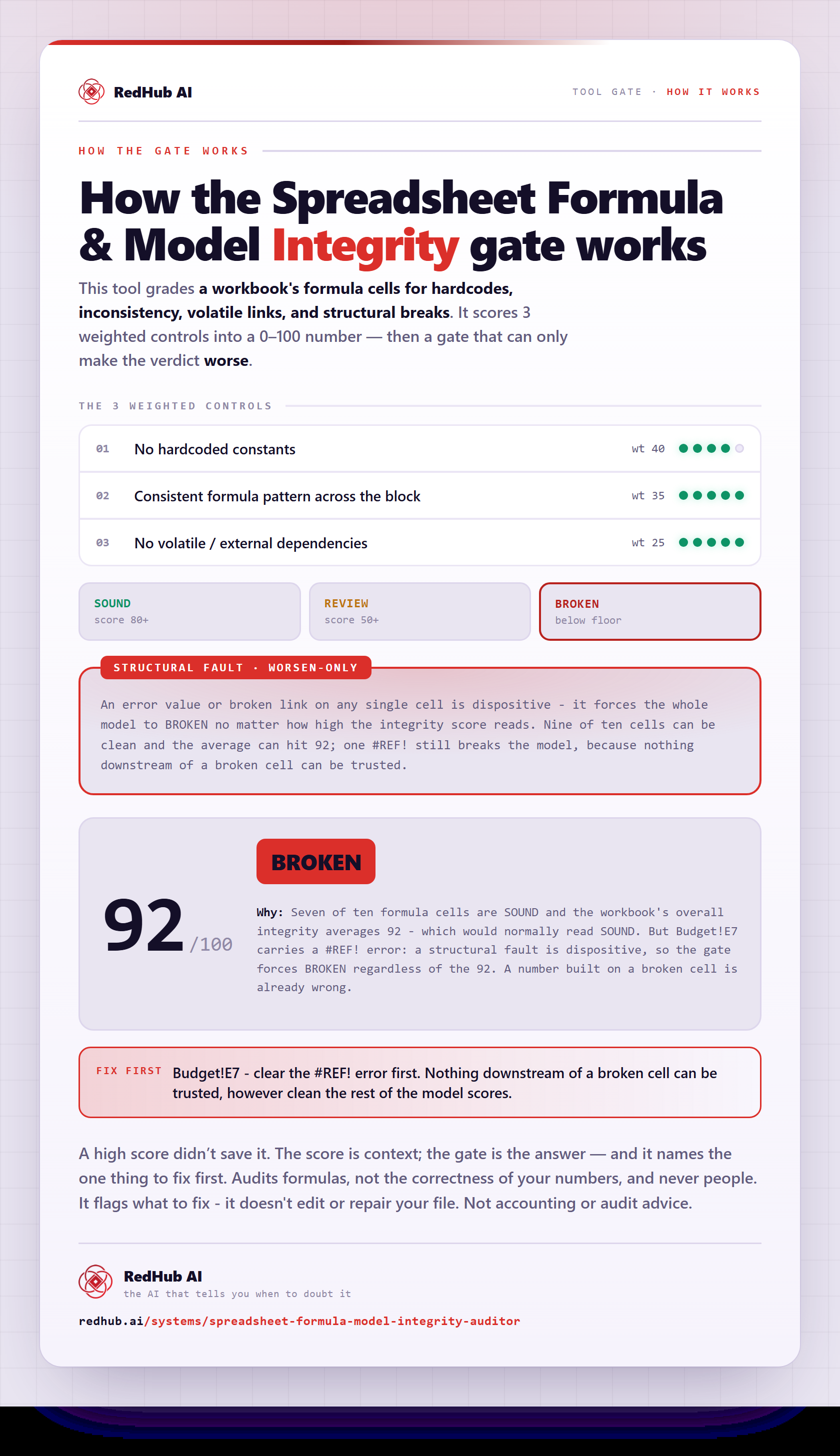
How the gate works, in one image
How the Spreadsheet Formula & Model Integrity Auditor scores formula cells and forces BROKEN on one structural fault, whatever the score — the same math the demo runs, as a diagram you can share or embed anywhere.
View & embed the full diagramPoint it at a real .xlsx. Here is the verbatim output.
The shipped sample is a four-line budget with a tidy grand total - integrity score 89, seven cells SOUND. The auditor still calls it BROKEN, because one cell carries a #REF!. A number built on a broken cell is already wrong.
Spreadsheet Formula & Model Integrity Auditor  (SFI-069)
file: sample_model.xlsx
----------------------------------------------------------------------
Budget!E3       REVIEW   score  60  =D3*(1+0.085)
                -> hardcoded 0.085 in formula
Budget!D4       REVIEW   score  25  =B4*C4+50
                -> hardcoded 50 in formula; formula differs from its block
Budget!E7       BROKEN   score 100  =SUM(#REF!)
                -> error value #REF!
----------------------------------------------------------------------
integrity score: 89   SOUND 7 / REVIEW 2 / BROKEN 1   (10 formula cells)
structural failure present: True
MODEL VERDICT: BROKEN
fix first: Budget!E7

Audits the formula layer, not the numbers' correctness, and not people. Not accounting or audit advice.Two tiers of fault, one honest gate.
Structural faults are dispositive
An error cell or a broken external link forces BROKEN - regardless of the integrity score. The score can't outvote a cell that's already producing a wrong number.
Graduated signals only flag
A hardcoded constant, a block inconsistency, or a volatile dependency marks a cell REVIEW and lowers the score. On its own it never breaks the model - it tells you what to clean up.
The score never overrides the gate
Integrity is the mean of the cell scores, shown for context. One BROKEN cell makes the whole model BROKEN at any score. Clean cells can't rescue a broken one.
A structural integrity check on a file.
- · A formula-layer auditor: errors, hardcodes, inconsistencies, volatile links
- · A runnable Python tool that reads your real .xlsx, plus a workbook that reproduces the gate
- · Deterministic and offline - same file, same verdict, every time
- · A check that your numbers are correct - it audits the formulas, not the answers
- · A repair tool - it flags and points to the cell; it never edits your file
- · A financial audit, and it does not score or rank people
Audits a spreadsheet's formulas, not the correctness of the numbers and not people. Not accounting or audit advice; confirm any figure that matters with the person who owns the model.
Anyone who ships a number out of a spreadsheet.
- Analysts and operators who inherit models they didn't build
- Founders and finance leads sanity-checking a board model before it goes out
- Consultants who hand clients spreadsheets and need them defensible
- Anyone who's been burned by a hardcoded number or a stray #REF!
The rest of the data-integrity stack.
Document Field Validator
$79Validate each record's fields once the file parses - the per-row correctness layer next to this structural one.
Finance & Reporting Automation Kit
$129A self-checking close: every tie-out labeled Ties out / Review / Does not reconcile, with one close status.
AI Document Extraction Kit
$99Pull structured fields out of documents with a flag-don't-guess rule, before they land in your model.
CSV / Data-Export Schema & Quality Gate
$69Gate the data going into the model — is the export structurally sound before a formula touches it?
The questions operators actually ask before they trust a model.
Because a structural fault is dispositive and a score can't outvote it. The shipped four-line budget has seven SOUND cells, a tidy grand total, and an integrity score of 89 — but Budget!E7 carries =SUM(#REF!), an error cell that's already feeding a wrong number into the total. One error cell forces the whole model BROKEN regardless of the score. The integrity score is the mean of the cell scores, shown for context only; it never rescues a model that has a cell producing garbage. Clear the #REF! and the same model falls to REVIEW — which proves the gate does distinct work from the score.
No — and that's the gap it fills. It audits the formula layer, not the values. A totals check confirms the columns add up; it will happily certify a grand total that's built on a #REF! three columns over, or on a tax rate hardcoded inside a formula. This reads the actual formulas and grades them for the faults that silently corrupt a model: error cells and broken external links (structural, dispositive), plus hardcoded magic numbers, copy-paste inconsistencies, and volatile/external dependencies (graduated, flag for review). If you want a self-checking close that grades tie-out math, that's the Finance & Reporting Automation Kit — this checks whether the formulas themselves are trustworthy.
Structural faults are dispositive; graduated signals only flag. A structural fault — an error value (#REF!, #DIV/0!, #VALUE!, #NAME?, #N/A, #NUM!, #NULL!; the newer #SPILL! and #CALC! are not on its list) in a formula or its cached result, or a broken external link — makes the cell BROKEN and forces the whole model BROKEN, because a number built on it is already wrong. A graduated signal — a hardcoded constant that should be an input (any number but 0, 1, 2 and 100), a formula whose shape differs from the row or column of three or more formulas it sits in (flagged only when it is the single odd one; a SUM, SUBTOTAL or AVERAGE-style total at the end of the row or column it adds up is not counted as part of it; a plain number typed over a formula is read as an input and is not flagged), or a volatile/external dependency (NOW, TODAY, RAND, OFFSET, INDIRECT, or an external workbook link) — marks the cell REVIEW and lowers its score, telling you what to clean up without breaking the model.
Each formula cell scores 0–100 on three weighted levers: no hardcoded constant (40), consistent with its row/column block (35), and no volatile or external dependency (25). A cell is SOUND at 80 or above with no fault, REVIEW on any graduated signal (or a score below 80), and BROKEN on any structural fault. The model's integrity score is the mean of the cell scores — context only. Fix-first points you at the single thing to address: the first structural cell in scan order if there is one, otherwise the lowest-scoring non-SOUND cell.
It reads your real .xlsx — it parses the actual formulas, not just the cached values — but it never edits, repairs, or writes back to your file. It flags the faults and points you to the exact cell; the included Fix-It Runbook tells you how to resolve each one. It's deterministic and offline: no AI, no network, nothing uploaded, so the same file always produces the same verdict. The companion workbook reproduces the same per-cell and model logic on a pasted sample so you can see the scoring without running Python.
No. It's a structural integrity check on a file's formulas, not an accounting or audit opinion — it asserts nothing about whether your numbers are correct, only whether the formulas producing them are trustworthy. It never scores or ranks people. Confirm any figure that actually matters with the person who owns the model. It pairs with the CSV / Data-Export Schema & Quality Gate (is the data going in structurally sound?), the Document Field Validator (are the records valid?), and the Finance & Reporting Automation Kit (does the close tie out?).
Trust the formula,
not just the total.
One purchase, lifetime access, 12 months of updates. $69, once.
Sold by RedHub AI LLC · Secured by Stripe · redhub.ai