Catch the bad exportbefore it corrupts everything.
One ragged row, a mis-encoded header, a missing column — and every tool downstream silently mangles your data. This gate grades an exported CSV before anything touches it: a verdict per column and one file verdict, READY, FIX, or BLOCK. A structural failure blocks the file no matter how clean the cells that parsed look.
Your “clean” export still broke the import.
One ragged row
A single extra field shifts every column after it. From that row down, your email column is quietly holding phone numbers — and nothing errors.
A mangled header
A BOM-mangled or duplicate header cell, a missing required column — the file parses “okay” and silently corrupts every tool downstream.
The cells look fine
Every value that parsed reads clean, so a quality score says 100 — while the file is structurally unusable. The damage is structural, not fancy.
Toggle a check. Watch the gate.
Toggle a structural check or edit a column's null and type-mismatch rates and watch the verdict recompute. Flip the ragged-row check to PASS and the same file falls to READY.
Live demo · toggle a structural check or edit a column
Structural checks
Columns (null % · type-mismatch %)
File verdict
BLOCK
1 structural fail · file quality 100 (context only)
Columns
6 clean · 0 dirty · 0 missing
Fix first: consistent_row_width
Every column can read CLEAN and the file still BLOCKs — a ragged or mis-encoded file can't be trusted to line up, however clean the cells that did parse look. Structure is categorical; quality is graduated.
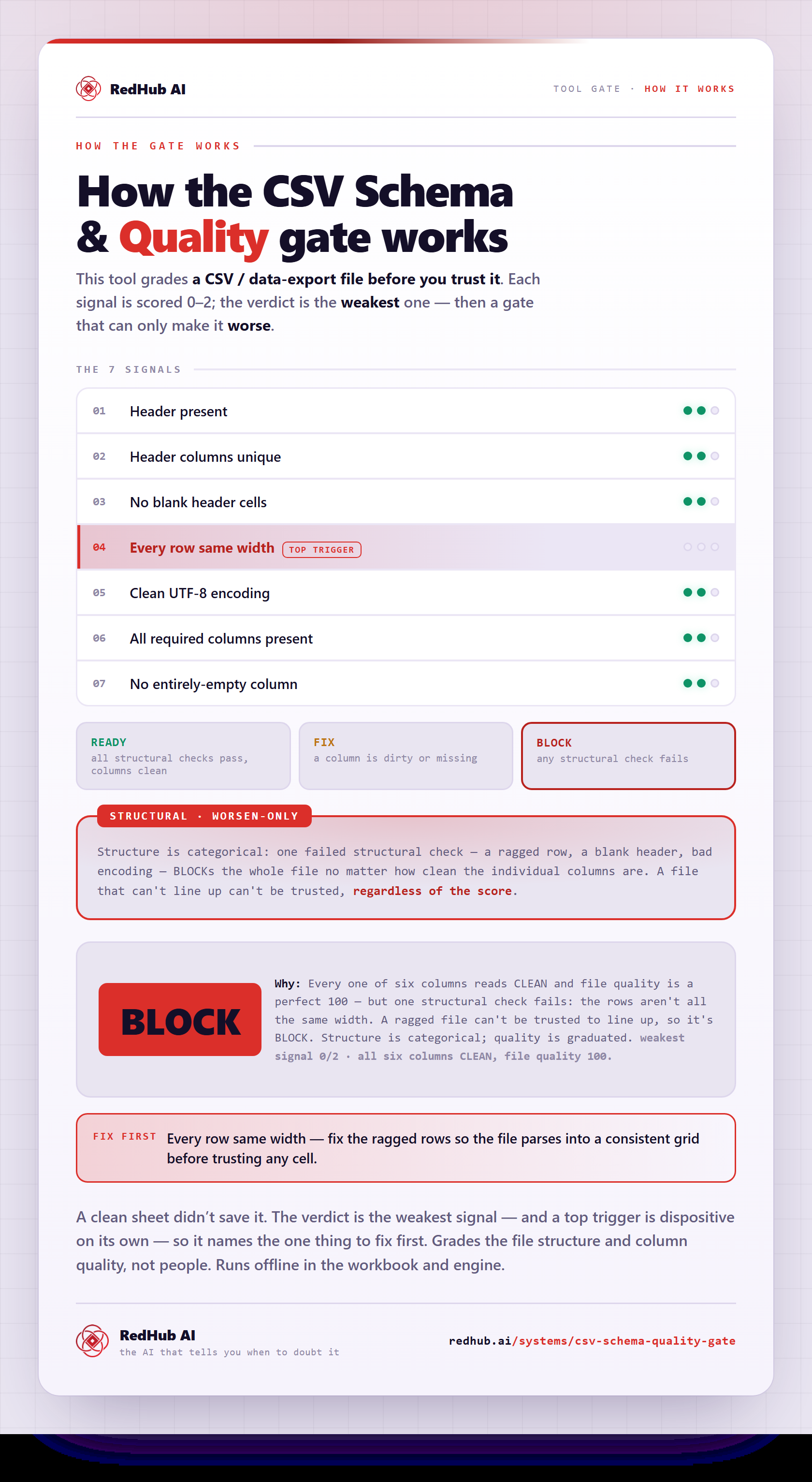
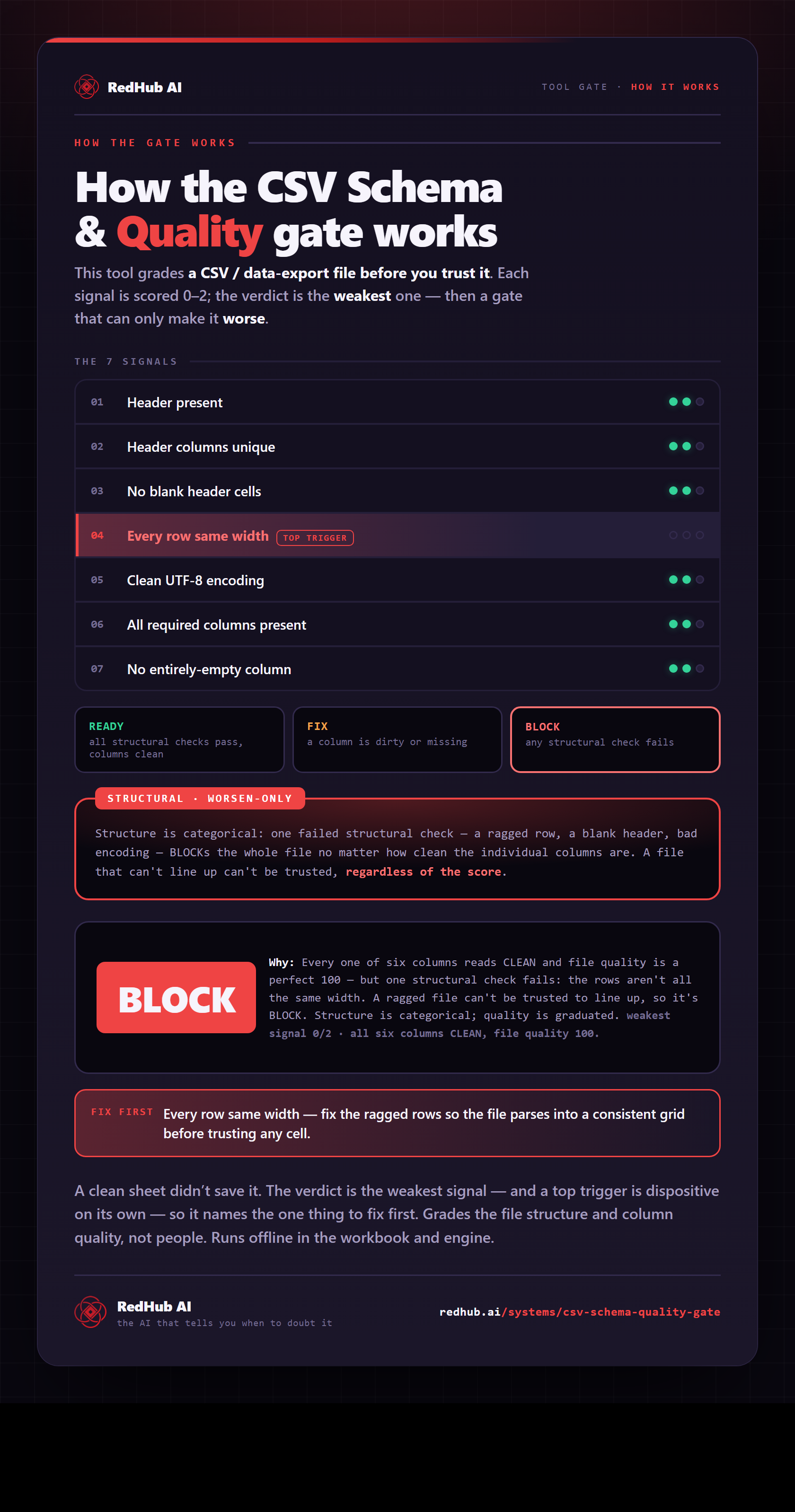
How the gate works, in one image
The seven structural checks that are categorical — one failed check BLOCKs the whole file no matter how clean the columns are — the same math the demo runs, as a diagram you can share or embed anywhere.
View & embed the full diagramEvery column clean — file still blocked.
The sample export scored by the engine. All six columns read CLEAN and the file quality is a perfect 100 — yet the verdict is BLOCK, because one row carries an extra field. A ragged file can't be trusted to line up; the cells you read may belong to the wrong column. Structure is categorical; quality is graduated.
CSV / Data-Export Schema & Quality Gate  (CSG-069)
==============================================================
  File: sample_export.csv  (5 rows x 6 cols)
  Structural checks:
    [OK ] header_present
    [OK ] header_no_blanks
    [OK ] header_unique
    [FAIL] consistent_row_width
    [OK ] encoding_clean
    [OK ] required_columns_present
    [OK ] no_empty_columns
  Columns:
    order_id           quality 100  CLEAN     (null 0%, type-mismatch 0%)
    email              quality 100  CLEAN     (null 0%, type-mismatch 0%)
    amount             quality 100  CLEAN     (null 0%, type-mismatch 0%)
    order_date         quality 100  CLEAN     (null 0%, type-mismatch 0%)
    status             quality 100  CLEAN     (null 0%, type-mismatch 0%)
    notes              quality 100  CLEAN     (null 40%, type-mismatch 0%)
--------------------------------------------------------------
  CLEAN 6 / DIRTY 0 / MISSING 0   file quality 100 (context)
  FILE VERDICT: BLOCK
Fix first: structural:consistent_row_widthStructural gate, then quality score.
Structural checks — categorical
Header present / unique / no blanks, every row the same width, clean UTF-8, every required column present, no empty column. Any failure forces BLOCK — a file that can't be parsed can't be trusted, however clean the cells look.
Quality score — graduated
Per column, 0–100 on four levers (required-present 10, null-rate 25, type-match 55, format 10). A typed column with any malformed value is DIRTY even at a high score. READY needs every column clean; FIX is parseable but dirty.
Clear about the lane. No inflated promises.
It is
- The first gate on any export, upstream of every row-level tool
- A deterministic read on whether a file can even be processed
- A force-multiplier that de-risks every downstream data tool
It isn't
- A cleaner — it never transforms or rewrites your data
- A record-level validator (that's the Document Field Validator)
- A score of any person
Honest scope: this kit grades a file you export and enter against a schema you define. It does not clean, transform, or rewrite your data, and it does not score or rank people. Not legal advice.
For anyone burned by a file that looked fine.
Anyone who feeds exported CSVs into a pipeline, a model, an import, or another RedHub tool and has been burned by a file that looked fine but wasn't. Run it the moment an export lands, before a single row is processed — it blocks exactly the files that would corrupt everything downstream.
The rest of the document-ops line.
Document Field Validator
$79
The next gate down — once a file parses cleanly, validate each record's fields by rule.
AI Document Extraction Kit
$99
Produces many of the CSVs you'll gate here — extract with judgment, then check the export.
Document Processing Pipeline Diagnostic
$79
Find the slowest stage in your whole document pipeline and route it to its fixer.
The questions operators actually ask before they trust an export.
Because structure is categorical and quality is graduated, and structure wins. The shipped sample has six CLEAN columns and a perfect file quality of 100 — but one row carries an extra field, so the cells no longer line up with the header. From that row down, the value in “email” might actually be a phone number. A ragged file can't be trusted however clean the cells that did parse look, so the structural gate forces BLOCK. Flip the row-width check to PASS and the same file falls to READY. Clean cells, blocked file — that's the whole point.
Structural checks ask whether the file can even be parsed and lined up: is the header present, unique, and free of blank cells; is every row the same width; is the encoding clean UTF-8; is every required column present; is any column entirely empty. Any one failing forces BLOCK — these are categorical, pass or fail. Quality checks are graduated: each column scores 0–100 on four weighted levers (required-present 10, null-rate 25, type-match 55, format 10), where type-match dominates because a malformed value in a typed column is the real downstream-corruption risk. A column is CLEAN only at quality ≥ 80 with no type mismatch and its null rate within spec.
BLOCK on any structural failure, or if file quality drops below 50 — the file can't be safely processed. READY when there's no structural failure, every column is CLEAN, and quality is ≥ 80 — import it. FIX when the file parses but at least one column is DIRTY or MISSING — it's salvageable, but fix the flagged columns first. The fix-first pointer names the single thing to address: the first structural failure if there is one, otherwise the lowest-scoring dirty column.
No. The CSV / Data-Export Schema & Quality Gate is a gate, not a cleaner — it never transforms, rewrites, or repairs your file. It reads the raw file plus a small schema you define (column name, type, required, allowed null rate), measures real statistics, runs the structural and quality checks, and returns a verdict with, where a column or check is short, a fix-first pointer. You (or the tool that produced the export) make the fix; the included Fix-It Runbook tells you how for each verdict. It's deterministic and offline — same file and schema, same verdict, every time, and nothing is uploaded.
Upstream of it. This gate runs first, on the whole file: can it be parsed, do the columns line up, is the schema right. Only once a file passes here does the Document Field Validator make sense — it checks each record's fields by rule (required, format, range, cross-field). One asks “is this file safe to process at all?”, the other asks “is each row's data valid?” Running the schema gate first means the field validator never wastes a pass on a file whose cells are silently in the wrong columns. It's the upstream force-multiplier for the whole Document Processing line.
CSV and delimited data exports — the kind that fall out of a CRM, a billing system, an analytics tool, or another RedHub kit. You point the runnable Python engine at the file and a JSON schema; it streams the file and measures row width, encoding, header integrity, null rates, and per-column type-match against the types you declared (int, decimal, date, email, enum, and so on). The companion workbook reproduces the same scoring and gate on a pasted sample so you can see the logic without running Python. It grades a file's structure and quality, never people, and it's not legal advice.
New to the document-ops line? Run the Document Processing Pipeline Diagnostic first — it scores your workflow across six stages and, where a stage is short, routes you to the exact drop that fixes your bottleneck.
Stop the bad export
at the door.
Gate every CSV before it touches your pipeline — READY, FIX, or BLOCK in one run. One purchase, lifetime access, 12 months of updates. $69, once.
Honest scope: this kit grades a file you export and enter against a schema you define. It does not clean, transform, or rewrite your data, and it does not score or rank people. Not legal advice.
Sold by RedHub AI LLC · Secured by Stripe · redhub.ai