Find the one stageholding your document pipeline back.
Score your workflow across six stages from your own inputs. The diagnostic takes the worst stage as the headline — a pipeline is only as automated as its weakest link — and, where a stage is short, routes that constraint to the exact drop that fixes it. Run it first; it tells you what to buy.
A document workflow can average healthy and still stall on one stage every single day.
is all it takes. Five automated steps and one manual one is still a manual pipeline — everything queues at the manual step.
A 73 average looks fine while a single stage sits at 45 and quietly carries the whole flow by hand.
fix document ops — but which one do you need? Buying the wrong tool first is the expensive mistake this prevents.
Mark six stages, and, where a stage is short, the diagnostic names your constraint and the drop that fixes it.
Are documents arriving complete and on time, or chased by hand?
Does each document land in the right lane without a human sorting it?
Are extracted fields trustworthy, or re-keyed and spot-checked by hand?
Do cross-document checks hold without manual tie-out?
Are generated outputs send-safe, or proofed row by row?
Are files named, deduped, and PII-clean before they move on?
Gap analysis from your own marks · pinned to 2026-06-23 · no AI, no baked-in multiplier · you run the pipeline.
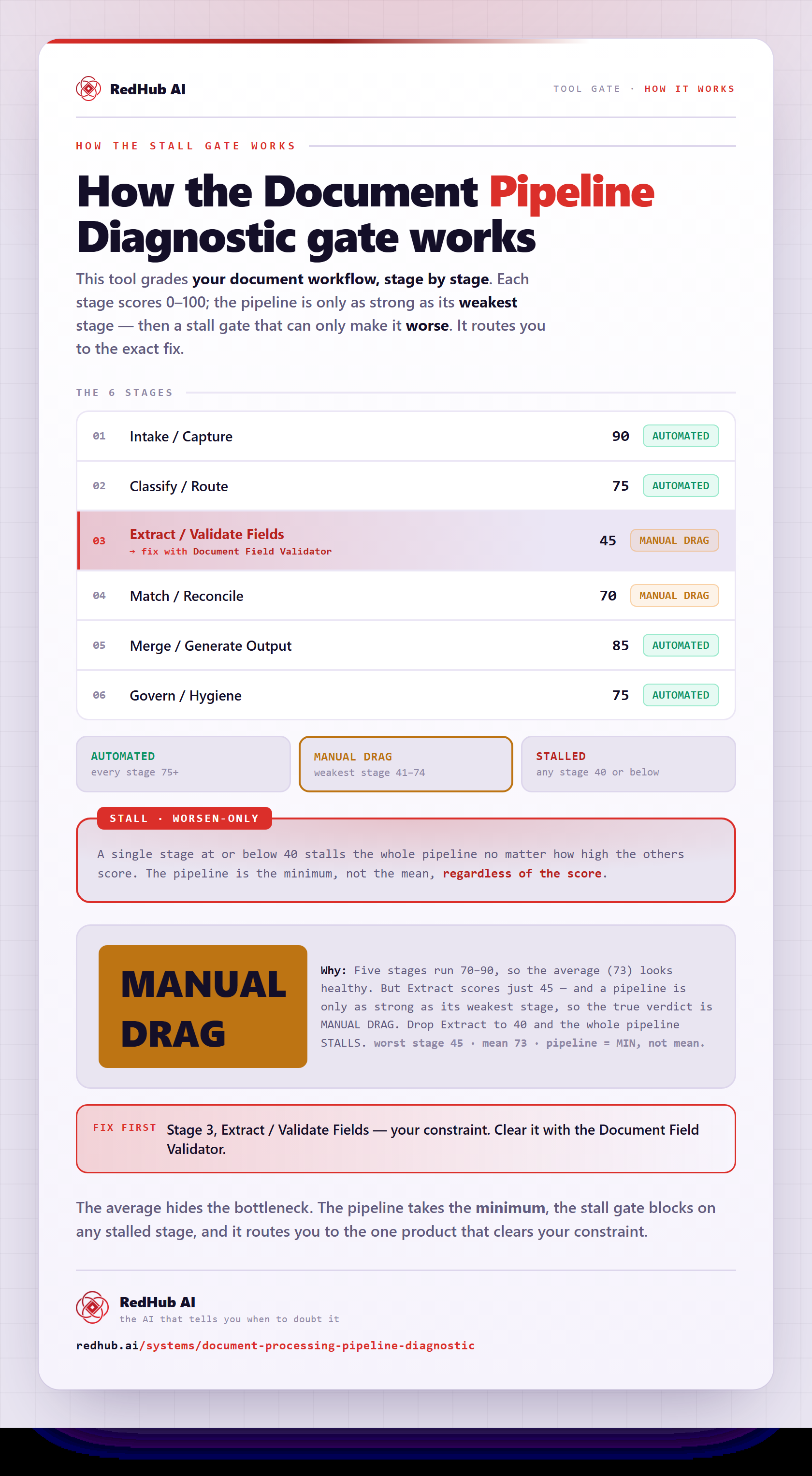
How the gate works, in one image
The six workflow stages scored and reduced to their minimum — not the mean — with the stall gate and the routing to the exact drop that clears your constraint. The same math the demo runs, as a diagram you can share or embed anywhere.
View & embed the full diagramThe pipeline score is the minimum of the six stage scores — the worst stage is the headline.
Each stage scores 0–100 as a plain fraction of your four 0–5 marks. The pipeline score is the MINIMUM, the average is context only, and a hard stall gate forces STALLED if any stage falls to 40 or below — no matter how high the others score. Here is the engine on the shipped sample:
================================================================
DOCUMENT PROCESSING PIPELINE DIAGNOSTIC
================================================================

STAGE SCORES (0-100, from your own 0-5 marks):
  1. Intake / Capture            90  AUTOMATED
  2. Classify / Route            75  AUTOMATED
  3. Extract / Validate Fields   45  MANUAL DRAG  <- CONSTRAINT
  4. Match / Reconcile           70  MANUAL DRAG
  5. Merge / Generate Output     85  AUTOMATED
  6. Govern / Hygiene            75  AUTOMATED

  Pipeline score (MIN, the headline): 45
  Mean (context only):                73.3
  Thresholds: AUTOMATED >= 75 | STALLED <= 40

VERDICT: MANUAL DRAG

FIX THIS FIRST (your constraint stage):
  Stage 3: Extract / Validate Fields (45, MANUAL DRAG)
  -> Document Field Validator (DFV-079)  redhub.ai/systems/document-field-validator

This is a gap analysis from your own inputs. You run the pipeline.
================================================================
Three operating principles keep the verdict honest.
The score is your own marks made legible — no AI scoring, no baked-in lift estimate. The same arithmetic runs in the engine, the workbook, and this page.
A stalled stage holds the whole pipeline regardless of how strong the rest is, and releases the instant it clears the floor. No happy-ears verdict.
It names a single constraint — earliest stage on a tie — and one drop to buy. Re-run after you deploy; the next constraint surfaces.
A routing diagnostic, not a magic automation that touches your documents.
- A six-stage scorer that, where a stage is short, finds your single bottleneck.
- A front door that, where a stage is short, routes the constraint to the exact fixer drop.
- Deterministic and offline — the same math in three places.
- A re-runnable check you repeat as you automate each stage.
- An automation that reads, moves, or processes your documents.
- An AI that guesses your scores — you mark each signal yourself.
- A promise of a specific time saved or a hours-back figure.
- Legal or accounting advice. It is operating hygiene.
Operators who suspect their document workflow leaks, but can't name where.
→ Intake Completeness Checker
→ Classify & Route Kit
→ Document Field Validator
→ 3-Way Match · Two-List Recon
→ Template Merge Engine
→ Naming · Dedup · PII Readiness
The diagnostic points you to these; here are the three heaviest stage-fixers.
The most common constraint — fields you still re-key by hand. PASS / REVIEW / REJECT per field.
When your reconcile stage is the bottleneck. APPROVE / HOLD / BLOCK PAYMENT with a hard payment gate.
When govern is your constraint and the risk is exposure. CLEAR / REDACT FIRST / DO NOT SHARE.
Direct answers on the headline math, the gate, and the routing.
It scores your document workflow across six stages — intake, classify, extract, reconcile, merge, and govern — from your own 0–5 marks, then, where a stage is short, names the single stage holding the whole pipeline back and the exact RedHub drop that fixes it. Run it first; it tells you which tool to buy instead of guessing across nine.
Because a pipeline is only as automated as its weakest stage. Five automated stages and one manual one is still a manual workflow — every document stops at the manual stage. So the pipeline score is the MINIMUM of the six stage scores. The average is shown only for context, and when the average is high while the minimum is low, that gap is the finding.
It can't on its own — but the pipeline can. If any single stage scores 40 or below, the stall gate forces the whole pipeline to STALLED no matter how high the other five score, because that stalled stage blocks everything downstream. Raise that stage above 40 and the gate releases; the verdict then follows the new minimum.
No. It is fully offline and deterministic — the stage score is a plain fraction of the marks you enter (100 × your marks ÷ the maximum), with no AI, no guessing, and no baked-in multiplier. The same arithmetic runs identically in the Python engine, the workbook, and the on-page demo.
The earlier stage wins the tie and becomes your constraint. The reasoning is flow order: the bottleneck you hit first in the pipeline is the one to fix first, because clearing it is what lets documents reach the later stages at all.
Two stages have more than one honest target. Match / Reconcile routes to the 3-Way Match for three procurement documents, or the Two-List Reconciliation Kit for joining two flat lists on a key. Govern / Hygiene routes to the File Naming Engine, the Duplicate Finder, or the PII Redaction Readiness Kit depending on whether your bottleneck is naming, duplicates, or PII. The diagnostic names the primary fixer; the fix-map playbook explains the fork.
Stop guessing which tool you need.
Diagnose the pipeline first.
One purchase, lifetime access, 12 months of updates. Find your constraint, fix one stage, re-run. $79, once.
Sold by RedHub AI LLC · Secured by Stripe · redhub.ai