Don't pay for goodsyou didn't receive.
Match every invoice line against the purchase order and the goods receipt before you pay — and get a clear APPROVE, HOLD, or BLOCK PAYMENT. A deterministic AP control that stops the over-bill the invoice hides.
The over-bill is invisible on the invoice — and visible only across all three documents.
The invoice is formatted perfectly, the PO number is right, the math ties — and you received fifty fewer than you're paying for.
A bill arrives for spend nobody authorized. Without a match, it slides into the run and gets paid.
Manual AP review reads the invoice in isolation. The error is only visible when all three documents are compared.
Match an AP run and watch the gate block the invoice that bills more than was received.
INV-5003 · Label Works LLC
BLOCK PAYMENT · 86%A payment-blocking check failed, so this invoice is BLOCK PAYMENT regardless of its 86% match — you don't pay for goods you didn't receive or didn't authorize, however clean the rest of the invoice looks.
2 approve · 1 hold · 2 blocked. One blocked invoice holds the run.
AP run (payments blocked): Two clean, one soft price-variance HOLD, two blocked — one over-bill, one with no PO. The run is blocked.
Every check is a fixed comparison across your own PO, invoice, and receipt — no model, no guess. The workbook and the Python engine produce these exact verdicts. The duplicate and cumulative checks read only the invoices in this run.
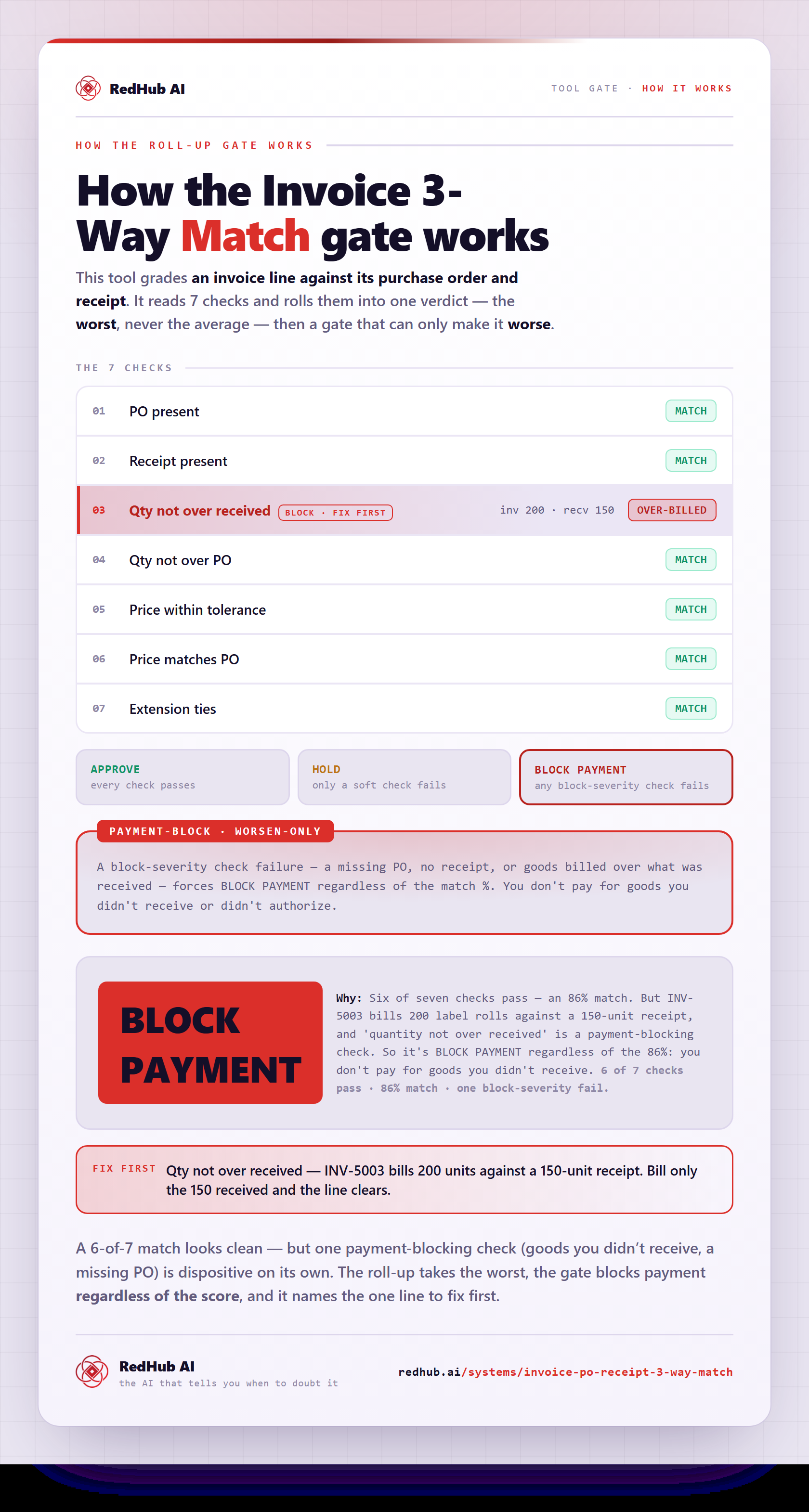
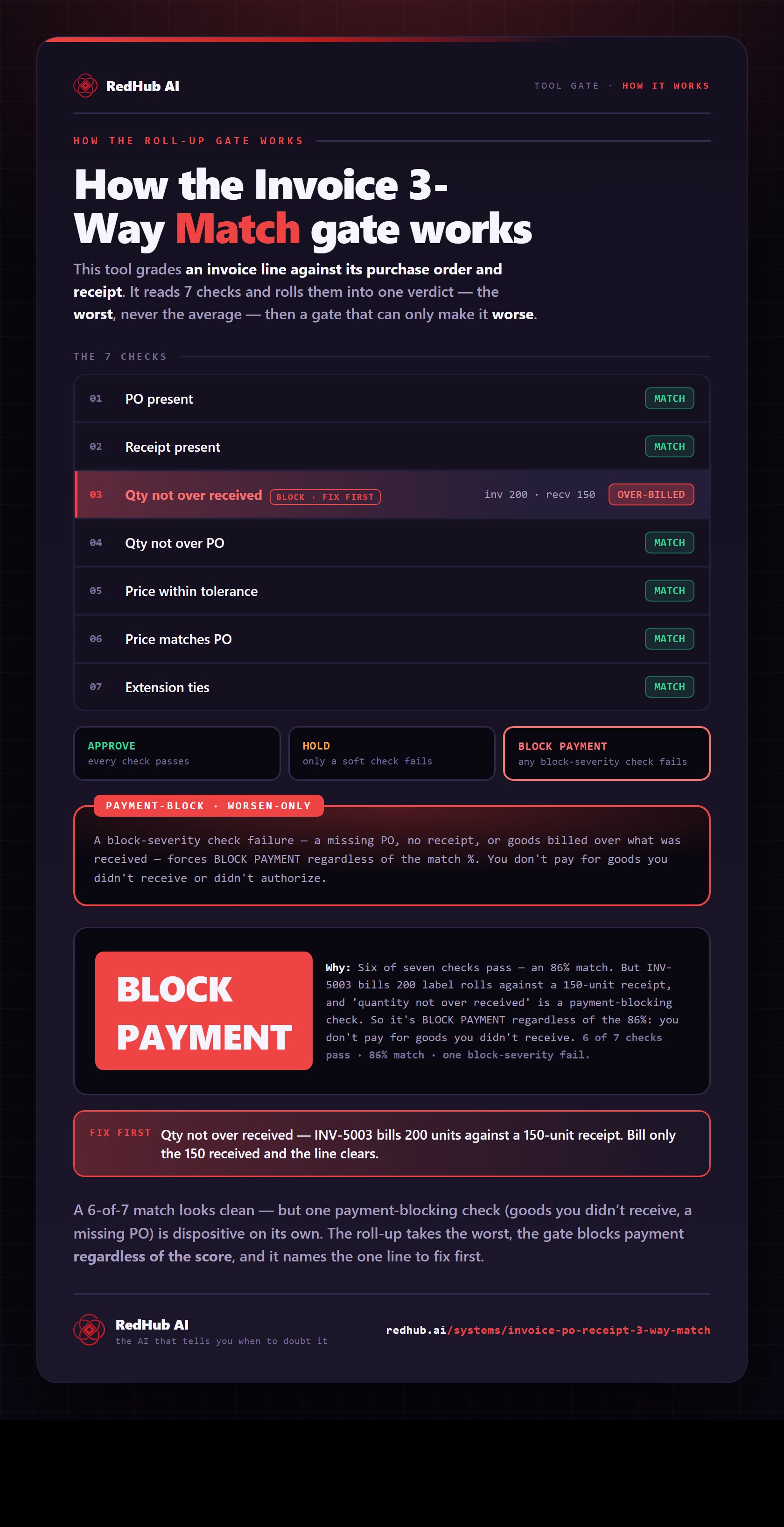
How the gate works, in one image
Seven fixed PO/receipt checks rolled up to the worst and the payment-block gate that forces BLOCK PAYMENT when an invoice bills more than was received — the same match the demo runs, as a diagram you can share or embed anywhere.
View & embed the full diagramThe same verdicts from the Python engine — every check, every invoice.
======================================================================
  INVOICE-PO-RECEIPT 3-WAY MATCH  ·  as of 2026-06-22
======================================================================
  INVOICE       VENDOR                 MATCH   VERDICT        FAILED CHECKS
----------------------------------------------------------------------
  INV-5001      Northwind Supply Co     100%   APPROVE        —
  INV-5002      Crate & Co               86%   HOLD           price_within_soft
  INV-5003      Label Works LLC          86%   BLOCK PAYMENT  qty_not_over_received  [BLOCK]
  INV-5004      Ghost Vendor Inc         14%   BLOCK PAYMENT  po_present, price_within_block, qty_not_over_received, receipt_present, price_within_soft, qty_not_over_po  [BLOCK]
  INV-5005      Wrap Supply             100%   APPROVE        —
----------------------------------------------------------------------
  APPROVE 2   HOLD 1   BLOCK PAYMENT 2
----------------------------------------------------------------------
  AP RUN: PAYMENTS BLOCKED
======================================================================
  Matches your own PO, invoice & receipt. Not accounting or legal advice.
======================================================================
INV-5003 matches 86% — right PO, right price, math ties — but bills 200 label rolls against a 150-unit receipt. That one over-bill forces BLOCK PAYMENT, and one blocked invoice holds the run. The match score is context; the gate decides. The engine also compares the invoices in a run with each other: the same vendor and invoice number twice, or the same vendor, total and PO under two invoice numbers, reads HOLD with the reason printed. It also adds up the quantity billed on each PO line across the run: when two invoices together bill more than was received, the one that takes the total past the receipt reads HOLD with the cumulative totals printed. An invoice with no lines reads HOLD, never APPROVE. It does not know invoices paid in an earlier run.
Three operating principles, enforced in the match.
Deterministic, not a model
Every check is a fixed comparison across the PO, invoice, and receipt. The same run always produces the same verdict — auditable and repeatable.
Over-bill or no-PO blocks payment
Any line that bills more than was received, references no PO, or is overcharged forces BLOCK PAYMENT regardless of the match score.
Tolerances are yours to set
Price block, price soft, quantity, and extension tolerances let you separate a real exposure from normal rounding noise.
The general-AP three-way match — not a manufacturing receiving check, not a close.
- A deterministic match of invoice vs PO vs receipt, plus two duplicate checks and a cumulative billed-quantity check across the run — same run, same verdict.
- A general AP control for any business paying vendors, services included.
- Tunable — set price, quantity, and extension tolerances to your risk.
- Transparent — engine, workbook, and demo all produce the same result.
- The manufacturing receiving-and-quality match (that's the Manufacturing Ops Pack).
- A month-end numeric close (that's the Finance & Reporting Automation Kit).
- A people-scoring tool — it matches documents, not individuals.
- An ERP or a payment processor — it gates the pay decision; you pay.
Scope: The Invoice-PO-Receipt 3-Way Match compares your own PO, invoice, and receipt against rules and tolerances you set and returns a business-judgment payment verdict. It does not score or rank people, and it is not accounting or legal advice.
Anyone approving vendor invoices who can't afford to pay for what didn't arrive.
- AP teams and bookkeepers approving vendor invoices.
- Owner-operators who pay their own bills and want a check.
- Finance ops standardizing a match before payment.
- Builders who want a deterministic AP gate in a pipeline.
- Manufacturing receiving + quality inspection (that's the Ops Pack).
- Reconciling the month-end close (that's the Finance Kit).
- Scoring or ranking people — it matches documents only.
Validate, match, defend — the honest money sequence.
Document Field Validator
Validate each invoice's fields by rule first, then match it against the PO and receipt here.
ViewFinance & Reporting Automation Kit
Once payments are clean, close the month on a workbook that checks its own tie-outs.
ViewMargin Leak Auditor
Block the overcharge here; defend the realized margin on every deal there.
ViewStraight answers on how it matches and what it blocks.
It matches every invoice line against the purchase order (what you authorized) and the goods receipt (what you actually received), keyed on PO number + line number, and runs seven fixed checks: PO present, receipt present, quantity not over received, quantity not over PO, price within block tolerance, price within soft tolerance, and the extension ties (qty × unit price = line total). Each line gets a result and each invoice a verdict — APPROVE, HOLD, or BLOCK PAYMENT. Two further checks compare the invoices in a run with each other for duplicates, and a third adds up the quantity billed on each PO line across the run. Every check is a deterministic comparison across your own three documents; no model, no judgment call.
Because of the payment-block gate. The match score is shown for context but never decides — the gate does. Any line that bills more than was received, references no PO, has no receipt, or is overcharged beyond tolerance forces BLOCK PAYMENT regardless of how high the match score is. In the worked example an invoice bills 200 label rolls against a 150-unit receipt: every other check passes (86% match) but that one over-bill blocks it, because you don't pay for goods you didn't receive or didn't authorize, however clean the rest of the invoice looks.
BLOCK PAYMENT means a payment-blocking check failed — an over-bill, a missing PO or receipt, or a price over the block tolerance — and the line should not be paid as-is. HOLD means only soft checks failed: things like a price that's off the PO by more than the soft tolerance but still within the block limit, a quantity over the PO that the receipt nonetheless covers, a duplicate flag, or a cumulative flag. An invoice with no lines also reads HOLD, because nothing was matched. HOLD is a 'look before you pay'; BLOCK PAYMENT is a 'do not pay until this is resolved.' The four editable tolerances set where a price or quantity variance starts to count, and each check's block or soft severity is set in the engine's config.json.
It catches two kinds, within one run. If the same vendor and invoice number appears more than once, or the same vendor, invoice total and PO number appear under two different invoice numbers, every invoice in that group reads HOLD instead of APPROVE and the engine prints which entry it matched. A repeat invoice otherwise passes all seven line checks, because it points at the same PO and receipt as the first copy. The limits matter: it compares only the invoices in the run (the input file, or the five on the Match Worksheet), so an invoice you paid in an earlier run is unknown unless you include it; names and numbers are compared after trimming spaces and ignoring case and nothing else, so INV-5001 and 5001 are different numbers to the first check. A flag means review the two together. It does not say which one is the mistake. Over-billing spread across invoices of different amounts is a separate check, covered in the next answer.
The cumulative check holds the one that crosses the line. Billed quantity is added up per PO line (PO number + line number) across the invoices in the run, in input order. In the shipped example one receipt covers 150 label rolls; one invoice bills 150 and a second bills 100 more. Each passes all seven line checks on its own, but the second takes the running total to 250, so it reads HOLD and the engine prints the totals: 250 billed (amount 875.00) against 150 received. The limits matter: the invoices before the one that crosses the receipt are not held, so the order of the input decides which invoice is; only the invoices in the run are added up, so quantity billed in an earlier run is unknown unless you include it; receipt rows are not added together, so enter one receipt row per PO line with the total received to date; and it is quantity that trips the check, with the amount shown beside it. A line that is over the receipt by itself still reads BLOCK PAYMENT.
Yes — four tolerances are editable cells on the Match Worksheet: a price block tolerance (default 10%), a price soft tolerance (default 2%), a quantity tolerance (default 0), and an extension tolerance (default $0.01). They separate a real exposure from normal rounding or an agreed price change, so you decide what counts as a true variance. The verdict logic is otherwise fixed and deterministic — the same AP run always produces the same verdicts.
The Manufacturing & Distribution Ops Pack ships a manufacturing-scoped receiving match (PO / receiving / quality for inventory) bundled inside a seven-skill pack. This is a standalone, general-AP three-way match for any business paying vendors — services included, not just inventory. It's also a different kind of product: a runnable engine plus a workbook that gates a payment decision, not a skill pack. If you're a manufacturer wanting the full ops suite, that pack; if you want a focused pay/hold/block control over your AP run, this.
No. It gates the pay decision and produces an APPROVE / HOLD / BLOCK PAYMENT verdict per invoice plus an AP-run rollup (AP RUN CLEAN / NEEDS REVIEW / PAYMENTS BLOCKED) — it does not connect to your bank, your ERP, or your payment system, and it moves no money. You run it against an exported AP run, act on the verdicts in your own systems, and remain responsible for what you pay. It does not score or rank people, and it is not accounting or legal advice.
New to the document-ops line? Run the Document Processing Pipeline Diagnostic first — it scores your workflow across six stages and, where a stage is short, routes you to the exact drop that fixes your bottleneck.
Match it.
Then pay it.
One purchase, lifetime access, 12 months of updates. $79, once.
Scope: matches your own PO, invoice & receipt; does not score or rank people; not accounting or legal advice.
Sold by RedHub AI LLC · Secured by Stripe · redhub.ai