The backlog alreadyset your lead time.
Your quote sheet says four weeks. Your constraint center is sitting on a six-week queue at the rate it actually earns hours — not the rate on its nameplate. This reality check computes the physics lead per work center from your own backlog and demonstrated throughput, confronts every quoted lead with it, and trips the shop the moment any queue grows faster than it burns. Every inflated promise starts here — catch it at the quote desk, not in the expedite meeting.
Your lead time is quoted off a rate sheet. Your backlog disagrees.
The sample’s CNC-MILL queue at its demonstrated 90 hours a week — while sales quotes 5. Every order accepted through that center is a week late the moment it’s acknowledged.
WELD’s queue growth — booking 70 hours a week against 48 it demonstrably burns. Today it reads COVERED. In a month its queue has grown by almost two weeks of lead. The snapshot can’t see it; the gate can.
The sample shop’s total backlog across seven centers — the number that actually sets the lead time, whatever the rate sheet says. Five numbers per center is all the tool needs.
Seven centers, one constraint, one growing queue — live.
| Center | Backlog hrs | Demo hrs/wk | Intake hrs/wk | Quoted wks | Computed wks | Read | Queue |
|---|---|---|---|---|---|---|---|
| SAW | 2.0 | COVERED | steady | ||||
| CNC-MILL | 6.0 | CUTTING IT CLOSE | steady | ||||
| WELD | 2.0 | COVERED | +22/wk | ||||
| PAINT | 2.0 | COVERED | steady | ||||
| ASSY | 3.0 | CUTTING IT CLOSE | steady | ||||
| INSPECT | 1.5 | COVERED | steady | ||||
| BRAKE | 2.0 | COVERED | steady |
Try it: drop WELD’s intake from 70 to 46 and the gate releases — the verdict falls back to QUOTING TIGHT and fix-first moves to CNC-MILL, the center quoting 5 weeks on a 6-week queue.
Same math as the engine and the workbook — byte-for-byte, exact at every boundary. Nothing here is scored by AI, nothing leaves this page, and the verdict will not soften because you wanted it to.
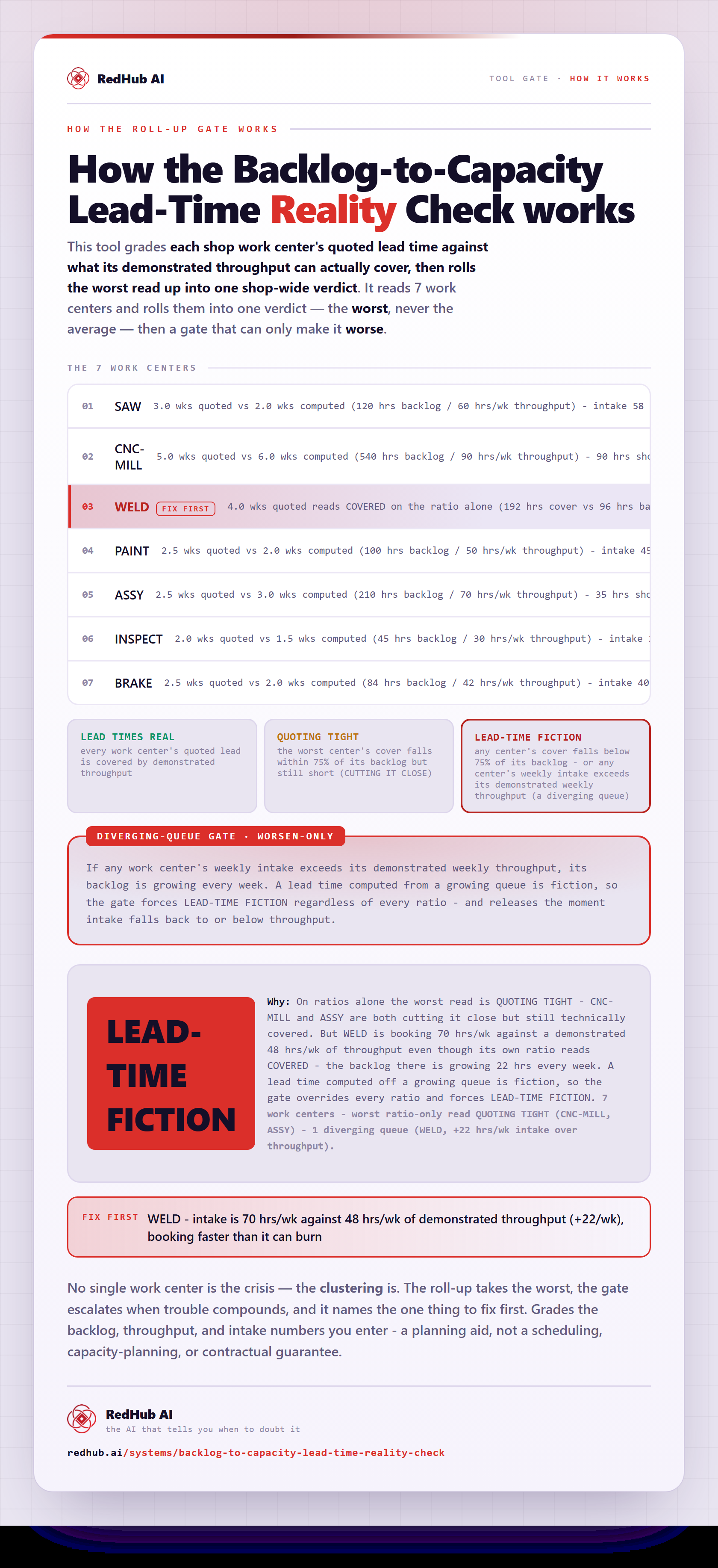
How the gate works, in one image
How the Backlog-to-Capacity Lead-Time Reality Check rolls up work centers and catches the one diverging queue that makes an on-schedule shop lie — the same math the demo runs, as a diagram you can share or embed anywhere.
View & embed the full diagramA physics check you can run, not a consultant you can argue with.
The engine is zero-dependency Python — point it at a five-column CSV of your work centers and it prints every center’s computed lead, its read, the queue slope, and the verdict. The workbook reproduces the identical math for the spreadsheet-native, and the demo above runs the same logic. Band boundaries are exact cross-multiplications, so all three layers agree at every edge. This is the engine’s verbatim output on the shipped sample:
BACKLOG-TO-CAPACITY LEAD-TIME REALITY CHECK - BLR-079
==============================================================
Work centers read: 7   Total backlog: 1,195 hours

CENTER     BACKLOG  DEMO/WK  INTAKE/WK  QUOTED  COMPUTED  READ             QUEUE
SAW            120       60         58     3.0       2.0  COVERED          steady
CNC-MILL       540       90         88     5.0       6.0  CUTTING IT CLOSE steady
WELD            96       48         70     4.0       2.0  COVERED          DIVERGING +22/wk
PAINT          100       50         45     2.5       2.0  COVERED          steady
ASSY           210       70         66     2.5       3.0  CUTTING IT CLOSE steady
INSPECT         45       30         28     2.0       1.5  COVERED          steady
BRAKE           84       42         40     2.5       2.0  COVERED          steady

Worst-center read: QUOTING TIGHT
DIVERGING QUEUE: WELD booking 70 hrs/wk against 48 demonstrated (+22/wk) - a lead computed from a
growing backlog is fiction. Verdict forced to LEAD-TIME FICTION.

VERDICT: LEAD-TIME FICTION
Fix first: WELD
Built so the verdict can’t be negotiated.
Demonstrated, never nameplate
The lead is computed from what each center actually earned per week over a trailing window — setups, rework, and absenteeism included. Nameplate capacity is the first lie in most quote sheets, and this tool refuses to inherit it.
The gate sees the slope
A center booking more hours per week than it burns forces LEAD-TIME FICTION even while its snapshot ratio reads COVERED — because a lead computed from a growing backlog is already wrong, it just hasn’t happened yet. Worsen-only: the gate never lifts a verdict, and it releases the moment intake falls to or below throughput.
Exact at every boundary
Bands compare quoted × demonstrated hours against backlog hours by cross-multiplication — no division, no epsilon, no rounding games at the edges. The worst center sets the shop’s headline, because averaging seven centers is how the constraint hides.
A reality check for the quote desk, not a scheduler.
- A deterministic, offline read of five numbers per work center — engine, workbook, and demo produce the identical verdict from the identical rows, exact at every band boundary.
- The pre-quote sibling of the Promise-Date Integrity Tripwire: PDI measures the promises you already broke; this catches the next one before it’s made.
- A weekly discipline: the runbook installs the demonstrated-hours ritual, the intake throttle, and the re-quote rule for the constraint center.
- A scheduler, an APS module, or an ERP integration. It sequences nothing, connects to nothing, and reads nothing you don’t type in.
- A capacity model with a queueing theory PhD. It is deliberately the arithmetic your constraint center already obeys — backlog over burn — because that’s the number your quote sheet ignores.
- A performance review. It grades a shop’s quoting physics — never a scheduler, an estimator, or any person. Fix-first names a work center, not a name.
Scope note. This tool grades a shop’s quoting physics from five numbers you enter per work center — it scores work centers and quotes, never people, and it schedules nothing. Quoted lead times can carry contractual weight once acknowledged; what a quoted lead legally obligates you to is a question for your contracts and your counsel. Not scheduling software and not legal advice.
Anyone quoting weeks while the queue speaks in hours.
Job shops and fabricators whose quoted leads haven't been reconciled with the backlog since the rate sheet was printed
Owners who keep hearing “we're at capacity” and “quote four weeks” in the same Monday meeting
Quote-desk and inside-sales teams who need a defensible number when a customer pushes on lead time
Ops managers who suspect one center sets every late date and want it named with arithmetic, not opinion
Shops recovering from PROMISE INFLATION that need the next promise set from physics, not habit
Anyone adding a shift or a machine who wants the before/after measured on the same yardstick
The capacity leg of the honesty desk.
OEE Honesty Grader
$99Audit the throughput number itself — whether the demonstrated hours you feed this tool are even real.
AI Pricing & Quote Intelligence Studio
$99The pricing side of the same quote desk — what to charge, once you know what you can honestly promise.
PM Deferral & Pencil-Whip Tripwire
$89Why demonstrated throughput decays — the maintenance that stayed green while the work never happened.
Straight answers, before you pay.
One physics fact per work center: computed lead = backlog hours ÷ demonstrated weekly hours, where demonstrated means actual earned hours over a trailing window — never nameplate capacity. Your quoted lead is confronted with it per center (COVERED / CUTTING IT CLOSE / FICTION), and the shop's headline rides the worst center, because a quote is only as real as its constraint.
A worsen-only override: any center booking more hours per week than it demonstrably burns forces the verdict to LEAD-TIME FICTION, whatever every ratio says. A lead computed from today's backlog is fiction when the backlog grows every week — the ratio sees the queue, the gate sees the queue's slope. It releases the moment intake falls to or below throughput, and it never lifts a verdict.
Because nameplate capacity is the first lie in most quote sheets. A center rated for 80 hours a week that has earned 48 a week for two months has a demonstrated throughput of 48 — absenteeism, setups, rework, and maintenance included. Feed the tool the rate sheet instead of the actuals and every verdict downstream inherits the fiction.
Five numbers: the center name, backlog hours (released plus firm orders queued today), demonstrated weekly hours (trailing 6–8 weeks of actuals), intake weekly hours (new hours booked per week, same window), and the lead time sales quotes for work through that center. No dates, no ERP connection — most shops can fill the ledger from a dispatch list and a booking report in twenty minutes.
No — they're exact. The bands compare quoted × demonstrated hours against backlog hours by cross-multiplication, so there's no division and no epsilon. The engine, the workbook, and this page's demo agree at every boundary, not just in the middle; the 1-decimal computed lead you see is display only.
It grades a shop's quoting physics — never a person. Fix-first names a work center to act on, not someone to blame. It's deterministic and offline: same five numbers in, same verdict out, every run. Not scheduling software, not an ERP module, and not legal advice.
The queue doesn’t read the quote sheet.
Quote what the queue can keep.
One purchase, lifetime access, 12 months of updates. $79, once.
Grades the shop’s quoting physics, never a person. Not scheduling software or legal advice.
Sold by RedHub AI LLC · Secured by Stripe · redhub.ai