A referral system —or a lucky streak?
Referrals are an advisory firm's cheapest, highest-converting channel — and the one most often left to chance. Mark six dimensions of referral health and find out whether your engine is systematic, leaking, or running on luck, plus, where a dimension is short, the one thing to fix first.
Everyone gets referrals. Far fewer have a system that produces them on purpose.
The ask that never happens
Most advisory referrals come from an ask nobody makes systematically — it happens when someone remembers, which is to say rarely and unpredictably.
The COI pipeline that's really a contact list
A CPA you 'have a good relationship with' but never speak to on purpose isn't a pipeline. Centers of influence are the highest-yield source an RIA has — when they're worked deliberately.
The arrangement that's a liability
The moment a referral is compensated, it touches the Marketing Rule. An arrangement with no agreement and no disclosure isn't a strong system with a weak spot — it's a risk.
Mark six dimensions per firm. Two gates catch what a score would hide.
Mark each dimension 0/1/2 on evidence. The verdict falls out.
Fix first: Ask cadence & triggers — the weakest dimension across the portfolio.
Two firms read AD HOC for different reasons: Meridian scores 72 yet fails because its compliance dimension (dotted •) is zero — an arrangement without that evidence is not treated as complete. The Solo practice scores 62 yet fails the no-engine floor — with both growth dimensions (▸ ask cadence and COI pipeline) at zero, there's no engine at all. The verdict comes from your own evidence marks; it grades a referral system, never people, and rules on no specific arrangement. Compensating referrals touches the Marketing Rule — confirm with counsel. Not legal advice.
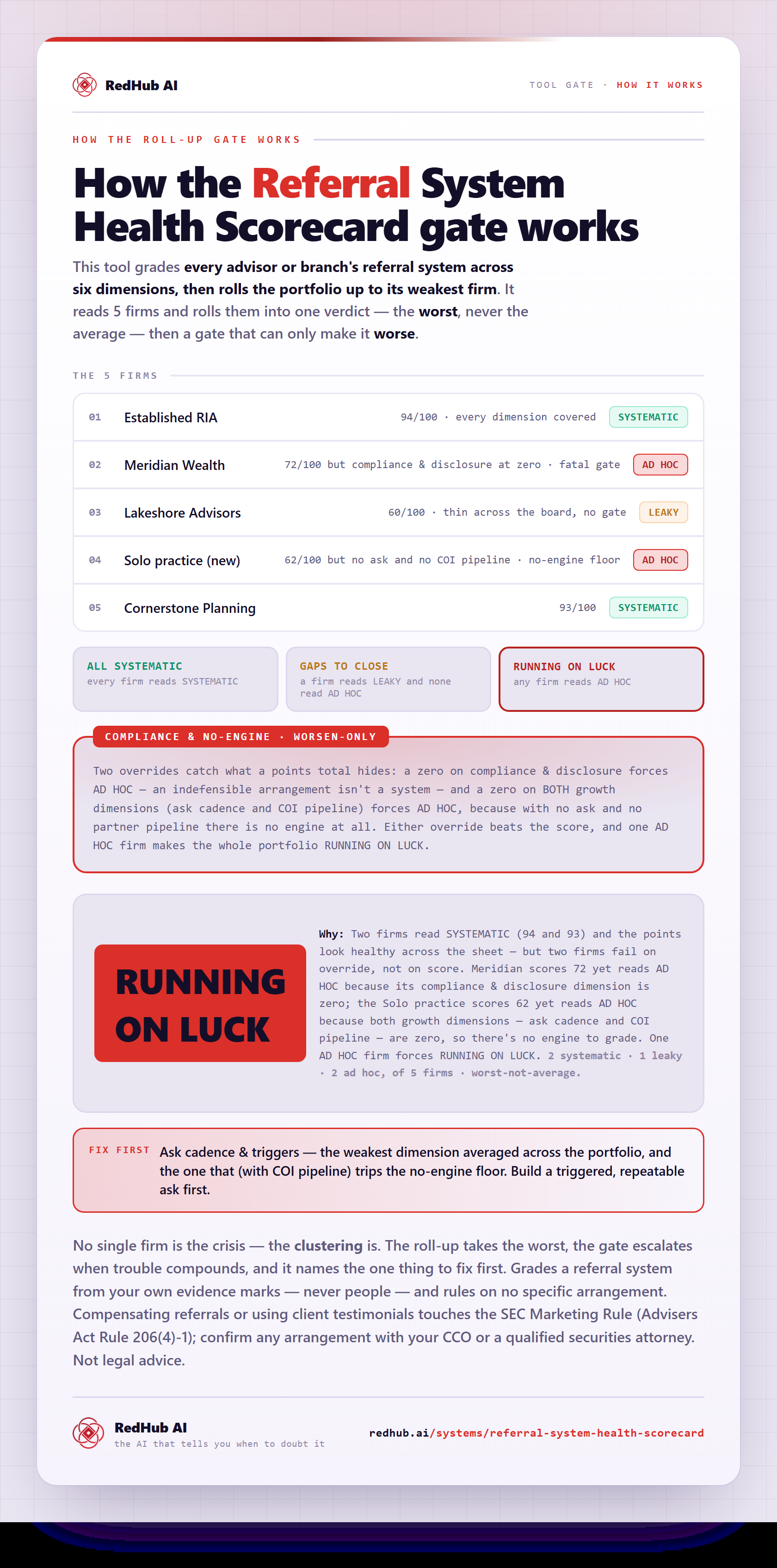
How the gate works, in one image
How the Referral System Health Scorecard rolls a portfolio up to its weakest firm and reads RUNNING ON LUCK when disclosure scores zero — the same math the demo runs, as a diagram you can share or embed anywhere.
View & embed the full diagramThe same verdict from the command line.
The workbook and a zero-dependency Python engine produce identical results. Point the engine at a firms file and it prints the referral-engine read — verbatim below, from the shipped sample.
==============================================================================
  REFERRAL SYSTEM HEALTH SCORECARD
  Referral-engine read - as of 2026-07-05
==============================================================================

  PORTFOLIO VERDICT ..... RUNNING ON LUCK
  Firms graded .......... 5
  2 systematic  -  1 leaky  -  2 ad hoc
  Fix first ............. Ask cadence & triggers

------------------------------------------------------------------------------
  FIRM / ADVISOR           CAD COI ADV TRA COM REC SCORE  VERDICT
------------------------------------------------------------------------------
  Established RIA            2   2   2   2   2   1    94  SYSTEMATIC
  Meridian Wealth            2   2   1   2   0   2    72  AD HOC
  Lakeshore Advisors         1   1   1   1   2   1    60  LEAKY
  Solo practice (new)        0   0   2   2   2   2    62  AD HOC
  Cornerstone Planning       2   2   2   1   2   2    93  SYSTEMATIC
------------------------------------------------------------------------------

  ! Meridian Wealth scores 72 on points yet reads AD HOC:
    the compliance & disclosure dimension is at zero.
    A referral arrangement that isn't compliant isn't a system - it's
    a liability, and cadence or COI polish can't buy that back.

  KEY: CAD=Ask cadence & triggers | COI=Centers-of-influence pipeline | ADV=Advocacy identification | TRA=Tracking & attribution | COM=Compliance & disclosure | REC=Reciprocity & nurture loop

  The verdict comes from your own evidence marks - no benchmark. It
  grades a referral system, never people, and rules on no specific
  arrangement. Compensating referrals or testimonials touches the
  Marketing Rule - confirm any arrangement with your CCO or counsel.
  Not legal advice.
==============================================================================Six weighted dimensions, two of them able to override the score.
Ask cadence & triggers
A triggered, repeatable ask — not one that waits for someone to remember.
COI pipeline
CPAs and estate attorneys worked on purpose, with two-way reciprocity.
Advocacy identification
Promoters found from real satisfaction signals, so the ask lands right.
Tracking & attribution
Every referral sourced, tracked to origin, and followed up.
Compliance & disclosure
Required agreement and disclosure evidence identified for review where compensated.
Reciprocity & nurture
Advocates and COIs get value back; the loop is closed.
Each dimension is marked 0/1/2 on evidence; the weights sum to 100 for a 0–100 score, banded SYSTEMATIC (75+) / LEAKY (50–74) / AD HOC (under 50). Two overrides catch what a score hides: a zero on compliance forces AD HOC (an arrangement without the applicable agreement or disclosure evidence is not treated as complete by this scorecard), and a zero on both growth dimensions forces AD HOC (with no ask and no pipeline, there's no engine at all).
A grader of the referral system you have. Not a builder, and not compliance advice.
What it is
- A diagnostic that grades an existing referral system
- Six dimensions built for advisory referrals (advocacy + COIs)
- A per-firm verdict with a compliance gate and a no-engine floor
- A portfolio rollup across advisors, with the dimension to fix first where a dimension is short
What it isn't
- Not a referral-program builder (that's the Advocacy Engine)
- Not legal or compliance advice, and not a ruling on any arrangement
- Not a guarantee of referral volume
- Not a score of any person — it grades a system
The verdict comes from your own evidence marks — no benchmark, nothing uploaded. It grades a referral system, never people, and rules on no specific arrangement. Compensating referrals or using client testimonials touches the SEC Marketing Rule (Advisers Act Rule 206(4)-1); confirm any arrangement with your CCO or a qualified securities attorney. Not legal advice.
Anyone who wants referrals to be a channel, not a surprise.
RIA principals
Your cheapest growth channel is referrals — find out whether it's a system you can scale or a streak you can't repeat.
Advisory firm partners
Grade every advisor on the same six dimensions; the portfolio verdict follows the weakest one, so you know where the leak is.
Compliance-minded advisors
See your referral arrangements graded against the Marketing-Rule reality before an examiner asks — the compliance gate is built in.
Firms leaning on COIs
The COI pipeline is weighted heaviest among the growth dimensions. See whether your CPA and attorney relationships are a pipeline or a contact list.
Grade the referral engine here; build the pieces and the funnel next door.
Customer Referral & Advocacy Engine
The build-it companion: the Identify / Ask / Reward / Amplify / Track loop and compliant templates that assemble the system this scorecard grades.
ViewLead-Gen Funnel Diagnostic
Grades the whole marketing funnel and, where a stage is short, names the constraint stage — the broader view above the referral channel this scorecard zooms into.
ViewAI Reputation & Reviews Engine
Earns and responds to reviews compliantly — the advocacy signals that feed the identification dimension, on the right side of the FTC rule.
ViewBefore you buy.
Stop leaving referrals to luck.
Grade the system.
One purchase, lifetime access, 12 months of updates. $79, once.
Grades a referral system, not people; rules on no specific arrangement. Compensating referrals touches the Marketing Rule — confirm with your CCO or counsel. Not legal advice.
Sold by RedHub AI LLC · Secured by Stripe · redhub.ai