Your funnel is onlyas fast as its tightest stage.
Grade all six stages of your lead funnel, find the one that's choking it, and get routed to the fix. The diagnostic reports your weakest stage — not the average that flatters you — so you fix the thing that actually limits flow.
One weak stage caps the whole funnel — and the average hides it.
Throughput is set by your weakest stage. Five great stages can't make up for one broken one downstream.
A funnel can average 71 and still be LEAKING — because one stage at 46 caps everything that flows through it.
Without the constraint named, you polish stages that aren't your problem. Motion without progress.
Score your six stages and watch the constraint surface.
Speed-to-lead
Do you reach leads while warm?One or two stages drag the whole funnel. Fix the constraint stage first.
Speed-to-lead (46) is your constraint — fix it with the Speed-to-Lead Routing Kit before optimizing anything else.
Slow to respond (leaking): Five solid stages, but speed-to-lead drags — the mean looks fine, the constraint doesn't.
The headline is your lowest stage, not the average — a funnel flows only as fast as its tightest stage. Every number derives from the ratings you set. The workbook and the Python engine produce this exact result.
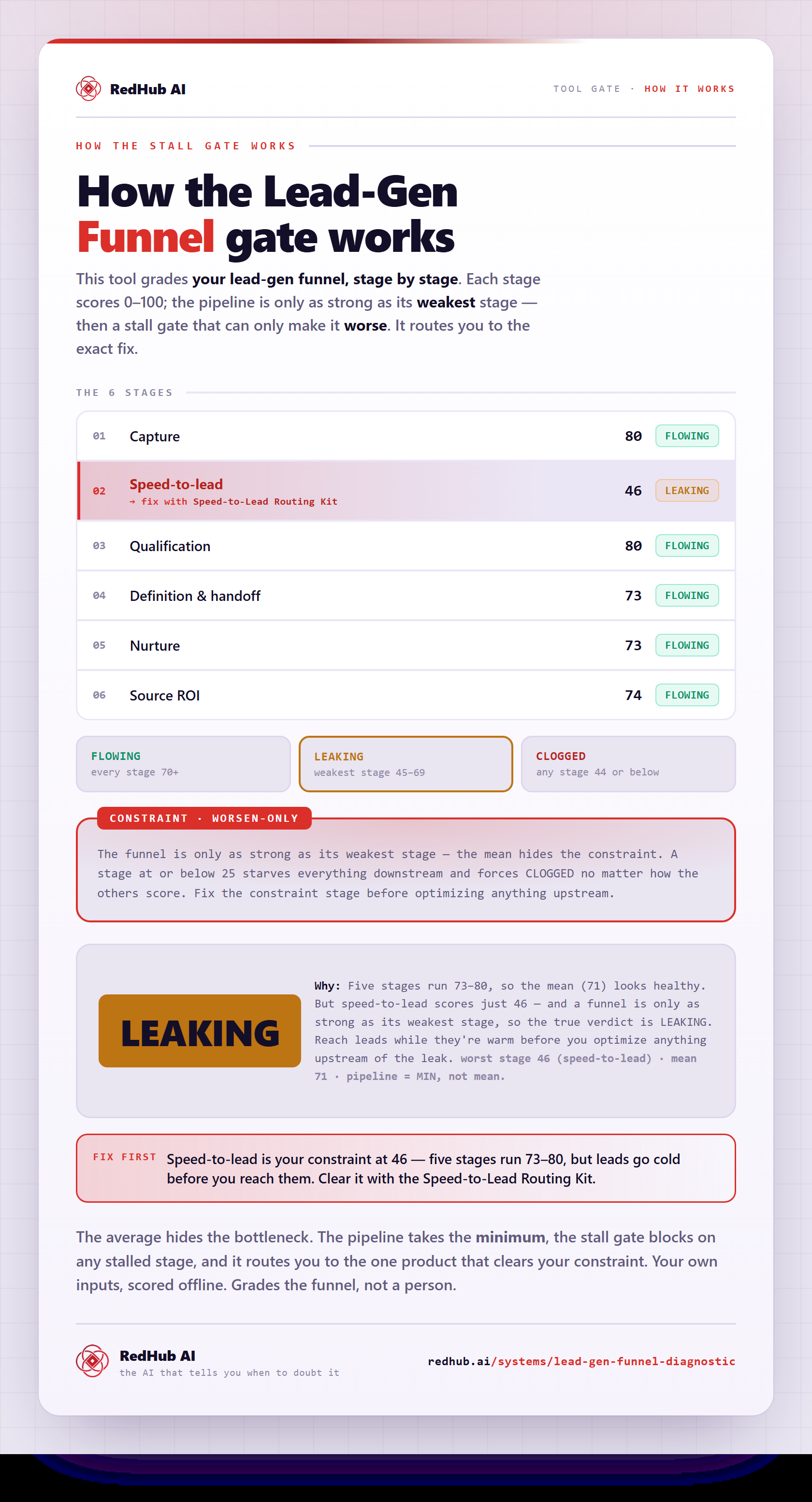
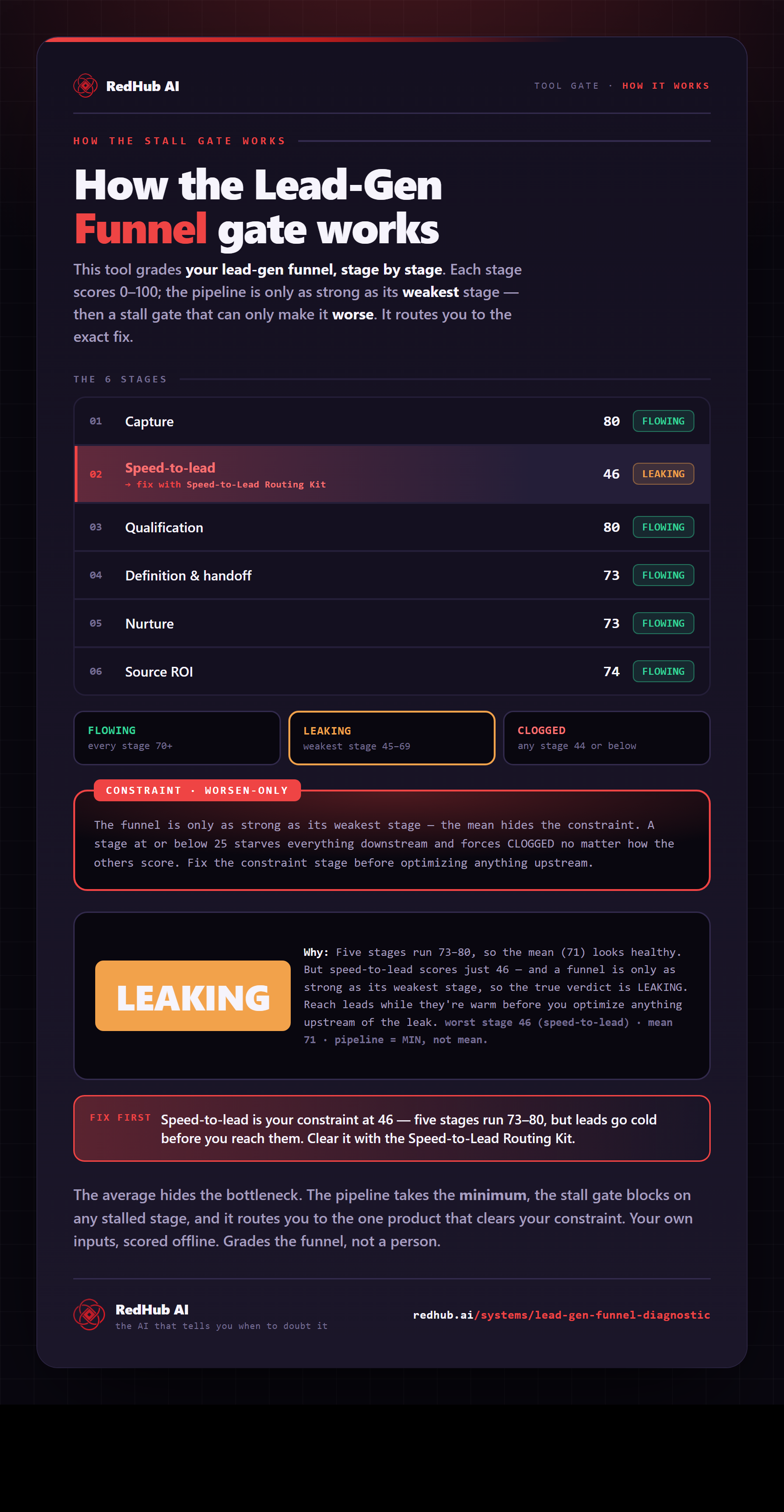
How the gate works, in one image
Six funnel stages scored 0–100 and the constraint gate that reads the weakest stage, not the mean — a 71-mean funnel still LEAKS when speed-to-lead is 46. The same math the demo runs, as a diagram you can share or embed anywhere.
View & embed the full diagramThe same diagnosis from the Python engine — constraint named, fix routed.
================================================================
  LEAD-GEN FUNNEL DIAGNOSTIC  ·  as of 2026-06-22
================================================================
  STAGE                  SCORE   STATUS
----------------------------------------------------------------
  Capture                   80
  Speed-to-lead             46   <-- CONSTRAINT
  Qualification             80
  Definition & handoff      73
  Nurture                   73
  Source ROI                74
----------------------------------------------------------------
  Mean stage score       71 / 100  (context only)
  Funnel score           46 / 100  (the constraint stage)
----------------------------------------------------------------
  VERDICT: LEAKING
----------------------------------------------------------------
  FIX FIRST: Speed-to-lead  (score 46)
  -> Speed-to-Lead Routing Kit  [/systems/speed-to-lead-routing-kit]
================================================================
The mean is 71 — which looks FLOWING. But Speed-to-lead at 46 is the constraint, so the verdict is LEAKING and the fix is routed straight to the Speed-to-Lead Routing Kit. The average flatters; the bottleneck fixes.
Three operating principles, enforced in the math.
It reports the constraint
The headline is your lowest stage, not the average. The average is shown only for context. You act on the bottleneck.
A broken stage breaks the funnel
Any stage at or below the floor forces CLOGGED regardless of the average. A dead stage starves everything downstream.
It routes you to the fix
Each stage maps to the exact drop that fixes it. Fix the constraint, re-score, and it points to the next-weakest.
A diagnostic and a router, not a benchmark and not a fixer.
- A six-stage funnel score that reports your constraint, not the average.
- A router: each stage maps to the exact drop that fixes it.
- Transparent — engine, workbook, and demo all produce the same result.
- Honest by design — every number traces to your inputs.
- A benchmark of “good” numbers — it grades your funnel against your own ratings.
- The fix itself — the fixes live in the stage-specific drops it routes you to.
- A people-scoring tool — it grades funnel stages, not individuals.
- A guess — no baked-in benchmark, no invented number.
Scope: The Lead-Gen Funnel Diagnostic grades your own funnel stages and returns a business-judgment verdict. It does not score or rank people, it is not for hiring, tenant, or credit screening, and it is not legal advice.
Anyone spending on leads who isn't sure where the funnel breaks.
- Founders unsure which part of the funnel to fix first.
- Marketers spending on leads that aren't converting to pipeline.
- RevOps standing up or auditing a lead funnel end-to-end.
- Anyone deciding which RedHub lead-gen drop to buy first.
- Scoring or ranking people — it grades funnel stages only.
- Hiring, tenant, or credit screening.
- Anyone wanting an industry benchmark — this grades your own funnel.
The diagnostic routes you to the drop that fixes your constraint.
Inbound Lead Qualification Engine
If Qualification is your constraint — score inbound leads against a real rubric.
ViewLead Nurture Decision System
If Nurture is your constraint — decide advance / nurture / recycle / drop per lead.
ViewSpeed-to-Lead Routing Kit
If Speed-to-lead is your constraint — reach new leads while they're still warm.
ViewStraight answers on how it diagnoses and what it won't do.
Where a stage is short, it finds your constraint — the single stage that's capping your whole lead funnel. It scores six stages (capture, speed-to-lead, qualification, definition & handoff, nurture, source ROI) 0–100, reports the lowest-scoring stage as your funnel score, and returns FLOWING, LEAKING, or CLOGGED. Where a stage is short it names the bottleneck and routes you to the exact RedHub drop that fixes it. It diagnoses the funnel and, where a stage is short, points you at the fix; it isn't the fix itself.
Because a funnel is a chain, not an average — throughput is set by the weakest stage, not the mean of all of them. Averaging six stages into one healthy-looking number hides the one stage that's actually limiting flow, so you end up polishing stages that were never the problem. The diagnostic shows the mean only for context; the headline funnel score is the constraint stage, because that's the number that's really capping your pipeline.
Because of the broken-stage gate. If any single stage scores at or below 25 — effectively non-functional — the verdict is forced to CLOGGED no matter how strong the other five are. One dead stage starves everything downstream of it, so a healthy average is false comfort: a funnel with a dead capture stage isn't 'mostly fine,' it's broken at the top. Unblock the dead stage before optimizing anything else.
Each of the six stages maps to the specific RedHub drop that fixes it — capture → Lead-Capture Page Kit, speed-to-lead → Speed-to-Lead Routing Kit, qualification → Inbound Lead Qualification Engine, definition & handoff → MQL to SQL Definition & Handoff Kit, nurture → Lead Nurture Decision System, source ROI → Lead Source ROI Scorecard. Where a stage is short the diagnostic names your constraint and points you straight at its fixer, so you buy and fix the right thing first. Fix it, re-score, and it points to the next-weakest stage.
Each stage is rated on three sub-criteria, marked 0–5 against weights that sum to 100, so each stage score is the sum of (mark ÷ 5 × weight) — a 0–100 number. The funnel score is the minimum of the six stage scores (the constraint), which maps to FLOWING (70+), LEAKING (45–69), or CLOGGED (under 45) — then the broken-stage gate is applied. Every number traces to your own ratings; there's no baked-in benchmark. The included Python engine and workbook compute it identically.
No to both. It grades your own funnel stages against the ratings you enter — it does not score or rank people, and it's not for hiring, tenant, or credit screening. It also isn't an industry benchmark of 'good' numbers: the verdict comes from your funnel, not a comparison to anyone else's. It's a business-judgment diagnostic, not legal advice.
Find the bottleneck.
Fix the right thing first.
One purchase, lifetime access, 12 months of updates. $79, once.
Scope: grades your own funnel stages; does not score or rank people; not for hiring, tenant, or credit screening; not legal advice.
Sold by RedHub AI LLC · Secured by Stripe · redhub.ai