Is this AI agent worthbuilding — or will the controls eat the ROI?
Over 40% of agentic AI projects get canceled — most because the mitigation an agent needs costs as much as it returns. This gate scores a proposed agent on six use-case-fit dimensions, runs the money against the controls, and returns one verdict: BUILD, PILOT FIRST, or DON'T BUILD. Before the budget is spent.
The agent that looked great on paper gets killed by its own guardrails.
of agentic AI projects are forecast to be canceled by end of 2027 — escalating cost, unclear value, inadequate controls.
the recurring killer: the validation layers, oversight, and maintenance an agent needs often wipe out the projected return.
of the thousands of vendors claiming “agentic” are real — the rest is automation rebranded, sold at an agentic price.
Score a proposed agent. Watch a 94 still read DON'T BUILD.
The two gates worsen only — they hold a project back, never promote it. The score comes from your own marks; no industry multiplier, nothing uploaded.
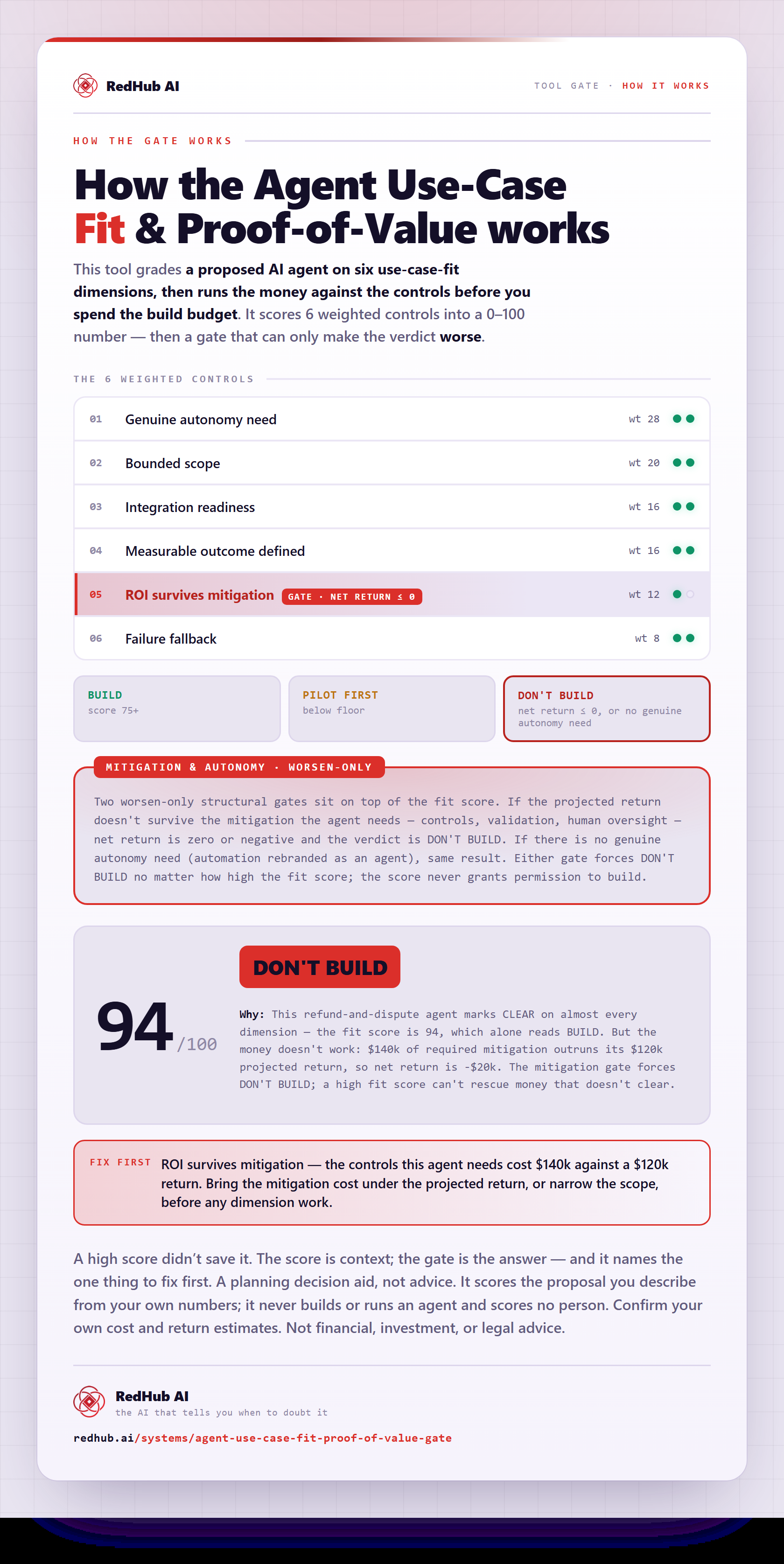
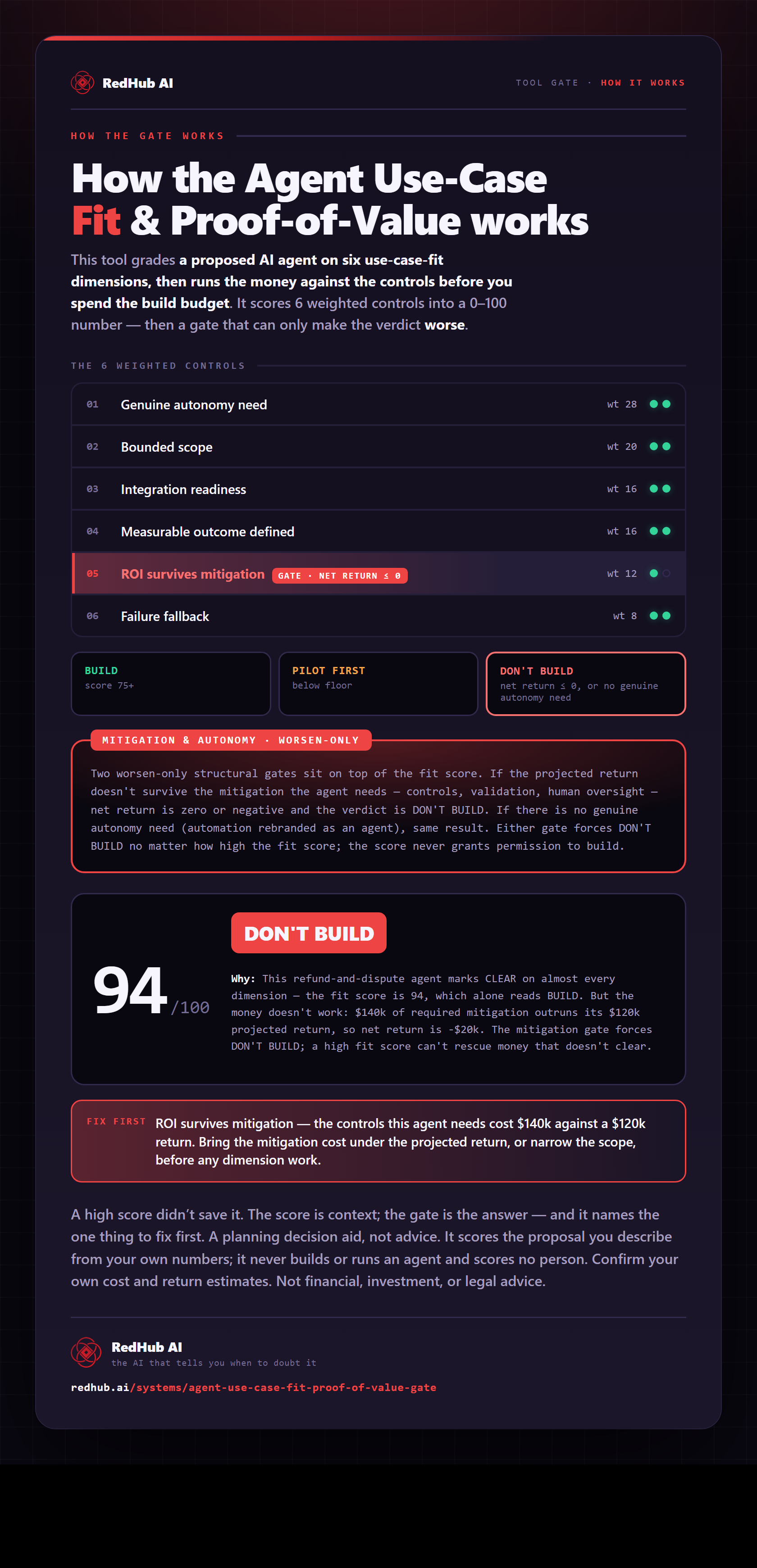
How the gate works, in one image
How the Agent Use-Case Fit & Proof-of-Value Gate scores an agent's fit and forces DON'T BUILD when the money doesn't clear or it can't act on its own — the same math the demo runs, as a diagram you can share or embed anywhere.
View & embed the full diagramOne command grades your whole agent slate.
The zero-dependency Python engine reads your projects and returns the verdict, the net return, and, where a signal is short, the one thing to fix first — the same logic the workbook and the demo run. Verbatim output on the shipped 6-project sample:
$ python3 auf_engine.py sample_projects.csv
==================================================================
  AGENT USE-CASE FIT & PROOF-OF-VALUE GATE
==================================================================

  Refund & dispute resolution agent
    fit score : 94/100   net return : $-20,000
    verdict   : DON'T BUILD  [gate: mitigation erases ROI]
    fix first : ROI survives mitigation

  Invoice-coding & AP triage agent
    fit score : 100/100   net return : $140,000
    verdict   : BUILD

  Lead-research enrichment agent
    fit score : 72/100   net return : $34,000
    verdict   : PILOT FIRST
    fix first : Bounded scope

  FAQ "agent" (canned answers)
    fit score : 64/100   net return : $27,000
    verdict   : DON'T BUILD  [gate: no genuine autonomy]
    fix first : Genuine autonomy need

  Contract-redline drafting agent
    fit score : 60/100   net return : $35,000
    verdict   : PILOT FIRST
    fix first : Bounded scope

  Inventory-reorder decision agent
    fit score : 92/100   net return : $128,000
    verdict   : BUILD
    fix first : Integration readiness

------------------------------------------------------------------
  PORTFOLIO : STOP-FIRST   (BUILD 2 / PILOT 2 / DON'T BUILD 2)
  mean fit  : 80.3 (context only)
  work first: FAQ "agent" (canned answers)
------------------------------------------------------------------Three principles keep the verdict honest.
If the return doesn’t survive the mitigation the agent needs, no fit score can rescue it. The gate decides; the score is context.
A gate can hold a project back, never promote one. A clean BUILD is earned on fit and on the math — not handed out by a high average.
Every verdict comes from your own marks and your own two dollar figures. No baked-in benchmark, no AI scoring, nothing uploaded.
A pre-build decision aid, not an agent tester.
- A go/no-go gate for a proposed agent, run before any budget is spent.
- Six use-case-fit dimensions plus the ROI-vs-mitigation math, in one verdict.
- A slate grader — score every proposed agent, get the one to work first where anything is short.
- Not a tester — it never builds, runs, or connects to an agent.
- Not the go-live control check (that's the Go-Live Readiness Gate).
- Not a guarantee of outcome, and it scores no person.
A planning decision aid, not advice. It scores the proposal you describe from your own numbers; it never builds or runs an agent and scores no person. Confirm your own cost and return estimates. Not financial, investment, or legal advice.
The person who has to defend the agent roadmap.
Decide here. Deploy and run there.
Once you decide to build, grade the operational controls before you flip it live.
Audit what your agents and connectors can actually touch — scope, writes, staleness.
Evaluate a built agent at the trajectory level and gate CI on ship / hold / fix.
The questions buyers ask first.
Because the fit score is context, not the decision. The Agent Use-Case Fit & Proof-of-Value Gate runs two worsen-only structural gates on top of the score, and the first one is dispositive: if the projected return doesn't survive the mitigation the agent needs — the controls, validation layers, and human oversight — net return is zero or negative and the verdict is DON'T BUILD no matter how strong the fit looks. The refund-agent example scores 94 and still reads DON'T BUILD because its $140k of required mitigation outruns its $120k return. A high score can't rescue money that doesn't work.
Each proposed agent is marked MISSING / PARTIAL / CLEAR (0/1/2) on six use-case-fit dimensions, weighted to 100: genuine autonomy need (28), bounded scope (20), integration readiness (16), measurable outcome defined (16), ROI survives mitigation (12), and failure fallback (8). The weighted marks produce the 0–100 fit score. Then you enter two dollar figures — annual mitigation cost and projected annual return — and the gate runs the money against the marks to land BUILD, PILOT FIRST, or DON'T BUILD.
DON'T BUILD fires when either gate trips — the mitigation erases the ROI, or there's no genuine autonomy need (automation rebranded as an agent). BUILD is earned: no gate fires, fit is 75 or higher, and no dimension is MISSING — strong fit, the return survives the controls, nothing missing. PILOT FIRST is the floor for any gate-clear project that isn't a clean BUILD yet — worth a bounded pilot to prove the value on a low-risk path before you commit the budget.
Score a whole slate of proposed agents and the gate rolls them into one program verdict — SLATE READY (every project is BUILD), SOME TO PILOT (no DON'T BUILD, at least one PILOT FIRST), or STOP-FIRST (at least one DON'T BUILD) — and, where a project is short, names the single one to work first (worst verdict, then lowest fit). The mean fit is shown as context only; it never decides anything, because an average can quietly promote a slate that has a stop-first project hiding in it.
No. This is a pre-build decision aid — it scores the proposal you describe from your own marks and your own two dollar figures, entirely offline. It never builds, runs, deploys, or connects to an agent, and it uploads nothing. Once you decide to build, the operational control check is a separate step: the AI Agent Go-Live Readiness Gate grades the live controls, and the Agent Reliability Harness evaluates a built agent at the trajectory level.
No. It's a planning decision aid that scores the proposal you describe, not financial, investment, or legal advice, and it scores no person — only the proposed use case and the numbers you supply. The cost and return figures are your own estimates; confirm them before you act on a verdict. The deterministic Python engine, the workbook that reproduces it, and the on-page demo all run the same logic, so the verdict is auditable and repeatable rather than a black box.
Don't build the agent that
dies in its own guardrails.
Score the proposal, run the money, get the verdict — before the budget is spent. One purchase, lifetime access, 12 months of updates. $99, once.
A planning decision aid, not advice. It scores the proposal you describe from your own numbers; it never builds or runs an agent and scores no person. Confirm your own cost and return estimates. Not financial, investment, or legal advice.
Sold by RedHub AI LLC · Secured by Stripe · redhub.ai