Your AI notetaker isin the exam now.
Seventy percent of RIAs run an AI notetaker, and regulators treat an ungoverned one the way they treated off-channel texts. This grades every tool in your firm on the two questions that decide an exam — did the client consent, and did a human review the notes — plus four more, and, where a tool is short, tells you which one to fix first.
Not legal advice. A deterministic readiness aid that grades your process from your own marks — it renders no legal ruling, makes no reportability or books-and-records determination, and scores no person. Regulatory specifics cited here are dated and move; confirm consent law, recordkeeping, and supervisory duties with your compliance counsel before relying on any tool.
The tool quietly taking notes in every client meeting is now the firm's biggest unmanaged exam risk.
of RIAs use AI for meeting documentation — the single most common AI use case in the channel, most of it adopted faster than the compliance program.
regulators treat an unauthorized AI tool used in business like an unauthorized messaging platform: in scope for supervision and recordkeeping.
in SEC penalties already levied on two firms for AI-washing — overstating AI capabilities without a reasonable basis. The exam attention is not hypothetical.
Two questions decide whether a notetaker is an asset or a liability: did the client consent before it captured the meeting, and did a human review the summary before it became the client record. Everything else is process around those two. The Tripwire grades all six.
Mark each tool once. The gate controls light up red the moment they hit zero.
Mark each notetaker 0 / 1 / 2. Consent and human review are gate controls. As of 2026-07-05.
Tripwire fired — Copilot notes (unreviewed) scores 80 (DEFENSIBLE on points alone) but reads EVIDENCE GAP because human review is absent. A strong process can't rescue a missing gate control.
| Tool / deployment | Consentgate | Human reviewgate | Retention | Vendor DD | WSP | Authorized | Score | Verdict | |
|---|---|---|---|---|---|---|---|---|---|
| 100 | DEFENSIBLE | ||||||||
| 74 | SHORTFALL | ||||||||
| 10 | EVIDENCE GAP | ||||||||
| 80 | EVIDENCE GAP | ||||||||
| 42 | EVIDENCE GAP |
Fix first: Otter.ai (personal) — the worst tool in the inventory.
Grades your process, never a person. It renders no legal ruling and decides nothing about whether AI summaries are books-and-records. Not legal advice — confirm consent law, recordkeeping, and supervision with compliance counsel.
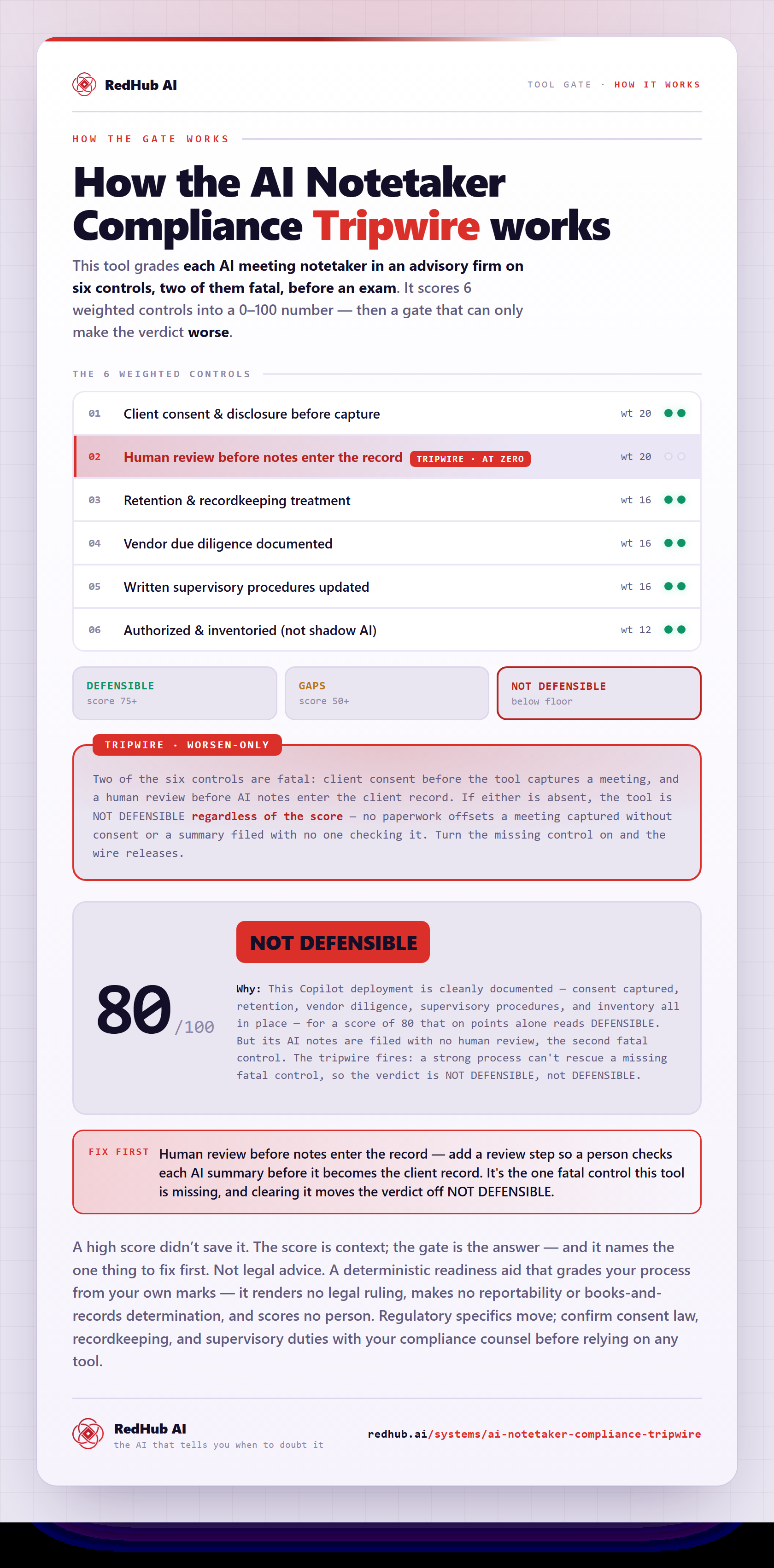
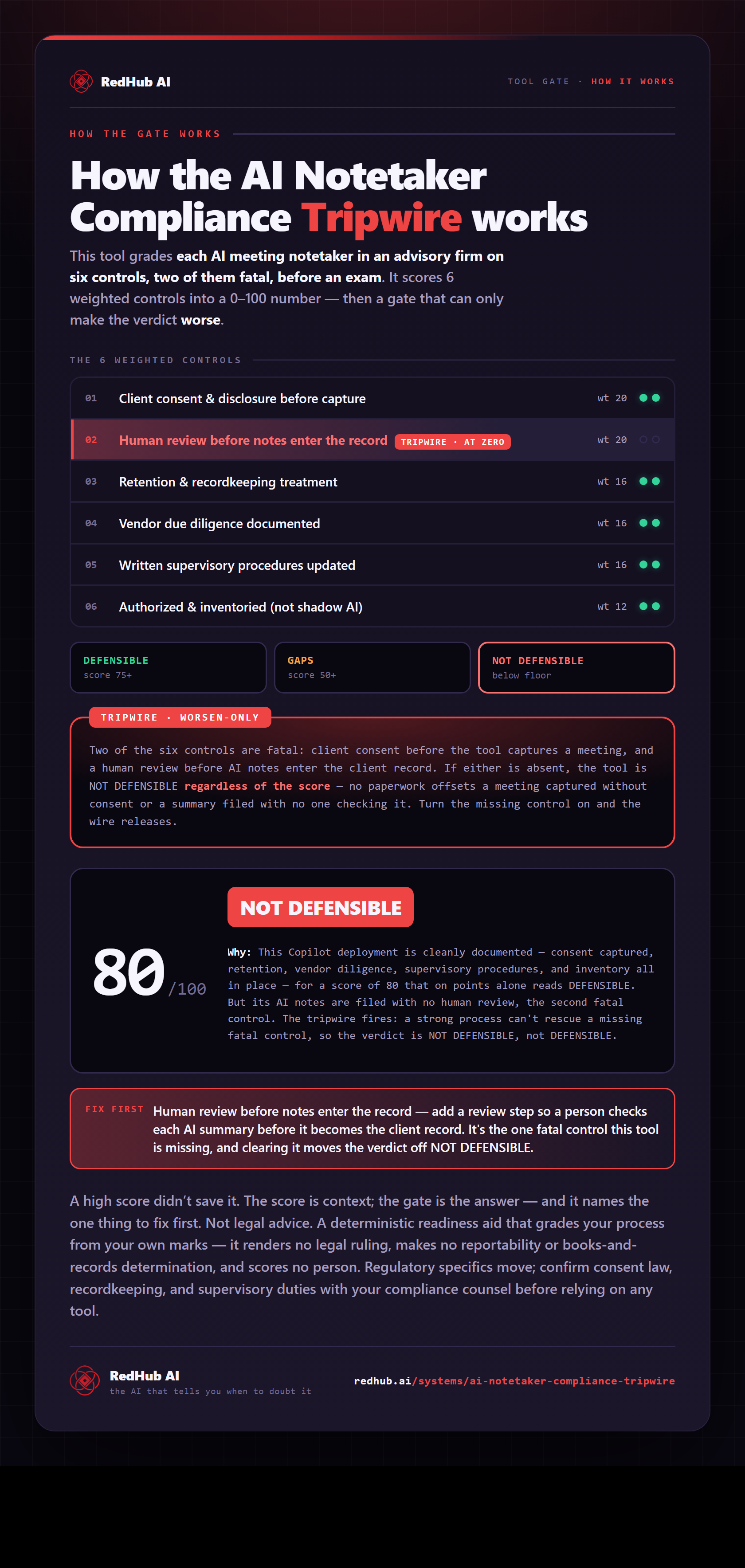
How the gate works, in one image
How the AI Notetaker Compliance Tripwire scores a deployment and trips to EVIDENCE GAP when consent or human review is missing — the same math the demo runs, as a diagram you can share or embed anywhere.
View & embed the full diagramA workbook for the CCO, and an engine that grades your whole tool inventory from a CSV.
The same logic runs three ways — a zero-dependency Python engine, an Excel workbook that reproduces it exactly, and the live demo above. Verbatim output on the shipped five-tool sample:
==========================================================================
  AI NOTETAKER COMPLIANCE TRIPWIRE
  Firm readiness read - as of 2026-07-05
==========================================================================

  FIRM VERDICT .......... STOP AND FIX
  Tools graded .......... 5
  Evidence gaps ......... 3 of 5  (60% exposed)

--------------------------------------------------------------------------
  TOOL / DEPLOYMENT           SCORE  VERDICT          NOTE
--------------------------------------------------------------------------
  Jump (firm-wide)            100  DEFENSIBLE
  Zocks (advisor pilot)        74  SHORTFALL
  Otter.ai (personal)          10  EVIDENCE GAP     gate: consent
  Copilot notes (unreviewed)   80  EVIDENCE GAP     gate: human_review
  Fathom (2 advisors)          42  EVIDENCE GAP
--------------------------------------------------------------------------
  1 defensible  -  1 shortfall  -  3 evidence gaps

  ! TRIPWIRE FIRED: Copilot notes (unreviewed)
    Scores 80 (DEFENSIBLE on points alone) but reads EVIDENCE GAP
    because Human review before notes enter the record is absent.
    A strong process can't offset a missing gate control.

  FIX FIRST: Otter.ai (personal)
    Client consent & disclosure before capture

  Grades your process, never a person. Renders no legal ruling and
  decides nothing about whether AI summaries are books-and-records.
  Not legal advice - confirm your obligations with compliance counsel.
==========================================================================
Note the honesty: the Copilot deployment scores 80 — a DEFENSIBLE number on points alone — yet reads EVIDENCE GAP, because its notes are filed with no human review. Turning that one control on is the whole fix. A strong process can't offset a missing gate control.
Three rules that make the verdict trustworthy.
Two gate controls, no exceptions
No consent before capture, or AI notes filed unreviewed, forces EVIDENCE GAP regardless of score. These are the two failures no paperwork can offset, so they can't be averaged away.
It grades the process, not the law
It renders no legal ruling and takes no position on whether AI summaries are books-and-records — the open question regulators haven't resolved. It readies you either way.
The worst tool sets the firm verdict
One tool at EVIDENCE GAP makes the firm STOP AND FIX. Shadow AI on a single laptop is enough — which is exactly why discovery comes first.
A readiness aid that grades your notetaker process from your own marks.
- A deterministic, offline read of your firm's AI-notetaker readiness, tool by tool.
- A shadow-AI discovery frame plus a per-tool DEFENSIBLE / SHORTFALL / EVIDENCE GAP verdict.
- A ranked remediation plan — clear the tripwires, then close the gaps in weight order.
- A workbook for the CCO plus an engine that grades a large inventory from a CSV.
- ✕A legal ruling on whether your AI summaries are books-and-records — that stays open.
- ✕A compliance certification, safe harbor, or opinion of counsel.
- ✕Connected to any tool — it reads no transcript and grades no person.
- ✕A determination of any reporting duty, consent-law requirement, or deadline.
Not legal advice. A deterministic readiness aid that grades your process from your own marks — it renders no legal ruling, makes no reportability or books-and-records determination, and scores no person. Regulatory specifics cited here are dated and move; confirm consent law, recordkeeping, and supervisory duties with your compliance counsel before relying on any tool.
The person who has to answer for the AI tools when the examiner asks.
Chief Compliance Officers
You know advisors adopted notetakers faster than you could govern them. Inventory the reality, grade it, and walk into the exam with a defensible per-tool posture.
Solo & small RIAs without a CCO
No compliance team, same obligations. Run the discovery and the six controls yourself in an afternoon, and know exactly what to fix.
Firms rolling out a notetaker
Grade the tool before firm-wide deployment, so consent, review, and retention are built in from day one instead of retrofitted after an exam finding.
RIA aggregators & OSJs
Score every advisor's tools on one standard and see where the shadow AI and the gate-control gaps actually sit across the network.
Build the AI-governance record the exam wants.
AI Governance & Acceptable Use Kit
The policy templates that set the rules this Tripwire operationally checks. Policy, then proof.
ViewAI Vendor & Sub-Processor Data-Flow Register
Where the notetaker's data actually goes: the DPA, retention, and cross-border register behind the vendor-DD control.
ViewAutomated-Decision Transparency Scorecard
The disclosure sibling: could you defend an automated decision about a person before a regulator asks?
ViewThe answers a CCO asks for first.
Grade the tool in the room
before the examiner does.
One purchase, lifetime access, 12 months of updates. $79, once.
Not legal advice. A deterministic readiness aid that grades your process from your own marks — it renders no legal ruling, makes no reportability or books-and-records determination, and scores no person. Regulatory specifics cited here are dated and move; confirm consent law, recordkeeping, and supervisory duties with your compliance counsel before relying on any tool.
Sold by RedHub AI LLC · Secured by Stripe · redhub.ai