Sort every documentto the right queue.
Classify each incoming document and route it with a rule pack you control — and get a clear ROUTE, QUARANTINE, or UNMATCHED. A deterministic front door that refuses to silently misroute the document two rules send two different places.
The wrong first sort poisons everything downstream — and the worst one looks confident.
A signed agreement that mentions an invoice gets first-match-won to accounts payable — and a lawyer never sees it.
Nothing in your rules matches it, so it sits unrouted in an inbox until someone notices.
Manual intake routing is inconsistent and slow. A rule doesn't get tired on the fortieth document of the morning.
Route an intake batch and watch the gate quarantine the document two rules claim differently.
vendor-msa-signed.pdf
QUARANTINEfrom legal@vendor.com · $1500 · This Master Services Agreement is entered into by the parties. Invoice for the s…
Two rules match but point to different destinations (AP - standard queue vs Legal - executed), so this document is QUARANTINE — the higher-priority rule does not silently win. A person routes it, instead of a contract quietly landing in AP.
4 routed · 1 quarantined · 1 unmatched. One conflict holds the batch.
Every match is a fixed rule firing on the document's own signals — no probabilities, no model. The workbook and the Python engine produce these exact verdicts.
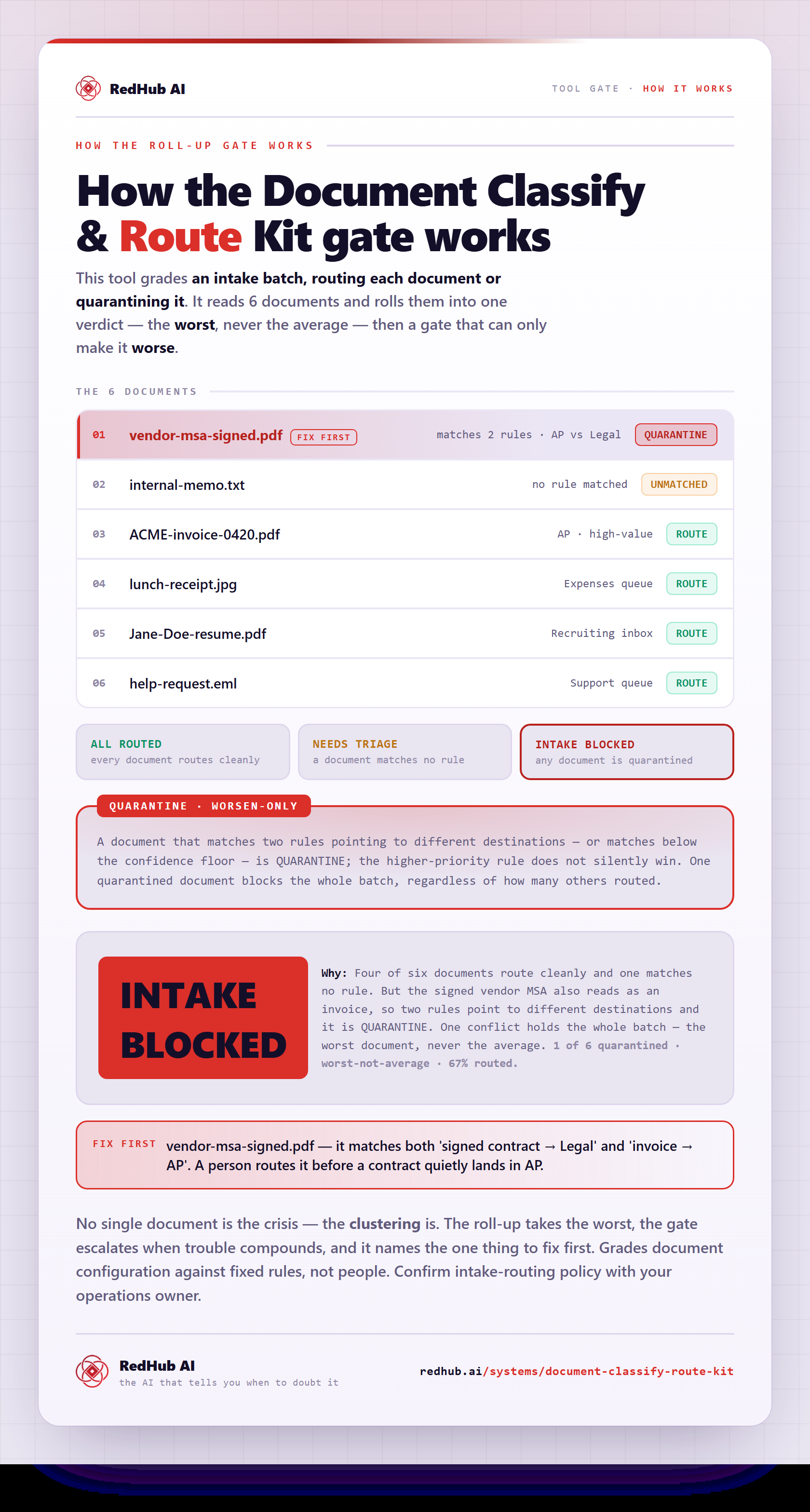
How the gate works, in one image
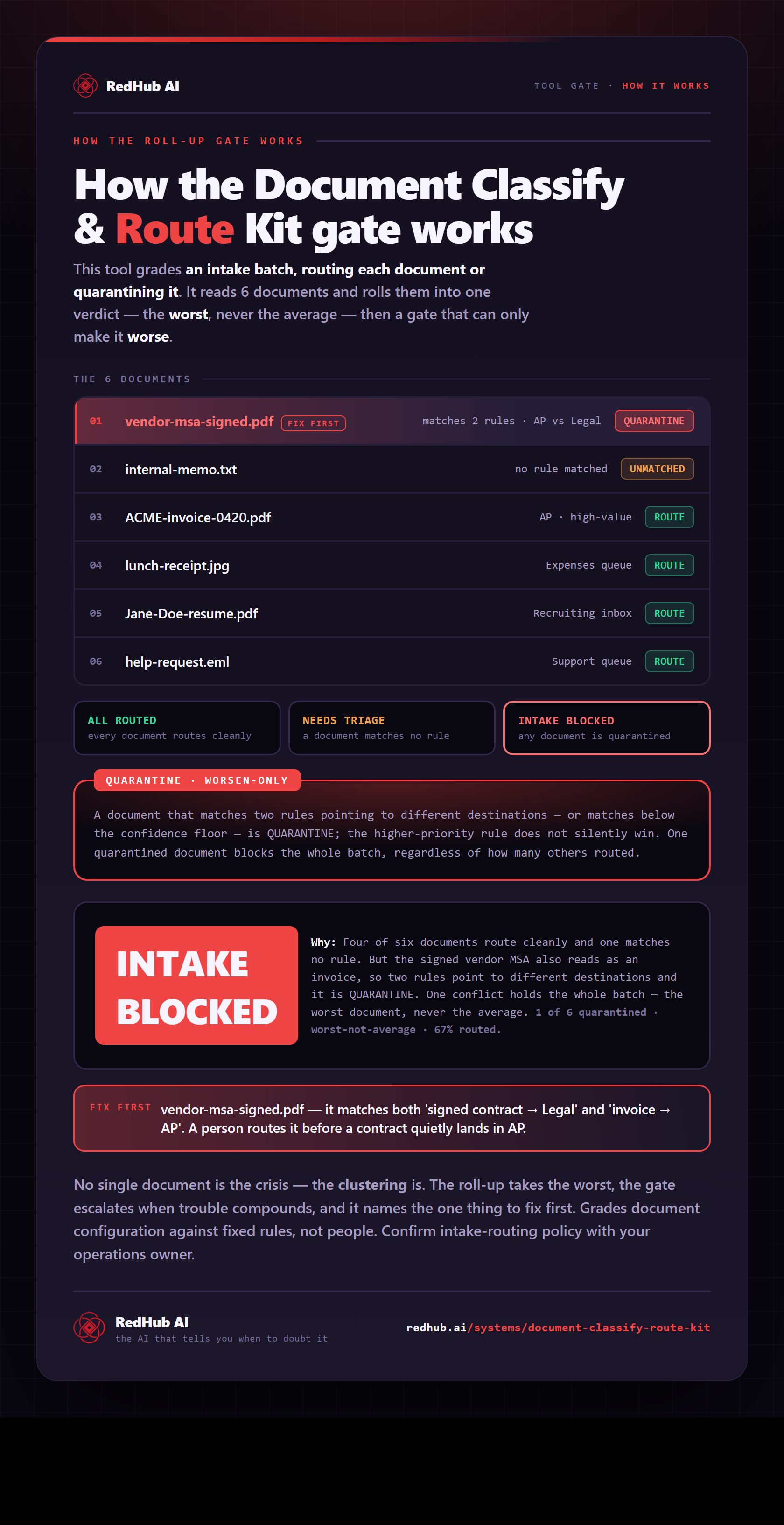
Each document rolled up to the worst and the conflict gate that quarantines a document matching two destinations — a 67%-routed batch still reads INTAKE BLOCKED. The same logic the demo runs, as a diagram you can share or embed anywhere.
View & embed the full diagramThe same verdicts from the Python engine — every rule, every document.
======================================================================
  DOCUMENT CLASSIFY & ROUTE  ·  as of 2026-06-22
======================================================================
  ACME-invoice-0420.pdf          ROUTE       Invoice (high-value)  ->  AP - manager approval
  lunch-receipt.jpg              ROUTE       Receipt / expense  ->  Expenses queue
  Jane-Doe-resume.pdf            ROUTE       Resume / CV  ->  Recruiting inbox
  vendor-msa-signed.pdf          QUARANTINE  conflict: AP - standard queue | Legal - executed
  internal-memo.txt              UNMATCHED   no rule matched
  help-request.eml               ROUTE       Support request  ->  Support queue
----------------------------------------------------------------------
  ROUTE 4   QUARANTINE 1   UNMATCHED 1   (routed 67%)
----------------------------------------------------------------------
  INTAKE: INTAKE BLOCKED
======================================================================
  Sorts your own documents by your own rules. Not legal advice.
======================================================================
The vendor MSA reads as an invoice (→ AP) and a signed agreement (→ Legal) at once. Two destinations, so it QUARANTINEs — the higher-priority AP rule does not silently win, and a person routes it. One conflict holds the batch. The routed share is context; the gate decides.
Three operating principles, enforced in the routing.
Deterministic, not a model
Every match is a fixed rule firing on the document's own signals — no probabilities. The same document always routes the same way.
A real conflict never auto-resolves
If two rules send a document to two destinations, it's quarantined regardless of priority. The machine refuses to guess; a person routes it.
Your rules, your priority order
You write the rule pack and order it. Specific rules first, catch-alls last, with a confidence floor you set.
A deterministic routing gate that quarantines ambiguity — not a black-box classifier.
- A rule-based router — same document, same destination, every time.
- Priority-ordered, first-match-wins, with a quarantine for real conflicts.
- Tunable — write your rules, order them, set the confidence floor.
- The front door of a document line — classify here, process downstream.
- A machine-learning classifier with opaque confidence scores.
- A field extractor (that's the Document Extraction Kit).
- A people-scoring tool — it routes documents, not individuals.
- A mail server or workflow engine — it decides the queue; you move it.
Scope: The Document Classify & Route Kit sorts your own documents using rules you write and returns an operational routing verdict. It does not score or rank people, and it is not legal advice.
Anyone whose documents need to reach the right desk before anything else happens.
- Ops teams running a shared intake inbox or folder.
- Bookkeepers and admins sorting invoices, receipts, and contracts.
- Anyone standardizing how documents reach the right queue.
- Builders who want a deterministic classify-and-route step in a pipeline.
- Extracting fields from a document (that's the Extraction Kit).
- Fuzzy ML classification with no explicit rules.
- Scoring or ranking people — it routes documents only.
Classify, extract, validate — the document line in order.
AI Document Extraction Kit
Once a document is routed, pull its fields with a model that flags low-confidence values for review.
ViewDocument Field Validator
Route it here, then validate the routed document's fields against your rules.
ViewPII Redaction Readiness Kit
Scan the sorted documents for sensitive data before any of them are shared.
ViewStraight answers on how it routes and what it quarantines.
It sorts every incoming document to the right queue. A routing rule pack you control matches each document on fixed signals — filename, keyword/text, sender, an amount threshold, a date present — assigns a document type and a destination, and evaluates the rules in priority order, first-match-wins. Each document gets a clear verdict: ROUTE (sent to a destination), QUARANTINE (held for a human), or UNMATCHED (no rule claimed it). It's the classify-and-route front door before extraction, validation, or matching — it decides where a document goes; it doesn't move or open it.
Because of the ambiguity gate. If a document matches two rules that point to different destinations, it's QUARANTINEd regardless of which rule has higher priority — the higher-priority rule does not silently win. That's deliberate: silently first-match-winning a conflicted document is exactly how a signed contract that happens to mention an invoice lands in accounts payable and a lawyer never sees it. A genuine cross-destination conflict is a person's call, so the machine refuses to guess and hands it to a human.
They're two different problems, kept deliberately distinct. QUARANTINE means the document matched but can't be safely auto-routed — either two rules sent it to two different destinations (a conflict), or its single match rested on fewer signals than your confidence floor (too weak). UNMATCHED means no rule matched it at all — a gap in your rule pack. Quarantine says 'your rules disagree about this one'; unmatched says 'your rules don't cover this one.' One you resolve by deciding; the other by adding a rule.
Neither — it's fully deterministic. There's no model, no probabilities, and no opaque confidence score: a rule either matches the document's signals or it doesn't, the same way every time, so the same document always routes the same place. That makes every routing decision auditable and explainable — you can point at the exact rule and signals that produced it. (For model-based field extraction from a document, that's the AI Document Extraction Kit, which runs upstream of this.)
The confidence floor is the minimum number of independent signals a single match must rest on before the kit will auto-route it. Set it to 1 and any single matching signal routes the document; raise it to 2 and a rule that fires on just one weak signal is QUARANTINEd instead, so a human confirms it. It lets you require corroborating evidence — a filename and a keyword, say — before a document is auto-sorted, without changing any of your routing rules. It's separate from the ambiguity gate (which is about conflicting destinations, not signal strength).
Make tiered rules mutually exclusive. If you want a high-value invoice to go to a manager and everything else to the standard AP queue, give the lower tier a disjoint condition (e.g. amount under $5,000) so each invoice matches exactly one tier — otherwise a large invoice matches both, and because their destinations differ, the ambiguity gate quarantines it as a conflict. The gate is meant for genuine cross-department conflicts (invoice vs legal), not deliberate priority refinements within one workflow. The included rule-design playbook walks through this.
New to the document-ops line? Run the Document Processing Pipeline Diagnostic first — it scores your workflow across six stages and, where a stage is short, routes you to the exact drop that fixes your bottleneck.
Sort it right.
The first time.
One purchase, lifetime access, 12 months of updates. $69, once.
Scope: sorts your own documents by your own rules; does not score or rank people; not legal advice.
Sold by RedHub AI LLC · Secured by Stripe · redhub.ai