Catch the broken mergebefore it sends.
One unmapped placeholder turns every email into a literal {{first_name}}. One empty required field leaves a blank where a company name should be. This engine reads your template and your data list and tells you exactly what would break — before a single message goes out.
A merge breaks in one place — and it breaks every row the same way.
A placeholder with no matching data column renders as literal text in every single message you send.
A blank required field doesn't error — it quietly sends a greeting with a hole where a name should be.
You find out when a reply lands: 'Hi {{first_name}}.' By then the whole batch is already out.
Edit the template and watch the gate move from FIX ROWS to HOLD.
Template structure is sound; fix the flagged rows, then re-run.
| first_name | company | verdict | why | |
|---|---|---|---|---|
| Dana | Acme Co | dana@acme.com | READY | |
| Luis | Bright LLC | luis@bright.io | READY | |
| Priya | — | priya@nova.com | BLOCK | missing: company |
| Sam | Orbit Inc | not-an-email | FIX | invalid: email |
| Rae | Pine & Co | rae@pine.co | READY |
It is the check, not the sender. You send; this only flags what would break. Resets on reload.
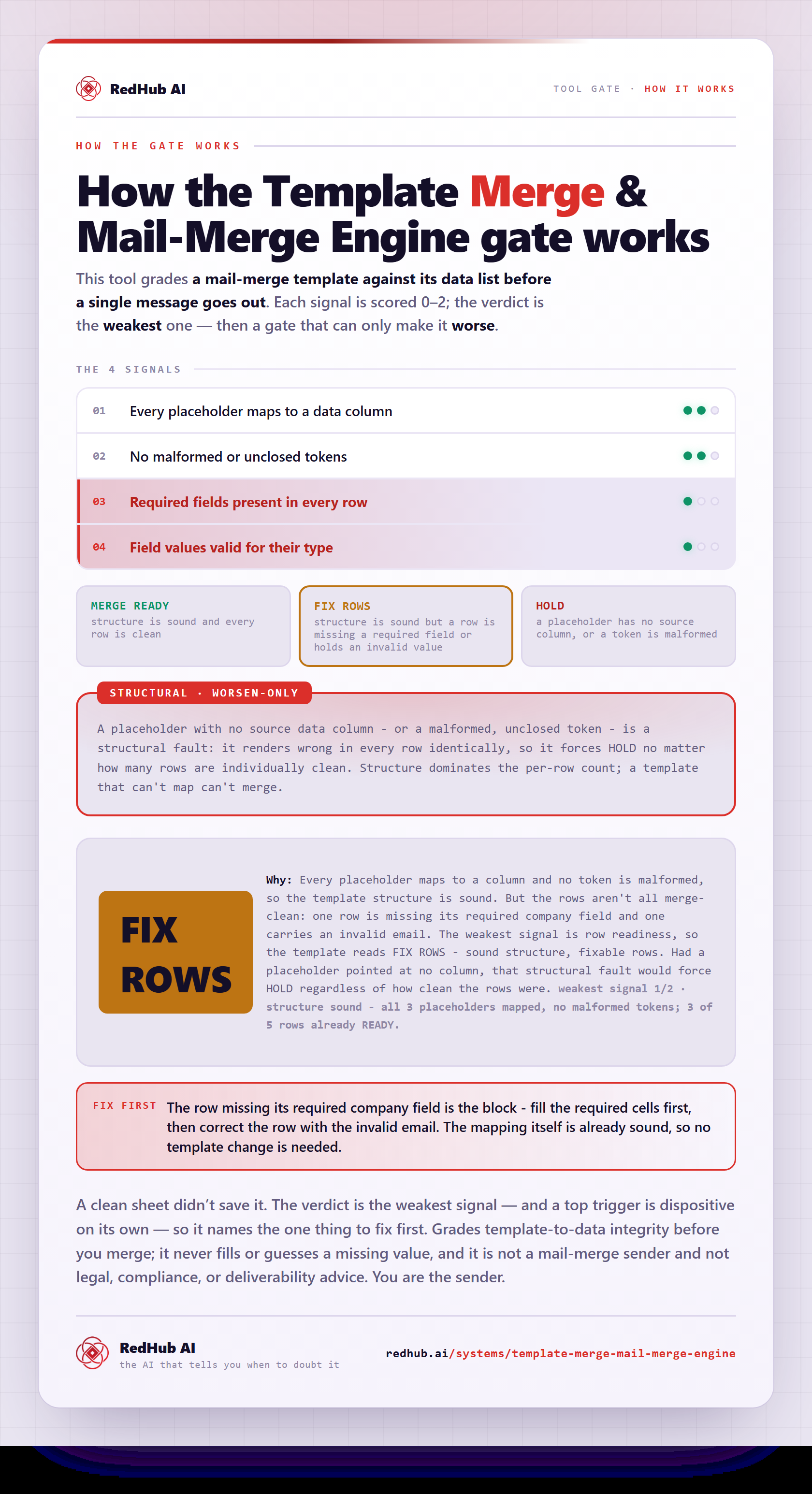
How the gate works, in one image
How the Template Merge & Mail-Merge Engine reads a merge by its weakest check and holds at FIX ROWS when any row isn't clean — the same math the demo runs, as a diagram you can share or embed anywhere.
View & embed the full diagramPoint it at a template and a CSV; it prints the verdict you can trust.
============================================================
  TEMPLATE MERGE & MAIL-MERGE ENGINE  ·  TMM-069
============================================================
  Placeholders used : company, email, first_name
  Data columns      : amount, company, email, first_name, renewal_date
------------------------------------------------------------
  Rows: 3 READY  ·  1 FIX  ·  1 BLOCK
    row  1  READY
    row  2  READY
    row  3  BLOCK  missing: company
    row  4  FIX    invalid: email
    row  5  READY
------------------------------------------------------------
  TEMPLATE VERDICT : FIX ROWS
  Template structure is sound; fix the flagged rows, then re-run.
============================================================
  It is the check, not the sender. You send; this only flags what would break.
The same logic ships three ways — the Python engine, the workbook, and the demo above — and all three return the identical verdict from the identical inputs. No macros, no network, no AI.
Structure dominates count, completeness is per-row, and nothing is ever guessed.
A placeholder with no data column, or a malformed token, forces HOLD regardless of how many rows are clean — because it breaks every row identically.
READY, FIX, or BLOCK comes from that row's actual values against the template's placeholders — not a sample, not an average.
It flags what's missing or malformed and stops. It never invents a name, an address, or a value to make a row pass.
It is the check that runs before the merge — not the tool that sends it.
- An offline pre-send check for template ↔ data integrity.
- A per-row READY / FIX / BLOCK grade and a per-template gate.
- A workbook and engine that return the same verdict, every time.
- Not a mail-merge sender — your ESP, Word, or GHL still does the sending.
- Not an AI that fills or guesses missing fields.
- Not legal, compliance, or deliverability advice. You are the sender.
Anyone who runs a personalized merge and can't afford a {{first_name}} in the wild.
- Agencies and operators sending renewal, onboarding, or campaign merges.
- Anyone exporting a CRM list into a templated email or letter run.
- Ops teams who want a repeatable pre-send gate, not a one-off eyeball.
- Single, hand-written one-off emails (there's nothing to merge).
- Teams wanting the tool to send — this only checks, never sends.
- Anyone needing AI to write or fill the content itself.
Check the merge here; write, gate consent, and send over there.
Write the template in your voice and pass deliverability QA; bring it here to confirm it merges clean.
This checks the merge renders; that checks you're permitted to contact. Run both before a dormant-list send.
For the conversations that follow the merge — capture, qualify, and book without inventing a policy.
Straight answers on what it checks, what it returns, and what it never does.
New to the document-ops line? Run the Document Processing Pipeline Diagnostic first — it scores your workflow across six stages and, where a stage is short, routes you to the exact drop that fixes your bottleneck.
Never send a broken merge.
Check it first.
One purchase, lifetime access, 12 months of updates. $69, once.
Sold by RedHub AI LLC · Secured by Stripe · redhub.ai