Your rate looks fine.Your bill is still bleeding.
Most businesses overpay for card processing by 20–40% — and the worst of it hides where a rate calculator never looks. This audit grades your statement on both axes: your real effective rate against the band you confirm, and the fee padding that survives a clean-looking rate.
The processor's statement is a billing document dressed up as a transparency tool.
how much most businesses overpay for processing — usually without knowing the audit exists
junk-fee load — statement, batch, PCI non-compliance, 'misc' — that a rate number never surfaces
the year processors met interchange cuts by adding padded line items to claw the savings back
You check your statement and see a percentage. Maybe 2.5%, maybe 2.9%. That number feels like the whole story. It isn't. Your headline rate applies to a best-case card you rarely run; your real cost is the effective rate — everything they took, over everything you processed.
And even the effective rate misses the padding. When a transaction downgrades, your processor collects more, and the statement buries it in a category you'd need a consultant to decode. When a PCI-non-compliance fee or a "regulatory product" fee appears, it's pure margin dressed as a requirement. The rate can look fine while the bill quietly bleeds. This audit reads both.
Watch the padding gate override a rate that sits inside the band.
Enter one statement's numbers. Watch the padding gate override a rate that looks fine.
Audits the statement you enter, from your own numbers. Sets no rate, moves no money, contacts no processor. The band and thresholds are inputs you confirm. Not financial, accounting, or legal advice.
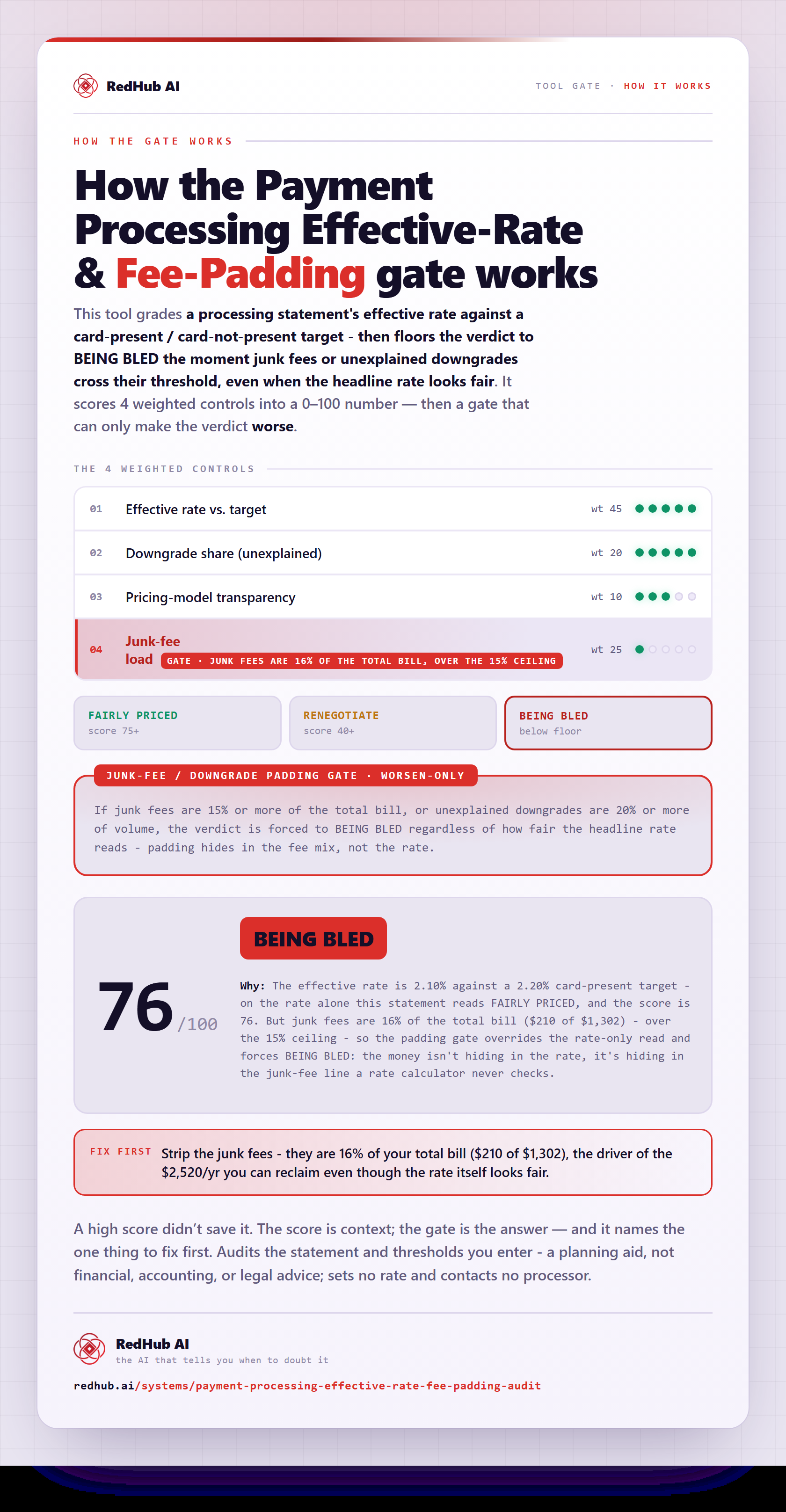
How the gate works, in one image
How the Payment Processing Effective-Rate & Fee-Padding Audit scores a statement and forces BEING BLED when junk fees dominate, whatever the headline rate — the same math the demo runs, as a diagram you can share or embed anywhere.
View & embed the full diagramA zero-dependency engine grades a whole portfolio and, where anything is short, names what to work first.
The same math the workbook and the demo run, as a stdlib Python CLI. Point it at your exported statements; it grades each one, floors the padded ones, totals the reclaim, and names the statement costing you the most. Verbatim output on the shipped 4-statement sample:
==========================================================================
          PAYMENT PROCESSING EFFECTIVE-RATE & FEE-PADDING AUDIT
                RedHub AI  ·  PFA-079  ·  as of 2026-07-04
==========================================================================

  Main St retail (CP)  [card present]
    Volume $86,000.00   Fees $1,720.00   Effective rate 2.00%
    Band target 2.20%  ·  junk load 1%  ·  downgrades 5%
    HEADLINE FAIRLY PRICED  GATE INERT  VERDICT FAIRLY PRICED
    Reclaimable: $0.00/mo  ($0.00/yr)
    Fix first: Nothing structural to fix; re-audit at the next April/October interchange update.

  Warehouse counter (CP)  [card present]
    Volume $62,000.00   Fees $1,302.00   Effective rate 2.10%
    Band target 2.20%  ·  junk load 16%  ·  downgrades 10%
    HEADLINE FAIRLY PRICED  GATE FIRED  VERDICT BEING BLED   <- padding gate floored a rate-in-band statement
    Reclaimable: $210.00/mo  ($2,520.00/yr)
    Fix first: Strip the junk fees: they are 16% of your total bill.

  Online store (CNP)  [card not present]
    Volume $140,000.00   Fees $4,340.00   Effective rate 3.10%
    Band target 2.80%  ·  junk load 2%  ·  downgrades 10%
    HEADLINE RENEGOTIATE    GATE INERT  VERDICT RENEGOTIATE
    Reclaimable: $420.00/mo  ($5,040.00/yr)
    Fix first: Move off tiered pricing to interchange-plus, then renegotiate the markup.

  B2B portal (CNP)  [card not present]
    Volume $95,000.00   Fees $3,990.00   Effective rate 4.20%
    Band target 2.80%  ·  junk load 4%  ·  downgrades 30% (unexplained)
    HEADLINE BEING BLED     GATE FIRED  VERDICT BEING BLED
    Reclaimable: $1,330.00/mo  ($15,960.00/yr)
    Fix first: Explain or eliminate the downgrades: 30% of volume is downgrading unexplained.

--------------------------------------------------------------------------
  PORTFOLIO: MONEY LEAVING THE BUILDING
  Work first: B2B portal (CNP)
  Total reclaimable across statements: $23,520.00/yr
--------------------------------------------------------------------------
  Audits the statement you paste. Sets no rate, moves no money, contacts
  no processor. Not financial, accounting, or legal advice.
==========================================================================
The Warehouse counter is the teaching case: 2.10% effective — inside the 2.20% band — floored to BEING BLED by a padding gate a rate calculator would never trip.
Three operating principles the audit never breaks.
Your numbers, your band
The effective rate is total fees ÷ total volume — everything they took over everything you ran. It's graded against the well-optimized band you confirm, not a benchmark baked into the verdict. No industry multiplier, no invented figure.
The padding gate does distinct work
A statement can sit inside its rate band and still bleed through junk fees and unexplained downgrades. The gate is worsen-only: it can floor a fine-looking rate to BEING BLED, but it can never lift a verdict. That's the money a rate calculator can't see.
It grades the statement, not you
Deterministic and offline. It audits the artifact you paste, names the one fix to make first where there is money to reclaim, and totals those dollars. It sets no rate, contacts no processor, and moves no money — the decisions and the negotiation stay yours.
An honest read of one bill, not a promise about your processor.
- A deterministic audit of the statement you paste, from your own numbers.
- Two axes: effective rate vs. your confirmed band, plus a worsen-only padding gate.
- A reclaimable-dollar figure and, where there is money to reclaim, the one fix to make first — per statement and across the portfolio.
- An SOP to pull the numbers and a runbook to renegotiate with the results.
- Not connected to your processor — it reads nothing live and files no claim.
- Not a rate quote or a switch recommendation; it grades, you decide.
- Not a statutory tool — the bands and thresholds are inputs you confirm.
- Not a scorer of people; it grades a fee statement, never a person.
Not financial or legal advice. This audit grades a fee statement — an artifact — from your own numbers. The band and padding thresholds are editable inputs you confirm, not asserted statutory figures. It sets no rate, moves no money, and contacts no processor. Confirm current interchange schedules and any contract terms with your processor and advisors.
Anyone whose statement they've never actually read line by line.
- Retail, e-commerce, and services owners taking cards at any real volume.
- Founders and operators who suspect the bill but can't decode the statement.
- Fractional CFOs and bookkeepers auditing a client's processing costs.
- B2B sellers running commercial cards who've never checked Level 2/3 qualification.
- You want someone to file the claims and negotiate for you — this hands you the read, not the service.
- You need live processor integration — this is an offline audit of a statement you export.
- You're looking for legal or financial advice on a contract — take the audit to your advisor.
Three tools that sit on the same cost-and-payments desk.
Defends the realized margin on booked deals. This audit defends the fee line underneath it.
The other half of the payments desk — grades whether your chargeback ratio threatens your merchant account.
Grades the controls that stop a spoofed-vendor or deepfake payment from clearing.
The answers buyers ask before they run their first statement.
A rate calculator answers one question — what is my effective rate — and stops. This audit runs a second, independent axis that a rate number cannot see: fee padding. A statement can sit comfortably inside its rate band and still be bleeding money through junk fees and unexplained downgrades. The padding gate can override a fine-looking rate and floor the verdict to BEING BLED — never the other way around. That worsen-only override is the whole point: it surfaces the money a rate calculator misses.
Your own. The well-optimized bands (card-present 1.7–2.2%, card-not-present 2.0–2.8%) and the padding thresholds are editable inputs you confirm, not figures baked into the verdict. If your channel, ticket size, or industry justifies a different band, you overwrite it per statement. The verdict is driven entirely by your own statement numbers against the lines you confirm — there is no hidden industry multiplier.
Five numbers per statement: total card volume, total fees, the sum of any junk-fee lines (statement, batch, PCI non-compliance, 'regulatory/misc'), the downgraded volume from the transaction-summary section, and whether that downgrade share is operationally explained by your card mix. The included Statement-Audit SOP shows you exactly where each lives on a processor statement and which lines count as junk.
Because a high downgrade share is not automatically a problem. A merchant with lots of legitimate rewards or corporate cards will show downgrades that are simply the cost of that mix. The gate is designed to catch the symptom case — a terminal misconfigured, missing address verification, a card-present setup running card-not-present — so it only floors the verdict when you confirm the share is not accounted for. An explained 30% share stays on its rate headline; an unexplained one floors to BEING BLED.
No. It is deterministic and fully offline. It audits the statement you paste from your own numbers. It sets no rate, contacts no processor, files no claim, and moves no money. It computes the verdict and the reclaimable dollars; you take the results to your processor. The included Fee-Renegotiation Runbook gives you the scripts and the order of operations for that conversation.
At least at the two card-network interchange update cycles each year — April and October — plus any time you change your checkout flow, add a processor, or see your effective rate creep up. Fee creep is the quiet failure mode: processors introduce new 'program fees' at the start of a quarter, and in 2026 several met network interchange cuts by adding padded line items to claw the savings back. A quarterly re-audit keeps the gains you win.
Read the bill they built
to keep you from reading.
One purchase, lifetime access, 12 months of updates. $79, once.
Not financial or legal advice. This audit grades a fee statement — an artifact — from your own numbers. The band and padding thresholds are editable inputs you confirm, not asserted statutory figures. It sets no rate, moves no money, and contacts no processor. Confirm current interchange schedules and any contract terms with your processor and advisors.
Sold by RedHub AI LLC · Secured by Stripe · redhub.ai