Record the authority videoyour clients are searching for.
Four Claude Skills turn vidIQ search data into a recorded, point-of-view video in about 70 minutes — research the right topic, interview you into an opinionated outline, then build an animated deck with a built-in teleprompter. You stay the expert and the voice.
You have the expertise. You don't have a repeatable way to turn it into video.
You sit down to film and stall on what the topic even is — or chase a trending idea you have no real take on.
Off-the-shelf AI scripts come out fluent and forgettable. They sound like every other channel and build no authority.
Research, scripting, slides, and a teleprompter pass eat an afternoon per video — so the channel goes quiet.
The pick is the highest-scoring topic you can actually speak to.
This is the scoring core, live. Tune the four levers and watch the verdict — then see how the cohort ranks and which one the engine says to record. The authority gate is the honest part: drop a topic's first-hand authority and it falls out, whatever its search demand.
Strong, speakable, and it pulls clients. Record it.
Demo resets on reload. Bring your own vidIQ Max plan for the live research step. No guaranteed views or clients.
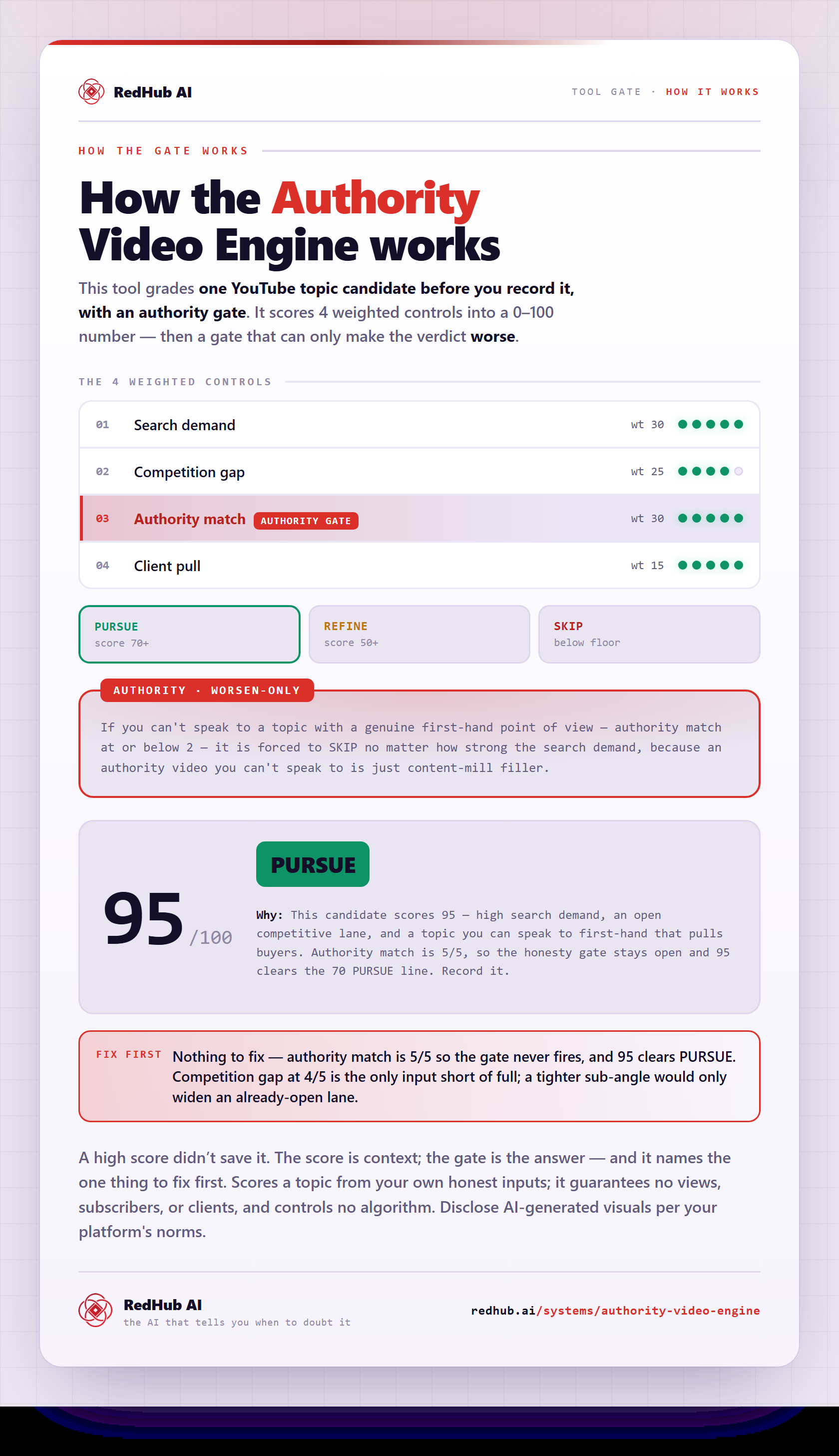
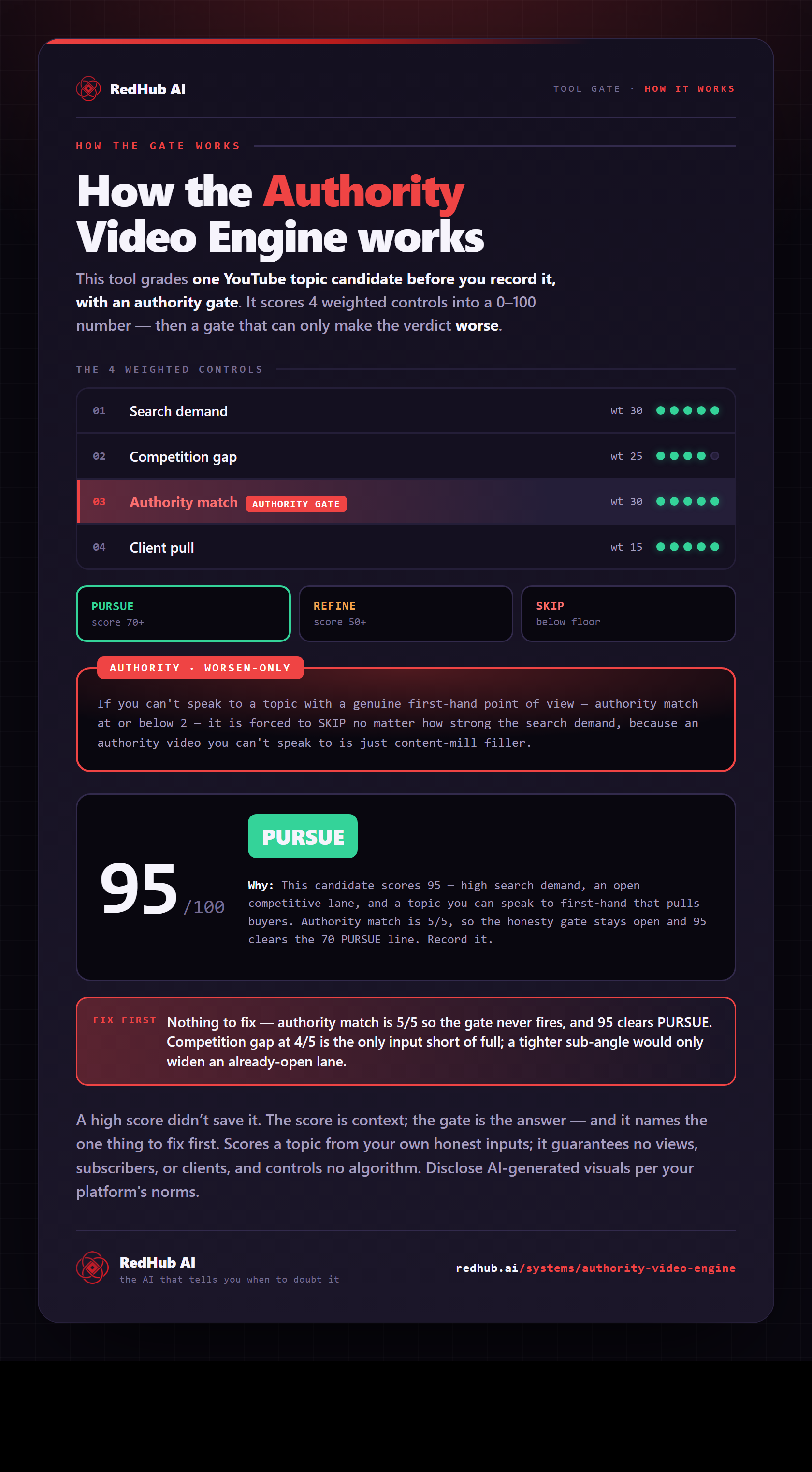
How the gate works, in one image
How the Authority Video Engine scores a video topic's fit and forces SKIP when it's outside your authority, whatever the demand — the same math the demo runs, as a diagram you can share or embed anywhere.
View & embed the full diagramOne pipeline, four Skills, from idea to recorded video.
The vidIQ MCP pulls real search demand, competition, and opportunity. The scout skill scores 5–8 candidate titles 0–100 and names the one to record.
The outline skill asks for your opinions, client stories, and contrarian takes, then builds an opinionated structure competitors can't copy.
A focused research pass resolves only the flagged gaps with sourced support — substance under your point of view, never a generic explainer.
The slide-plan skill outputs markdown for Claude Design: animated slides on one side, presenter notes on the other. Record from the notes in ~20 minutes.
Plus a runnable Python scoring engine with a worked sample, a spreadsheet that reproduces the same math, the slide-plan template, and two playbooks — the 70-minute workflow and the MCP setup & orchestration guide.
Three rules the engine holds to.
Every topic is scored on live vidIQ search and competition data through your own MCP connection — never invented numbers.
The outline is built from your stories and opinions. The uncopyable layer is the whole point, so the engine interviews instead of assuming.
A topic you can't speak to first-hand is forced to SKIP, whatever its search demand. The one video this engine refuses to make is content-mill filler.
An orchestration layer on top of your tools — honest about what it can and can't do.
- A repeatable workflow that turns your expertise into a recorded video, fast.
- The orchestration layer — Skills, scoring, templates, and playbooks — on top of vidIQ + Claude Design.
- Built to keep your point of view on top and refuse generic, swappable content.
- Not a vidIQ subscription or a source of YouTube data — you bring your own vidIQ Max plan and MCP connection.
- Not a guarantee of views, subscribers, or clients; it improves your odds, not your outcomes.
- Not legal advice. Disclose AI-generated visuals per your platform's norms and confirm vidIQ's current terms.
Built for experts who sell what they know.
- A coach, consultant, or fractional exec who wins clients on credibility.
- A founder building a personal brand and a known voice in a niche.
- Already paying for vidIQ (or willing to) and recording your own video.
- Want a faceless, fully-automated channel with no point of view.
- Won't connect vidIQ or won't go on camera.
- Expect guaranteed views or a growth hack rather than a repeatable system.
Make the video once, then put it everywhere.
Originate a repeatable short-form series around the same authority topics.
Turn one recorded video into AEO-optimized, omni-channel pieces.
Build the same authority on LinkedIn, in your real voice.
The honest answers, before you buy.
Yes — you bring your own vidIQ Max plan with the vidIQ MCP connected to Claude. This kit is the orchestration layer that sits on top of vidIQ's real YouTube data; it doesn't include or resell that data. The vidIQ MCP is read-only, so it can research and surface insights but can't change anything on your channel. If the MCP isn't connected, the scout skill is built to say so rather than invent numbers.
Four Claude Skills (topic research and scoring, the thought-leadership outline interview, the in-scope research pass, and the slide-plan architect), a runnable Python scoring engine with a worked sample, a spreadsheet that reproduces the same scoring, a markdown slide-plan template for Claude Design, and two playbooks — the 70-minute workflow and the MCP setup and orchestration guide. The Skills run in Claude; the engine runs anywhere with Python; the workbook opens in Excel, Sheets, or Numbers; the deck is generated in Claude Design.
Each candidate is scored 0–100 across four weighted levers — search demand (30), competition gap (25), authority match (30), and client pull (15). Topics scoring 70+ are PURSUE, 50–69 are REFINE, below 50 are SKIP, and the highest-scoring PURSUE topic is the recommended pick. One honesty gate sits on top: if you can't speak to a topic with a genuine first-hand point of view, it's forced to SKIP no matter how strong the search demand — because an authority video you can't speak to is just content-mill filler.
That's the exact failure mode it's built to avoid. The outline skill interviews you about your opinions, client stories, mistakes, and contrarian takes, and builds the video around them — the layer competitors can't copy. The research pass only fills gaps the outline flags, in scope, so substance supports your point of view instead of flattening it into a neutral explainer. The authority gate refuses topics where you'd be reciting generic information.
It's the target for the full loop once you're set up: roughly 15 minutes to research and pick a topic, 20 to run the outline interview, 5 for the gap pass, 10 to generate the deck in Claude Design, and about 20 to record from the presenter notes. Your first run takes longer while you connect the MCP and install the Skills. The notes double as a teleprompter, so you record without writing a traditional script.
No, and it won't pretend to. The scores are your own honest inputs, and the engine improves your odds of recording the right thing — it doesn't control the algorithm or the market. This is creative and workflow guidance, not legal advice; disclose AI-generated visuals per your platform's norms, and confirm vidIQ's current terms before relying on the integration.
Stop guessing what to film.
Record the one that counts.
One purchase, lifetime access, 12 months of updates. $199, once. Bring your own vidIQ Max plan.
Sold by RedHub AI LLC · Secured by Stripe · redhub.ai